Introduction
Biden’s COVID Credits temporarily expanded Obamacare’s premium tax credits by removing the income cap and allowing larger subsidy amounts. Households with incomes of more than $500,000 can qualify for Biden COVID Credit subsidies. Because of the Biden COVID Credits, 42 percent of Obamacare exchange enrollees have fully subsidized healthcare plans.
The Biden COVID Credits are scheduled to expire at the end of 2025. In 2026, the pre-Biden Obamacare subsidies would come back into effect. While premiums are expected to rise in 2026, the main drivers are Obamacare’s underlying problems, not the sunset of the Biden COVID Credits.
Extending the Biden COVID Credits would cost taxpayers an estimated $448 billion over ten years.
Policy Background
Obamacare PTC
Obamacare (officially known as the Patient Protection and Affordable Care Act, or “ACA”) was enacted in 2010 to expand government control over healthcare.
In 2014, Obamacare began to provide premium tax credits (PTC) that subsidize the purchase of health insurance plans offered on state or federally operated insurance exchanges.
While the PTC is called a “tax credit,” it does not generally operate like a typical credit claimed for the past year on an annual tax return. Instead, the PTC is most often paid in advance
directly to an insurance company by the U.S. Department of the Treasury. This payment is meant to reduce the monthly premium paid by the individual for the subsidized Obamacare health insurance plan.
Obamacare PTCs are available to individuals who:
- Have a household income between 100 percent[1] and 400 percent[2] of the federal poverty level;
- Are not eligible for other sources of health coverage, such as employer-sponsored insurance, Medicare, or Medicaid; and
- Enroll in an approved insurance plan on an Obamacare exchange.
The size of an Obamacare PTC subsidy is generally equivalent to the cost of a premium for a “benchmark plan”
[3] minus the individual’s expected premium contribution. The expected premium contribution is a percentage of monthly household income which represents the maximum amount an individual would pay in monthly premiums for the benchmark second lowest-cost silver plan. The expected contribution percentage increases on a sliding scale based on the income of the household, so that lower earners pay a lower percentage of their monthly income while higher income households pay more. The expected contribution percentages for a given year are calculated annually based on a formula that considers the growth of insurance premiums and incomes.
The Obamacare PTC is permanent law and does not have an expiration date.
The Biden COVID Credit Expansion
Using the COVID-19 pandemic as justification, the Biden Administration temporarily expanded the Obamacare PTC. The PTC was expanded in two ways. The Biden COVID Credits:
- Eliminated the maximum income limit for subsidy eligibility; and
- Significantly expanded the size of the subsidy by reducing or eliminating the individual expected premium contribution.
The Biden COVID Credits are available from 2021 through 2025.
The Biden COVID Credits were created by the American Rescue Plan Act of 2021 (ARPA) and were temporarily available for 2021 and 2022. ARPA was the $1.9 trillion stimulus spending bill that helped spark the 20.1 percent inflation increase between January 2021 and January 2025.
[4]
The Inflation Reduction Act of 2022 (IRA) extended the Biden COVID Credits for 2023 through the end of 2025.
Impacts of the Biden COVID Credit Expansion
Elimination of Income Limit
Eliminating the maximum income limit means that very wealthy people qualify for Obamacare subsidies.
Households earning more than $500,000 per year (2,446 percent of the poverty level) can be eligible for thousands in annual taxpayer subsidies thanks to the Biden COVID Credits. Even a single-adult household earning more than $250,000 per year can qualify for a Biden COVID Credit subsidy.[5]
The Congressional Budget Office (CBO) estimates that new Obamacare enrollees account for 89 percent of the costs of extending the Biden COVID Credits. Half of the newly projected enrollees would be in households above the pre-Biden Obamacare subsidy limit of 400 percent of the federal poverty level.
[6]
Even before the income limit was eliminated by the Biden COVID Credits, high-income households could qualify for Obamacare subsidies. Under the pre-Biden Obamacare policy, subsidies were available to individuals in households below 400 percent of the poverty level. For a normal family of four, 400 percent of the federal poverty level is equivalent to $128,600, which is 60 percent higher than the median household income.
[7]
Expansion of the Subsidy
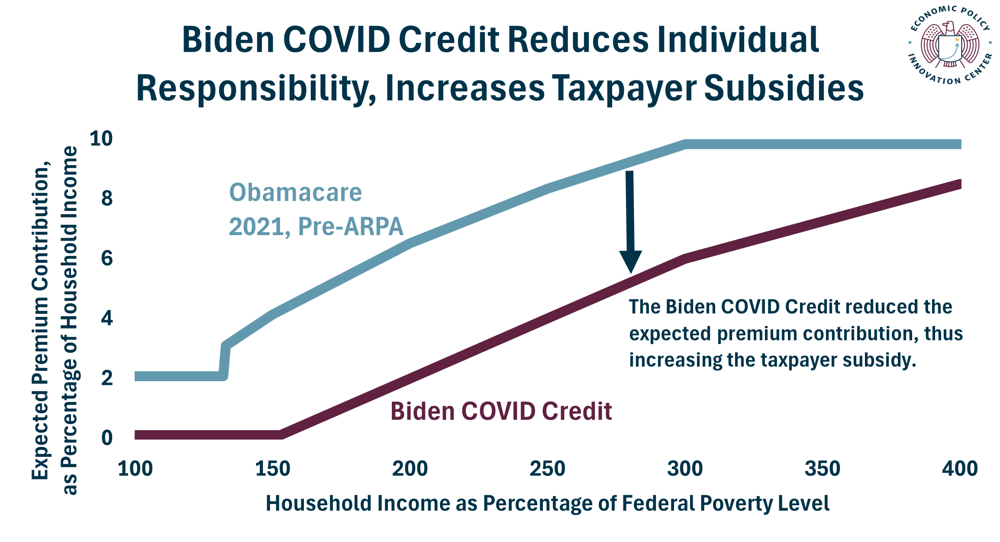
The Biden COVID Credits reduced and even eliminated the expected premium contributions that individuals would pay for their health insurance. Those costs are instead borne by taxpayers in the form of larger subsidies.
Under the Biden COVID Credits, individuals in households with incomes between 100 percent and 150 percent of the federal poverty level are not expected to pay for their health insurance, as taxpayers fully subsidize their benchmark Obamacare plan.
Prior to the pre-Biden Obamacare policy, these households faced a maximum expected contribution toward a benchmark plan between 2 and 4 percent of monthly income. For a normal family of four, 150 percent of the
federal poverty level is equivalent to $48,225; a 4 percent premium contribution for this household would be about $166 per month.
In 2024, 42 percent of Obamacare enrollees were in fully subsidized plans. Another 28 percent of enrollees pay a premium of $50 or less. Seventy-nine percent of enrollees paid $100 or less per month.
[8]
Higher-income households also reap significant new taxpayer subsidies thanks to the Biden COVID Credits. A four-person household earning $96,500 (300 percent of the federal poverty level) would have had an expected premium contribution of just under 10 percent of monthly income under pre-Biden Obamacare, or about $790 per month for a benchmark plan. The Biden COVID Credits reduced the expected contribution to 6 percent, or $482 per month.
Taxpayers pay for this difference. This means about $3,700 annually in new taxpayer-funded Biden COVID Credit subsidies for a household taking in nearly $100,000 per year.
Fiscal Impact
The Biden COVID Credits are extraordinarily costly.
In large part due to Biden’s COVID Credits, outlays for Obamacare PTCs between FY 2021 and 2024 were 73 percent higher than projected in the pre-Biden CBO baseline.
[9]
If the Biden COVID Credits were extended permanently, the CBO estimates it would add an average of $40 billion to the deficit per year, totaling $383 billion over the next decade.
[10] The Biden COVID Credits would increase the annual costs of permanent-law Obamacare spending by about one-third.
Resulting increases in net interest costs would add another $64 billion, for a total cost of $448 billion over the FY 2026 to 2035 period.
[11]
The Biden COVID Credits do not actually reduce premiums, they just shift added costs to the taxpayer.
| Extending Biden COVID Credits Would Add $448 Billion to Deficit |
|
2026 |
2027 |
2028 |
2029 |
2030 |
2031 |
2032 |
2033 |
2034 |
2035
(est.) |
2026 – 2035 |
| Increase in Deficit |
23 |
32 |
34 |
36 |
38 |
40 |
42 |
43 |
46 |
48 |
383 |
| Interest Costs |
0 |
1 |
3 |
4 |
5 |
7 |
8 |
10 |
12 |
14 |
64 |
| Total Cost |
24 |
33 |
37 |
40 |
43 |
47 |
50 |
53 |
58 |
62 |
448 |
| In billions of dollars.
Source: Congressional Budget Office for FY 2026 – 2034 and author extrapolation for FY 2035. |
Upcoming Timeline
The Biden COVID Credit subsidy expansions will expire at the end of plan year 2025 on December 31, 2025.
Beginning in plan year 2026, taxpayer-provided subsidies for health insurance plans on the exchanges revert to original Obamacare subsidies.
Open Enrollment for 2026 Obamacare plans begins November 1, 2025, and lasts through January 15, 2026. Coverage begins on January 1, 2026.
[12]
The Biden COVID Credits Should Expire as Scheduled
The Biden COVID Credits should expire as scheduled at the end of this year. No Congressional or Executive action is needed.
There are many reasons why the Biden COVID Credits should not be extended:
- They are temporary pandemic-era subsidies.
The Biden COVID Credits were created in 2021 during the COVID-19 pandemic. The COVID-19 pandemic has been over officially since May 2023. The subsidies were always meant to be temporary and should expire along with other misguided, costly, and temporary COVID policies.
- No Republican has ever voted for these Obamacare or Biden subsidies.
Obamacare was enacted by Democrats on a purely partisan basis in 2010. The Biden COVID Credits were created on a purely partisan basis in Biden’s ARPA spending stimulus law and extended in a purely partisan basis by the IRA. President Trump and the Republican majorities in the current Congress have no ownership of the Biden COVID Credit or its planned sunset. After the expiration of the Biden COVID Credits, the PTCs simply return to the original Obamacare levels.
- Obamacare subsidizes abortion.
Extending the Biden COVID Credits would increase taxpayer funding for abortion. Obamacare plans and PTC subsidies are not covered by the Hyde Amendment. This means that taxpayer funds are used to cover elective abortions.[13] The Charlotte Lozier Institute and the Family Research Council found that 59 percent of Obamacare plans covered elective abortions in 2022, including every plan in eight states and Washington, DC.[14]
- The excessive $448 billion cost.
Extending the Biden COVID Credits would be extraordinarily expensive, adding $448 billion to the deficit over the next decade, including interest costs. Growing healthcare spending is already a key driver of the unsustainable federal budget, and extending the temporary subsidies would make the debt problem significantly worse.
- Obamacare is rife with fraud, and the Biden COVID Credits incentivize fraud.
The Paragon Health Institute estimates that 6.4 million individuals were improperly enrolled in Obamacare exchanges in 2025, at a taxpayer cost of $27 billion. Because the Biden COVID Credits allow for $0 premium plans for households between 100 and 150 percent of the federal poverty level, there is a significant incentive to misrepresent actual incomes to qualify. An estimated 62 percent of the enrollees in fully subsidized plans for households claiming to be between 100 and 150 percent of the federal poverty level were not actually eligible. Paragon further reports that “in 29 states, the number of sign-ups reporting income between 100 percent and 150 percent FPL exceeds the number of potential enrollees.”[15]
- The Biden COVID Credits often benefit insurance companies, not patients.
The Obamacare PTC is usually paid straight to the insurance company by the Treasury. There is also a significant incentive for insurance companies to tolerate and profit from fraud. Under Obamacare, if the income of a beneficiary is misrepresented on the application for benefits, the liability and cost of recapturing excess subsidies are borne by the individual, not the insurance company or broker. In 2025, 45 percent of exchange enrollees were automatically re-enrolled in an Obamacare plan.[16] Some of these individuals had no knowledge they even had been signed up,[17] giving the insurance company a $0 cost per enrollee as it collected thousands of dollars in payments from the Treasury.
- Obamacare is not, and never has been, affordable or sustainable.
Supporters of the Biden COVID Credits point to the potential high costs of Obamacare plans after the expiration of the expanded subsidies. This simply reinforces the fact that Obamacare is not, and never has been, an affordable or sustainable policy for consumers.
An analysis of proposed 2026 Obamacare insurance premiums by the left-leaning KFF and the Peterson Center on Healthcare found that average premiums are increasing by 20 percent. However, only 4 percentage points, or 20 percent, of the rate increases are attributed to the expiration of the Biden COVID Credits, “due to insurers anticipating that some healthier members will leave the ACA Marketplaces when their subsidies decrease, creating an enrollee base that is less healthy and more expensive on average.” In contrast, the majority of Obamacare premium rate increases are attributable to other factors such as the general trend of rising healthcare costs, labor costs and workforce shortages, and the cost of GLP-1 and specialty medications.
[18]
Conclusion
The Biden COVID Credits were created on a partisan basis in 2021 and justified as a temporary expansion of Obamacare subsidies during the pandemic.
The Biden COVID Credits provide fully subsidized Obamacare plans for 9 million individuals, 42 percent of exchange enrollees. Much of the benefit of the Biden COVID Credits flows to high-income households because ARPA (and the subsequent IRA extension) removed the income cap for subsidy eligibility. As a consequence, households earning more than $500,000 per year can qualify for Biden COVID Credits.
These expanded subsidies are scheduled to expire at the end of 2025, when the pre-Biden Obamacare PTC rules will take effect. Obamacare insurance premiums are scheduled to increase in 2026, but that is primarily due to the underlying problems with Obamacare, not the expiration of the Biden COVID Credits.
Extending the Biden COVID Credits would cost taxpayers $448 billion over the next decade. Obamacare is already rife with fraud, with an estimated 6.4 million individuals improperly enrolled at an annual cost of $27 billion. The Obamacare PTCs subsidize abortion using taxpayer funds, and extending the Biden COVID Credits would increase taxpayer funding for abortion.
The Biden COVID Credits should expire as scheduled at the end of this year.
[1] Individuals in households with income below 100 percent of the poverty level generally qualify for Medicaid coverage. In states that have expanded Medicaid to able-bodied adults under Obamacare, Medicaid coverage is available for households that make up to 138 percent of the federal poverty level. Therefore, in Medicaid expansion states, Obamacare subsidies are available only to those between 138 percent and 400 percent of the poverty level.
[2] In 2025, 400 percent of the federal poverty level for a family of four is $128,600 annually. Alaska and Hawaii are treated differently than the 48 contiguous states. In 2025, 400 percent of the federal poverty level for a family of four in Alaska is $ 160,760 annually; in Hawaii it is $147,920 annually.
[3] A “benchmark plan” is a silver plan on the Obamacare exchange with the second-lowest cost premium in the region. Paragon Health Institute, Health Care Glossary,
https://paragoninstitute.org/glossary/benchmark-plan/ (accessed August 13, 2025).
[4] U.S. Bureau of Labor Statistics, Consumer Price Index for All Urban Consumers: All Items Less Food and Energy in U.S. City Average [CPILFESL], retrieved from FRED, Federal Reserve Bank of St. Louis;
https://fred.stlouisfed.org/series/CPILFESL (accessed August 10, 2025).
[5] KFF, “Health Insurance Marketplace Calculator,” October 29, 2024,
https://www.kff.org/interactive/subsidy-calculator/ (accessed August 10, 2025).
[6] Congressional Budget Office, “The Effects of Permanently Extending the Expansion of the Premium Tax Credit and the Costs of that Credit for Deferred Action for Childhood Arrivals Recipients,” June 24, 2024,
https://www.cbo.gov/publication/60437 (accessed August 10, 2025).
[7] U.S. Department of Health and Human Services, “2025 Poverty Guidelines: 48 Contiguous States,” January 2025,
https://aspe.hhs.gov/sites/default/files/documents/dd73d4f00d8a819d10b2fdb70d254f7b/detailed-guidelines-2025.pdf (accessed August 10, 2025); and U.S. Census Bureau, Median Household Income in the United States [MEHOINUSA646N], retrieved from FRED, Federal Reserve Bank of St. Louis;
https://fred.stlouisfed.org/series/MEHOINUSA646N (accessed August 10, 2025).
[8] Centers for Medicare & Medicaid Services, “Health Insurance Marketplaces 2024 Open Enrollment Report,” p. 20, March 2024,
https://www.cms.gov/files/document/health-insurance-exchanges-2024-open-enrollment-report-final.pdf (accessed August 10, 2025).
[9] Matthew Dickerson and Amelia Kuntzman, “The Biden-Harris Spending Binge,” Economic Policy innovation Center, October 23, 2024,
../../federal-budget/the-biden-harris-spending-binge/.
[10] FY 2026 – 2035 increase in the deficit of $383 billion reflects CBO estimate for FY 2026 – 2034 and author extrapolation for FY 2025. Congressional Budget Office, “The Effects of Permanently Extending the Expansion of the Premium Tax Credit and the Costs of that Credit for Deferred Action for Childhood Arrivals Recipients,” June 24, 2024,
https://www.cbo.gov/publication/60437 (accessed August 10, 2025).
[11] Author estimate based on Congressional Budget Office, “How Changes in Revenues and Outlays Would Affect Debt Service, Deficits, and Debt,” March 5, 2025,
https://www.cbo.gov/publication/60835 (accessed August 10, 2025).
[12] HealthCare.gov, “When can you get health insurance?,”
https://www.healthcare.gov/quick-guide/dates-and-deadlines/ (accessed August 10, 2025).
[13] Charlotte Lozier Institute and Family Research Council, “Obamacare Abortion Resources,” Abortion in Obamacare,
https://obamacareabortion.com/resources (accessed August 10, 2025).
[14] Charlotte Lozier Institute and Family Research Council, 2022 Fact Sheet,” Abortion in Obamacare, January 4, 2022,
https://downloads.frc.org/EF/EF22A03.pdf (accessed August 10, 2025).
[15] Brian Blase, PhD, Chris Medrana, Niklas Kleinworth, and Jackson Hammond, “The Greater Obamacare Enrollment Fraud,” Paragon Health Institute, June 2025,
https://paragoninstitute.org/private-health/the-greater-obamacare-enrollment-fraud/ (accessed August 10, 2025).
[16] Centers for Medicare & Medicaid Services, “Health Insurance Exchanges 2025 Open Enrollment Report,” p. 8,
https://www.cms.gov/files/document/health-insurance-exchanges-2025-open-enrollment-report.pdf (accessed August 10, 2025).
[17] Joseph Walker, “Americans Clicked Ads to Get Free Cash. Their Health Insurance Changed Instead,” Wall Street Journal, September 13, 2024,
https://www.wsj.com/health/healthcare/social-media-ads-health-insurance-scams-37d1ecfa (accessed August 10, 2025).
[18] Jared Ortaliza, et. al., “How much and why ACA Marketplace premiums are going up in 2026,” Peterson-KFF Health System Tracker, August 6, 2025,
https://www.healthsystemtracker.org/brief/how-much-and-why-aca-marketplace-premiums-are-going-up-in-2026/ (accessed August 10, 2025).