Medicaid spending is supposed to be jointly financed by the federal government and states. However, states are increasingly designing Medicaid money laundering schemes that result in massive federal expenditures without any state financial obligation. The state of California, colluding with insurance companies who cover Medicaid beneficiaries, has created one of the most outrageous ones yet – a money laundering scheme that results in California obtaining more than $19 billion in federal money without any state contribution over the period from April 2023 through December 2026.
[1] That money is used to implement major expansions in the Medicaid program to fund illegal immigrants and long-term care (LTC) for the wealthy. This scheme enriches insurers, attracts illegal immigrants to the United States, and adds mountains to the federal debt, all at the expense of working Americans.
This outrageous use of federal funds is characteristic of the Medicaid program and demonstrates the need to fundamentally reform the way it is financed. Under the current program, the federal government covers 50 percent of the costs of the disabled, pregnant women, single mothers, and children on Medicaid in California. Federal taxpayers cover 90 percent of Medicaid costs for able-bodied working-age adults without children. But, in California, these new schemes mean that federal taxpayers are paying 100 percent of Medicaid costs for illegal immigrants and the extremely wealthy brought on to the program following the elimination of the asset test for LTC.
For 20 years, California has imposed a tax on insurers to help pay for Medicaid for the program’s beneficiaries.
[2] In essence, these taxes permit the state to spend more on Medicaid, obtain federal reimbursement for that Medicaid expenditure, and raise payment rates to those insurers, who in turn increase downstream rates for many providers. In 2023, California dramatically increased its insurer tax in a money laundering scheme to get the federal government to cover costly Medicaid expansions. With the Biden
Administration’s approval, the state is currently using (and will continue to use) this insurer tax to generate billions of federal dollars in costly expansions without spending any additional state funds.
Major Expansions of California’s Medicaid Program
In 2024, California expanded the state’s Medicaid program (also known as Medi-Cal) in two major ways. First, the state expanded Medicaid coverage to illegal immigrants between the ages of 26 and 49.
3 While the state had previously granted Medicaid eligibility to illegal immigrants in other age groups, the 26 to 49 age bracket is by far the largest in California (and nationally), comprising about 75 percent of individuals who are in the country illegally.
[3] Expanding coverage to this group is expected to cost $3.9 billion from California’s General Fund from January 2024 to June 2025.
[4] [5]
Second, California completely abolished its asset tests for Medicaid LTC.
7 Eliminating the asset test enables heirs of wealthy seniors to protect those assets with taxpayer-financed LTC services, such as nursing home and community-based services, through California’s Medicaid program. Such an expansion extends eligibility for Medicaid, a welfare program, to extremely wealthy households while also discouraging private, responsible planning for LTC.
California’s change led to an enrollment surge. In 2024, California’s Legislative Analyst’s Office (LAO) observed “a sharp increase in Medicaid enrollment among the senior population.”
[6] Monthly Medicaid enrollment increased from 1,600 new senior recipients per month in the last six months of 2023 to 14,500 new senior recipients per month from January to July 2024. LAO concluded the “full elimination of the asset limit test” was “the key driver of this caseload surge.”
[7] Recently, LAO estimated that the increased senior caseload will cost the state’s General Fund $700 million in FY 2024-2025–significantly higher than the $230 million the state would have spent if its original enrollment estimate was correct.
[8]
3 Over time, California has expanded Medicaid (Medicaid managed care) plans to cover illegal immigrants. In 2016, the state expanded eligibility to those ages 18 and younger. In 2020, the state expanded eligibility to those aged 19 to 25. In 2022, the state expanded eligibility to those 50 and older. The state maintains that state general funds are used to pay for these expansions. However, as this paper shows, the cost is borne by the federal taxpayer.
Using the Insurer Tax to Fund Excessive State Costs
To fund the program’s growth, California has resorted to using a Medicaid money laundering scheme to have federal taxpayers indirectly pay for the state’s largesse. The federal government permits states to engage in these tactics within certain limits.
In 2023, the Centers for Medicare and Medicaid Services (CMS) approved California’s expanded tax on insurers.
[9] The state had previously taxed insurers a monthly per-enrollee fee of $55. However, the state tripled that tax to $182.50 per month per enrollee in 2023 for Medicaid insurance plans (or $2,190 per plan annually) but only assessed a $1.75 monthly fee per enrollee for private insurance plans (or $21 per plan annually).
[10] Under the approved plan, the tax on Medicaid insurance plans increased to $187.50 per enrollee per month in 2025 and is scheduled to increase to $192.50 per enrollee per month in 2026. Meanwhile, the tax on private insurance plans increased to $2 per enrollee per month in 2025 with a scheduled increase to $2.25 per enrollee per month in 2026. The tax is higher on Medicaid insurance plans because the state receives matching federal funds when they pay those plans to provide Medicaid coverage. The same is not true for commercial insurers. In a sense, the tax on commercial insurers is merely a pretext to meet federal standards aimed at reducing the extent of this obvious kickback scheme.
CMS approved the Medicaid Provider Tax based on a loophole in regulations. Normally, the statute requires that all provider taxes be broad-based and uniform. However, California used a perverse statistical test established through regulation in 1993.
[11] CMS acknowledged that California’s tax did not abide by the statute’s broad-based and uniform requirements. Nonetheless, CMS approved the tax while stating they would change the regulations in the future. Unfortunately, in the waning days of the Biden Administration, CMS approved another corrupt insurer tax for New York.
[12][13] Other states will follow suit unless this scheme is addressed by Congress, given the broad authority states currently have to abuse the provider tax loophole.
How the Scheme Works
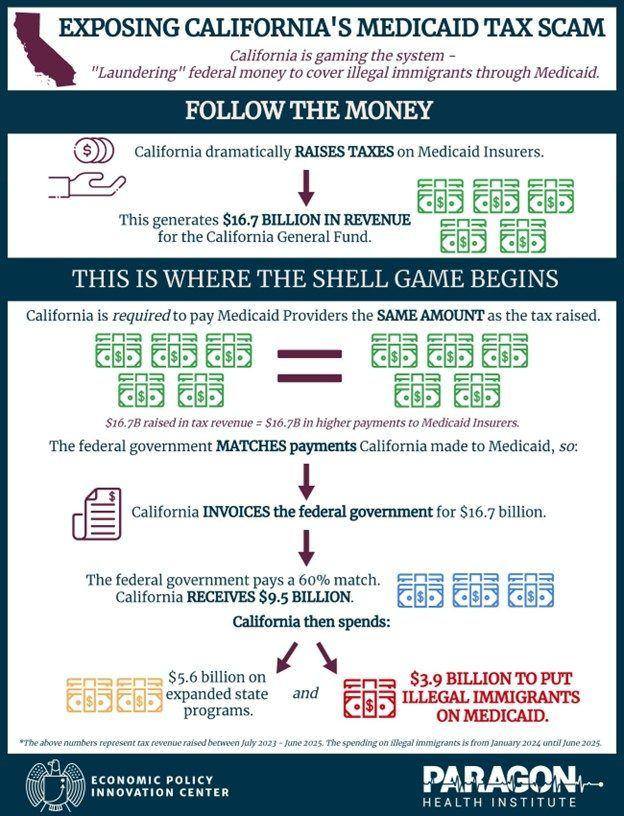
In 2023, California dramatically increased the tax on Medicaid insurers. During the 2023-2024 and 2024-2025 fiscal years, this tax generated $16.7 billion. The state deposited these amounts into the state’s general fund.
A 2016 CMS regulation requires California to increase Medicaid capitation rates by the same amount as the tax (i.e., $16.7 billion in this case) thereby offsetting the tax.
[14][15] This allows California to claim reimbursement from the federal government for its share of the higher payments. With an average federal match of about 60 percent (both expansion and non-expansion populations are covered by Medicaid plans), the federal government reimbursed California $9.5 billion for the tax payments made between July 2023 and June 2025. In essence, California’s Medicaid money laundering resulted in the state obtaining $9.5 billion without any increase in state costs.
To boost the insurers complicit in designing the money laundering scheme, California set aside $4.3 billion for “plan augmentations,” which increase the insurers’ rates further. The remaining $5.2 billion was redirected to other state programs.
California Launders Federal Money to Enroll Illegal Immigrants in Medicaid Plans
California uses $3.9 billion of its money laundering scheme to pay the full cost of Medicaid coverage to illegal immigrants, resulting in health insurance plans wholly paid by the American taxpayer. Federal law prohibits federal Medicaid funds from covering illegal immigrants.
[16] Therefore, technically California must pay for this population using state money. However, as this scheme shows, the state directly increased capitation rates to offset the tax, the increased capitation rates are then fully covered by the federal government, and the state can use the equivalent amount of revenue to pay for costs such as Medicaid for illegal immigrants.
California’s Medicaid expansion has cost more than earlier projections because of the significant increase in illegal immigration during the Biden Administration. In 2020, the LAO estimated that expanding Medicaid benefits to illegal immigrants would cost about $3 billion per year and cover 1.15 million people.
[17] Today, the Migration Policy Institute estimates there are 2.74 million illegal immigrants in California - although the actual number is likely even higher.
[18]
The cost of covering all California’s illegal immigrants through Medicaid (and not just the January 2024 expansion to those ages 25 to 49) is much more expensive than initially projected. While the state originally projected it would cost $3 billion per year, California officials recently said the state expects to spend $9.5 billion for illegal immigrants’ Medicaid from FY 2024-2025.
[19] [20] Coincidentally, this is how much funding California has generated since 2023 from the federal government as a result of their enhanced Medicaid insurer laundering scheme.
Conclusion
California’s Medicaid insurer tax is just one example of how states have broken the federal-state partnership to obtain federal funds with no state financing responsibility to pay for their spendthriftness. But since the dollars they use are not
technically federal funds, the state can get around having to abide by any long-standing guardrails.
With these schemes, states such as California can funnel more and more federal dollars through insurers without states picking up any of the bill. And, the ease with which states can launder federal funds to obtain more federal Medicaid money is what causes perverse expansions of the program, including federal dollars funding illegal immigrants’ health care and permitting the wealthiest Americans to join a welfare program so taxpayers can fund their LTC.
[1] California Department of Health Care Services, “2023-24 Budget Act,” July 2023, at
https://www.dhcs.ca.gov/Documents/Budget-Highlights/DHCS-FY-2023-24-Budget-Act-Highlights-07-1323.pdf.
[2] California Department of Health Care Services, “Managed Care Organization Provider Tax,” May 2023, at
https://www.dhcs.ca.gov/Documents/LGA/Governors-Budget/DHCS-MCO-Tax-Primer-5-26-23.pdf.
[3] Legislative Analyst’s Office, “The 2020-2021 Budget: Analysis of the Medi-Cal Budget”
, February 2020, at
https://lao.ca.gov/reports/2020/4161/Medi-Cal-Budget-021420.pdf.
[4] California Department of Health Care Services, “2023-24 Budget Act,” July 2023, at
https://www.dhcs.ca.gov/Documents/Budget-Highlights/DHCS-FY-2023-24-Budget-Act-Highlights-07-13-23.pdf.
[5] California Department of Health Care Services, “2025-26 Governor’s Budget,” January 2025, at
https://www.dhcs.ca.gov/Documents/Budget-Highlights/DHCS-FY-2025-26-Governors-Budget-Highlights.pdf. 7 In 2021, Gov. Gavin Newsom signed Assembly Bill 133 into law, which abolished Medicaid's asset test for eligibility. This allows anyone, regardless of wealth, to enroll in Medicaid's LTC. The first phase increased the asset limit from $2,000 to $130,000, effective July 1, 2022. The second phase removed the asset test entirely, effective January 1, 2024.
[6] The California Legislature’s Nonpartisan Fiscal and Policy Advisor, “The 2025-26 Budget: Medi-Cal Fiscal Outlook,” November 2024, at
https://lao.ca.gov/Publications/Report/4941.
[7] Ibid.
[8] The California Legislature’s Nonpartisan Fiscal and Policy Advisor, “The 2025-26 Budget: Understanding Recent Increases in the Medi-Cal Senior Caseload,” March 2025, at
https://lao.ca.gov/Publications/Report/5010.
[9] Department of Health and Human Services Centers for Medicare and Medicaid Services,
CA MCO Tax Waiver Approval and Companion Letter, December 2023, a
t https://www.dhcs.ca.gov/Documents/CA-MCO-Tax-Waiver.pdf.
[10] Ibid.
[11] Ibid.
[12] Grace Ashford, “New York Has a Budget Trick to Try on the Federal Government,” New York Times, April 5, 2024,
https://www.nytimes.com/2024/04/05/nyregion/medicaid-budget-taxes.html.
[13] Amanda D'Ambrosio, "Hochul: CMS Approves NY’s Health Plan Tax that Could Yield $1.5-8 Billion if Upheld," The Alliance for Rights and Recovery, December 24, 2024,
https://rightsandrecovery.org/e-newsbulletins/2024/12/24/hochul-cms-approves-nys-health-plan-tax-that-could-yield-1-5-8-billion-if-upheld/.
[14] Capitation, as defined by CMS, is a means of “paying health care providers or organizations in which they receive a predictable, upfront, set amount of money to cover the predicted cost of all or some of the health care services for a specific patient over a certain period of time.” In this case, the Medicaid insurance plans are being paid to cover the amount of the tax. Centers for Medicare and Medicaid Services, “Capitation and PrePayment,” at
https://www.cms.gov/priorities/innovation/key-concepts/capitation-and-pre-payment.
[15] CMS, "Medicaid and Children's Health Insurance Program (CHIP) Programs; Medicaid Managed Care, CHIP Delivered in Managed Care, and Revisions Related to Third Party Liability," 81 Fed. Reg. 27498 (May 6, 2016),
https://www.federalregister.gov/documents/2016/05/06/2016-09581/medicaid-and-childrenshealth-insurance-program-chip-programs-medicaid-managed-care-chip-delivered.
[16] Personal Responsibility and Work Opportunity Reconciliation Act of 1996 (PRWORA), Section 401(a) of the 8 USC § 1611.
[17] Legislative Analyst’s Office, “The 2020-2021 Budget: Analysis of the Medi-Cal Budget”
, February 2020, at
https://lao.ca.gov/reports/2020/4161/Medi-Cal-Budget-021420.pdf.
[18] Migration Policy Institute, U.S. Census Bureau, “Unauthorized Immigrant Population, 2019”, accessed March 7
th, 2025,
https://www.migrationpolicy.org/data/unauthorized-immigrant-population/state/CA.
[19] Legislative Analyst’s Office, “The 2020-2021 Budget: Analysis of the Medi-Cal Budget”
, February 2020, at
https://lao.ca.gov/reports/2020/4161/Medi-Cal-Budget-021420.pdf.
[20] Kenneth Schrupp, “California spending $9.5B on healthcare for undocumented immigrants this year,” February 2025, at
https://www.thecentersquare.com/california/article_14d06ede-e975-11ef-8542-cf8d17e0a983.html.