The Bureau of Labor Statistics (BLS) release of its
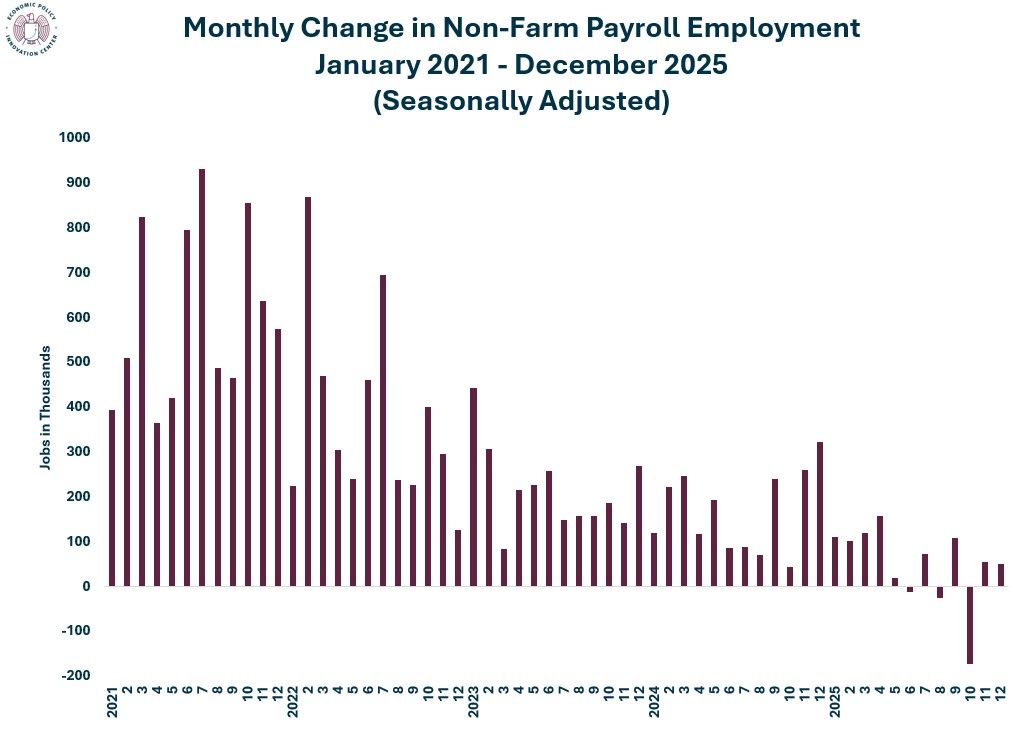
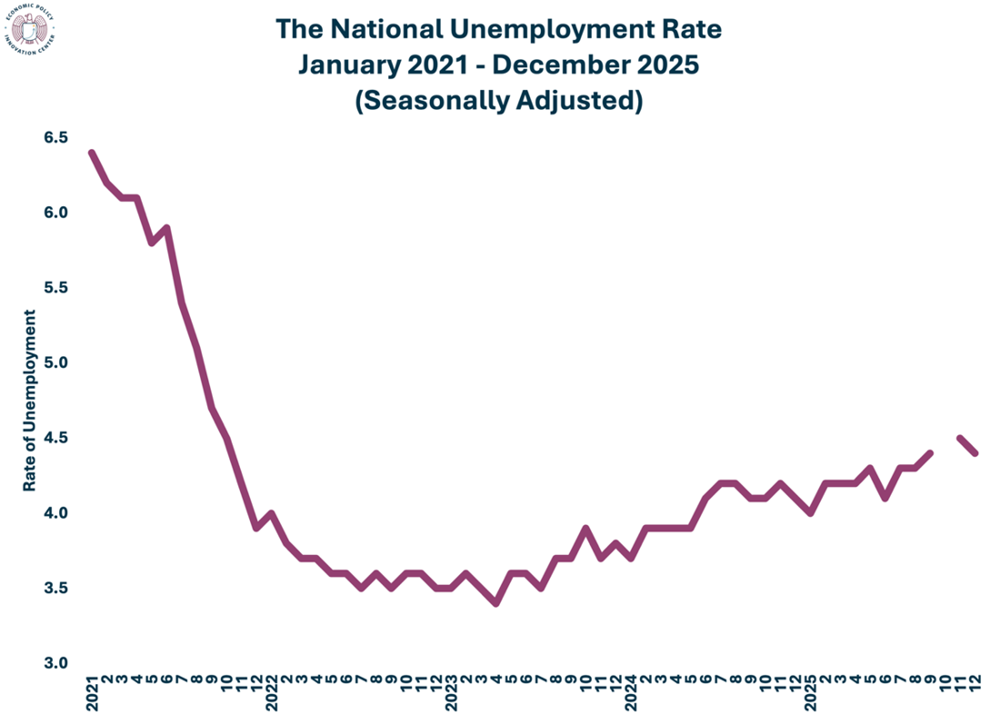
December jobs report which signaled a return to normal times on a number of fronts. First, the headline jobs and unemployment rates look about right for a modestly growing economy. BLS reported that private and public employers created a net 50,000 jobs in December, which, for a year-long weak job market is a relatively solid number. Moreover, the unemployment rate dropped from a
revised 4.5% to 4.4%.
[1] Second, BLS is back to its regular schedule for surveying households and businesses after the long suspension of activity caused by the government shutdown. The Bureau reported that none of its December work was affected by the suspension of government activity.
Job Growth Remains Slow
Some commentators will note that December’s jobs number and, indeed, all of 2025 indicate deeper weaknesses in the U.S. economy. They evidence this point by comparing 2025 to the past three years (2022-2024), when monthly jobs gains were averaging 254,000. The average for 2025 stands at an unrevised 49,000 jobs. While other indicators (the rate of hiring and job openings, as well as some of the components of Gross Domestic Product) have confirmed a slowing in economic activity compared to the post-pandemic period, this sharp decline in job creation most likely stems from the administration’s immigration policies, which have dramatically decreased labor force growth. The labor force grew by an average of 2,530,000 jobs in 2022 and 2023. That dropped to 1,085,000 in 2024 as the economy slowed and President Biden made major adjustments to his immigration policies in the second half of that year. While we are still waiting for revised labor force estimates for 2025 (BLS delayed the revisions until next month), the indications are that the labor force grew even more slowly this year than last.
While more jobs were gained than lost in December, the decline in the goods-producing sectors continued. Overall, this sector lost 21,000 jobs, with employment in construction and manufacturing respectively declining by 11,000 and 8,000. The services side of the economy was not exempt from job losses, though overall it grew by 58,000 positions. Retail trade declined by 25,000, and transportation and warehousing shrank by 6,600 jobs. On the plus side, employment in health care and social assistance grew by 38,500, and the highly volatile leisure and hospitality sector expanded by 47,000.
It may be significant that BLS continued to revise downward its previous estimates of job gains. BLS lowered its estimates for October by 68,000 (from 173,000 to 105,000) and for November by 8,000 (from 64,000 to 56,000). Some analysts read a trend in downward or upward revisions as an indication of deeper trends in the economy.
Unemployment Drops, But Economic Conditions Remain Steady Overall
While the unemployment rate at 4.4% is slightly below last month’s 4.5%, there’s little reason to see a change in trend. The rate has been growing in a see-saw fashion for two-and-a-half years.
All of the unemployment rates as estimated by sex, ethnicity and race, and educational attainment ticked down in December, but
none by a statistically significant amount. The population of unemployed workers declined by 278,000, but that also missed the threshold (380,000) for statistical significance.
[2] Indeed, we get very little indication from the household survey that economic conditions are substantially improving or decaying. Thus, the December reading of labor markets from BLS looks like a normal report that invites us to wait for next month’s estimates.
2025 in Retrospect
It is worth taking a moment to review the headline numbers from this past year. In 2025:
- Non-farm payroll employment rose by 525,000 jobs.
- Payroll employment in the goods producing sectors (e.g. manufacturing, mining, construction, and so forth) declined by 80,000 jobs.
- The service producing sectors, however, rose by 762,000 jobs.
- Employment in federal, state, and local government shrank by 157,000 jobs (principally in the federal and state governments).
- The civilian labor force grew by 2,977,000 individuals.
- The unemployed population grew by 551,000.
- The population not in the labor force (not working or looking for work) grew by 2,202,000.
- The cohort looking for work came to 683,000 (many of whom are not in the labor force).
- The labor force participation rate hardly budged, dropping only 0.1% from 62.2% in December of 2024 to 62.1% in December 2025.
Understanding Technological Developments in the Economy
All these new statistics and the pattern of the past year strongly suggest that we should continue to ask, is today’s labor market getting weaker or stronger? It may puzzle some who do not follow labor market data closely why economists have a hard time answering this question. Perhaps one of the reasons there is so much hand waving is that the statistical concepts we have developed over the past quarter century may be less suitable for analyzing labor market changes today than when they were created.
For example, it may be that the growing presence of AI in workplaces throughout the economy is both yielding output gains and disrupting labor markets. I personally think that there are amazing pockets of highly productive labor today, but there are also vast areas where workers are seeing little progress and significant disengagement from work.
- Durable manufacturing productivity is up over the past several quarters.
- Non-financial business sector is seeing productivity growth rates that are near their 10-year highs.
- However, BLS has been signaling a sharp decline in job creation for over a year despite growth in productivity. Job openings for October 2025 are virtually the same as in October 2024. That said, hires are down 200,000 year over year, as are separations and quits. Employers are holding on to employees, employees are holding on to their jobs, and employers are holding steady on staffing increases.
Do we have a slow jobs market, or are we seeing the early days of high-tech disruption that may, in the end, produce positive outcomes for workers? Policymakers and many economists may be missing some of the significant changes happening in workplaces all across the economy simply because we have not developed the statistics to measure these changes. For example, we know very little about changes in tasks, or what workers actually do despite their job titles.
Why would this be a problem? What happens in the office or at the work bench ultimately becomes a jobs number on the first Friday of each month. Workplace changes are happening at an accelerated pace today, and we should be tracing those changes by tasks rather than changes in job titles. AI and robotics are reshaping the workplace and, thus, the economy by changing tasks, and economists are missing most of that story.
One has only to look at what is happening in high tech to see why economists need a better way to measure changes at the task level. AI is rapidly altering the tasks formerly done exclusively by highly trained humans. For example, the job creation rate in “computer systems design and related services” had been growing at an average annual rate of 3.4% between 2015 and 2023. From September 2023 on the annual rate has been an average of -0.9%. Some analysts believe that this reversal stems from an industry-wide effort to reduce a workforce that was rapidly expanded during the COVID years. That is a compelling narrative until you look more closely at the data.
Most of the decline has been in a sub-component, Computer Design Service. Establishments primarily engaged in planning and designing computer systems that integrate computer hardware, software, and communications technologies, as well as providing related services. That sector has been declining at an annual rate of 1.9% over the past year and is intensely driven by AI capabilities.
The December jobs report joins a series of peaks inside the U.S. labor market that lead to more questions than they answer. Some of those answers will emerge when future reports confirm whether the workers face declining or improving job prospects. Other questions, like the effects of AI, truly require economists to devise new ways of analyzing changes in the workplace and the economic structure.
The comforting aspect of these challenges is that the seem so normal: labor economists and policymakers always appear to be waiting on new data to answer the big labor questions, and there is not a moment in the evolution of work when we seem to have exactly the right statistics and data to tell us what is truly going on.
[1] Some readers probably expected to see November’s 4.6% unemployment rate in this sentence, and they will wonder why I’m reporting a decline in the rate from 4.5 last month to 4.4 in December. The reason is a revision to the seasonal adjustment factors for 2025. This adjustment, which affected all of the household survey estimates for the year, resulted in a lowering of the unemployment rate for November from 4.6 to 4.5%.
[2] If an indicator misses the threshold for statistical significance, the usual interpretation of that miss is that the estimate could easily change with the introduction of additional data. In other words, the user of the statistic cannot be relatively certain it will not change.