The enormous anticipation surrounding today’s jobs report clearly demonstrates how vital official government statistics are. The six-week delay in labor market numbers caused by the government shutdown significantly challenged policymakers from the Federal Reserve to the major boardrooms as they sought to discern the trend in economic activity. Now, at last, we have a partial reading on October and our first look at November employment activity…all in one major report.
Employment Numbers Signal Weakness
The
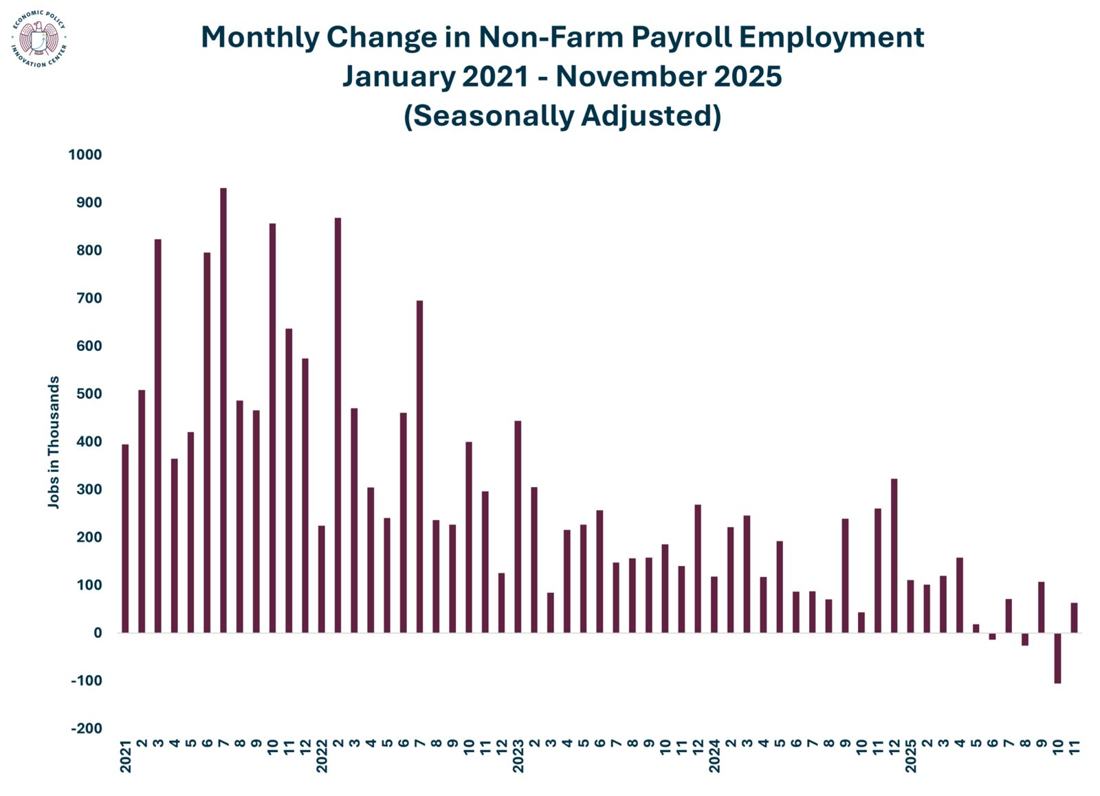
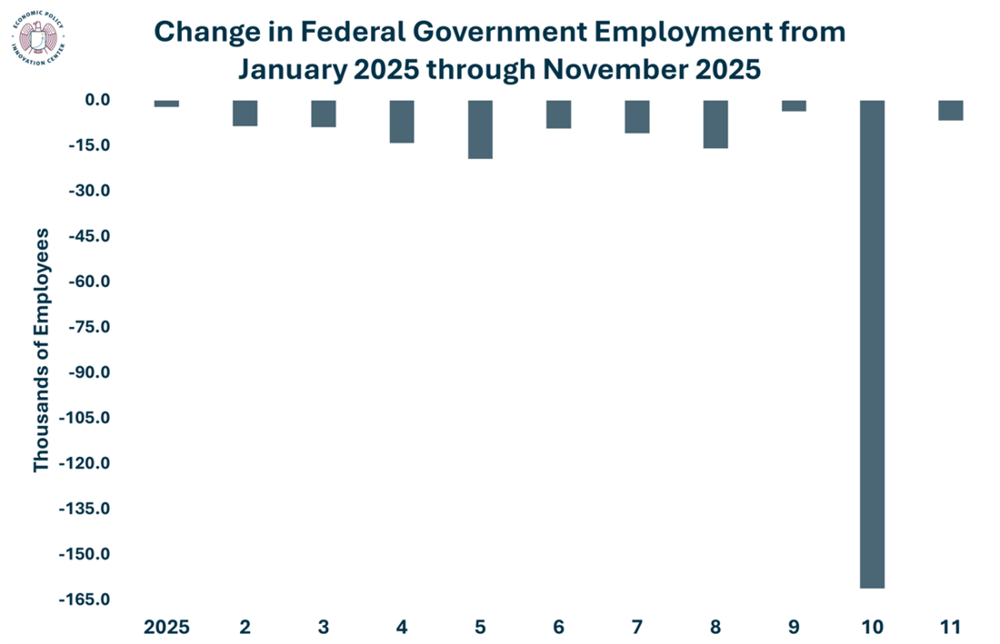
new data appear to confirm that the labor market remains weak. Data collected so far for November show a net job increase of 64,000, mostly in the health care and construction sectors. An estimate for October based on incomplete data shows a decrease in jobs of 105,000. This drop mostly stemmed from a sharp decrease in federal government employment of 161,000.
[1]
Downward revisions to the August and September jobs estimates further confirmed the weakness in US labor markets. The Bureau of Labor Statistics (BLS) revised the August number by -22,000 and dropped the September estimate by -11,000. There were no revisions to the October estimate, since today’s estimate, like November’s, constitutes the first estimate that will be revised as further data are collected.
Unemployment Levels Warrant Watching
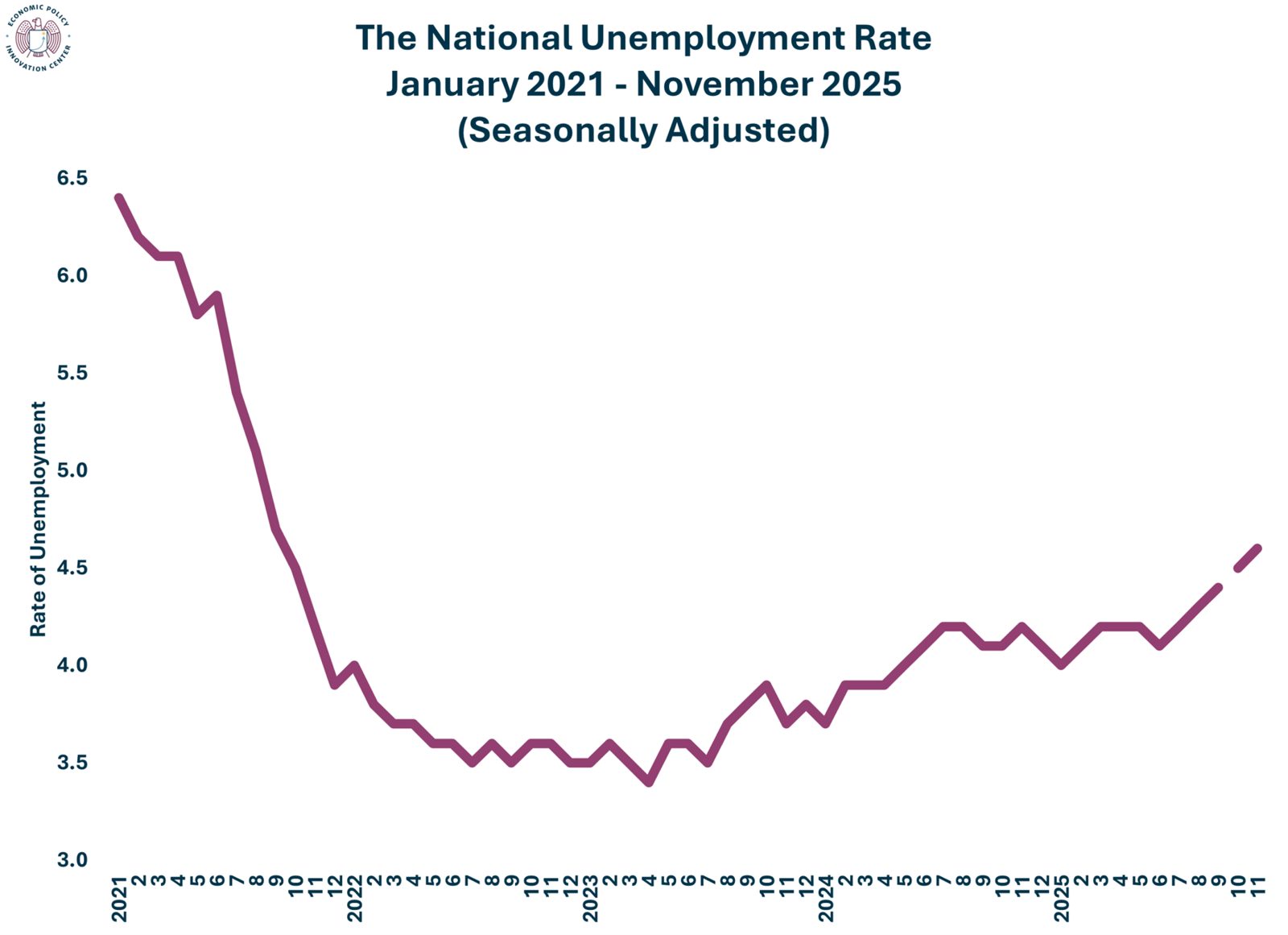
Additional evidence of labor market weakening can be found in the unemployment estimates. BLS set the November national unemployment rate at 4.6 percent. That is an increase from September’s estimate of 4.4 percent, a full 0.4 percent higher than the 4.2 percent in November of 2024, and the highest rate in the past 5 years. BLS will not publish an October 2025 unemployment rate, since it did not field a household survey in October. In fact, all of the October statistics based on the household survey (formally known as the Current Population Survey) will never be published.
The total number of people who are not employed but looking for work in the four weeks prior to the November survey (that’s the BLS definition of unemployment) rose by 228,000 between September and November. A significant proportion of this increase is due to people re-entering the labor force in search of work. These re-entrants grew by 293,000 (other categories declined), and one wonders why the number grew so much. Could this be the effect of rising prices on the budgets of retirees, of recently retired federal workers now looking for their next career move, or of a weakening economy causing households with income challenges to offer up more labor? Analysts will want to keep a close eye on this aspect of labor market activity in the months ahead.
Part-time work also increased. Between September and November, the number of people working part-time because they could not find full-time work rose by 909,000, which is a substantial increase for any two-month period. Of that number, about 321,000 full-time workers were placed on part-time or slack work.
The unemployment rate for teenagers rose significantly from 13.2 percent in September to 16.3 percent in November.
[2] Among workers aged 20 to 24, the unemployment rates remained elevated: both sexes at 8.3 percent and men at 9.1 percent. The unemployment rate for African American workers, both sexes, rose from 7.5 to 8.3 percent. For African American men, the rate jumped substantially from 7.4 percent in September to 8.4 percent in November.
The US economy is now significantly above the rate of unemployment that policymakers associate with stable labor market activity and limited inflation, or a target unemployment rate of about 3 to 3.5 percent on an annual basis. While it is true that the rate of net job increase that holds the unemployment stable has dropped from 150,000 in the 2023-2024 period to around 85,000 today (thanks to the administration’s successful effort to reduce immigration), policymakers must still be deeply concerned about today’s net increase of 64,000 (which probably will be revised downward in the two months ahead) when coupled with the rising unemployment rate. The jobs report number is not sufficiently high to restrain rising unemployment, and the reported unemployment rate remains well above its target level.
The Employment Outlook
Of course, some part of the labor market’s recent apparent weakness is due to the Trump administration’s vigorous effort to reduce federal government employment. Until October 1, this effort had produced a steady reduction in federal employment (excluding the US Post Office). The chart below shows monthly employment change, with the large reduction in October caused by the end of the early retirement program. In total, federal employment has fallen by 259,300 since January of this year.
Some sectors saw significant employment gains in November. This was particularly true for construction (28,000), health care (65,000), and professional and business services (12,000). Many other sectors lost jobs: for example, manufacturing (-6,000) and transportation and warehousing (-17,700). While leisure and hospitality declined by -12,000, this sector has otherwise been growing steadily over the past 12 months. Manufacturing has shed 58,000 jobs since the beginning of the year and 200,000 jobs since 2022, or the full recovery from the COVID slowdown. Transportation and warehousing, which is a bellwether for the state of economic activity, also shows recent weakening and has declined by 60,100 jobs since January of this year.
The Reliability of Data Estimates
Many analysts, however, will wonder if these October and November estimates are as statistically solid and reliable as estimates for jobs and the labor force made before the shutdown. As much as Wall Street and Washington looked forward to their publication today, the question that must linger in many minds is just how good these data are.
For its part, BLS was just as tight lipped on characterizing their work as they normally are. BLS did include a short section titled “Establishment Survey Estimates and the Federal Government Shutdown”, but it did little to assure readers about the statistical quality of the estimates. In fact, the section concluded with this murky sentence: “It is not possible to precisely quantify the total impact of the federal government shutdown on payroll employment estimates for October and November.”
Speaking as a former Commissioner of Labor Statistics (2019-2023) and the one who managed BLS during the COVID-19 crisis, I suspect the estimates are as good as BLS could possibly produce. During April through October of 2020, BLS had to publish labor and price estimates that often were based on incomplete information or large gaps in data series. They did so with considerable success and carefully documented where estimates were especially shaky.
I believe readers of today’s report can, indeed, rely on these published estimates and use them in their analytical and policy work. That said, BLS has laid down a major marker in suggesting that the October and November jobs numbers likely will always bear an invisible asterisk: the true effect of the shutdown on official statistics will probably never be known and data from these two months should be used carefully.
So, where does that leave us? I think we can conclude that the October and November employment numbers do nothing to dislodge the view that the trend in job creation continues below its potential and the pool of people looking for work continues to expand. At this point, analysts can say without too much disagreement that the trend in labor market activity is decidedly in the wrong direction.
[1] The October decline in federal government jobs can be attributed to the end of the early retirement program that allowed workers to stop working but continue to receive compensation through buyouts and pay packages through the end of the fiscal year. That program’s end triggered mandatory retirements on October 1, 2025.
[2] The sample size for teenagers is relatively small, and the series is notoriously noisy. So, some caution should be used in reading this result. However, this month’s unemployment rate was statistically significant.