

Between May and July 2021, 20 states implemented COVID-19 vaccine lotteries in an attempt to increase vaccination rates. The potential lottery winnings were considerable. For instance, New Mexico awarded a top prize of $5 million in cash for getting vaccinated. Other prizes were available as well, including a “staycation,” hunting and fishing licenses, and passes to state parks.
To finance New Mexico’s COVID-19 vaccine lottery (called “Vax 2 the Max”), the state government received $16 million in federal funding from the Coronavirus State and Local Fiscal Recovery Fund (SLFRF). The SLFRF was created by President Biden’s American Rescue Plan Act (ARPA) and provided $350 billion to state, local, territorial, and tribal governments to “support [the state and local response] to and recovery from the COVID-19 public health emergency.”
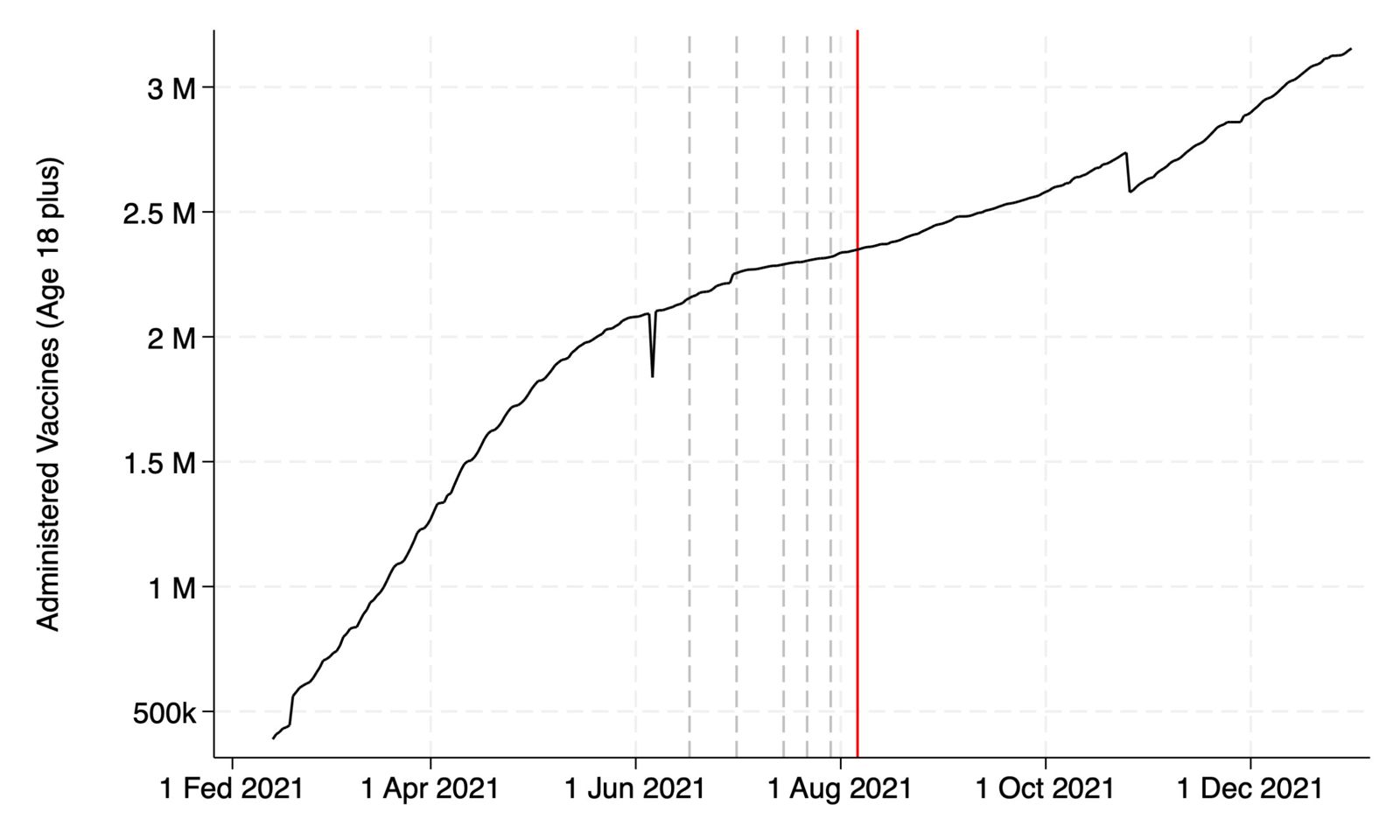
The vaccine lottery was clever. But did it work? Figure 1 shows the number of total vaccines administered in New Mexico during 2021 for those ages 18 and older (i.e., those eligible for the lottery). The dashed gray vertical lines represent each of the five initial lottery entry deadlines. The solid red line represents the grand prize lottery entry drawing for the $5 million cash payment.
Figure 1. Total administered vaccines in New Mexico during 2021
Source: Author’s calculations using data from the Centers for Disease Control and Prevention and New Mexico.
Simply glancing at the figure, it appears that the vaccine lottery had no effect. The trend line before and after the lottery entries closed is nearly identical. But if you get out your microscope or enhance the figure, you might be able to see a slight increase in the number of vaccines administered around July 1 which coincided with an entry deadline for one of the lottery drawings.
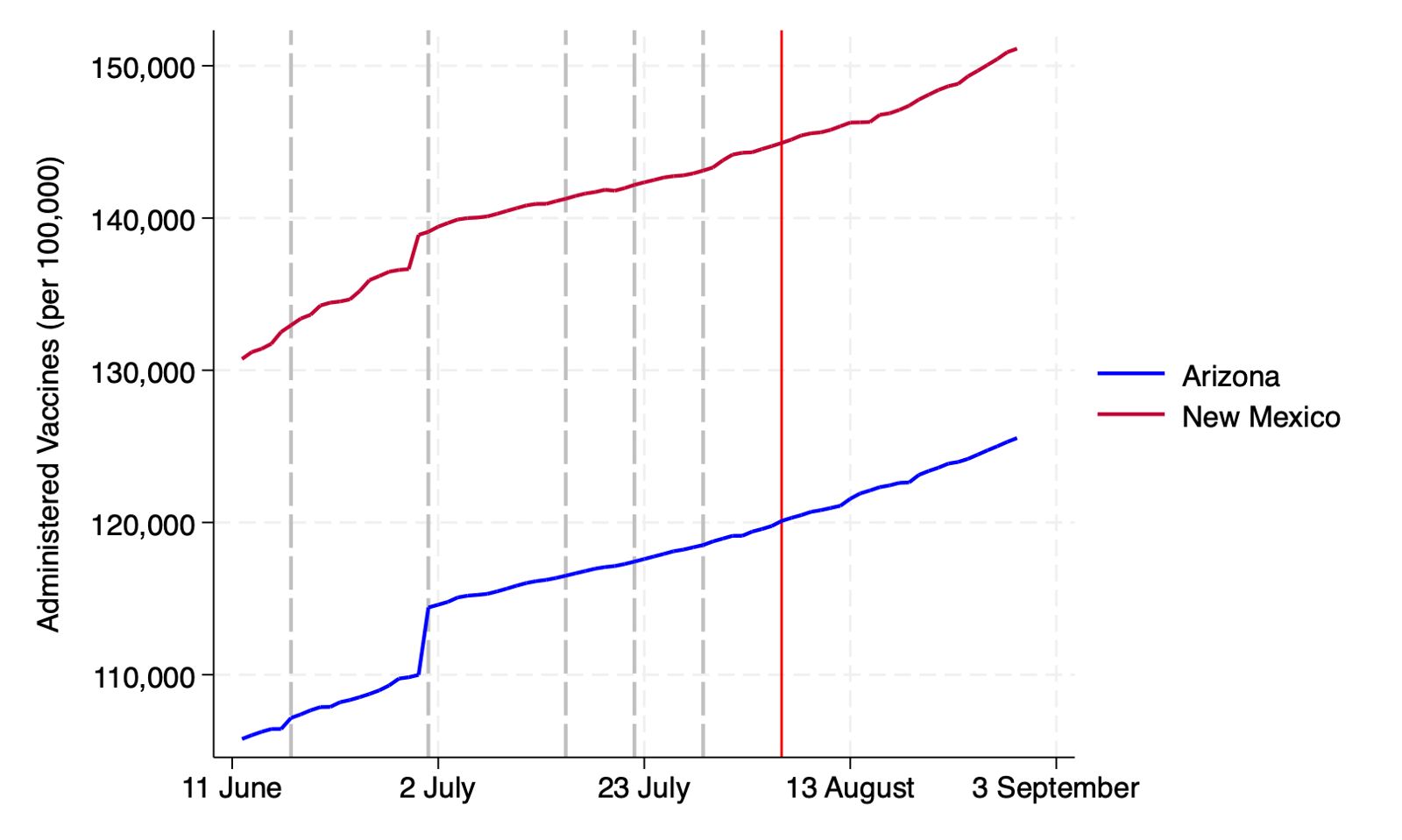
To see whether this increase around July 1 might have been related to the vaccine lottery, or something else (including a statistical anomaly), I compared COVID-19 vaccines administered in Arizona. Arizona has the benefits of being next to New Mexico and sharing many similarities, but Arizona did not have a vaccine lottery. Because there are more people in Arizona, I compared vaccines administered for every 100,000 people in the state.
Figure 2 shows the comparison of New Mexico with Arizona. I shortened the period to include June to September to emphasize the increase. You can see the same increase occurred in Arizona except that it was even larger. This suggests that the increase in vaccine administrations had little (if anything) to do with New Mexico’s “Vax 2 the Max” vaccine lottery.
Figure 2. Total administered vaccines per 100,000 people in Arizona and New Mexico
Source: Author’s calculations using data from the Centers for Disease Control and Prevention and New Mexico.
This supports findings by others that the vaccine lotteries were not particularly successful. But they were expensive. California spent $116.5 million on a lottery program. Illinois offered $7 million in cash prizes and $3 million in scholarships. It is difficult to determine the exact subsidies these programs received from the federal government.
However, we can track the $16 million to New Mexico through the SLFRF. As it turns out, that amounts to millions in debt and inflation for no return.