An Introduction to Radio Spectrum
Radio spectrum is a critical resource that supports vast parts of the economy, from broadband infrastructure to emerging technologies. Everything from 5G mobile broadband, cellphones, Wi-Fi in homes and offices, GPS navigation, over-the-air television, satellite services, communications to air-traffic control, emergency service radios, and many other telecommunications technologies all rely on access to frequency bands.
However, spectrum is inherently scarce. The finite nature of electromagnetic spectrum provides “real estate,” and federal licensing rules determine who may transmit on which bands, at which power, and for what purpose. Because both nature and regulation limit access, efficient spectrum allocation policy is essential for innovation, international and domestic competition, and economic growth. Since the 1990s, one way that spectrum has been more effectively allocated in the United States is by auctioning the use of different frequency bands.
[1]
Congress is currently considering proposals that would provide auction authority as well as creating a planned sequence for those auctions – called a spectrum pipeline – providing the capacity for additional innovation and market certainty. The spectrum pipeline is an important development because it helps guarantee that spectrum will be auctioned without getting ahead of the policymaking process. This process can include deciding what specific frequency bands can be auctioned, the timing of the auctions, and other conditions associated with use.
Spectrum Auction Revenues: Actual Versus Forecasted
Spectrum auctions have the capacity to raise significant revenue for the federal government in at least two ways. First, the spectrum auction itself raises revenue through the sale of licenses at auction. Second, auctioning spectrum to the private sector can spur innovation and boost additional revenue through economic growth. This is particularly relevant when spectrum auction reauthorization is included in budget reconciliation, because the revenues can help offset new spending or revenue loss from tax cuts.[2.Paul Winfree, “Spectrum Auction Would Help US Stay Ahead of China,”
Washington Examiner, September 1, 2024 at
https://www.washingtonexaminer.com/opinion/3136713/spectrum-auction-would-help-us-stay-ahead-of-china/]
However, it is very difficult to forecast spectrum auction proceeds because the prices that companies are willing to pay are revealed only through the decentralized bidding process. The government (e.g., the Federal Communications Commission or FCC) cannot know those prices in advance. The prices that private companies are willing to pay for spectrum reflect many things including the potential value of spectrum to the market participants, development of new technology, competition amongst companies that use spectrum, the overall market condition, and far too many variables for these humble economists to include (that is, in fact, the elegance of the free market).
Because of these many uncertainties, forecasters – and in this case, the Congressional Budget Office – often adopt a cautious approach, producing conservative estimates of auction revenues. However, actual proceeds show that spectrum auction revenues usually come in far higher than these estimates. For example, over the past 20 years, actual spectrum auction proceeds have been 167 percent higher than CBO projections. This is not a criticism of forecasters. Rather, it reflects the inherent difficultly of predicting market outcomes where prices are revealed through competition.
Since 2000, Congress has renewed or expanded the FCC’s auction authority through four major statues that have led to auctions. Where the auction involved only the bands specified in statute, CBO’s revenue estimates were extremely conservative. For example, actual revenues raised were $9 billion higher for the 700 MHz auction and $65 billion higher for the C-Band auction. Without fully adjusting for unauctioned or co-mingled spectrum blocks, cumulative auction revenues have exceeded CBO’s estimates by $97 billion over the period.
There have been instances where spectrum auctions were authorized but they never happened. For example, the Bipartisan Budget Act of 2015 and the Infrastructure Investment and Jobs Act of 2021 both authorized auctions that did not occur. CBO estimated that auctions authorized under these laws could raise a total of $14.6 billion.
This is one reason for why spectrum pipelines are important. Without a transparent, time-bound pipeline, it is difficult for stakeholders to make planned investments. Furthermore, in the absence of a pipeline, federal agencies can quietly veto or delay federal spectrum auctions for commercial use because there is not a forcing mechanism to weigh the opportunity cost of hording spectrum against the economic benefits of reallocating it. This reduces economic potential by leaving frequencies underutilized.
Table 1. Revenue Estimates and Actual Proceeds Associated with Legislation that Led to Spectrum Auctions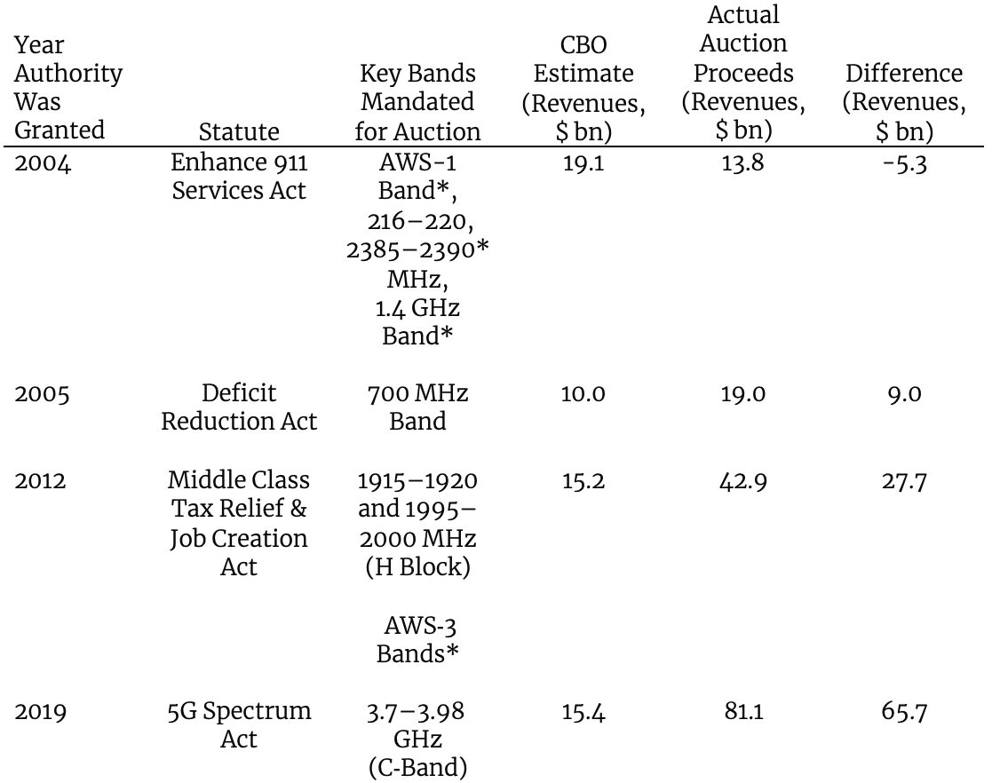
* AWS-1 auction included one other block that was not estimated by CBO. 2385–2390 MHz block remains unauctioned but was included in the CBO estimate. 1.4 GHz auction included two other blocks that were not estimated. AWS-3 auction included one other block that was not estimated.
Conclusion
The reconciliation bill that Congress is developing offers a rare opportunity to renew FCC’s auction authority and release valuable federal spectrum for commercial use. Experience with spectrum auctions suggest that this is fiscally prudent. Over the past 20 years, competitive bidding has generated $97 billion more than CBO has projected, and auctions dedicated solely to legislated bands have out-performed CBO estimates by margins of 60 to 300 percent. Auction authority is a great example of a policy that can reduce the deficit, fuel private sector innovation, and increase economic growth.
To get the maximum value out of the spectrum auctions, Congress should pair the authority with a defined spectrum auction pipeline. This would include a requirement that the FCC, National Telecommunications and Information Administration (NTIA), and other relevant agencies publish (and adhere to) a multi-year auction schedule, with explicit deadlines, band identifications, and an expedited process for resolving interagency disputes, that avoids any single agency from vetoing action. Pairing renewed auction authority with a robust pipeline will allow Congress to score larger, evidence-based gains while strengthening America’s lead in next-generation connectivity.