Economists have often argued that when the real interest rate on government debt is lower than the real economic growth rate, debt tends to grow more slowly than the economy. So, a government can run modest primary deficits without increasing the size of the debt relative to GDP. However, there is an interesting new
paper forthcoming in the American Economic Review that says that’s only half the story because reliance on higher levels of debt tends to increase the real interest rate as investors demand higher yields. In other words, there is a market penalty that the federal government pays for extra debt.
Therefore, the actual test for whether it’s safe to run a primary deficit is stricter than simply a comparison between the interest rate and growth. The interest rate must be so low (or the growth rate high enough) that it can cover the extra price that we pay for the higher debt as well. If not, primary deficits can increase the stock of debt even when the interest rate is lower than the rate of growth.
Here’s an example: if the economy is expected to grow at about 2 percent, and the interest rate on government debt is about 1 percent, the typical view is that there is room to continue running primary deficits. But if the extra debt that the government must issue to pay for that deficit spending increases the gap between the interest rate and the growth rate by, say, 1.75 percentage points, it will eliminate any room to run primary deficits. In that case, any new borrowing would worsen the long-run debt and reduce fiscal space.
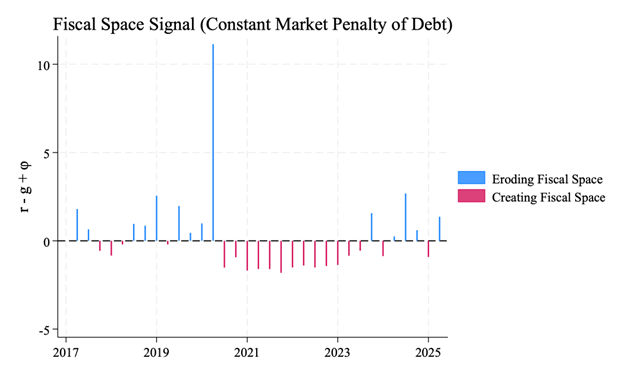
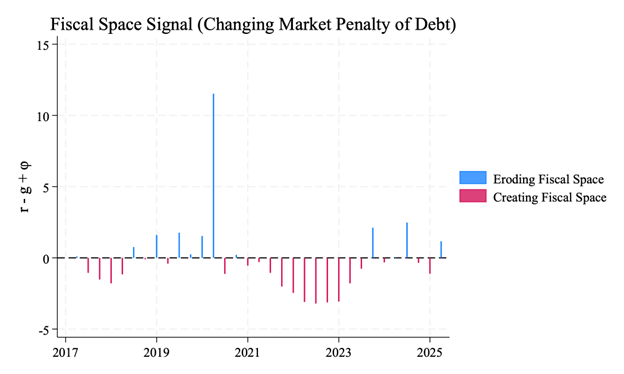
This new research gives us a way to establish a fiscal space signal for whether fiscal space is being eroded or created based on the real interest rate that the government pays on outstanding debt, the rate of economic growth, and the market penalty for issuing additional debt. Specifically, the fiscal space signal is equal to R(t) − G(t) + φ(t). R is the real interest rate, G is the rate of growth in the economy, and φ tells us how much the gap between interest and growth changes when debt increases. When the signal is higher than zero, the marginal primary deficit is more likely to increase the long-term debt ratio and thus erode fiscal space.
The two figures show the fiscal space signal during different points in time. The first figure shows the fiscal space signal assuming that the market penalty for new debt is constant (at 1.7 which is the average that the authors of the AER paper find for the U.S.). The second figure shows the fiscal space signal when the market penalty changes over time as Treasury issued more debt.
Source: Author’s calculations based on methods described in (Mian et al. forthcoming) and data from the Department of Treasury and the Bureau of Economic Analysis.
The fiscal space signal can be interpreted as marginal and contemporaneous. Also, it does not indicate the amount of fiscal space or borrowing capacity that is remaining by itself. Rather, the signal and the space measures are complementary. The fiscal signal answers whether today’s relationship between the Treasury’s borrowing rates, economic growth, and market sensitivity is adding to or subtracting from the cushion. The fiscal space measure answers how large the cushion is.
What we can say with some confidence is that the government’s response to the pandemic significantly reduced the amount of fiscal space that was available (more on that in my paper
The Fiscal Red Line). As economic growth took off during the recovery, the federal government began to create additional fiscal space. However, even the relatively strong growth effects were offset as more debt was issued in 2022 and 2023, and the Fed began responding to sustained inflation. This is why in the second figure there is a much steeper regression to zero in the fiscal space signal beginning in 2022.
This shows how close we are to the threshold where even small primary deficits raise the long-run debt ratio, despite moderate interest rates and a growing economy. As debt rises, the market penalty increases, so each marginal dollar of borrowing costs more and reduces fiscal space. To preserve future borrowing capacity, Congress should enact policies that reduce the primary deficit enough to move the signal into the creating space region permanently during periods of growth in order to rebuild the cushion we once had.