When Congress passed the Inflation Reduction Act (IRA), it promised investments in green energy—but with a blank check. The Congressional Budget Office originally estimated total federal spending to be around
$270 billion across the ten-year window. However, more recent cost estimates have placed it between
$936 billion and $1.97 trillion over the next ten years. The potential for double counting or stacking credits and the absence of firm caps on many of the IRA’s green energy tax credits has led to a massive increase in the law’s true cost to taxpayers.
Green Energy Provisions Provide Loophole Potential
The Inflation Reduction Act contains a plethora of energy tax credits and subsidies. Many of these tax credits do not have limits set on the amount individuals can claim and some do not even have fixed expiration dates. Instead, credits such as the Clean Electricity Production Tax Credit (45Y) expire only when greenhouse gas (GHG) emission levels reach 25% of 2022 levels.
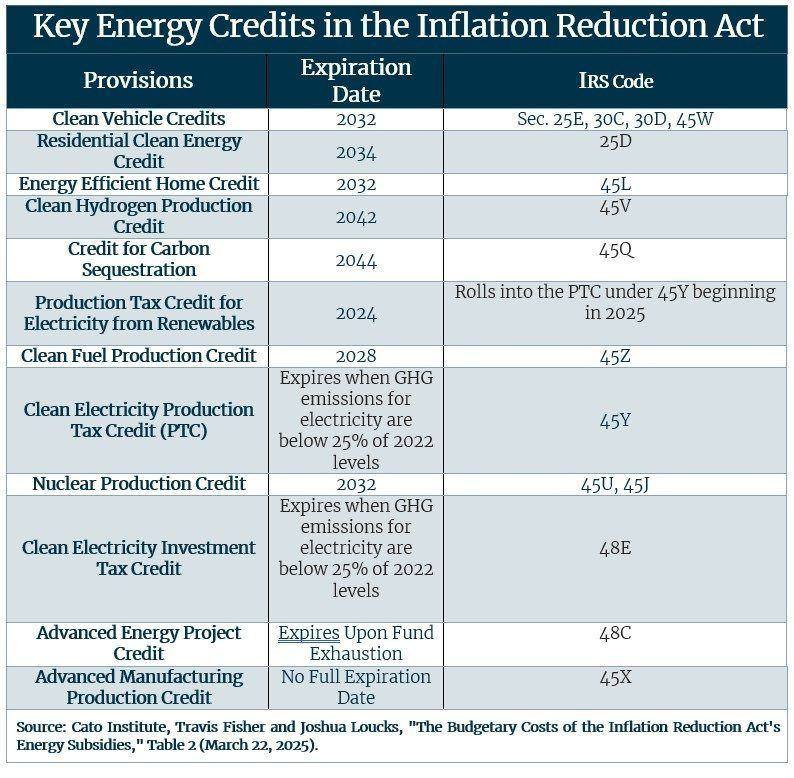
The biggest cost drivers of the IRA are the uncapped tax credits such as the Clean Electricity Investment Tax Credit (48E) and the Clean Electricity Production Tax Credit (45Y). These credits require the federal government to reimburse a portion, usually 30%, of the cost of a new green power plant or storage facility or pay an inflation adjusted premium per unit of clean electricity produced respectively. Solar, wind, and other so-called green energy producers can claim these tax credits for construction or production associated with a “zero-emission” facility. Producers can also claim these tax credits based on “
anticipated” GHG emissions rates before production has even begun.
While
directly claiming two tax credits for the same production facility is prohibited, businesses are able to strategically claim different parts of the same facility for whichever of the two credits provides a greater payoff. This practice allows companies to maximize their subsidies without violating the letter of the law. However, many small start-ups in the energy world do not have access to the skilled tax accountants that will be able to take advantage of this system. Instead, the IRA’s tax credit structure allows more established energy groups to leverage their funding to game the system at the expense of the taxpayers.
Bonus Credits That Don’t Benefit
The IRA includes so-called “bonus” energy tax credits that create opportunities for gaming the system. One such
bonus credit provides an additional 10% investment tax credit if producers use U.S.-made steel, iron, or manufactured products. However, the definition of “U.S.-manufactured” is overly broad: only 40% of the total cost of manufactured components must come from domestically mined, produced, or manufactured sources, with a scheduled increase up to 55% in future years. This means producers can source up to 60% of component costs from foreign suppliers and still qualify for the domestic content bonus.
Another bonus—the “
Energy Community Bonus Credit”—offers an additional 10% tax credit if the project is located in an “energy community,” defined as an area with current or historical dependence on fossil fuel employment or tax revenue. But eligibility is based on broad geographic boundaries, such as census tracts or metropolitan statistical areas. As a result, developers can site projects just within the edge of a qualifying area to claim the bonus, without meaningfully contributing to community revitalization.
These bonus credits can be stacked on top of other IRA energy credits. A developer could place a renewable energy project just inside an energy community, use partially domestic materials, and combine the base investment tax credit with both the domestic content and energy community bonuses—for a total subsidy covering up to 50% of the project’s cost. Additional tax credits may further increase the rate of subsidization depending on how the producer is able to structure the facility to maximize the amount he can claim.
No Caps Means Unlimited Payouts
These energy tax credits have no caps on the total amount that companies or individuals can claim. Credits such as the Advanced Manufacturing Production Credit (45X), Clean Electricity Investment Tax Credit (48E), and the Clean Electricity Production Tax Credit (45Y) have no limit on the amount which can be claimed and allows the government to essentially write a blank check for the amount which will be paid out each year. As demand increases for these tax credits, we have seen the cost estimates skyrocket as companies scramble to ensure that no gains are left on the table.
Without enforceable limits and a take-up rate exceeding initial expectations, the government is exposed to runaway credit claims, incentivizing firms to overbuild or exploit vague definitions, ultimately worsening deficits and undermining our nation’s long-term fiscal stability. Congress should repeal these tax credits using the reconciliation process before they overwhelm the budget and fuel a future debt crisis.