


The Fed’s actions fostered a culture amongst the old Washington establishment that encouraged reliance on the central bank to bail out poor fiscal policies. Instead of taking responsibility for fiscal decisions, past administrations and Congresses expected the Fed to intervene when their policies led to economic dysfunction. The ‘central banks are the only game in town’ dynamic created perverse incentives for fiscal irresponsibility, as the costs of poor governance deferred or masked by the Fed’s monetary interventions…. At the heart of these concerns is the erosion of central bank independence, which is a cornerstone of sustainable economic growth and stability.
Secretary of the Treasury Scott Bessent
“The Fed’s New ‘Gain-of-Function’ Monetary Policy”
The International Economy Magazine (Spring 2025)
An important question in economic policy today is whether developments in the Federal Reserve’s monetary policy have changed the behavior of fiscal policymakers. Specifically, has Congress become more inclined to rely on borrowing when it observes that the Federal Reserve (hereafter referred to as “the Fed”) is willing to purchase federal debt? This is distinct from the broader question of whether the Fed’s interventions cause other distortions in capital markets, asset prices, or exchange rates. Rather, the issue here is analyzing the impact of incentives that shape fiscal policymakers’ choices given the Fed’s posture as a major buyer of Treasuries. Historically, the Fed’s holdings of Treasury securities were relatively modest. That pattern changed dramatically beginning in 2008. Through several rounds of quantitative easing (QE), the Fed increased its holdings of Treasuries and mortgage-backed securities to unprecedented levels. Fed holdings of Treasury securities rose from less than $800 billion in 2007 to more than $5 trillion by 2022. At several points, the Fed absorbed a large share of net new Treasury issuance, with its holdings of debt growing from roughly 12 percent of gross domestic product (GDP) before the COVID-19 pandemic to 25 percent by 2022. This degree of intervention could condition Congress, the main fiscal policymaking institution, to believe that the Fed stands ready to accommodate nearly unlimited borrowing needs. If true, the distinction between monetary policy in support of broadly recognized macroeconomic goals and monetary policy enabling fiscal expansion becomes distorted. There is reason to believe that the Fed’s interventions through QE create an implicit guarantee. If the Fed is expected to purchase debt, market constraints become weakened. Under normal conditions, additional government borrowing might raise interest rates on debt, which might in turn crowd out private investment. But if the Fed is willing to accommodate an unlimited level of higher deficits, Congress may then be willing to expand primary deficits (i.e., deficits not including debt service costs) to pursue short-term political and economic gains. Fiscal space, or the government’s borrowing capacity, might then also be expanded based on the expectation that the Fed can absorb debt without a large cost. As United States Secretary of the Treasury Scott Bessent recently suggested, this notion erodes the Fed’s independence as fiscal policymakers begin to expect the Fed to intervene on their behalf.[1] It also cuts against the principle of monetary dominance that grounds economic policy in the United States.[2] Under monetary dominance, debt markets act as an explicit limit to federal borrowing and spending. However, under fiscal dominance, the Fed would be compelled to adjust its balance sheet to accommodate fiscal policy, which would undermine its central goals of promoting price stability and full employment. The question of whether the Fed’s adoption of QE has changed fiscal behavior can be tested empirically. One approach is to examine changes in the U.S. primary deficit when the Fed is actively buying Treasury securities. If Congress systematically contributes to larger primary deficits, it suggests that monetary policy is shaping fiscal behavior. This will also help us determine at what point the Fed’s independence has been eroded not by political pressure (which is a cultural issue controlled by the Fed itself), but by the expectations that fiscal policymakers internalize in response to monetary policy. At this point, the Fed’s credibility can collapse as markets begin to perceive that monetary policy is subordinated by fiscal pressure. In fact, the evidence generally supports the view that QE increases after fiscal conditions deteriorate rather than reliably causing higher primary deficits. Further, Treasury debt issuance during fiscal shocks (i.e., recessions and the COVID-19 pandemic) shrinks the share of debt held by the Fed with debt purchases under QE playing some catchup. Data does show, however, that in the short-run deficits are higher and the active fiscal response is relatively expansionary when a fiscal shock occurs if the stock of debt held by the Fed is already high or the Fed is actively purchasing federal debt. This may be driven by QE having the effect of reducing the cost of financing by lowering term premia. It is a good sign for economic policy that there are not persistently high fiscal deficits simply because the Fed is able to purchase federal debt. However, the Fed’s active purchasing of debt has also muted market signals, potentially leading to overspending and reliance on debt during adverse fiscal events. This almost certainly occurred in the aftermath of the COVID-19 pandemic, when too much government spending contributed to high and persistent inflation. Figure 1: Debt Held by the Public and the Federal Reserve’s Holdings of Treasury Securities, 1990-2025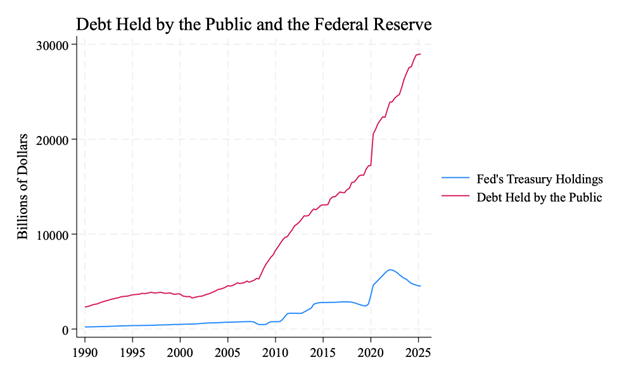 Note: The figure shows the Fed’s Treasury holdings as well as federal debt held by the public.
Source: Author’s calculations using data in appendix.
Note: The figure shows the Fed’s Treasury holdings as well as federal debt held by the public.
Source: Author’s calculations using data in appendix.
The Federal Reserve Has Become a Major Buyer of Government Debt
Both the debt held by the public and the Fed’s holdings of Treasuries have increased considerably over the past 15 years. Figure 1 shows that both the debt held by the public and the Fed’s holdings of debt have climbed dramatically since the mid-2000s. Debt held by the public rose from $4.5 trillion to nearly $30 trillion, while the Fed’s Treasury portfolio climbed from under $1 trillion to $4.5 trillion today. Before 2008, the Fed held a modest, steady stock of Treasuries to manage bank reserves and the policy rate. With QE, the Fed began large-scale asset purchases and bought longer-term Treasuries, financed by reserves, to reduce term premia and support market functioning. Figure 2 shows that the Fed’s share of publicly held Treasuries has been variable over time. The share tends to rise during QE and fall during issuance spikes or during quantitative tightening (QT). This illustrates that even large purchases can leave the Fed’s balance sheet flat or lower it if the public debt is rising. These patterns make it hard to claim from levels alone that Fed policy is driving the rise in debt, but they are clearly correlated, and both respond to economic shocks. Figure 2. Percent of Debt Held by the Public that are Held by the Federal Reserve, 1990-2025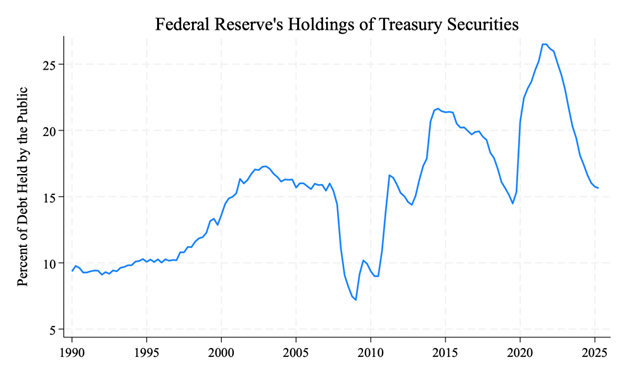 Note: The figure shows the Fed’s Holdings of Treasury securities as a percent of debt held by the public.
Source: Author’s calculations using data in the appendix.
Note: The figure shows the Fed’s Holdings of Treasury securities as a percent of debt held by the public.
Source: Author’s calculations using data in the appendix.
Other Research Shows that QE Effects Treasury Markets
The empirical research literature on the fiscal effects of QE is relatively limited compared to its potential consequences. That said, several themes are evident given the existing research. Adrian et al. (2025a; 2025b) find that large-scale asset purchases can lower government borrowing costs and increase economic output. However, they do not estimate changes in primary deficits.[3] Christensen et al. (2024) also study how QE (or policies that resemble QE) effects debt management, finding that it changes the maturity structure of government debt.[4] Other contributions examine how QE affects fiscal behavior indirectly. For example, Del Negro and Sims (2005) and Schreger et al. (2024) suggest that monetary accommodation can create increased perceptions of fiscal capacity which can raise the risk of fiscal dominance.[5] The Congressional Budget Office (CBO) suggests that the budgetary impact of QE runs through three channels.[6] First, it reduces net interest costs due to lower interest rates on Treasuries. Second, it increases Fed remittances from earnings on securities. Third, it has macroeconomic feedback effects by increasing output and employment during economic downturns and recovery. That said, the net effect over a longer period depends on the normalization of the Fed’s balance sheet which may increase interest costs. Furthermore, Fed remittances to the Treasury are only made when the Fed earns net income. That is, when its interest earnings and other revenues exceed its operating expenses and the interest it pays on reserves and reverse repurchase agreements. Therefore, the longer-term consequences of QE remain unknown.QE Episodes Have Not Persistently Changed Active Fiscal Policy
A key question is whether the Fed’s large-scale asset purchases (QE) have a persistent effect on fiscal policy rather than merely coinciding with fiscal shocks when deficits naturally rise. The answer to this question will help us understand whether QE has created an incentive for fiscal irresponsibility in a way that shows up as higher deficits. To do so, I examine how the primary deficit (i.e., the deficit excluding debt service payments) behaves after each instance of the Fed announcing QE. The method I use is examining what happens to the primary deficit over successive quarters as it relates to major QE announcements.[7] To make a fair comparison, I adjust for where the federal budget stood last quarter and for the state of the economy, including the output gap, unemployment rate, and bond market measures of financial conditions. This provides a path over time that shows whether deficits increase or decrease after QE. I also examine what was happening before the QE announcements to see whether deficits were already moving in the same direction.[8] Figure 3. The Effect of QE Announcements on the Primary Deficit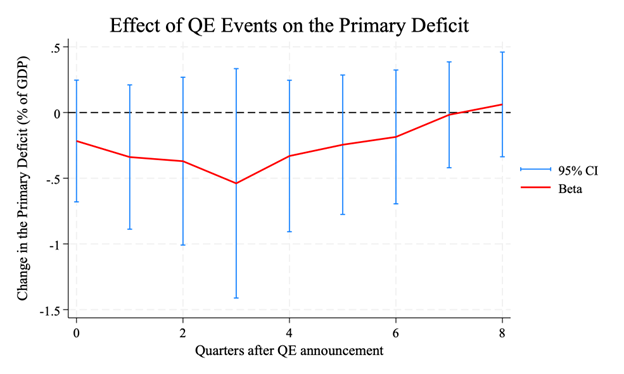 Note: This figure shows the estimated effect of QE (Beta) on the primary deficit while the blue bars are the 95% confidence intervals around that estimate. At each quarter, Beta shows how much the primary deficit is expected to differ from what would have been without a QE announcement as a percent of GDP. Therefore, a negative Beta shows a bigger deficit (or looser policy), however, the estimates are not statistically significant from zero.
Source: Author’s calculations using data and methods in appendix.
Figure 3 shows the effects of QE announcements on the primary deficit over the two years following the announcements.
As you can see, there is an increase in the primary deficit in the quarters following the QE announcement, but it is not statistically different from zero (this is shown by the 95 percent confidence intervals). Furthermore, any short-term effect diminishes starting with the fourth quarter post-announcement. This is consistent with the hypothesis that the QE announcements follow fiscal shocks rather than cause persistent changes in fiscal policy that led to higher primary deficits.
One shortfall with using the primary balance is that it does not account for automatic stabilizers, or changes in the budgetary effects of programs that occur automatically when economic conditions deteriorate. This means that any deficit impact from QE may not be driven by active choices made by fiscal policymakers. To isolate these active choices, I estimate the effects of QE announcements on the cyclically adjusted primary balance (CAPB) and fiscal impulse.
Figure 4. The Effect of QE Announcements on the Cyclically Adjusted Primary Balance
Note: This figure shows the estimated effect of QE (Beta) on the primary deficit while the blue bars are the 95% confidence intervals around that estimate. At each quarter, Beta shows how much the primary deficit is expected to differ from what would have been without a QE announcement as a percent of GDP. Therefore, a negative Beta shows a bigger deficit (or looser policy), however, the estimates are not statistically significant from zero.
Source: Author’s calculations using data and methods in appendix.
Figure 3 shows the effects of QE announcements on the primary deficit over the two years following the announcements.
As you can see, there is an increase in the primary deficit in the quarters following the QE announcement, but it is not statistically different from zero (this is shown by the 95 percent confidence intervals). Furthermore, any short-term effect diminishes starting with the fourth quarter post-announcement. This is consistent with the hypothesis that the QE announcements follow fiscal shocks rather than cause persistent changes in fiscal policy that led to higher primary deficits.
One shortfall with using the primary balance is that it does not account for automatic stabilizers, or changes in the budgetary effects of programs that occur automatically when economic conditions deteriorate. This means that any deficit impact from QE may not be driven by active choices made by fiscal policymakers. To isolate these active choices, I estimate the effects of QE announcements on the cyclically adjusted primary balance (CAPB) and fiscal impulse.
Figure 4. The Effect of QE Announcements on the Cyclically Adjusted Primary Balance
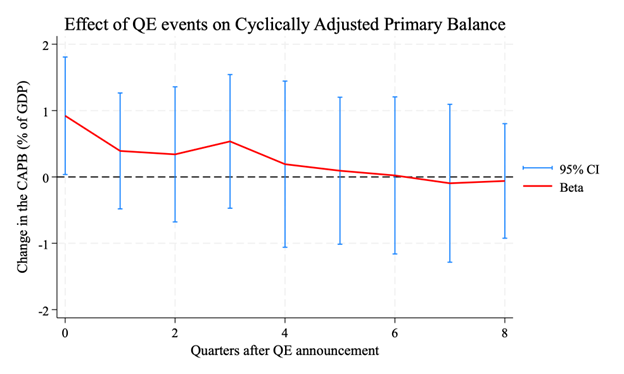 Note: This figure shows the estimated effect of QE (Beta) on the cyclically adjusted primary balance (CAPB). At each quarter, Beta shows how much the CAPB is expected to differ from what would have been without a QE announcement as a percent of GDP. Therefore, a positive Beta shows a bigger CAPB (or looser policy), however, the estimates are not statistically significant from zero.
Source: Author’s calculations using data and methods in appendix.
The CAPB is the primary balance minus the budget elasticity multiplied by the output gap.[9] The fiscal impulse is the negative of the change in the CAPB. I distinguish between the CAPB, a level of the active fiscal stance, and the fiscal impulse, which captures the change in that stance from one period to the next. CAPB is stock-like. It captures how tight or expansionary fiscal policy is at a point in time after removing the business-cycle component. The fiscal impulse is flow-like. It measures the period-to-period shift in policy, defined as the negative of the change in CAPB. Therefore, when CAPB increases (or tightens) by 1 percentage point, the fiscal impulse is -1 percentage points (a contractionary impulse).
Figures 4 and 5 show the CAPB and fiscal impulse following QE announcements. Both measures show no statistically meaningful fiscal expansion after QE announcements.
Figure 5. The Effect of QE Announcements on the Fiscal Impulse
Note: This figure shows the estimated effect of QE (Beta) on the cyclically adjusted primary balance (CAPB). At each quarter, Beta shows how much the CAPB is expected to differ from what would have been without a QE announcement as a percent of GDP. Therefore, a positive Beta shows a bigger CAPB (or looser policy), however, the estimates are not statistically significant from zero.
Source: Author’s calculations using data and methods in appendix.
The CAPB is the primary balance minus the budget elasticity multiplied by the output gap.[9] The fiscal impulse is the negative of the change in the CAPB. I distinguish between the CAPB, a level of the active fiscal stance, and the fiscal impulse, which captures the change in that stance from one period to the next. CAPB is stock-like. It captures how tight or expansionary fiscal policy is at a point in time after removing the business-cycle component. The fiscal impulse is flow-like. It measures the period-to-period shift in policy, defined as the negative of the change in CAPB. Therefore, when CAPB increases (or tightens) by 1 percentage point, the fiscal impulse is -1 percentage points (a contractionary impulse).
Figures 4 and 5 show the CAPB and fiscal impulse following QE announcements. Both measures show no statistically meaningful fiscal expansion after QE announcements.
Figure 5. The Effect of QE Announcements on the Fiscal Impulse
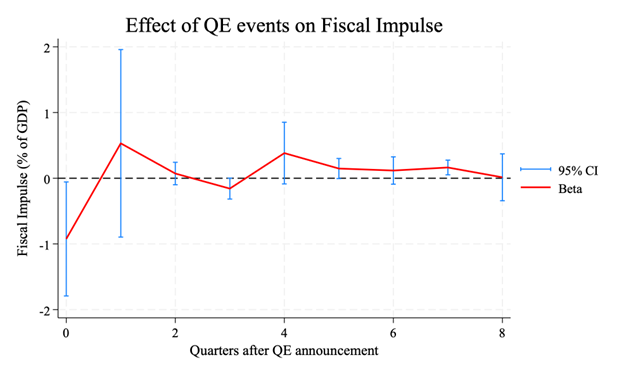 Note: This figure shows the estimated effect of QE (Beta) on the fiscal impulse. At each quarter, Beta shows how much the fiscal impulse is expected to differ from what would have been without a QE announcement as a percent of GDP. Therefore, a negative Beta shows a bigger fiscal impulse (or looser policy), however, the estimates are not statistically significant from zero.
Source: Author’s calculations using data and methods in appendix.
Again, the short-term increase at the time of the announcement likely indicates that QE is responding to fiscal conditions rather than causing persistent fiscal expansion.
Note: This figure shows the estimated effect of QE (Beta) on the fiscal impulse. At each quarter, Beta shows how much the fiscal impulse is expected to differ from what would have been without a QE announcement as a percent of GDP. Therefore, a negative Beta shows a bigger fiscal impulse (or looser policy), however, the estimates are not statistically significant from zero.
Source: Author’s calculations using data and methods in appendix.
Again, the short-term increase at the time of the announcement likely indicates that QE is responding to fiscal conditions rather than causing persistent fiscal expansion.
QE Increases the Size of the Fiscal Response During Shocks
The evidence presented in this paper challenges the idea that the Fed’s decisions to purchase additional Treasuries contributes to persistently expansionary fiscal policy. Another way to look at it is that QE is responding to fiscal shocks rather than causing persistently higher primary deficits by signaling that the Fed is willing to purchase federal debt. However, by absorbing more Treasury debt, the Fed can mute market signals which may lead to increased borrowing during adverse fiscal events. There are two ways to examine whether the Fed’s decisions to purchase federal debt have contributed to more expansionary fiscal policy after economic shocks. The first is to examine the post-shock fiscal response when the Fed’s balance sheet already holds a large share of Treasury debt with periods when it does not. The second is to examine shocks that arrive while the Fed is actively buying Treasuries compared to when purchases are flat or negative. Figure 6. The Primary Deficit After Shocks When Fed Balance Sheet is Above and Below Median Size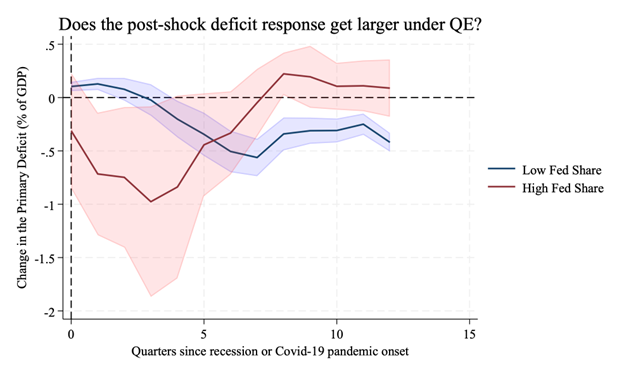 Note: This figure shows the estimated effect of changes in the primary deficit based during periods when the Fed’s share of Treasury securities is above or below its median holdings (i.e., “High Fed Share” and “Low Fed Share”). At each quarter, the estimated effect shows how much the primary deficit is expected to differ from what it would have been without an adverse economic event as a percent of GDP. Therefore, a negative effect shows a bigger primary deficit (or looser policy). This shows that during periods of High Fed Share, when an adverse economic event occurs the initial primary deficit effect is large but then comes back to zero within a year. During periods of Low Fed Share, the initial primary deficit effect is actual positive (suggesting tightening) but then increases. These results suggest that during periods of “High Fed Share” the fiscal response to adverse economic events is larger and quicker.
Source: Author’s calculations using data and methods in appendix.
Note: This figure shows the estimated effect of changes in the primary deficit based during periods when the Fed’s share of Treasury securities is above or below its median holdings (i.e., “High Fed Share” and “Low Fed Share”). At each quarter, the estimated effect shows how much the primary deficit is expected to differ from what it would have been without an adverse economic event as a percent of GDP. Therefore, a negative effect shows a bigger primary deficit (or looser policy). This shows that during periods of High Fed Share, when an adverse economic event occurs the initial primary deficit effect is large but then comes back to zero within a year. During periods of Low Fed Share, the initial primary deficit effect is actual positive (suggesting tightening) but then increases. These results suggest that during periods of “High Fed Share” the fiscal response to adverse economic events is larger and quicker.
Source: Author’s calculations using data and methods in appendix.
High Fed Balance Sheet
In this section, we examine whether QE is associated with an expansionary fiscal stance after adverse shocks using quarterly data. The fiscal outcome being measured is the primary deficit as a share of GDP, reducing seasonality by using a four-quarter sum (see appendix for more details). More specifically, this enables analysis of how the primary deficit changes during periods when the Fed’s share of Treasury debt held by the public is above its sample median (i.e., “High Fed Share”). The core design of this test is an event study where the primary deficit is interacted with the policy state (i.e., “High Fed Share” vs. “Low Fed Share”), while each regression controls for the last quarter’s fiscal stance and the macroeconomic environment, similar to the analysis of the effect of QE announcements in the earlier section. This shows whether the fiscal stance expands or tightens after the shocks, and whether that response is different depending on the Fed’s policy state. Figure 6 compares the post-shock path of the primary deficit when the Fed’s share of Treasury debt is both above and below the median. Over the first year, the primary deficit increases more when the Fed share of debt is above the median. The point estimate dips to roughly -1 to -2 percent of GDP by quarters 2 to 4 after the shock begins. This gap closes and deficits reduce faster in the “High Fed Share” regime, while the Low Fed Share remains modestly negative. This pattern is consistent with “High Fed Share” periods coinciding with larger fiscal responses when the shock hits, rather than a persistently expansionary fiscal stance thereafter.Fed is an Active Buyer of Treasuries
To identify the timing of the Fed’s policy more precisely, I define QE operationally as quarters when the Fed is a new buyer of Treasury securities. Specifically, I take the quarter-to-quarter change in the System Open Market Account’s Treasury holdings and scale it to GDP. When the purchase flow is positive above a small threshold (i.e., 0.05 percent of GDP to reduce noise), I classify the quarter as “Fed Active.” This measure captures net additions to the Fed’s balance sheet rather than the stock of past purchases. This definition of QE has three advantages. First, the flows show when the policy is adding duration to the market. Second, using the flows avoids the denominator problem (when Treasury issuance without a Fed response reduces the Fed’s share of debt) that can influence that Fed’s share of debt. For example, when the Treasury is relying on debt issuance, the share can fall even while the Fed is buying debt. Third, a positive flow is unambiguously expansionary, making it a cleaner variable for examining whether fiscal behavior differs when the Fed is engaged in QE. Empirically, I use the “Fed Active” indicator in two ways. The first is in an event study where I estimate the effect of an economic shock on fiscal outcomes, allowing for the response to differ by whether the Fed is actively engaged in QE. This tells us whether the post-shock path fiscal outcomes differs when the Fed is a net buyer of federal debt. In the second, I run distributed lag regressions of changes in the fiscal outcome measures on current and lagged QE flows controlling for the economic cycle and financial conditions. Figure 7. The Primary Deficit After Shocks When Fed is Actively Buying Treasury Securities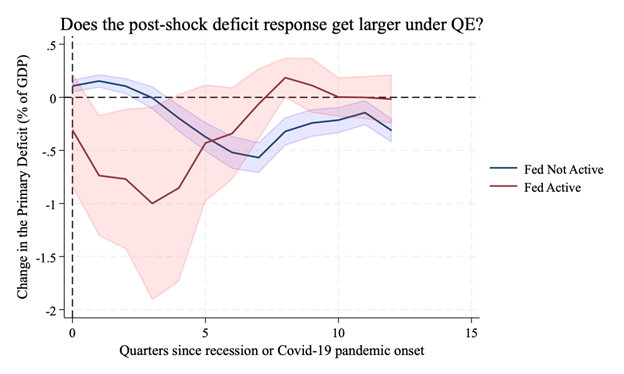 Note: This figure shows the estimated effect of changes in the primary deficit during periods when the Fed is actively buying Treasury securities based on when it is not (i.e., “Fed Active” and “Fed Not Active”). At each quarter, the estimated effect shows how much the primary deficit is expected to differ from what it would have been without an adverse economic event as a percent of GDP. Therefore, a negative effect shows a bigger primary deficit (or looser policy). This shows that during periods when the Fed is actively buying Treasury securities, when an adverse economic event occurs the initial primary deficit effect is large but then comes back to zero within a year. During periods when the Fed is not actively buying Treasury securities, the initial primary deficit effect is actual positive (suggesting tightening) but then increases. These results suggest that during periods of when the Fed is actively buying Treasuries the fiscal response to adverse economic events is larger and quicker.
Source: Author’s calculations using data and methods in appendix.
Figure 7 shows that in the first year after the shock, the “Fed Active” path falls and deficits widen by about 0.5 to 1.5 percent of GDP more than under “Fed Not Active.” By the second year, the two paths converge, and after 8 to 12 quarters after the initial shock the difference is small and sometimes slightly reversed. This suggests that QE episodes are associated with larger near-term fiscal response to shocks, but that fades within a year or two.
This effect could be consistent with the Fed actively purchasing debt coinciding with more significant shocks when the effects of the automatic stabilizers are larger. Therefore, I again turn to the measure of CAPB to isolate active fiscal policy when the shock occurs. Similar to the analysis of the effect of QE events on the CAPB, when the change in the CAPB is above zero, it means the active fiscal stance is expanding. If it is below zero, it is tightening.
Figure 8. The Active Fiscal Policy Stance After Shocks When Fed is Actively Buying Treasury Securities
Note: This figure shows the estimated effect of changes in the primary deficit during periods when the Fed is actively buying Treasury securities based on when it is not (i.e., “Fed Active” and “Fed Not Active”). At each quarter, the estimated effect shows how much the primary deficit is expected to differ from what it would have been without an adverse economic event as a percent of GDP. Therefore, a negative effect shows a bigger primary deficit (or looser policy). This shows that during periods when the Fed is actively buying Treasury securities, when an adverse economic event occurs the initial primary deficit effect is large but then comes back to zero within a year. During periods when the Fed is not actively buying Treasury securities, the initial primary deficit effect is actual positive (suggesting tightening) but then increases. These results suggest that during periods of when the Fed is actively buying Treasuries the fiscal response to adverse economic events is larger and quicker.
Source: Author’s calculations using data and methods in appendix.
Figure 7 shows that in the first year after the shock, the “Fed Active” path falls and deficits widen by about 0.5 to 1.5 percent of GDP more than under “Fed Not Active.” By the second year, the two paths converge, and after 8 to 12 quarters after the initial shock the difference is small and sometimes slightly reversed. This suggests that QE episodes are associated with larger near-term fiscal response to shocks, but that fades within a year or two.
This effect could be consistent with the Fed actively purchasing debt coinciding with more significant shocks when the effects of the automatic stabilizers are larger. Therefore, I again turn to the measure of CAPB to isolate active fiscal policy when the shock occurs. Similar to the analysis of the effect of QE events on the CAPB, when the change in the CAPB is above zero, it means the active fiscal stance is expanding. If it is below zero, it is tightening.
Figure 8. The Active Fiscal Policy Stance After Shocks When Fed is Actively Buying Treasury Securities
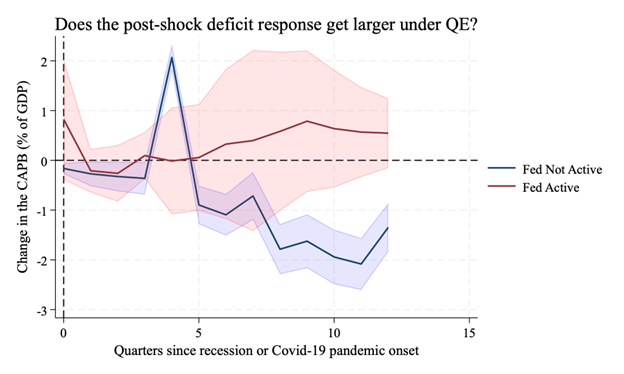 Note: This figure shows the estimated effect of changes in the cyclically adjusted primary balance during periods when the Fed is actively buying Treasury securities based on when it is not (i.e., “Fed Active” and “Fed Not Active”). At each quarter, the estimated effect shows how much the cyclically adjusted primary balance is expected to differ from what it would have been without an adverse economic event as a percent of GDP. Therefore, a positive effect shows a bigger cyclically adjusted primary balance (or looser policy). This shows that during periods when the Fed is actively buying Treasury securities, there is virtually no effect on the cyclically adjusted primary balance. During periods when the Fed is not actively buying Treasury securities, there is no effect on the cyclically adjusted primary balance at first. However, over time it falls suggesting tighter fiscal policy during the medium term.
Source: Author’s calculations using data and methods in appendix.
Figure 8 shows that if the Fed was actively buying debt at the onset of a shock, there is no immediate effect on fiscal expansion. However, the active stance expands after a little more than a year by about 0.5 percent of GDP. This suggests that when the Fed is actively buying debt, the active response to shocks is more expansionary.
Figure 9 shows the additional active fiscal response of CAPB based on the difference between periods when the Fed is actively buying debt relative to when it is not at the onset of a shock. When this difference is below zero, it suggests more active expansion when the Fed is buying relative to when the Fed is not actively buying Treasuries. At the onset of the shock, there is little difference in the initial response. However, the active response tends to be persistently expansionary beginning about one year after the shock, implying a larger medium-run fiscal expansion when QE is active. However, like the results in Figure 8, this result is driven by the fact that fiscal policy is tighter when the Fed is not actively buying Treasury securities.
Figure 9. The Difference in the Active Fiscal Policy Stance After Shocks Based on whether the Fed is Actively Buying Treasury Securities
Note: This figure shows the estimated effect of changes in the cyclically adjusted primary balance during periods when the Fed is actively buying Treasury securities based on when it is not (i.e., “Fed Active” and “Fed Not Active”). At each quarter, the estimated effect shows how much the cyclically adjusted primary balance is expected to differ from what it would have been without an adverse economic event as a percent of GDP. Therefore, a positive effect shows a bigger cyclically adjusted primary balance (or looser policy). This shows that during periods when the Fed is actively buying Treasury securities, there is virtually no effect on the cyclically adjusted primary balance. During periods when the Fed is not actively buying Treasury securities, there is no effect on the cyclically adjusted primary balance at first. However, over time it falls suggesting tighter fiscal policy during the medium term.
Source: Author’s calculations using data and methods in appendix.
Figure 8 shows that if the Fed was actively buying debt at the onset of a shock, there is no immediate effect on fiscal expansion. However, the active stance expands after a little more than a year by about 0.5 percent of GDP. This suggests that when the Fed is actively buying debt, the active response to shocks is more expansionary.
Figure 9 shows the additional active fiscal response of CAPB based on the difference between periods when the Fed is actively buying debt relative to when it is not at the onset of a shock. When this difference is below zero, it suggests more active expansion when the Fed is buying relative to when the Fed is not actively buying Treasuries. At the onset of the shock, there is little difference in the initial response. However, the active response tends to be persistently expansionary beginning about one year after the shock, implying a larger medium-run fiscal expansion when QE is active. However, like the results in Figure 8, this result is driven by the fact that fiscal policy is tighter when the Fed is not actively buying Treasury securities.
Figure 9. The Difference in the Active Fiscal Policy Stance After Shocks Based on whether the Fed is Actively Buying Treasury Securities
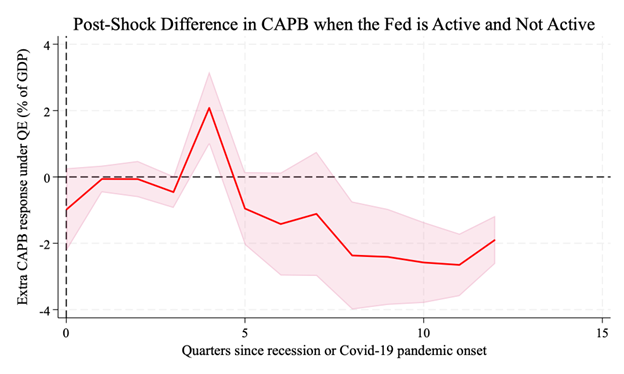 Note: This figure shows the difference in the estimated effect of changes in the cyclically adjusted primary balance during periods when the Fed is actively buying Treasury securities based on when it is not (i.e., “Fed Active” and “Fed Not Active”). At each quarter, the estimated effect shows how much the cyclically adjusted primary balance is expected to differ from what it would have been without an adverse economic event as a percent of GDP. Therefore, a negative effect shows a bigger cyclically adjusted primary balance (or looser policy). This shows that during periods when the Fed is actively buying Treasury securities, the effect of the adverse economic event on the cyclically adjusted primary balance is larger relative to when the Fed is not buying Treasury securities.
Source: Author’s calculations using data and methods in appendix.
Note: This figure shows the difference in the estimated effect of changes in the cyclically adjusted primary balance during periods when the Fed is actively buying Treasury securities based on when it is not (i.e., “Fed Active” and “Fed Not Active”). At each quarter, the estimated effect shows how much the cyclically adjusted primary balance is expected to differ from what it would have been without an adverse economic event as a percent of GDP. Therefore, a negative effect shows a bigger cyclically adjusted primary balance (or looser policy). This shows that during periods when the Fed is actively buying Treasury securities, the effect of the adverse economic event on the cyclically adjusted primary balance is larger relative to when the Fed is not buying Treasury securities.
Source: Author’s calculations using data and methods in appendix.
Conclusion
The evidence in this paper points to a simple story. QE follows fiscal events, but it has not systematically caused an expansionary fiscal stance absent macroeconomic shocks. I show that deficits widen before QE announcements and are not associated with a persistent increase in the primary balance, the CAPB, or the fiscal impulse. Where I do find a difference is around severe shocks (recessions, COVID-19) when the Fed’s purchasing of Treasury securities was already large or when it is actively buying. In other words, QE may contribute to persistent larger deficits associated with the shock but has not caused permanently larger deficits by itself. That said, by reducing the term premium signals on federal debt, QE can raise the risk of over-borrowing in the short run. There are several policy implications associated with these findings. First, QE can act as a numbing agent for market signals in the aftermath of an adverse fiscal event. Therefore, active fiscal choices should be tied to medium-term targets that can help limit borrowing to a safe level. Second, the Fed should always frame QE as temporary and contingent on events associated with the shock, publish plans to beginning tightening, and avoid any practices that could be perceived as fiscal accommodation. Third, Treasury should continually stress test debt issuance under scenarios when the Fed is not engaging in QE. Finally, Treasury should regularly report on debt market function and interest-cost risks under alternative sets of expectations.Appendix: Data
U.S. Treasury Securities Held by the Federal Reserve: Data is from the Federal Reserve. Primary deficit: Data used to construct the primary deficit (i.e., the deficit excluding net interest costs) is from the Monthly Treasury Statements. Debt held by the public: Data is from the Treasury Department. GDP: Data is from the Bureau of Economic Analysis. Output Gap: Data is from the Federal Reserve. Unemployment Rate: Data is from the Bureau of Labor Statistics. 10-year Treasury yield: Data is from the Treasury Department. The following constructions of the primary deficit, the cyclically adjusted primary balance, and the fiscal impulse are also included in the analysis using data above: Primary Deficit as Percent of GDP (4 Quarter Sum) Cyclically Adjusted Primary Balance
 Fiscal Impulse