


This weekend, Congress released the text of the latest spending bill – a six-part package including funding for half of the long-overdue fiscal year (FY) 2024 appropriations bill.
Buried in the 1,050-page text is an “anomaly” added by the Biden Administration that would allow $337 million to be reprogrammed away from broadband and toward new activities. This reprogramming is not merely a technical change in appropriations; it could have severe repercussions for both the future of artificial intelligence (AI) and for combatting the rise of woke government regulation.
The NTIA Anomaly
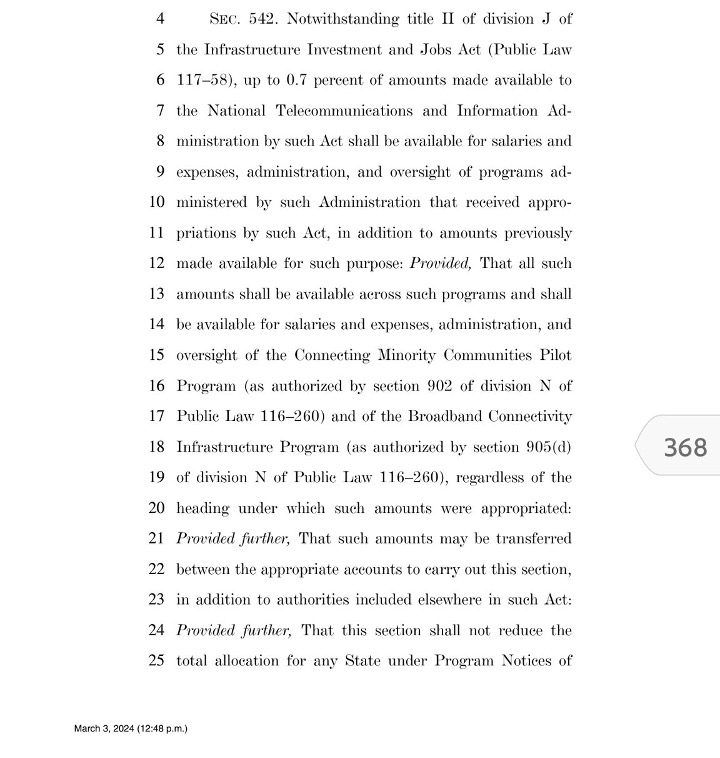
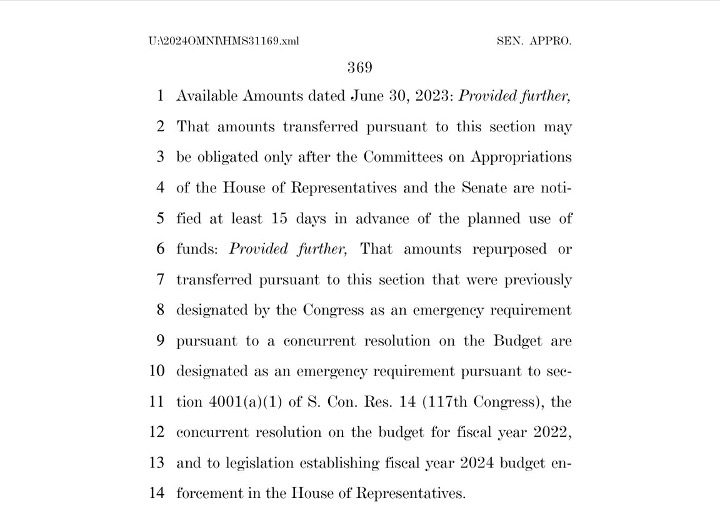
Section 542 of the minibus is a new provision that allows the
U.S. Department of Commerce to transfer existing appropriations. Specifically, this provision allows for 0.7% of funding from the Infrastructure Investment and Jobs Act (IIJA) to be reprogrammed to instead provide for administrative funding for broadband programs under the National Telecommunications and Information Administration (NTIA). That amounts to $337.5 million in new funding.
To put this into context, the entire FY 2024 budget request for NTIA salaries and expenses was only $172 million. That means the reprogrammed (and therefore new to NTIA) funding is nearly two times the amount that the agency normally requires for salaries and expenses – on top of the NTIA salaries and expenses funding already built into the underlying bill.
Any such major reprogramming should be carefully examined by Congress in execution of its Article I power. This is not a negligible amount of taxpayer dollars being shifted in a typical anomaly or technical change.
But why might they need this additional funding?
Redirecting Funds to a New Use
The IIJA authorized four broadband programs, each with up to 2% allocated for administrative funding. The largest of these programs, the Broadband Equity Access and Deployment (BEAD) program received $849 million, whereas the other three programs have much lower total funding and thus lower administrative funding. NTIA is requesting the reprogramming from BEAD program funding to pay for an increase in NTIA’s salaries and expenses.
However, even a very generous increase in funding to 5% for each existing program cannot explain the need for additional money. An increase in administrative funding to 5% of the budgets for existing programs would be $203 million (see table). This is $134 million less than the requested amount.
| IIJA Programs | Total Funding | Current Admin Funding | Admin Funding at 5% | Increase from Already Received |
| Middle Mile | $1,000,000,000 | $20,000,000 | $50,000,000 | $30,000,000 |
| Tribal Broadband Connectivity Program | $3,000,000,000 | $60,000,000 | $150,000,000 | $90,000,000 |
| Digital Equity | $2,750,000,000 | $55,000,000 | $137,500,000 | $82,500,000 |
| Total | $6,750,000,000 | $135,000,000 | $337,500,000 | $202,500,000 |
Reprogramming of administrative funding at this level would free existing resources. This would allow NTIA to fund additional initiatives, such as the regulation of artificial intelligence (AI) as directed by President Biden in October 2023.
Algorithmic Justice: Biden’s AI Executive Order
President Biden issued Executive Order 14110, the “Safe, Secure, and Trustworthy Development and Use of Artificial Intelligence,” on October 30, 2023.

From EO 14110 has arisen the prevalence of “algorithmic justice” within AI regulation. This may be related to a key Biden AI advisor on the EO, a “digital activist” who heads up the Algorithmic Justice League.
Algorithmic justice purportedly aims to remove bias from AI and related technologies, but as we have seen with Google’s Gemini, there are serious pitfalls here.
With AI being a primary research and data generation tool of the future, accuracy (both historical and factual) are key. Unfortunately, over-wrought attempts to erase bias in AI fall flat – there is no erasing bias from history and doing so undermines the serious nature of the past’s heinous discrimination.
Now, this funding reprogramming for NTIA could be used to implement algorithmic justice on a massive scale, making it the new standard for all AI in the United States. The Biden Administration is rewriting (or, recoding) reality on the taxpayer’s dime.
Congressional Countermeasures
At the time of this piece’s writing, Congress has not yet voted on the appropriations package in question. They still have time to strip the anomaly from the bill.
It is well within Congressional rights to reject this, or any, anomaly request sent up by the Office of Management and Budget. Congress could simply offer and accept an amendment stripping Section 542 from the bill. It could also add in limitation language prohibiting taxpayer funding for any algorithmic justice plans the Biden Administration has up its sleeve.
In this instance, rejecting the anomaly would protect the integrity of artificial intelligence and prevent a further systemization of woke ideology from being integrated into every aspect of Americans’ lives.