The
Infrastructure Investment and Jobs Act (IIJA), also known as the Bipartisan Infrastructure Law, spent $1.2 trillion in federal funding to reshape the transportation sector, including large subsidies for electric vehicles (EV) and EV charging infrastructure. The IIJA created new programs, expanded existing ones, and established new federal offices to oversee the transition to electric transportation.
Congress authorized this spending to accelerate the deployment of physical infrastructure. Several years into implementation, however, relatively few EV chargers have been
deployed, while a growing share of IIJA funding has been obligated for administrative activity, guidance development, and planning initiatives involving left-wing activist organizations.
Funds are not being used as Congress intended. Infrastructure deployment has not occurred at the projected pace and funds have been diverted to community level projects. This raises serious questions about whether IIJA dollars are being directed toward infrastructure deployment or toward unrelated policy objectives.
A New Office and New Spending
The IIJA created the
Joint Office of Energy and Transportation (JOET), a new entity operating by the Department of Transportation and the Department of Energy. Congress provided roughly $300 million to establish and operate the office, with the expectation that it would support the rapid and effective deployment of EV infrastructure authorized under the law.
JOET’s
primary function is to facilitate EV expansion programs created in the IIJA by developing guidelines, providing technical assistance, and processing grants. The office also oversees the
Communities Taking Charge Accelerator. This is a competitive grant program funded with IIJA dollars through JOET that is largely disconnected from the construction of meaningful physical infrastructure.
Rather than accelerating charger deployment, many of the grants coordinated through the Communities Taking Charge Accelerator explicitly fund projects that promote environmental justice or racial equity initiatives. As a result, funds appropriated to further EV development and deployment are being obligated for activities that do not directly produce chargers, vehicles, or EV infrastructure.
Funding Community Advocacy
The Communities Taking Charge Accelerator program funds planning, demonstration, and deployment of small-scale projects intended to expand access to electric vehicles and charging infrastructure. On January 15, 2025,
25 projects were announced as grant recipients, receiving a total of $43.7 million.
Every grant recipient partners with outside organizations. A list of these is available on the JOET Communities Taking Charge Accelerator award page. These partner organizations assist with project design and implementation. They work closely with the lead organization to achieve project priorities, even if they do not directly receive funds. Their involvement in shaping priorities, project scope, and the use of taxpayer dollars raises serious concerns about undue influence over how taxpayer money is spent.
This structure raises significant concerns from an appropriations standpoint. Congress appropriated IIJA funds to build infrastructure, not to indirectly subsidize advocacy networks. When federal dollars are obligated for planning and partnership activities that do not result in meaningful, deployable infrastructure, those expenditures move further away from the purpose Congress authorized.
The following examples represent some of the most egregious uses of these funds in the Communities Taking Charge Accelerator.
T.R.U.S.T., CA - $2 Million
The
Tenemos que Reclamar y Unidos Salvar la Tierra (T.R.U.S.T.) was
selected to lead a project to plan and construct “equitable electric charging infrastructure at community-controlled sites,” despite operating primarily as an environmental justice and immigration advocacy organization. The group explicitly promotes identity-based policymaking and community control as political objectives, underscoring how IIJA funds are being directed toward activist agendas rather than infrastructure as Congress intended.

The grant
announcement states that “T.R.U.S.T. South LA and its diverse coalition of key partners will develop dozens of e-mobility hubs throughout the region.” One of the “key partners” listed is the People for Mobility Justice advocacy organization, whose
homepage calls for the U.S. Immigration and Customs Enforcement to leave Los Angeles.
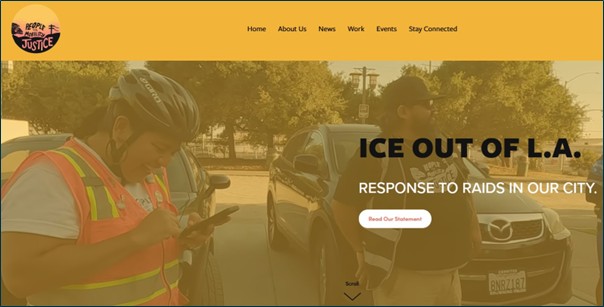
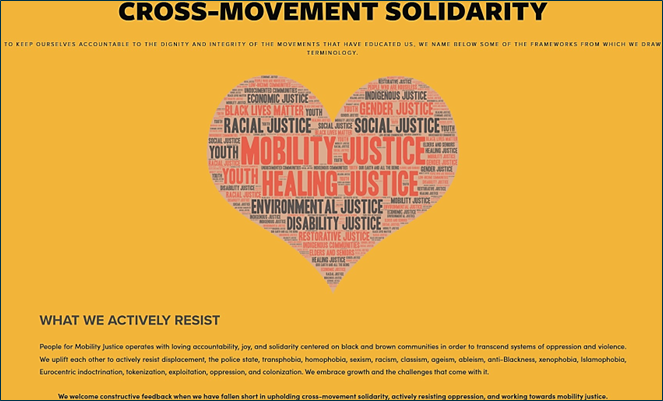
People for Mobility Justice promotes a framework aimed at reshaping transportation policy around “
cross-movement solidarity” and racial equity goals.
Using federal infrastructure dollars to support organizations engaged in political activism rather than infrastructure is not an appropriate use of taxpayer dollars.
Rocky Mountain Institute, CO - $2 Million
The
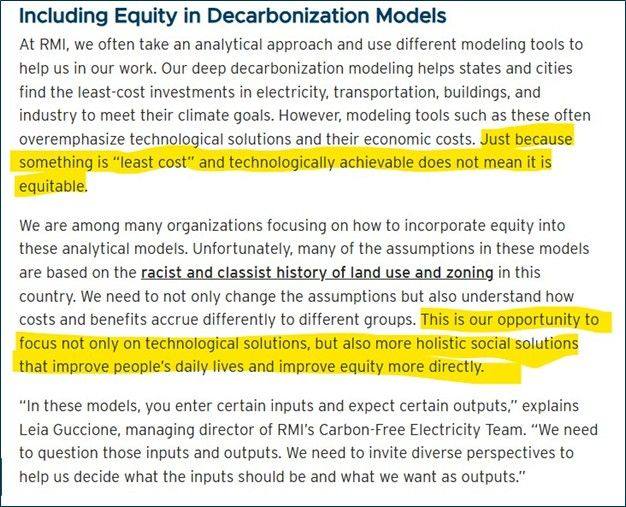
Rocky Mountain Institute (RMI) received $2 million from JOET to collaboratively develop standards for “equitable EV charging Infrastructure”. RMI was established to ensure an equitable transition to a “zero-carbon future”. RMI uses equity as a factor in its climate and carbon modeling and has a
page dedicated to keeping equity at the center of any proposed solutions to climate change.
In a 2019
report RMI also called for a national EV mandate that would be modeled after China’s national push for EVs, which points to the types of standards they would likely support. Standards are necessary for effective infrastructure. Sending taxpayer dollars to build projects based on standards rooted in controversial ideologies such as equity is not in line with efficient and effective infrastructure policy.
One collaborating partner
listed in the grant announcement for this project is
GreenLatinos. They are a national organization engaged in environmental justice and climate advocacy through education, coalition-building, and public engagement.
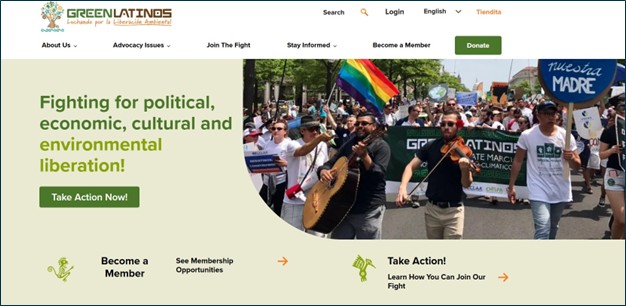
Allowing IIJA dollars to flow to advocacy groups exemplifies how infrastructure funding has drifted away from public benefit and toward subsidizing ideological agendas.
The Great Plains Institute for Sustainable Development Inc., MN - $458,792
The
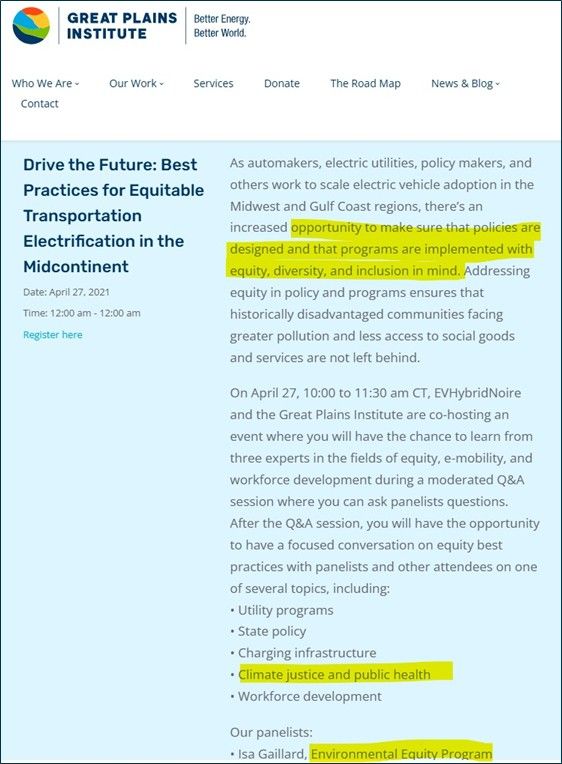
Great Plains Institute received almost $460,000 to lead a feasibility study and set up a “fully electric and equitable bike share system” in Minneapolis. Their mission is to transition to a net-zero carbon emissions economy and energy system. As part of this, their events page includes a lecture on how to ensure that equity and electric mobility issues are prioritized in policymaking. Conducting feasibility studies on equitable bike systems is not an appropriate use of infrastructure funds that were designed to support tangible investments.
Partners in this study as
listed on JOET’s grant website include
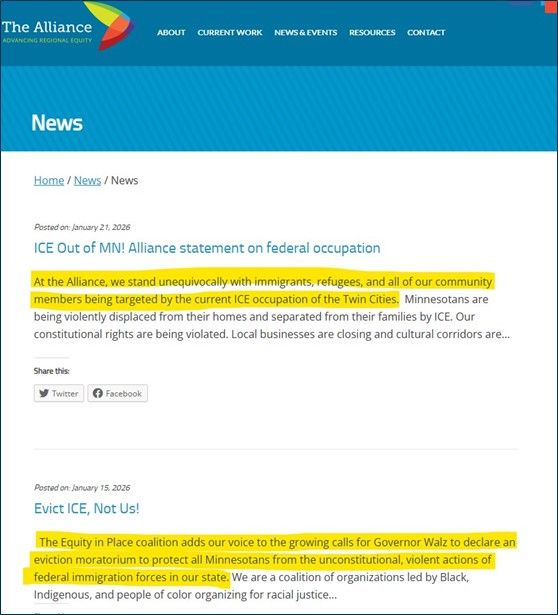
The Alliance. This organization is a coalition of community-based advocacy groups in Minneapolis, Minnesota, dedicated to advancing a broad equity agenda that spans racial, economic, environmental, and land-use policy in the Twin Cities region. Their news page features a statement calling ICE’s presence in Minnesota a “federal occupation.”
Policies that prioritize “equitable” outcomes shift government decision-making away from neutral service provision and toward differential treatment based on identity. This redirects funds away from projects that support infrastructure and is not in line with legislative intent.
Oonee, NY- $3.7 Million
Oonee manufacturers electric bike chargers and received a grant to
deploy two networks for EV charging. However, in the grant information, one of the work locations is Berlin, Germany.
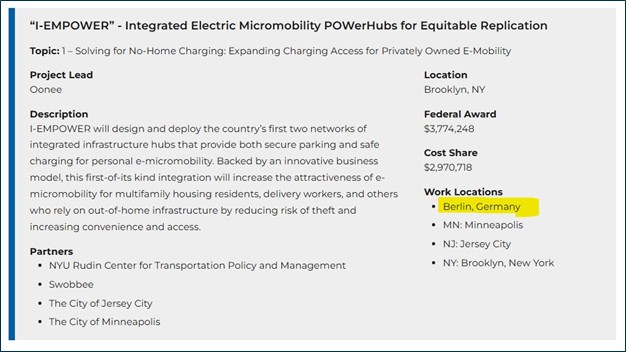
Listing a European city as the first work location begs the question as to why tax dollars designated for U.S. infrastructure are flowing to work located in Germany. Allowing federally funded work to be performed abroad undermines Congressional intent to invest in infrastructure at home.
Building Infrastructure, Not Ideology
Congress appropriated IIJA funds to accelerate the deployment of physical transportation infrastructure, particularly EV chargers and vehicles. Yet through the Joint Office of Energy and Transportation, IIJA funds have flowed to groups whose primary missions involve political advocacy, identity-based policy frameworks, and climate activism. In some cases, taxpayer dollars have even supported work conducted outside the United States, directly contradicting the purpose Congress set out.
When funds designated for infrastructure are repeatedly obligated without producing assets, a gap between Congressional intent and agency execution forms. Congress should not reauthorize IIJA programs that funnel federal dollars through advocacy organizations.