In 2022, Democrats passed a reconciliation package dubbed the Inflation Reduction Act (IRA) on party lines. Despite its name, the IRA was primarily a vehicle for the “
Green New Deal” agenda rather than a serious attempt to curb a wave of inflation heavily influenced by
excessive spending. The package included tax credits for energy production and “investment,” EV production and fueling stations, and more.
At the time, the CBO
estimated the cost of the spending and tax credits ($383 billion) would be balanced by a combination of tax hikes and an army of new IRS agents. However, the cost of the tax credits for “green” energy has exploded due to the lack of an upper limit, while the purported environmental benefits are
not materializing.
In fact, the cost of the tax credits could be orders of magnitude greater than the initial score, with
estimates now exceeding $1 trillion over the next decade and $4 trillion through 2050. While the cost is subject to change due to market fluctuations and consumer demand, it is now clear that keeping the IRA in place would add to unsustainable deficits and make inflation worse.
IRA Tax Credits Promote European Energy Policy, Strangling Economic Growth
While the IRA contained many disparate tax credits, the bulk of the fiscal impact flows from just a few.
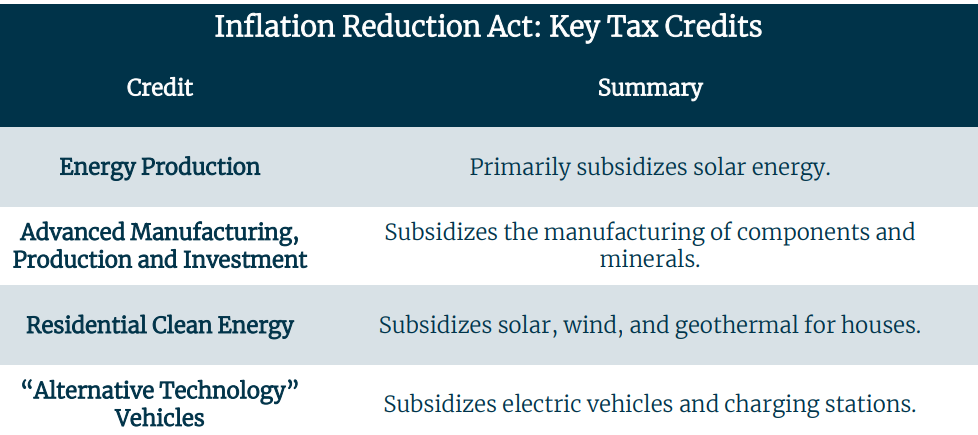
Corporations in many parts of the country are taking advantage of the IRA tax subsidies. This has created worries that repealing the credits would cause job losses in some states and districts. However, that mindset misses several key points.
First, IRA energy production tax credits are already harming the nation’s
energy grid due to the intermittent nature of wind and solar energy. Retaining the credits would encourage overproduction of these types of energy, placing more strain on the grid and crowding out investments in reliable energy sources such as natural gas.
Second, retaining the IRA’s approach to energy production will cost all Americans in the form of lost jobs and slower wage growth, even in states and districts that receive the most IRA tax credits.
Europeans are suffering from much higher energy prices than Americans due to their governments following the self-flagellating call of radical environmentalists. The difference in energy prices is a key reason why the U.S. is growing while Europe is
stagnating. Legislators who received a strong mandate to reduce the cost of living would do well to keep this in mind.
Third, the enormous cost of the IRA tax credits will consume valuable fiscal space. Legislators hoping to build on the job-creating, wage-growing success of the Tax Cuts and Jobs Act will have less revenue room to work with if the subsidies are partially or fully retained. Further, keeping the subsidies (which are really spending through the tax code) would increase deficits and push America closer to its
true debt limit.
Finally, a significant portion of the IRA tax credits subsidize investments that would have happened anyway. Technological advances in products such as EVs and residential solar panels will make them steadily more economical and thus increase consumer demand over time.
Legislators should recognize that the IRA tax credits do more harm than good and ought to
fully repeal them.