One of the biggest drivers of the rising cost estimates of the Inflation Reduction Act (IRA) is the ability for energy developers and producers to
stack tax credits. Green energy developers face no cap on the number of tax credits they can qualify for or on the amount of money they can receive through tax credits.
Before the IRA was enacted, most green energy companies received an investment tax credit (ITC) of
26% and that was set to
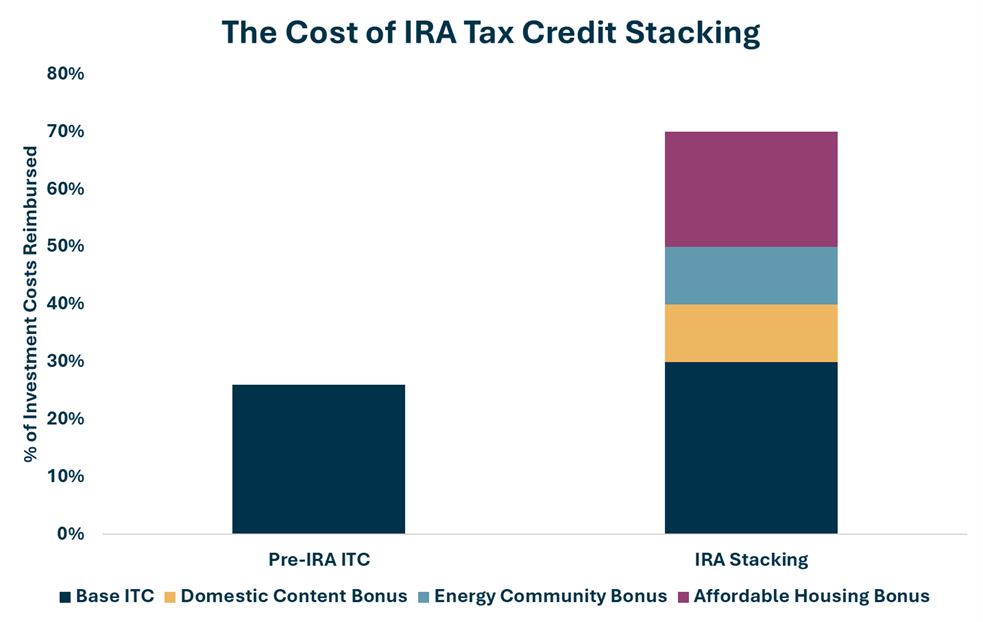
phase down to 22% by 2033. The old system did not allow for energy credit stacking, which effectively capped the reimbursement at 26% However, the IRA locked in the ITC at a 30% tax credit for most “clean” energy projects.
Under the IRA, an energy company can choose between a per megawatt inflation-adjusted credit called the production tax credit (PTC) or the ITC which reimburses a percentage of the producer’s development cost. The ITC is the more egregious offender when it comes to stacking with three “bonus” tax credits that can be used to increase the share of development cost paid for by taxpayer dollars from 26% to 70%.
Bonus Credits Explained
The Domestic Content Bonus: the
Domestic Content Bonus Credit provides an additional 10% tax credit for clean energy projects that use a sufficient amount of U.S.-made steel, iron, and manufactured products. To qualify, at least 40% of the total cost of manufactured components must be sourced from the U.S., with that threshold set to gradually increase to 55% by 2027 for energy projects, excepting offshore wind. Currently, under the “domestic” bonus credit, producers can procure 60% of component costs from foreign suppliers and still stack this credit.
The Energy Community Bonus: the
Energy Community Bonus Credit provides a 10% tax subsidy for clean energy projects located in “energy communities”. These communities are defined as broad geographic areas, such as census tracts or metropolitan statistical areas. This loose eligibility criteria means that producers can build just within a qualifying area but not actually contribute to economic revitalization of that community while still stacking this credit on the ITC.
The Affordable Housing Bonus: the
Affordable Housing Bonus Credit offers an additional 20% tax credit for clean energy projects installed on or in connection with qualifying low-income residential buildings. The bonus credit also stipulates that the “financial benefits” of the electricity produced are allocated “equitably” among the occupants of the building. What an equitable distribution looks like is not defined and allows for companies to claim that they are distributing equally and stack another 20% reimbursement credit onto the ITC.
What Can Congress Do?
Under the current system, energy developers can stack bonus tax credits to cover up to 70% of a project’s development costs when claiming the Investment Tax Credit. The combination of uncapped subsidies and the ability for developers to shift project costs onto taxpayers makes the IRA’s credit structure fiscally irresponsible.
The
current text of the House Ways and Means Committee’s reconciliation recommendations does not include full elimination of these bonus credits or even systematic changes to eliminate the ability to stack bonus credits. Only one bonus credit (the Affordable Housing Bonus credit) is set to be phased out but not until December 2031 when the ITC itself phases out.
Congress should seize the opportunity to achieve savings in the reconciliation bill by eliminating bonus credits—or at the very least, ending the ability to stack them.
If left unchanged, these provisions will continue to inflate the federal budget, deepen the deficit, and accelerate a potential debt crisis. Congress should pull the plug on these inflated tax credits and restore fiscal discipline.