Opening
Chairwoman Kiggans, Ranking Member Ramirez, and Members of the Subcommittee, thank you for inviting me to testify today.
I am here today as an expert witness on the federal budget and to provide analysis of certain bills that should improve the fiscal position of the U.S. Department of Veterans Affairs (VA).
While I come to you as a budget expert, I am also the proud wife of a soldier in the United States Army. This legislation is personal to me. You have an opportunity and responsibility to improve the functionality of the VA for those who have served and sacrificed. I am here to work with you so that this rare opportunity is not squandered.
The Current Debt Picture
Before we discuss the legislation at hand, we must first acknowledge the current fiscal situation of the nation. We are running a $1.9 trillion deficit this year, and continuing on the trajectory of spending beyond our means.
[1] We are $39 trillion in debt.
[2]
To put this into context, our debt translates to approximately $289,000 per household across America. When you add in the unfunded liabilities across Social Security and Medicare, and the added debt service costs, that total burden grows to $875,000 per household.
This is wildly unsustainable, and our debt continues to grow at an alarming rate.
A massive federal debt has real impacts now, not just in the future. It raises interest rates on Americans, is a drag on economic growth, and results in transfer payments that place upward, inflationary pressure on key sectors, including health care, which is of particular note to veterans given the strain on the Veterans Health Administration. All of these challenges are not simply relevant to the budget hawks and our spreadsheets. This negatively impacts American families, especially those like our veterans who heavily rely on government services and benefits they have earned the hard way.
Veterans Spending by the Numbers
While federal spending on veterans is not the largest portion of the federal budget (comprising about six percent of projected outlays in fiscal year (FY) 2026), it is certainly an important subset.
Every dollar spent in this function should be scrutinized to ensure it is indeed being used for veterans and not lost in a bureaucratic morass or wasted where it is not needed. Because the need is most certainly apparent given the multitude of simultaneous challenges our veterans face, from mental health struggles to homelessness, from job transition needs to civilian life re-entry.
In order to assess the legislative proposals before us, we must first examine relevant spending and question whether it matches Americans’ priorities.
Since FY 1977,
[3] total actual outlays for veterans benefits and services has grown from $18.04 billion to $377.22 billion in FY 2025.
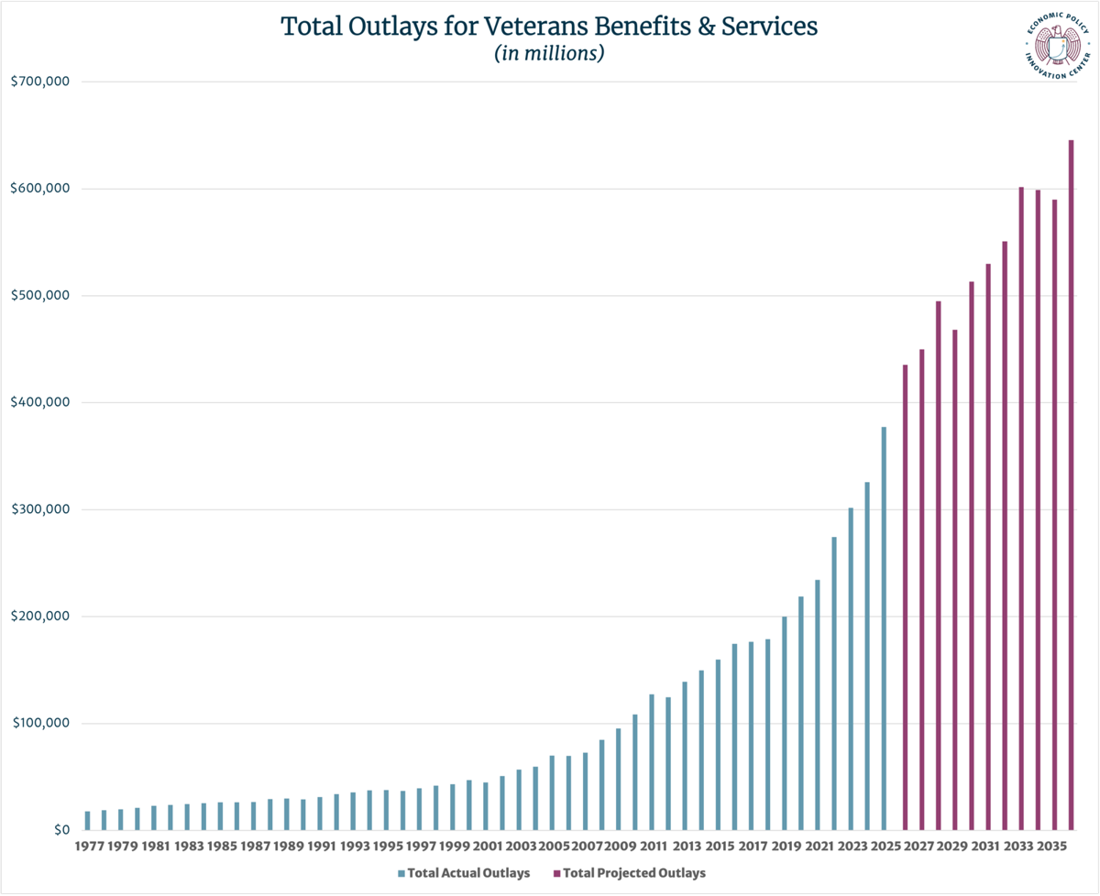 Source: Author’s chart using OMB historical tables and CBO baseline data.
As you can see from the chart provided, the rate of growth is notable in the previous 10 years, and the rate of increase only gets more extreme in the Congressional Budget Office’s projections for the coming decade.
Of course, spending on veterans is directly impacted by spending on defense, with an observable lag time between active duty-related outlays in the defense budget and the shift to the veterans affairs budget.
[4] Given the likely increase in defense spending due to the Iran conflict, it would be prudent for Congress to rein in unwarranted excess spending now, in preparation for veterans’ potential needs in the coming years.
The Global War on Terror started in the final weeks of FY 2001. Just 25 years later, FY 2026 outlays are projected to be 867 percent higher. The deployment height of the Iraq War during the 2007-2008 surge explains veterans outlay increases in the subsequent four years as soldiers returned home, particularly following the end of the Stop Loss program in 2010. However, after that, outlays continued to surge and are now well outpacing inflation. They also continue to grow even as the veteran population declines.
[5]
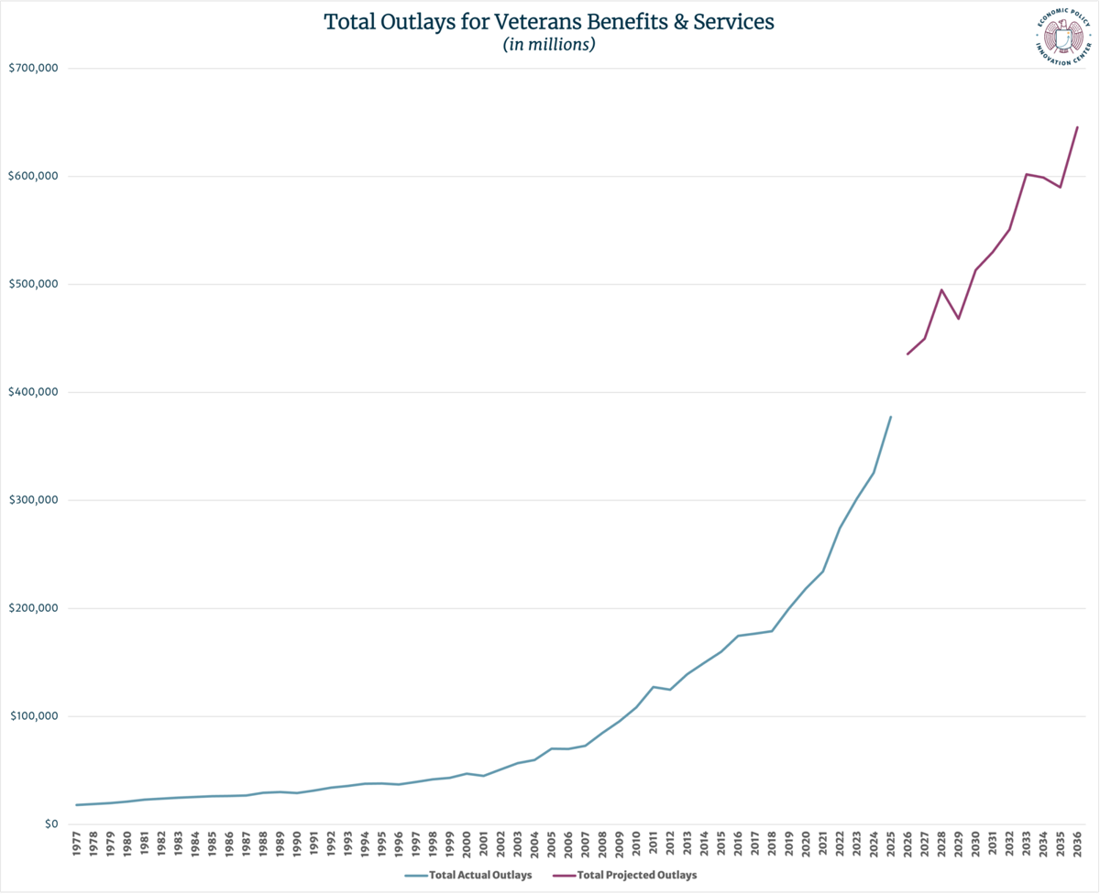 Source: Author’s chart using OMB historical tables and CBO baseline data.
I am not suggesting that all outlays are misspent dollars. To the contrary: many of the programs in the VA’s budget are essential for the wellbeing of America’s heroes, such as ensuring critical access to mental health for veterans, including those in rural areas who have long been abandoned.
[6] That is where tax dollars – a finite resource – should be going.
The Need for Oversight
Unfortunately, as outlays increase, there is a higher risk of fraud, waste, and abuse. There is also simply a higher chance of tax dollars being directed toward misaligned programming that neither matches the priorities of the American people nor best serves those veterans most in need of benefits and services. One example of this is the $1 million expenditure by the VA on forcing ferrets to consume alcohol in a “forced binge,” as uncovered in Senator Rand Paul’s annual Festivus Report wastebook.
[7]
A major part of the problem is that the mandatory (or, “autopilot”) spending side of veterans outlays has grown to 69 percent for fiscal year 2026. That means Congress as a whole is only reviewing (through the appropriations process) 31 percent of what it spends in taxpayer money each year for veterans services.
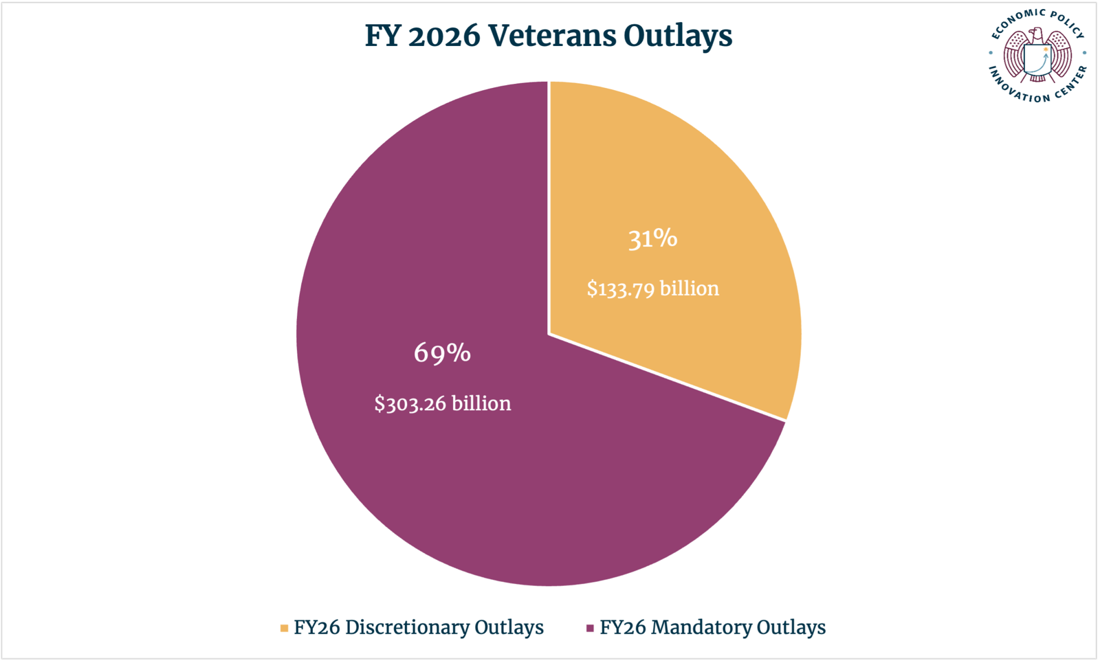 Source: Author’s chart using CBO baseline data.[8]
The VA only comprises six percent of the entire federal budget, but it is responsible for the fourth highest outlays to designated susceptible programs behind the U.S. Department of Health and Human Services, the Social Security Administration, and the U.S. Department of War. In FY 2025, the VA’s susceptible program outlays totaled $201 billion to its seven susceptible programs.
[9] Of this, $157.5 billion falls into the compensation bucket for VA employees. In FY 2025, the VA had $866.59 million in
known improper payments for compensation across the agency.
[10] This does not include those payments for compensation that are technically not improper but still problematic.
No wonder there are challenges within the Department and concerns about the agencies not supporting veterans properly while simultaneously hemorrhaging taxpayer dollars. Oversight – regular oversight –
must be a core component of any funding.
Failure to Focus on Core Mission
As the VA’s budget grows, you might expect to see significant improvements in veterans’ quality of life, access to care, and health outcomes. That is not what has happened.
According to the VA’s Office of Suicide Prevention, veteran deaths by suicide rates significantly increased from 2001 to 2023.
[11] In 2001, there were 23.2 veteran suicide cases per 100,000 veterans. By 2023, this had jumped to 35.2 per 100,000. Even at height of the Global War on Terror, that rate never rose above 30. This is, quite frankly, an unacceptable failure.
Another failure is the considerable wait times veterans must deal with before getting care at all. Right here in the National Capital Region, the Fort Belvoir VA Clinic has a 60 day wait time for a mental health appointment. That pales in comparison to the Greenville VA Clinic in Texas, where Congressman Self’s constituents would have to wait 105 days for mental health care.
Every single one of those veterans and their families would be appalled to learn that employees fired for bad behavior (particularly bureaucrats based in DC) are still able to keep their bonuses, or that VA employees who were supposed to relocate to help push down wait times – particularly in rural communities – instead retired and kept the relocation money, even while those who served are stuck in line, unable to access critical care.
Legislative Proposals
This brings us to today’s bills. While several of the bills would improve the operations of the VA, I will focus my analysis on four:
- H.R. 7319, the VA Bonus and Relocation Recovery Act (Rep. Self)
- H.R. 7683, the VA Fiscal Management Modernization Act (Rep. Bergman)
- H.R. 7950, to establish OCLA in the VA (Rep. Self)
- Discussion Draft, to modify the rate of pay for care or services provided under the Community Care Program (Rep. Miller-Meeks)
VA Bonus and Relocation Recovery Act. According to the Office of Management and Budget, the VA was assessed as being at high risk for improper payments in the compensation category for both FY 2024 and FY 2025. There is no room in the compensation account line item for additional failures. As demonstrated already in my testimony, it is unreasonable for VA employees to be provided with bonuses or relocation pay and then fail to follow through on those commitments and contracts. This commonsense legislation would close an important loophole that enables the government to recoup those dollars, which can then be spent to ensure providers are available to care for veterans in need of services. If these payments are not recouped, those dollars are lost and there is an opportunity cost given that there is no replacement employee pay available to incentivize relocation or reward good behavior.
VA Fiscal Management Modernization Act. Given the VA’s track record of fiscal mismanagement and inability to improve veterans’ outcomes or quality of life, it is prudent to establish a function to address these issues and advise the Secretary on financial management. With a Chief Financial Officer installed at the VA, this committee should finally have a productive partner with whom to work on improving the Department’s budgetary health. This bill will complement the bill the establish OCLA.
To Establish OCLA. It is unreasonable that this committee, other committees of jurisdiction, and the Congressional Budget Office are unable to gain access to necessary budgetary information from the VA in a timely manner. Establishing the Office of Congressional and Legislative Affairs (OCLA) has become necessary to ensure that the executive is responsive to the needs of legislators as they perform their constitutional responsibilities. Providing for a dedicated office will complement the VA Fiscal Management Modernization Act. Any stand-up expenses associated with this activity should be quickly offset by Congress once OCLA provides requested information on programs that require reform.
To Modify Community Care Rates. This bill is a fiscally responsible measure to prevent the VA from overpaying for medical services and costs under the Community Care program. Site neutral reimbursement rates are not only a fiscal saver, but also help veterans by promoting consistent access to care and reducing out-of-pocket expenses. Stopping unfair billing will be particularly meaningful in rural communities, in communities with high wait times for appointments at VA clinics, and in times of high population need (such as when there is an increase in post-active conflict stress).
Each of these bills would make notable improvements in the fiscal state of the VA and improve access to information for Congressional oversight purposes, while simultaneously prioritizing veterans over non-essential spending. None of them should increase deficits over the window; they will likely all reduce direct spending to a measurable degree whether immediately (like with bonus recoupment and site-neutrality) or over time (with improved fiscal management and the establishment of OCLA).
Conclusion
I encourage you to consider not only the legislation before us today, but any serious effort to reduce fraud, waste, and abuse at the VA. This is not simply on behalf of taxpayers across the country – this is to focus the Department on the priorities and mission of serving our veterans more effectively and efficiently.
Thank you, and I look forward to your questions.
[1] Congressional Budget Office, “Budget,”
https://www.cbo.gov/topics/budget (accessed December 2, 2025).
[2] U.S. Department of the Treasury, FiscalData, “America’s Finance Guide: Debt,”
https://fiscaldata.treasury.gov/americas-finance-guide/national-debt/ (accessed March 23, 2026).
[3] 1977 is the first full year following the switch to the current fiscal year cycle. By 1977, the U.S. military had also fully transitioned to an all-volunteer force, making the data more consistent with the current service environment.
[4] In most cases, this lag time is approximately four years, which is the average contract length. However, there are some notable exceptions, such as impacts from ending the Stop Loss program, high casualty environment years, and the Budget Control Act of 2011 drawdown.
[5] Federal Reserve Bank of St. Louis, using Current Population Survey Data from the Bureau of Labor Statistics, “Sizing Up the Ranks of America’s Veterans,” November 2023,
https://www.stlouisfed.org/open-vault/2023/november/sizing-up-ranks-america-veterans (accessed March 23, 2026).
[6] Once example of an essential service that should be funded is programming under the Sgt. Ketchum Rural Veterans Mental Health Act of 2021. This bipartisan law was championed in the 117
th Congress by Congresswoman Ashley Hinson (R-IA-01) and Congresswoman Cindy Axne (D-IA-03). The law is named in honor of Sergeant Brandon Ketchum, an Iowa Marine who served two tours of duty overseas and later took his own life after being turned away from a local VA hospital when he sought treatment for Post-Traumatic Stress Disorder.
[7] Committee on Homeland Security and Governmental Affairs, U.S. Senate, “The Festivus Report 2025,” December 2025,
https://www.hsgac.senate.gov/wp-content/uploads/FESTIVUS-2025-FINAL.pdf (accessed March 23, 2026).
[8] Congressional Budget Office, 10-Year Budget Projections, March 2026,
https://www.cbo.gov/data/budget-economic-data#3 (accessed March 23, 2026).
[9] The VA’s susceptible programs are: Purchased Long Term Services and Supports, Supplies and Materials, Pension, VA Community Care, Beneficiary Travel, Compensation, and Medical Care Contracts and Agreements. PaymentAccuracy.gov,
https://paymentaccuracy.gov/agencies-and-programs (accessed March 23, 2026).
[10] PaymentAccuracy.gov,
https://paymentaccuracy.gov/resources?fiscal-year=2025-data (accessed March 23, 2026).
[11] U.S. Department of Veterans Affairs, Office of Suicide Prevention, 2001-23 National Suicide Data Appendix.