The nation’s fiscal position is alarmingly fragile, strained by extensive pandemic relief and subsequent stimulus initiatives that drove inflation and massively expanded the debt between 2020 and today.
Publicly held debt is now at its highest level since World War II. In 1944, during pivotal battles like D-Day and the Battle of the Bulge, public debt stood at 86 percent of GDP, peaking at 106 percent in 1946 before declining sharply in the postwar years. Without meaningful fiscal reform, the Congressional Budget Office (CBO) projects that debt held by the public will be 99.9 percent by September and we will surpass the 1946 peak by 2029. Gross federal debt will be 123 percent of GDP by September which already exceeds the high of 119 percent during WWII.
Between early 2020 and the end of 2023, 76 percent of new federal spending was financed through bond issuance, with another 14 percent covered by money creation. This represents the heaviest reliance on debt and monetary expansion for new spending since the Civil War. By comparison, just 46 percent of additional World War II spending was debt-financed, and only about 10 percent came from money creation.
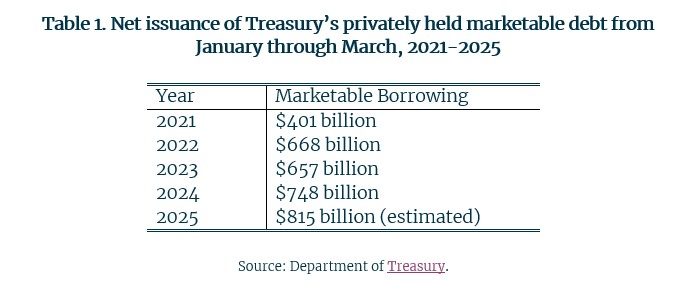
At the same time, federal borrowing remains at record levels, driven largely by the need to refinance a growing volume of maturing debt. To understand the scale of this borrowing, consider the Treasury’s projections for early 2025. In the first quarter of 2021, the Treasury borrowed $401 billion in privately held marketable debt. For the same period in 2025, the Treasury now expects to borrow $815 billion or more than double the amount just four years prior.
Examining these trends together underscores how significantly America’s fiscal outlook has shifted in recent years, and how it may evolve going forward. Government spending, driven by both deliberate increases and the inflationadjusted “autopilot” growth of certain programs, has propelled a sharp rise in federal debt. Absent major reforms to reduce long-term liabilities, these autopilot spending increases will continue to undermine America’s borrowing capacity.
Even under the CBO’s baseline scenario that assumes no wars, recessions, or natural disasters and relatively high economic growth with low interest rates, the pace of debt growth will eventually outstrip economic growth. At that stage, the United States would enter a “debt spiral,” causing interest rates to rise, impairing the government’s ability to issue new debt, and ultimately forcing substantial deficit reduction either through tax increases, spending cuts, or some combination of both to achieve a primary surplus.
Although economic growth can expand borrowing capacity even with high debt, my research suggests that by 2029, economic growth under reasonable forecasts will not be enough to replace existing debt capacity. This shift signals a persistent erosion that triggers a debt spiral. By the late 2030s, the situation will worsen, as mounting debt service costs crowd-out other investments. As debt capacity diminishes, interest rates will climb, new debt issuance will become untenable, and deficit reduction measures will become unavoidable.
In order to protect the most vulnerable populations that rely on government assistance (such as Medicaid for the disabled, pregnant women, and children), one of the most important things that Congress can do is to ensure that we do not run out of debt capacity by making sure that the financing of these programs is sustainable.
The rest of my testimony will explore the erosion of U.S. debt capacity over the past eight years, projections for the next 30 years without reform, and potential solutions to maintain sufficient debt capacity to safeguard the U.S. dollar as the world’s reserve currency and U.S. debt as the leading safe asset.
What is the current borrowing limit for the United States?
The borrowing or fiscal limit is the maximum debt-to-GDP ratio beyond which the government cannot stabilize its finances using its historical pattern of fiscal adjustments. If the U.S. debt ratio surpasses this limit, markets may lose confidence, interest rates could spike, and policymakers might be unable (or unwilling) to raise enough revenues or cut enough spending to keep debt from growing uncontrollably.
A nation’s fiscal space refers to the room a government has to undertake additional borrowing without undermining debt sustainability or risking a loss of market confidence. In simple terms, it is the difference between the fiscal limit and the current level of debt.
[1] Maintaining sufficient fiscal space is a form of insurance against events that have fiscal responses such as war, natural disasters, or recessions.
Table 1 shows data and model outputs for the first quarter of 2017 and from the fourth quarter of 2024.
[2] Columns include the real neutral rate (
r*) and real GDP growth (
g) as estimated by the Federal Reserve Bank of New York,
[3] then fiscal limit, alongside marketable debt, and the remaining fiscal space implied by each date’s environment (all as a percent of GDP), as calculated.
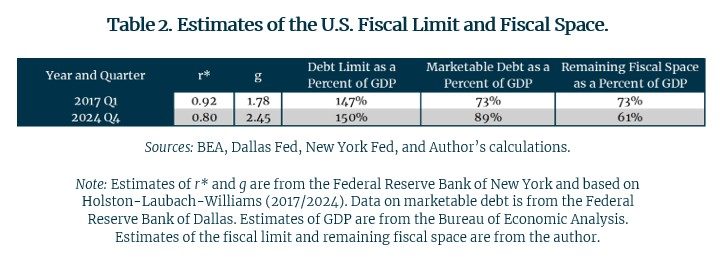
The borrowing limit can rise over time especially as potential growth increases. In fact, the borrowing limit increased by 3 percentage points of GDP in part because the fundamentals of the economy improved. However, increases in the fiscal limit were significantly outpaced by the growth in debt. As a result, the fiscal space available to deal with fiscal shocks has declined significantly despite the increase in the fiscal limit.
My research suggests that the U.S. fiscal limit was about 150 percent of GDP at the end of 2024 based on estimated values of
r* and
g. This implies that if debt climbs above these levels (assuming no changes to
r* or
g), the historically observed surplus response may be insufficient to stabilize the debt, thereby increasing the risk of unsustainable debt.
Over time, debt levels in the United States have increased. In early 2017, the value of marketable debt was around 73 percent of GDP, leaving roughly the same percentage of GDP in available fiscal space. By the fourth quarter of 2024, however, marketable debt was estimated to be roughly 90 percent of GDP. Therefore, the available fiscal space was at around 61 percent of GDP. This narrowing gap underscores the growing concern that higher debt may constrain future policy options.
Another important insight is that currently the real interest rate on debt remains lower than the real GDP growth rate. This dynamic has so far helped sustain U.S. debt by easing the burden of interest costs relative to economic growth. Even so, it does not eliminate the possibility of future problems including sustained spending on federal health programs that have historically exceeded economic growth. If interest rates were to rise significantly, or if economic growth were to weaken, the debt burden would become much harder to manage.
How has borrowing capacity changed since 2017?
The economic and fiscal landscape of the United States has evolved significantly since 2017. During the late-2010s, the economy enjoyed relatively robust growth and moderate government deficits, allowing policymakers to keep concerns about debt sustainability in check. However, the shock of the COVID-19 pandemic and the related government-imposed closures prompted a sizeable fiscal response which has affected fiscal space.
Fiscal space deteriorated sharply as the government enacted large-scale programs to offset the economic fallout associated with the pandemic and related policy decisions. These measures, combined with lower tax revenues as the government-imposed closures that dramatically slowed the economy, led to higher borrowing which accelerated the increase in public debt. Although the risk of events like this makes it important to maintain fiscal space, they left the federal government with a considerably smaller margin for dealing with future challenges.
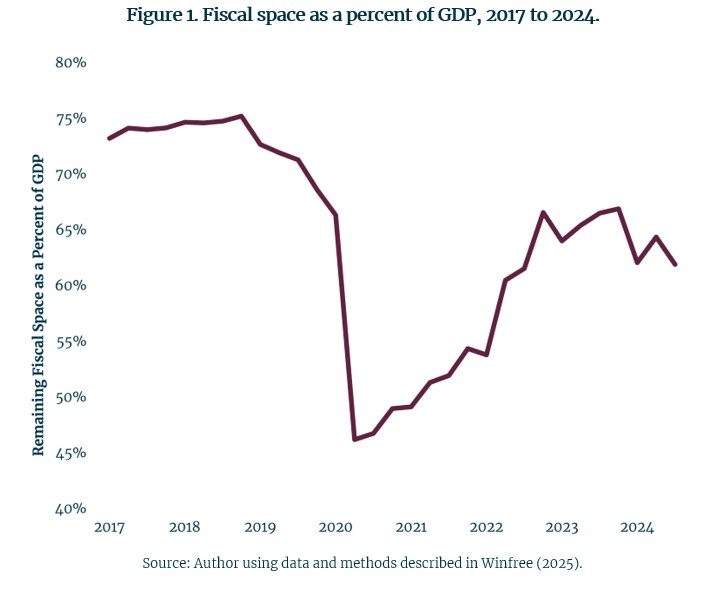
Notably, once the worst of the lockdowns subsided and economic activity resumed, the ensuing rebound helped partially restore some of that lost fiscal space. As businesses reopened and the initial supply chain limitations were overcome, consumer spending picked up, and labor markets began to adjust, faster economic growth helped increase revenues and eased pressure on deficits.
[4]
Despite the groundwork for a strong economic recovery, legislation enacted during the Biden administration contributed to an expansion of federal spending, driving up inflation and borrowing needs as well as putting pressure on rising interest rates.
[5] Therefore, the considerable Biden-era deficit spending slowed any gains that were being made to return fiscal space back to its prepandemic level.
How close is the U.S. to a debt spiral?
Debt held by the public has increased from 79 to 97 percent of the economy since 2020. Some analysts suggest that marketable debt is a better indication of a nation’s fiscal condition which has increased from 81 to 91 percent of the economy over the same period.
Placing the current debt-to-GDP ratio near 100 percent into historical perspective reveals the severity of the situation. The last time the United States approached comparable levels of debt was during and immediately after World War II, when the nation was mobilized for a global conflict. In the postwar era, high growth rates along with limited long-term liabilities helped reduce debt ratios (e.g., two of the most significant contributors to the government’s fiscal imbalances, Medicare and Medicaid, were not created until 1965).
The current fiscal landscape is markedly different from the past. Today, it is no longer feasible to rely solely on economic growth to reduce the debt burden without substantially slowing the growth of federal spending. While revenue growth has generally tracked the pace of economic expansion, mandatory or "autopilot" spending programs have grown by more than 300 percent since the 1960s as a share of GDP. This divergence stems from a structural imbalance. It is not possible to design a tax system that consistently generates revenue faster than the economy grows and long as many federal programs are structured to grow more rapidly than the economy year after year.
Over the long term, an economy with a high debt burden can still hobble along. Japan, for instance, has operated with debt well above 200 percent of its economy. However, the question for the U.S. is whether the composition of its debt and the global demand for its debt will remain stable. Historically, the dollar’s role as the world’s reserve currency and the status of its debt as a leading safe asset has allowed the United States to borrow more cheaply than other countries. With debt service costs rising under the strain of unsustainable debt levels, the risk of a broader erosion in global confidence in U.S. economic leadership is growing increasingly real.
Were foreign and domestic investors to perceive a significant increase in default risk or inflation risk, the interest demanded on Treasurys could increase even more, which would create a cycle of increased interest payments and higher debt that would be impossible to break from without significant fiscal reforms. For example, if the average interest rate that the U.S. paid to service its debt increased by 1 percentage point, it would increase spending on debt service by about $3.3 trillion over 10 years.
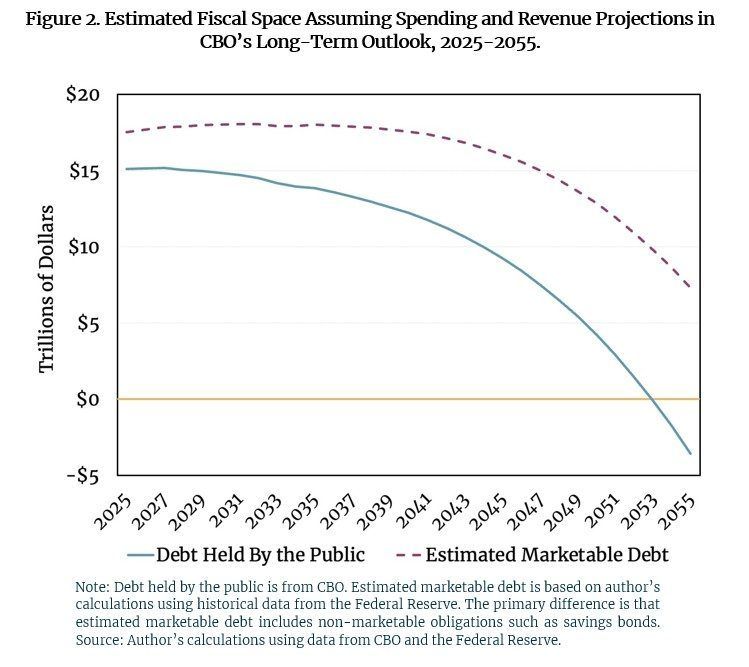
Under CBO’s long-term baseline, debt held by the public is expected to grow an average of 1.9 percentage points per year for the next 10 years and 1.8 percentage points per year during the next 20 years. Meanwhile, net interest payments will explode from $952 billion this year, to $1.8 trillion by 2035, and $2.9 trillion by 2045. Figure 2 shows projections of fiscal space under CBO’s projections of debt held by the public alongside my estimates of marketable debt. As you can see, fiscal space will soon begin to erode before becoming exhausted entirely by the 2050s.
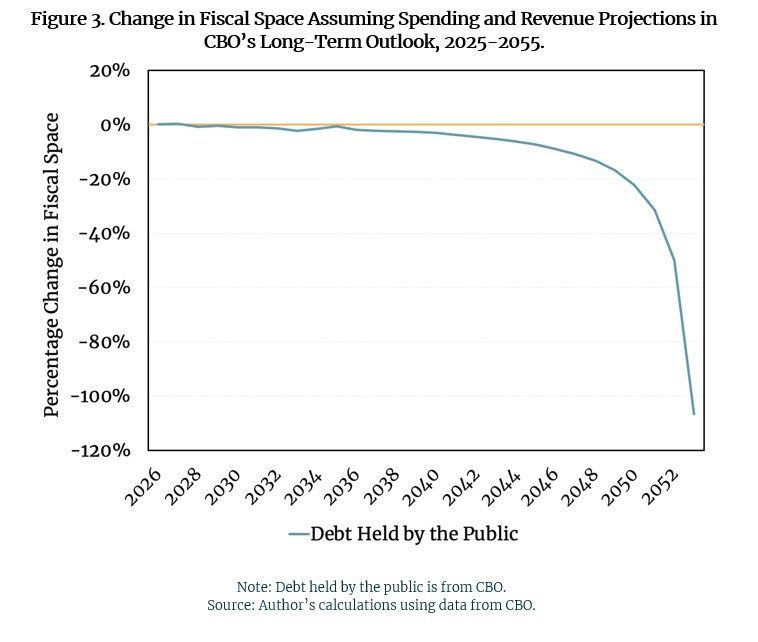
Figure 3 illustrates the projected erosion of fiscal space over the next 30 years. In the near term, continued economic growth is expected to maintain relative fiscal stability barring a major shock such as a recession or national security crisis that prompts a significant fiscal response. However, starting in 2029, the fiscal space replacement rate is projected to dip below one, indicating the onset of sustained erosion. By the late 2030s, this erosion will accelerate markedly, with fiscal space expected to be largely depleted by the early 2050s.
What can be done to restore U.S. borrowing capacity?
The two most important factors driving U.S. borrowing capacity are potential economic growth and the interest rate on debt. Given the erosion of borrowing capacity as well as the fiscal outlook under current law, it is essential that Congress enact changes in policy that encourage economic growth and reduce long-term liabilities of the federal government.
Restoring borrowing capacity to its 2017 level while also extending the Tax Cuts and Jobs Act of 2017 would require reducing primary deficits by about $100 to $140 billion per year. That is aligned with the target of $2 trillion in deficit reduction reflected by the House-passed budget resolution. Of course, the longterm budget was unsustainable in 2017 just as it is unsustainable today. That means that additional deficit reduction will be needed before the borrowing capacity begins to erode even further under current law.
Policies that foster economic growth include extending many of the provisions that will expire along with the TCJA including 100 percent bonus depreciation and research and development expensing. At the same time, if tax rates on individuals or small businesses are allowed to increase in 2025, fewer resources would be available for private domestic investment and aggregate demand could be reduced, thereby reducing economic growth and available jobs.
Congress must also reduce long-term liabilities to send a credible signal to the markets that there is political will to reduce the growth in spending. As guidance, Congress might target debt as a percent of the economy (e.g., a rule that public debt should never exceed the size of the economy) or annual deficits that generally keep pace with economic growth (e.g., a rule that budget deficits should generally not exceed economic growth unless the economy is in recession).
However, Congress must ultimately begin to reduce the growth in spending. Under CBO’s 2025 January baseline, there are only a handful of programs that are expected to grow faster than the economy in the long-run and the largest of these programs include the federal health care entitlements. For example, Medicaid was created in 1965 and has since grown faster than the economy in 45 of the 59 years between 1966 and 2024, or 81 percent of the time. CBO’s long-run baseline suggests that Medicaid will likely grow faster than the economy in 25 of the next 30 years. That level of growth is unsustainable and ultimately damages the prospects of the program for the vulnerable populations who the program was intended to serve.
The recent increase in federal spending on Medicaid has been driven by the expansion under the Affordable Care Act to abled bodied working age adults. This has put pressure on the federal budget. However, state budgets are also under considerable pressure from rising health care costs which has caused states to develop waiting lists for vulnerable populations. Medicaid reform is becoming a necessity in order to protect vulnerable beneficiaries, ensure program access to those who truly need help, reduce health care costs within the system, and to ensure access without enriching providers in the health system through a program originally designed for those with low-income.
Slowing the growth of spending will also help ease the pressure on interest costs. Over the past eight years, the annual cost of servicing the national debt has surged from $263 billion in 2017 to a projected $952 billion in 2025. According to the CBO, these costs are expected to climb to $1.8 trillion by 2035 and reach $3.7 trillion by 2050. At that point, under a static model, the government's remaining borrowing capacity would be nearly equal to the cost of servicing the debt itself. However, it’s likely that financial markets will compel Congress to act well before that threshold is reached, potentially triggering swift and severe spending cuts that could jeopardize essential programs.
[1] In this paper, I use market value of marketable debt (i.e., U.S. Treasury bills, notes, and bonds) rather than the value of debt that reflects the interest rates when it was issued. This is regarded by informed observers (including the Federal Reserve, Treasury, and the Congressional Budget Office) as the preferred measure in estimating the sustainability of the government’s current finances.
[2] The method used to calculate fiscal space is based on Ghosh et al. (2013) and is described in Winfree (2025). Atish R. Ghosh, Jun I. Kim, Enrique G. Mendoza, Jonathan D. Ostry, and Mahvash S. Qureshi, “Fiscal Fatigue, Fiscal Space and Debt Sustainability in Advanced Economies,”
The Economic Journal 123, no. 566 (2013): F4–F30. Paul Winfree, “The Fiscal Red Line: How Close is the U.S. to Its Borrowing Capacity,” Economic Policy Innovation Center (January 21, 2025) at ../../federal-budget/thefiscal-red-line-how-close-is-the-u-s-to-its-borrowing-limit/.
[3] The difference between
r and
r* is that
r is the real interest rate on current government bonds and
r* is the real natural interest rate consistent with full employment and stable inflation. The measure of
r is important for determining whether current debt levels are sustainable and
r* is used to gauge long-run debt sustainability. Another difference is that
r is observed and
r* is estimated.
[4] This is partly related to the growth effects of the Tax Cuts and Jobs Act of 2017. See Paul Winfree,
Testimony before the House Committee on Ways and Means on the Effects of the Tax Cuts and Jobs Act and the Fiscal Condition of the United States, U.S. House of Representatives, April 2024 at
../../wp-content/uploads/2024/04/Winfree-Testimony-Ways-and-MeansHearing-on-Tax-Reform-4.11.2024.pdf.
[5] Jonathon Hazell and Stephan Hobler, “Do Deficits Cause Inflation? A High Frequency Narrative Approach,” Centre for Macroeconomics Working Paper CFM-DP2024-39, 2024, at
https://www.lse.ac.uk/CFM/assets/pdf/CFM-Discussion-Papers-2024/CFMDP2024-39-Summary.pdf.