The Office of Management and Budget published the
Unified Agenda of Regulatory and Deregulatory Actions. This is the first regulatory
agenda of the Trump Administration and makes clear that President Trump intends to put regulatory reform at the forefront of this term.
The Unified Agenda lists all actions currently in the regulatory process across federal departments and agencies with an emphasis on future actions. While it reflects every item with a Regulation Identifier Number (RIN) recorded in the regulatory database, it
does not capture every regulatory or deregulatory item that can have a significant impact given that some actions are not formally considered regulations by agencies or assigned separate RINs. Still, the agenda’s subset of actions gives the public a valuable window into the Administration’s regulatory reform efforts going forward.
At the start of this term, President Trump pushed agencies to go further than before. Rather than simply imposing no new regulatory costs, he directed them to ensure that total regulatory costs are “significantly less than zero.” He also directed agencies to eliminate 10 existing rules for each new rule adopted. Given the regulatory output under the Biden Administration, meeting that target should be well within reach.
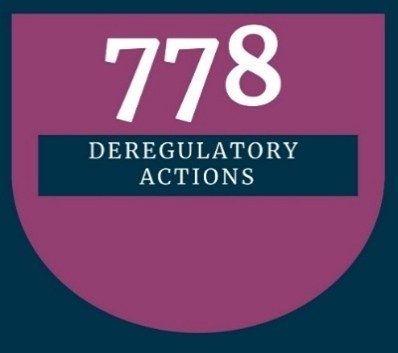
In this agenda, President Trump has laid out 778 active, deregulatory actions across the government, including at the Department of Housing and Urban Development, the Bureau of Land Management, the Department of Energy, and the Food and Drug Administration. An active action is one which is in the final, proposed, or pre-rule stages and that will be implemented going forward.
By reducing the regulatory burden on the American people and businesses, the Trump Administration will
boost the economy and allow Americans to focus more on work than on paperwork.
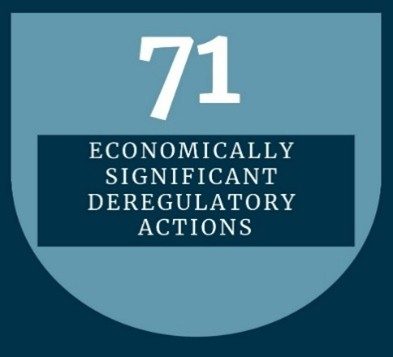
Of these 778 active deregulatory actions, 71 of them are categorized as economically significant. An economically significant regulatory or deregulatory action is generally considered to be one with an annual impact of $100 million or more on the economy.
Eliminating 71 of these regulations will reduce economic burdens on Americans and reduce regulatory costs by millions of dollars.
Analysis of the Unified Agenda
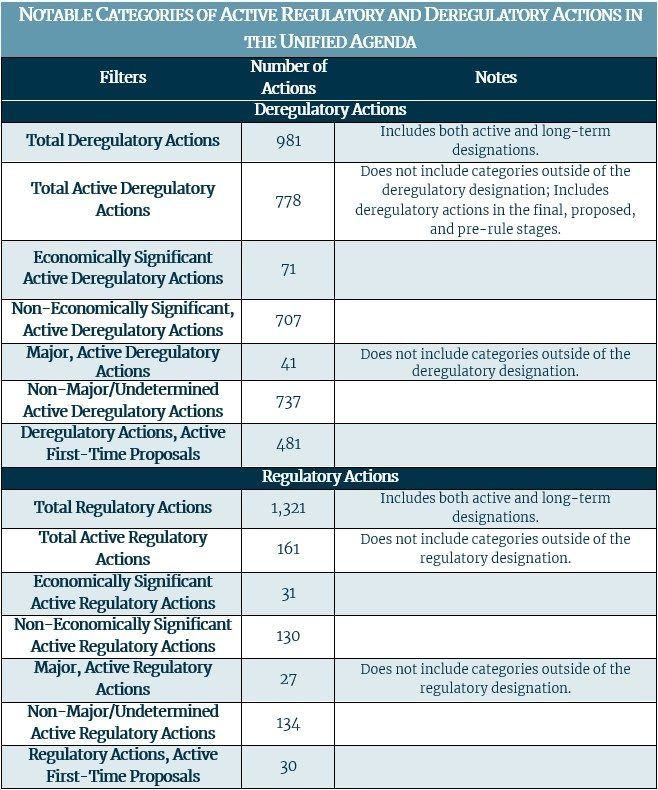 Source: Author’s own analysis of items included in Spring 2025 Unified Agenda of Regulatory and Deregulatory Actions.
Note: This table follows the definition of regulatory and deregulatory actions established by E.O. 14192’s guidance and does not include regulatory and deregulatory actions apart from the Unified Agenda. This table does not include other categories of deregulatory action such as the removal of guidance documents and information collections. It only captures active regulations within the government’s primary, formal regulatory database.
Source: Author’s own analysis of items included in Spring 2025 Unified Agenda of Regulatory and Deregulatory Actions.
Note: This table follows the definition of regulatory and deregulatory actions established by E.O. 14192’s guidance and does not include regulatory and deregulatory actions apart from the Unified Agenda. This table does not include other categories of deregulatory action such as the removal of guidance documents and information collections. It only captures active regulations within the government’s primary, formal regulatory database.
President Trump has demonstrated a clear commitment to deregulation with only 7% of all Unified Agenda items classified as regulatory actions and nearly 23% classified as deregulatory. Counting only items explicitly tagged as regulatory or deregulatory, 76% are deregulatory compared with 24% regulatory. The Administration has moved away from reissuing prior deregulatory actions and has made the majority of deregulatory actions first-time proposals (596 in total). With most deregulatory items in the early stages of rulemaking, the pipeline points to a steady increase in completed deregulatory actions over the coming months.
The Unified Agenda also reveals a targeted approach to eliminating regulatory burdens. Rollbacks are concentrated at the Departments of Transportation and the Interior, the Environmental Protection Agency, and the Department of Energy with 516 deregulatory actions and 34 economically significant. Other agencies are still reducing regulations, but at a slower pace. The U.S. Department of Treasury and the Department of Housing and Urban Development have not submitted many deregulatory items (a combined total of less than 70) and only one of these economically significant.
The Trump Administration is implementing a deregulatory program first focused on the transportation, energy, and public lands sectors designed to reduce regulatory burden over time as deregulatory items are finalized and more items join enter the pipeline in future agendas. By eliminating burdensome rules, the Administration is clearing the way for stronger growth, higher productivity, and more jobs. These reforms will allow American enterprise to flourish, with individuals and businesses devoting more energy to innovation and prosperity rather than regulatory compliance.