The Trump Administration released its first deregulatory scorecard of President Donald J. Trump’s second term, reporting a massive reduction of regulatory burdens.
Executive Order 14192, “Unleashing Prosperity Through Deregulation,” established a
regulatory budget aiming to remove at least 10 regulations for every new regulation implemented. It also limits new incremental regulatory costs to zero dollars. The Administration has exceeded both of these goals.
Comparing the Two Terms
The deregulatory scorecard reports an estimated
$211.8 billion in net regulatory cost savings, with zero new regulatory costs counted against the baseline for FY 2024. This exceeds the
$198.6 billion in overall regulatory costs saved during all four fiscal years of the first Trump Administration.
Going beyond the 10 regulations out for every new regulation in goal, the current Trump Administration eliminated 646 deregulatory actions compared to five significant regulatory actions. This comes out to 129 regulations out for every new regulation implemented.
This is even more savings than during first Trump Administration, which eliminated
5.5 regulations for every new regulation from 2017 to 2020. The increased scale of success is partially due to the massive number of regulations implemented during the four-year Biden Administration, which was more than three times the economic cost of those promulgated during the eight years of the Obama Administration.
Most of these savings and many of the deregulatory actions were concentrated in the U.S. Department of the Treasury, U.S. Department of Homeland Security, and U.S. Department of Health and Human Services in the 2025 scorecard. During the first Trump Administration, savings and deregulatory actions were concentrated in agencies such as the Environmental Protection Agency, U.S. Department of Transportation, and U.S. Department of Homeland Security.
These deregulatory economic savings from 2025 will build on the savings of the first term and potentially have an even larger impact on Americans and the economy.
Cost Savings in Context
Reducing regulations can drive economic growth and there are plenty of burdensome regulations to remove. Regulations have increased by
15% over the last ten years. The Biden Administration alone generated an estimated
$1.8 trillion in new regulatory costs over four years, or about $450 billion per year on average.
The total regulatory reforms of the first Trump Administration were projected to raise real household incomes by
$3,100 per year after 5 to 10 years according to the Economic Report of the President. With more regulatory savings in just the first year, the benefits for Americans will likely be significantly greater this time.
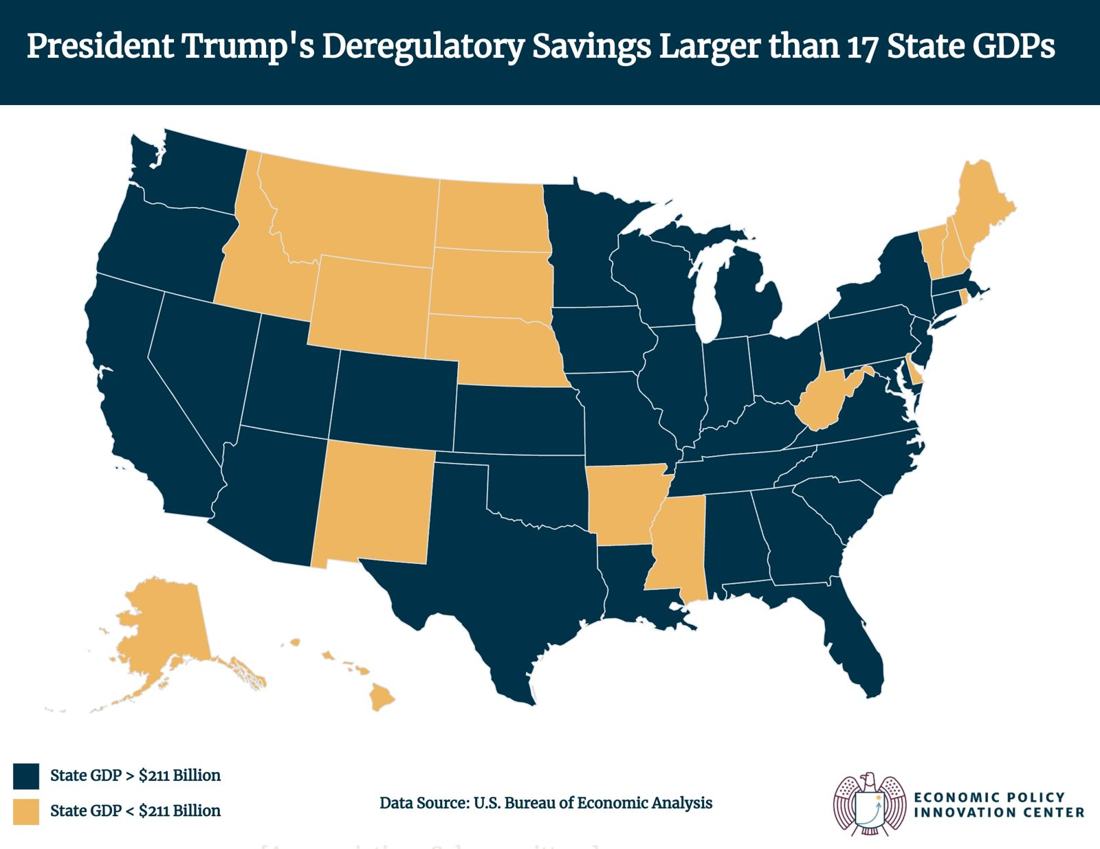
President Trump’s deregulatory initiative in the first year has economic impacts exceeding the full annual output of some entire states in the country. The deregulatory savings of $211.8 billion
exceeds the GDPs of about one-third of U.S. states and surpasses the combined GDPs of Hawaii ($117.6B), Wyoming ($51.5B), and Vermont ($46.3B).
The regulatory savings are equivalent to almost $1,600 in savings per American household. That figure is higher than the national median gross rent (rent plus utilities), which rose to
$1,487 a month in 2024, according to the latest U.S. Census Bureau data.
The Significance of Regulatory Reform
The deregulatory scorecard of the Trump Administration underscores just how large the economic impacts of regulatory policy can be. Regulatory savings over $211 billion in economic impact are significant and build on savings from the first Trump Administration. These savings rival the annual economic output of entire states and exceed costs that dominate household budgets. Deregulation is a proven driver of economic growth and savings of this magnitude have long-term effects on the economic prosperity of Americans. This, in turn, has a clear and measurable impact on both the economic and fiscal health of the nation.