
The Congressional Budget Office’s (CBO) monthly budget reviews have been painting a concerning picture. In its most recent tally of spending and revenues through August 2023, CBO has calculated that the deficit was $1.5 trillion through the first 11 months of the fiscal year (FY). This is $641 billion higher than the deficit was at this point just last year, in FY 2022. Net interest spending is 30 percent higher than it was a year ago because interest rates are higher, and debt held by the public has increased by $8.3 trillion since the beginning of 2020.
Despite the pandemic being behind us, debt is still increasing, in part, because COVID-19 pandemic-era appropriations are still being spent. In addition, Medicare spending is 18 percent higher than it was last year, Social Security spending is 11 percent higher, and income tax revenues are lower because of a decline in tax liabilities (again, in part because of pandemic-era tax credits).
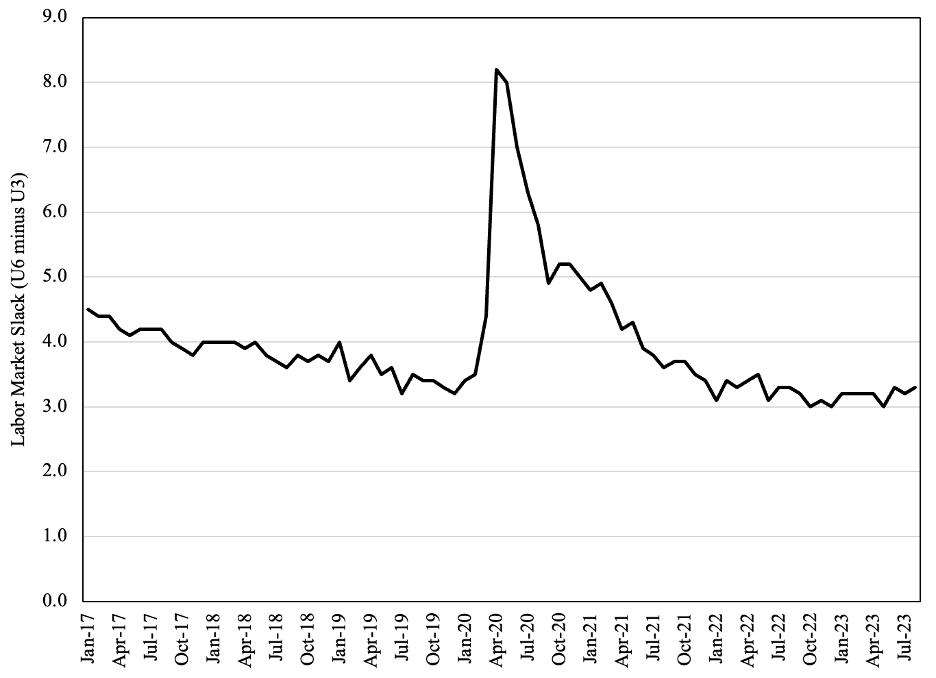
Meanwhile, the unemployment rate in August was 3.8 percent, and it has not been above 4 percent in over 18 months. The “labor market slack” – a measure of how many additional jobs could be added – is at the level it was immediately before the COVID-19 pandemic began (see Figure 1).
Figure 1. There is very little slack in the labor market.
This might sound like good news. However, the combination of high deficits, government subsidies for favored industries, high interest rates, and low unemployment suggests that private resources are being crowded out by the federal government. One area where this is likely happening is in private investment where manufacturing construction for favored industries, such as microchips and clean energy production, has been increasingly subsidized by the federal government over the last two years.
“Strengthening domestic manufacturing” may be a core component of what the White House has been calling “Bidenomics.” But it is important to understand the costs associated with the President’s economic agenda. Figure 2 shows that private fixed investment has essentially plateaued as manufacturing construction has grown. In fact, total private investment has fallen by more than 1 percent since the American Rescue Plan (ARPA) was enacted by President Biden and Congress in early 2021.
Figure 2. Private fixed investment has fallen by 1.3 percent as manufacturing construction has increased by 55 percent since the enactment of the American Rescue Plan Act (ARPA).
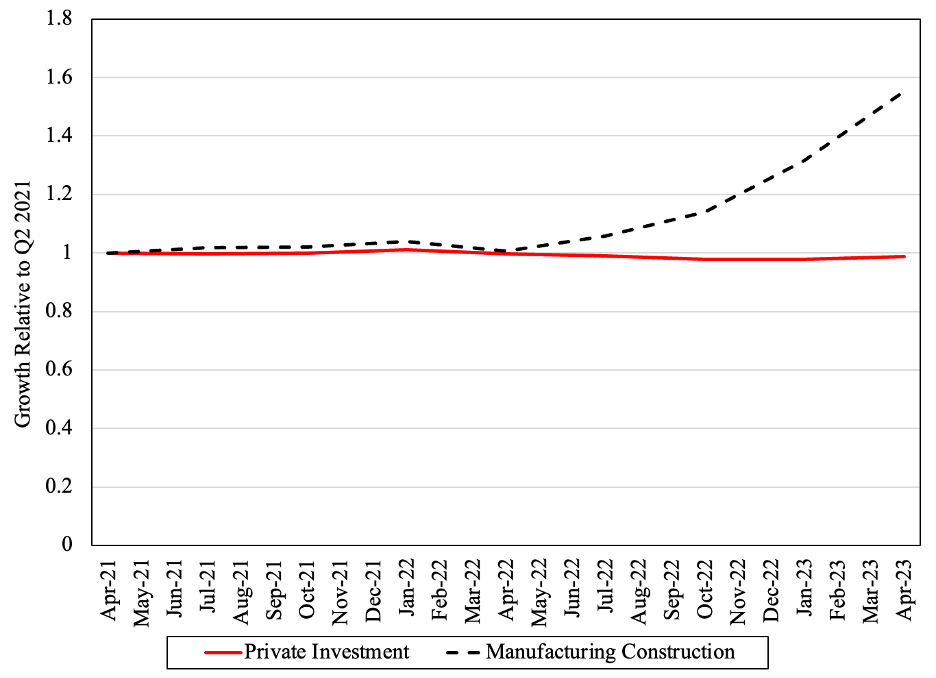
Source: Author’s calculations using data from the U.S. Bureau of Economic Analysis.
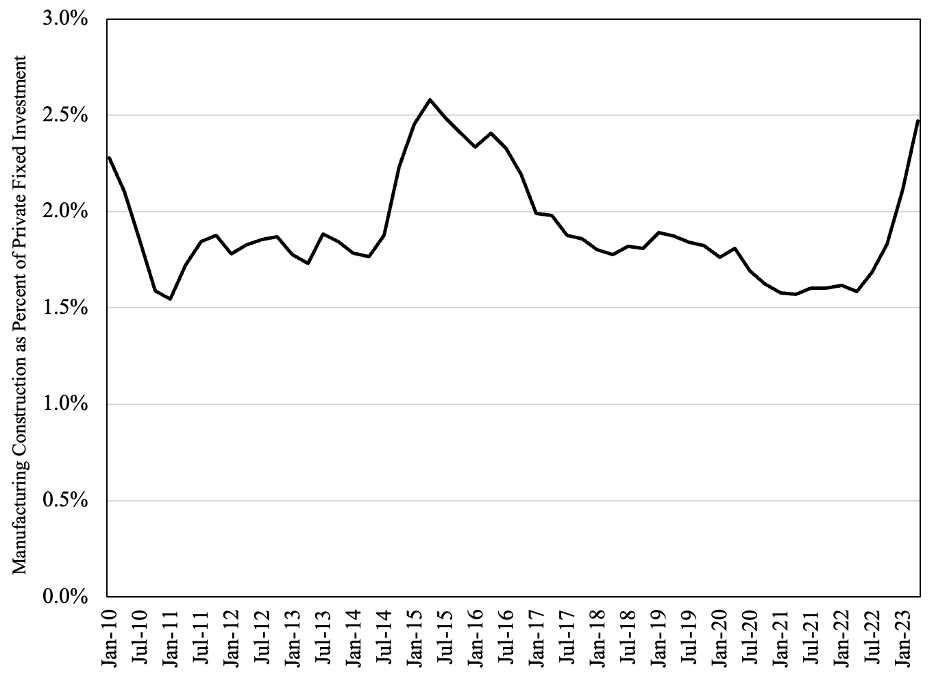
It is also possible that the subsidies for politically preferred industries associated with domestic manufacturing are driving higher interest rates by encouraging private investment. However, because manufacturing construction is a small component of total investment (see Figure 3), and private fixed investment is stagnating, that does not seem particularly likely.
Figure 3. Manufacturing construction is a small amount of total private fixed investment.
Recently, Paul Krugman suggested that the natural rate of interest may be increasing because the underlying fundamentals in the economy are strong and that economic growth is increasing. Although possible, it seems that the economy may be showing signs of stalling as consumer demand and manufacturing output appear to be declining. Therefore, higher rates are very likely caused by some combination of higher inflation expectations and more underlying uncertainty in the economy.
In other words, it is likely that higher rates are a function of higher deficits in the recent past and future.