Federal Improper Payments in 2024
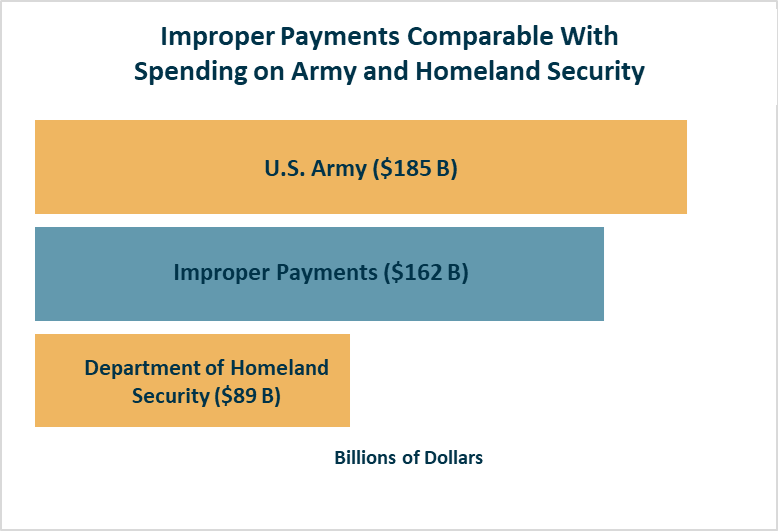
The data is in, and federal agencies spent at least $162 billion on payments to the wrong people and for the wrong amounts in fiscal year 2024.
[1] That figure is an underestimation because it excludes fraud and errors that were not caught and programs that do not track improper payments.
This means that as Americans are struggling under the pressure of rising prices — including per-capita food expenditures reaching a new record high — federal agencies’ mistakes, at $1,200 per household, are costing five weeks of groceries for a family of four.
[2] Over the past decade, the federal government’s $1.9 trillion in improper payments comes out to over $14,000 per household.
Elon Musk and Vivek Ramaswamy — the originators of the Department of Government Efficiency, or DOGE — have already called out improper payments, with Ramaswamy noting in a November 19 tweet, “This kind of flagrant waste needs to end. Time for @DOGE.”
[3]
While the DOGE can accomplish a good deal on its own to reduce improper payments, Congress will be needed to help hold agencies accountable and to ensure lasting changes.
What Is An Improper Payment and Why Do They Happen?
The White House’s Office of Management and Budget (OMB) defines an improper payment as, “a payment that should not have been made or that was made in the wrong amount.”
[4] While improper payments can include underpayments, only $8 billion out of $162 billion in improper payments was an underpayment in FY 2024 — less than 5 percent.
[5]
The overwhelming majority of improper payments — roughly 85 percent — are the result of agencies’ failure to identify that people are who they say they are and that they are eligible for the benefits they claim. Some of these improper payments can be difficult to prevent, such as determining whether an individual who claims the Earned Income Tax Credit and the Child Tax Credit actually had the child(ren) living with them for at least half of the year. Even then, however, Treasury could establish a policy of not finalizing tax returns that include child-related credits until after April 15
th so that they can cross check other returns to make sure that the same children are not claimed on more than one return.
The federal government operates a Do Not Pay database to help agencies verify the identity and eligibility of individuals and entities before sending payments. It includes data like prison records, debarment and exclusion lists, and tax delinquency records. But agencies fail to properly utilize the database, and the database is itself inadequate.
For example, the Payment Integrity Information Act (PIIA) and the Do Not Pay Initiative through Treasury typically require that agencies check the Do Not Pay database before sending out checks. Unfortunately, some agencies ping the Do Not Pay database and then issue the payments before they receive the results from the Do Not Pay database. Other agencies simply ignore or dismiss basic internal controls. Ramaswamy noted in an X post that “the Small Business Administration granted over 100,000 forgivable loans to individual who were on the DNP [Do Not Pay] list, resulting in $5.3 billion of payments to recipients who may have been ineligible for federal support. The SBA’s Inspector General recognized this & recommended the agency stop this, but the agency’s current leadership rejected the proposal.”
[6]
Moreover, the Do Not Pay database is itself lacking. Linda Miller, the former Assistant Director of Forensic Audits and Investigative Service at the GAO, explained in her 2022 congressional testimony that the Do Not Pay system “offers full access to only three of six databases required by improper payments laws and only partial or no access to the remaining three.”
[7] The Do Not Pay database only recently gained access to the Social Security Administration’s master death file — to make sure payments are not issued to dead people — but that data still has not been incorporated into the database.
Once improper payments are issued, only a tiny fraction is ever recovered — and recovery adds its own significant costs. While enhanced fraud detection processes and machine learning artificial intelligence mark improvements, the Treasury Department reported just $1 billion of recovered fraud in fiscal year 2024.
[8]
Which Programs Have the Biggest Improper Payments?
Out of 68 programs that report improper payments, 18 of them have improper payment rates over 10 percent, and six have improper payments rates over 25 percent. In terms of dollars, eight programs sent out more than $5 billion per year in improper payments, and 19 exceeded $1 billion in improper payments.
Out of the $162 billion in improper payments in 2024, 10 programs accounted for 83 percent of improper payments.
Below are some of the programs with the highest percentage and dollar-value of improper payments.
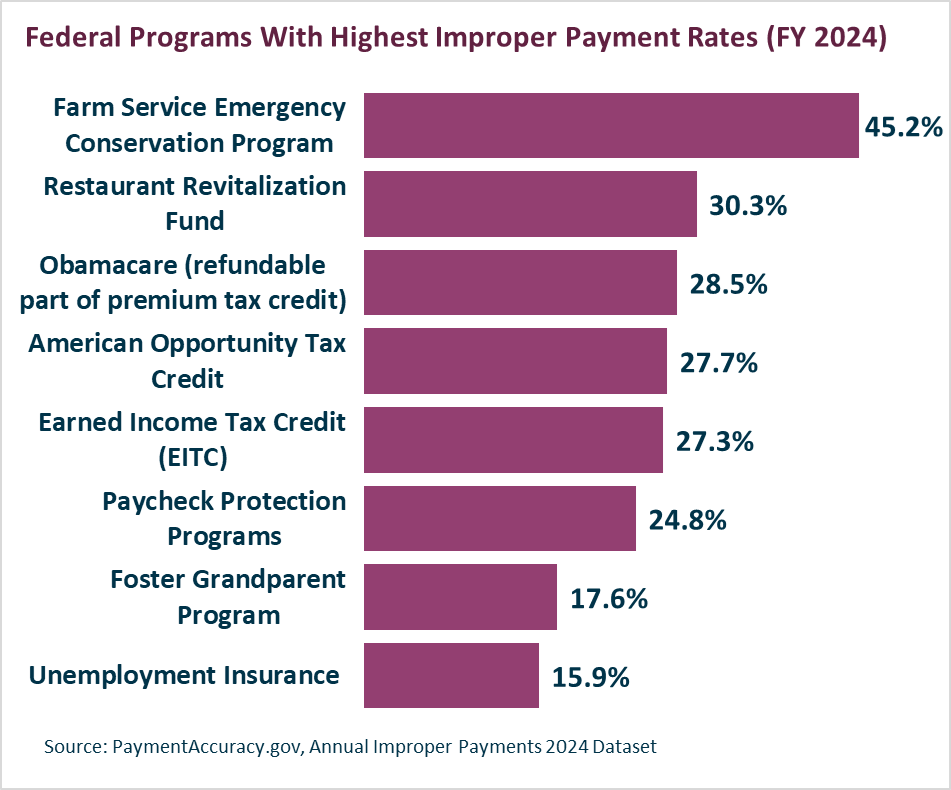
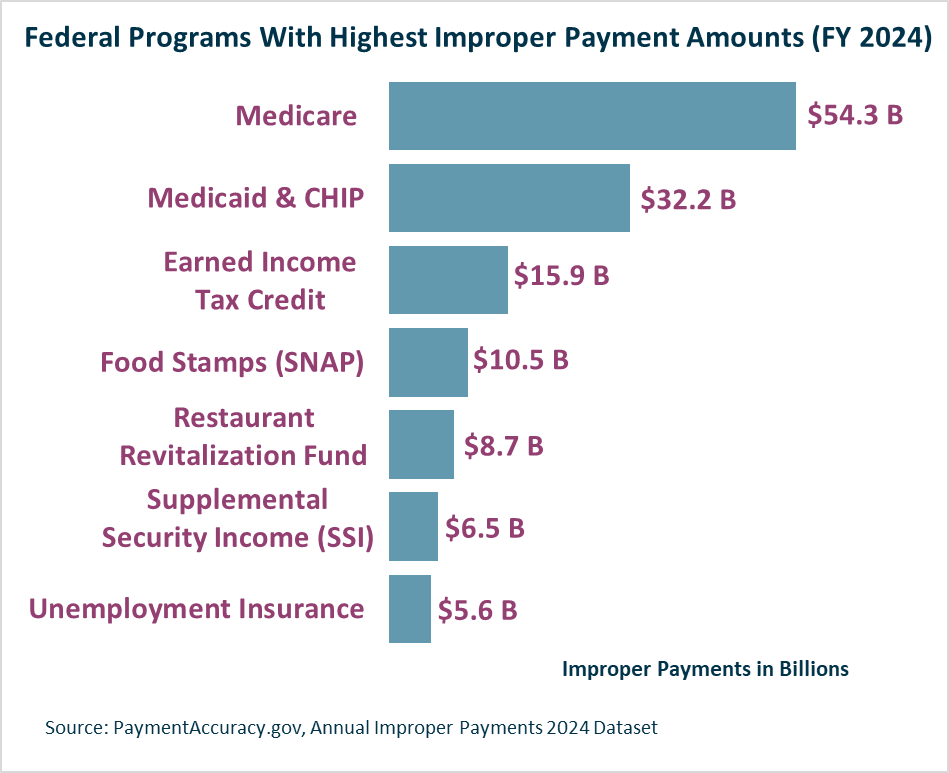
More than $1 out of every $4 of Earned Income Tax Credits (EITC) was an improper payment, totaling $15.9 billion in 2024.
Nearly $3 of every $10 in Obamacare’s refundable subsidies (Premium Tax Credits) were improper payments.
More than $1 out of every $10 in the Supplemental Nutrition Assistance Program (SNAP), or food stamps, was an improper payment.
Medicare, Medicaid, Obamacare, and the Children’s Health Insurance Program (CHIP) combined to send out $88 billion in improper payments in 2024. Those wrong payments are enough to pay for the health insurance premiums of 9.8 million individuals or 3.4 million families.
[9]
What Can Congress Do to Help DOGE Reduce Improper Payments?
Following a surge in improper payments, from $41 billion in 2007 to $104 billion in 2009, Congress enacted the bipartisan Improper Payments Elimination and Recovery Act of 2010 (IPERA). Yet, improper payments continued to rise to $149 billion in 2018, at which point Congress replaced IPERA with the updated Payment Integrity Information Act of 2019 (PIIA). But yet again, improper payments continued to surge, peaking at $278 billion in 2021 during the COVID-19 pandemic.
The PIIA contains commonsense requirements that should reduce improper payments, including provisions like requiring agencies to: conduct a risk analysis; identify programs susceptible to improper payments; publish improper payment estimates for at risk programs; implement corrective actions and set reduction targets; and report on the results of targets and actions, including quarterly reports of mitigation actions for high-priority programs. Some of these metrics are even published in agency scorecards at PaymentAccuracy.gov.
The problem, however, is that there are no consequences for failing to comply with the law. If an agency’s scorecard reflects shortcomings or outright failure, there are no penalties. Instead, Congress usually
increases agencies’ budgets when their improper payments rise, so that they can cover both their legitimate costs and their wrong payments. Imposing consequences is difficult because most federal payments come from mandatory spending programs that cannot be cut through the regular appropriations process, even if agencies recklessly issue tens of billions of dollars in improper payments.
Nevertheless, Congress has options to help address the causes of improper payments and to hold agencies accountable for brazen errors.
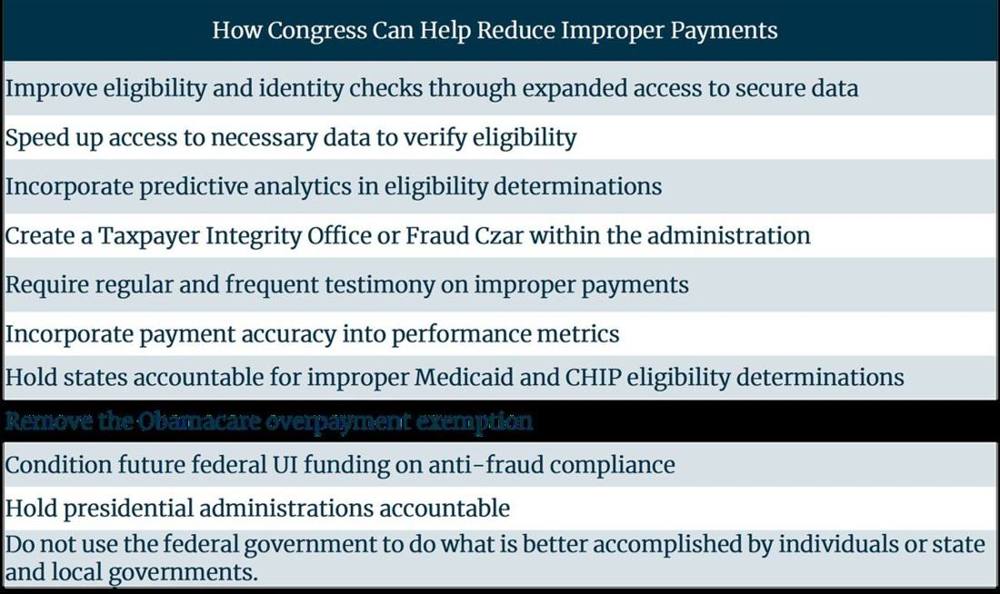
- Improve eligibility and identity checks through expanded access to secure data. With most improper payments resulting from the inability to properly verify identity and eligibility, Congress should — with proper security measures in place — expand data access and data sharing across government, including with state and local governments that administer federal programs. This will almost certainly require amending the Privacy Act.
- Speed up access to necessary data to verify eligibility. Congress should consider allowing the Treasury Department to bring data sources into the Do Not Pay database without authorization from the Office of Management and Budget (OMB). It currently takes between 18 to 24 months for OMB to approve new data coming into the Do Not Pay database. Treasury has the capability of running the Do Not Pay database and OMB would likely be happy to step aside and let Treasury manage it, with OMB retaining reserved authority.
- Incorporate predictive analytics into eligibility determinations. The private sector utilizes sophisticated and continually improving systems to prevent fraud and abuse. Congress should approve shifts in agency funding to adopt effective eligibility-determination analytics and consider mandating the use of such analytics for certain programs before agencies are allowed to issue payments.
- Create a Taxpayer Integrity Office or Fraud Czar within the administration. A new Taxpayer Integrity Office (TIO) or Fraud Czar could establish government-wide protocols along with targeted reforms to specific programs. The mission of this new government entity should be to make it easier for federal programs to protect taxpayers’ money and harder for them to waste it. To be successful, Congress must empower the TIO or Fraud Czar with enforcement capabilities.
- Require regular and frequent testimony on improper payments. Congress should require agency heads, program leaders, and Inspectors General to provide an account of improper payments and answer questions regularly regarding actions taken to reduce them. This should necessitate testimony before the House and Senate committees of jurisdiction (both authorizing and appropriating) over the agencies. Those in charge should know that they can lose their jobs if they fail to take necessary actions to reduce improper payments.
- Incorporate payment accuracy into performance metrics. Congress should amend the Government Performance and Results Act (GPRA) Modernization Act of 2010 to add payment accuracy to agencies’ performance metrics.
- Hold states accountable for improper Medicaid and CHIP eligibility determinations. Congress should direct the Centers for Medicare and Medicaid Services (CMS) to move more aggressively in recouping federal funds from the states for improper eligibility determinations.
- Remove the Obamacare overpayment exemption. Congress should amend the Affordable Care Act to remove the exemption for individuals with income below 400 percent of the poverty level to keep some of or all the overpayments they may receive from the Advance Premium Tax Credit.
- Condition future federal UI funding on anti-fraud compliance. If the federal government intervenes to expand unemployment insurance benefits, as it often does during recessions, states that accept federal unemployment insurance funds should be required to comply with anti-fraud measures, such as the National Institute of Standards and Technology (NIST) standards. If they fail to do so, they should lose federal funds.
- Hold presidential administrations accountable. To help maintain accountability across different Administrations, Congress can require accountability from the President of the United States. The Improper Payments Transparency Act (H.R. 8342)[10] would require the president’s budget request to include information about and explain how agencies are addressing improper payments, and the Enhancing Improper Payment Accountability Act (H.R. 8343)[11] would impose stricter and more timely reporting requirements and an explanation from agencies that fail to report improper payments.
- Do not use the federal government to do what is better accomplished by individuals or state and local governments. Growth in government has been accompanied by exponential growth in improper payments. In 2024, the federal government spent $3.8 trillion, or $29,000 per household on transfer payments. Instead of taking a top-down, one-size-fits-all federal approach that requires people to jump through bureaucratic hoops to receive benefits, federal policymakers should get out of the business of what is better accomplished by individuals, private businesses or charities, or state and local governments.
Conclusion
The new DOGE seeks transformative changes to make the federal government work better for the American people, but much of its potential success will require Congressional action. This is particularly true regarding reducing the $1.9 trillion of taxpayers’ money that the federal government spent on improper and unknown payments over the past 10 years.
By enhancing secure data sharing, tightening eligibility verification, creating and empowering a Fraud Czar or Taxpayer Integrity Office, holding agencies accountable, and ensuring effective oversight, Congress can help generate significant and lasting reductions in improper payments.
Equally important to reducing improper payments — and right-sizing the federal government — is for Congress to shift responsibilities for what represents much of the growth in the federal government in recent decades back to states and local governments, and to individual businesses and families.
The less money and autonomy that the federal government takes away from the American people, the fewer opportunities it has to misuse those resources or abuse its power.
[1] PaymentAccuracy.gov, “Annual Improper Payments Database,” 2024, https://www.paymentaccuracy.gov/ (accessed December 6, 2024). Per the Office of Management and Budget (OMB), which refers to “improper payments” as the figures listed as “improper and unknown payments” in its data reports, this report similarly includes both “improper” and “unknown” payments when referencing “improper payments.”
[2] USDA, “U.S. Consumers Increased Spending on Food Away From Home in 2023, Driving Overall Food Spending Growth, Economic Research Service, October 8, 2024, https://www.ers.usda.gov/amber-waves/2024/october/u-s-consumers-increased-spending-on-food-away-from-home-in-2023-driving-overall-food-spending-growth/ (accessed December 6, 2024).
[3] Vivek Ramaswamy [@VivekGRamaswamy], “The Treasury Department maintains a “Do Not Pay (DNP) list” that agencies are supposed to check before sending out $$$. DNP screens for deaths, delinquent federal debts, & excluded contractors. But it doesn’t really work that way: for example, the Small Business Administration granted over 100,000 forgivable loans to individuals who were on the DNP list, resulting in $5.3 billion of payments to recipients who may have been ineligible for federal support. The SBA’s Inspector General recognized this & recommended the agency stop this, but the agency’s current leadership rejected the proposal. This kind of flagrant waste needs to end. Time for @DOGE,” X, November 19, 2024, 10:45 pm,
https://x.com/VivekGRamaswamy/status/1859080606342058285 (accessed December 9, 2024).
[4] Office of Management and Budget, “Updated Data on Improper Payments,” December 30, 2021, https://www.whitehouse.gov/omb/briefing-room/2021/12/30/updated-data-on-improper-payments/ (accessed December 8, 2024).
[5] PaymentAccuracy.gov, “Annual Improper Payments Database,” 2024.
[6] Vivek Ramaswamy [@VivekGRamaswamy], “The Treasury Department …,” X, November 19, 2024, 10:45 pm.
[7] Linda Miller, testimony before the Committee on Oversight and Government Reform, U.S. House of Representatives, March 31, 2022,
https://docs.house.gov/meetings/GO/GO24/20220331/114566/HHRG-117-GO24-Wstate-MillerL-20220331.pdf (accessed December 9, 2024).
[8] U.S. Department of the Treasury, “Treasury Announces Enhanced Fraud Detection Processes, Including Machine Learning AI, Prevented and Recovered Over $4 Billion in Fiscal Year 2024,” October 17, 2024,
https://home.treasury.gov/news/press-releases/jy2650 (accessed December 9, 2024).
[9]The average health insurance premium in 2024 was $8,951 for individuals and $25,572 for families. Kaiser Family Foundation, “2024 Employer Health Benefits Survey,” October 9, 2024,
https://www.kff.org/report-section/ehbs-2024-section-1-cost-of-health-insurance/ (accessed December 4, 2024).
[10] H.R. 8342, Improper Payments Transparency Act, 118
th Congress,
https://www.congress.gov/bill/118th-congress/house-bill/8342 (accessed December 6, 2024).
[11] H.R. 8343, Enhancing Improper Payment Accountability Act, 118
th Congress,
https://www.congress.gov/bill/118th-congress/house-bill/8343 (accessed December 6, 2024).