$1.1 Trillion in Improper Medicaid Payments Over Past Decade
A primary source of Medicaid fraud and abuse stems from improper payments, which predominantly come from payments made on behalf of people who were not eligible for the program or who were wrongly classified by states in order to receive a higher federal reimbursement rate, or FMAP.
The Obama and Biden Administrations purposely downplayed enormous improper payment rates by directing the Centers for Medicare & Medicaid Services (CMS), when auditing Medicaid, to not check whether people enrolled in Medicaid were eligible for the program. That would be like the IRS not checking the earnings of someone claiming the earned income tax credit.
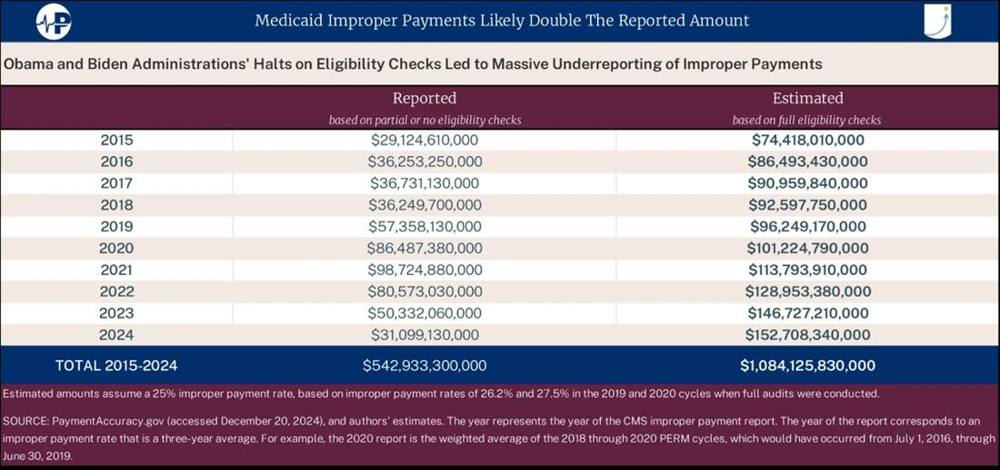
In 2024, for example, the Biden Administration reported that Medicaid issued $31 billion in improper payments. That’s massive in its own right, but the true amount was likely five times that, at $153 billion, which is enough to purchase private health insurance for 6 million families or
17 million individuals.
Using improper payment rates from two years in which CMS included full eligibility checks in Medicaid audits, Brian Blase and I estimated in our report,
Medicaid’s True Improper Payments Double Those Reported, that improper payments totaled $1.1 trillion, or $8,200 per household over the past decade. Considering that federal Medicaid spending is projected to
total $8.6 trillion over the next decade, improper Medicaid payments could exceed $2 trillion if left unchecked.
The massive expansion in Medicaid—including states and hospitals enrolling people who are not eligible and misclassifying enrollees as expansion enrollees to obtain higher reimbursement rates—not only fueled a surge in improper payments; it has also crowded out access to health care for Medicaid’s original, and most vulnerable recipients including pregnant women, children, individuals with disabilities, and the elderly.
Despite
Congress having enacted legislation that directs the Health and Human Services secretary to push the cost of excessive improper payments back onto states by withholding federal funds for improper payments over three percent, states have never had funds withheld under that requirement.
Solutions: To save money on wrong Medicaid payments, Congress should require states to conduct more frequent eligibility redeterminations, improve hospitals’ presumptive eligibility enrollment, and require full eligibility checks in Medicaid audits. Most importantly, Congress should require CMS to reduce future federal Medicaid reimbursements to high-offender states so those states, which are responsible for managing the programs, bear the cost of their failures instead of federal taxpayers.
Provider Taxes or Progressive Transfers?
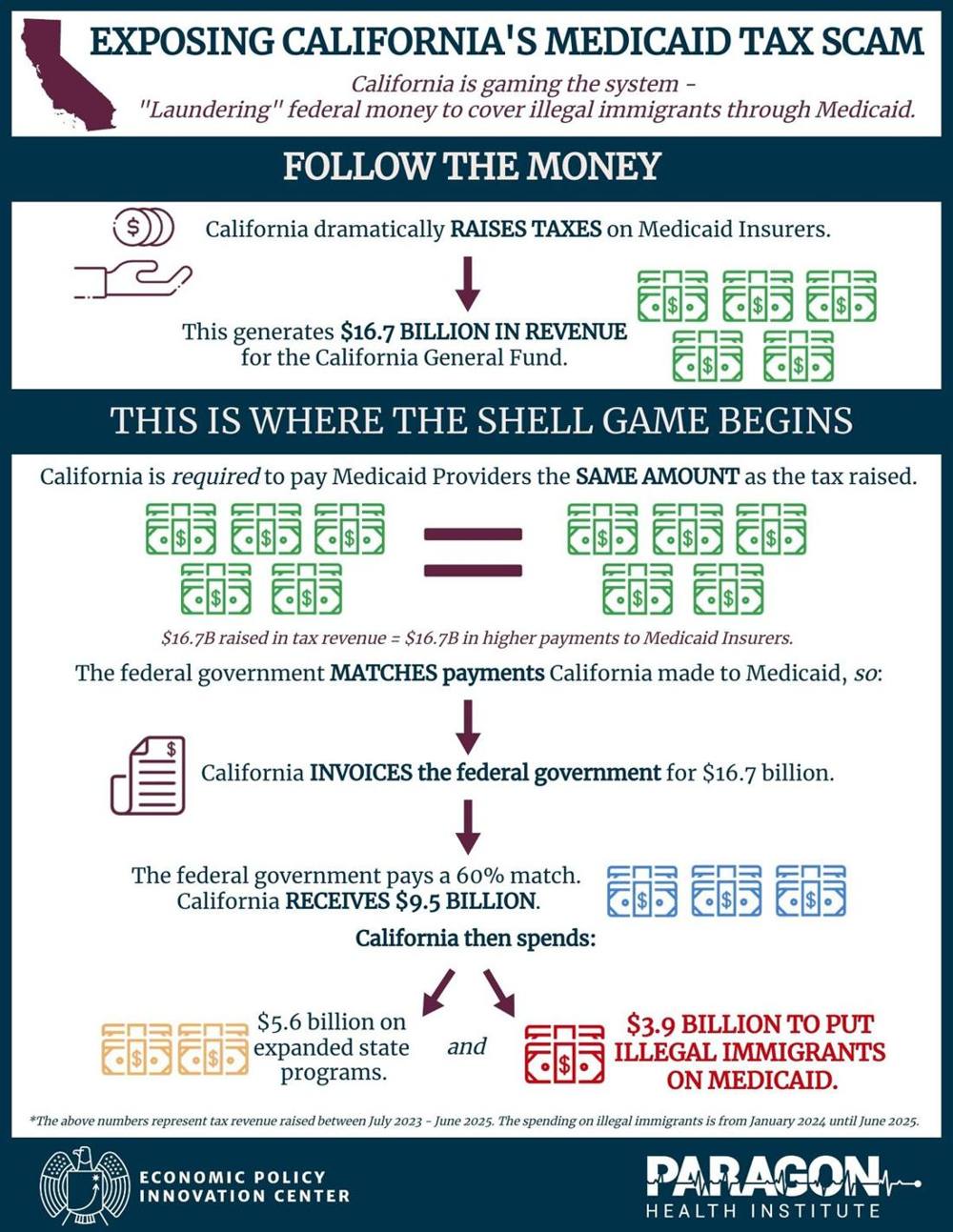
Another major abuse in Medicaid is so-called “provider taxes,” which states use to get the federal government to cough up more “Medicaid” funds than the law ordinarily allows. States can then use the additional federal dollars to boost their spending on non-Medicaid programs. This includes California and now New York using federal money to provide Medicaid to illegal aliens.
The way the provider tax works is that states create a new tax to impose on Medicaid providers. They then use that tax revenue to turn around and increase payments to the same providers who paid the tax. Having converted the tax into an alleged Medicaid expenditure, states then bill the federal government for the federal government’s share of the state’s Medicaid expenditures (which range from 50 percent to 90 percent).
As Paul Winfree and Brian Blase explain in their report
California’s Insurance Tax Shuffle: How Federal Money Ends Up Paying for Medicaid for Illegal Immigrants:
“This scheme effectively allows the state to ‘launder’ federal Medicaid funds without spending any of its own money.”
“California uses this influx of federal money to fund large-scale Medicaid expansions. The most significant of these are extending Medicaid coverage to illegal immigrants and eliminating the asset test so wealthy people can qualify for taxpayer-financed long-term care. Because the federal dollars are money laundered, the state circumvents restrictions on federal Medicaid funding for illegal immigrants.”
Winfree and Blase find that California’s manipulation of provider taxes will generate $19 billion in additional federal Medicaid funding between April 2023 and December 2026. This additional money consists of 100 percent federal funds with zero additional contributions from California.
The provider tax is a scheme that breaks the federal-state Medicaid partnership and enables states to use federal taxpayer dollars to pay for spending outside of what Medicaid law allows.
Solution: Congress should end the provider tax scheme. The Congressional Budget Office estimated that eliminating the provider tax would reduce federal Medicaid spending by $630 billion over the next 10 years. Much of this would consist of reducing backdoor spending on things that are illegal under Medicaid law.