What are the Two Federal Retirement Systems?
Civilian federal employees receive extremely generous retirement benefits from the federal government which provides a significant portion of their total compensation. All federal employees receive a pension, otherwise known as a defined benefit plan. Comparatively, only
15% of private sector workers receive a pension and that is often in substitution for a 401k plan. The system is geared towards rewarding federal employees with retirement plans that no one in the private sector can match. Taxpayers effectively guarantee the retirement plans of federal bureaucrats while having less money to save for their own retirement.
Federal employees hired prior to 1984 and who are at least 60 years or older are part of the Civil Service Retirement System (CSRS). Those hired in 1984 or later are part of the Federal Employees’ Retirement System (FERS). All federal employees, regardless of their date of hire, are also eligible to participate in the government’s 401(k)-style retirement plan, the Thrift Savings Plan (TSP). While
98% of current federal employees are in the FERS system,
56% of current federal retirees and their dependents are in the CSRS pension plan.
How are These Systems Funded?
Private sector employers are required to pre-fund pension benefits to ensure that if the firm closes, retirees will still receive their pensions which they have earned. Private sector pensions are typically invested in stocks that yield between 6% and 7% in inflation-adjusted returns per year. In contrast, the federal government is not required to pre-fund pensions plans. The excess of contributions into government pension plans minus what is paid out in benefits is invested in U.S. Treasuries that typically yield between 2% and 3% in inflation-adjusted annual returns. If payments promised from government pensions exceed contributions plus any returns earned, taxpayers make up the difference.
Between 1985 and 2022, the number of civil service pensions rose by
39% as workers aged out of the workforce. While most current federal workers are enrolled in FERS,
50.8% of retired federal workers, excluding survivors, receive benefits under CSRS compared to 49.2% under FERS. Retirees under CSRS received an average pension of
$5,447 per month ($65,364 per year) in 2022 compared to current FERS employees who received an average annuity of $2,126 per month ($25,512 per year).
Under CSRS, federal employees contribute
7% of their base pay towards the Civil Service Retirement and Disability Fund (CSRDF) and the agency matches that contribution. All other
funding comes from other governmental sources or interest on the fund.
Under FERS, employees contribute between
.8% and 4.4% of their pay to the CSRDF and the government contributes between 14.2% and 16%.
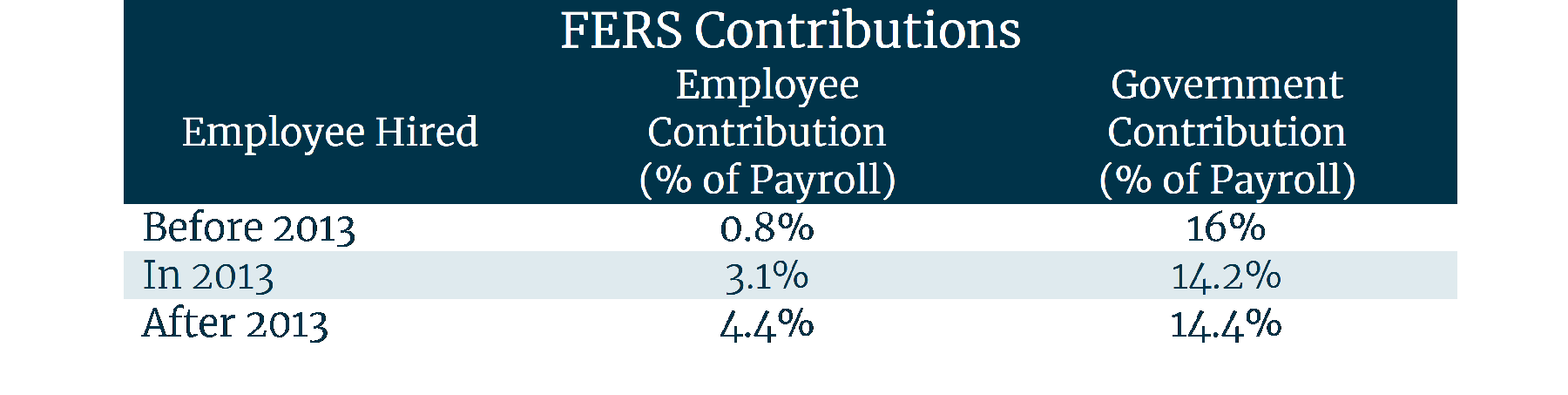
The change from the CSRS to FERS came in the Federal Employee’s Retirement System Act of 1986 which set up FERS as a path for retirement with Social Security. Requiring federal workers to contribute to both CSRS and Social Security would require employees to contribute 13% of their pay to the two programs and duplication of benefits. The rate adjustments for FERS came from the
Middle Class Tax Relief and Job Creation Act of 2012 and the
Bipartisan Budget Act of 2013.
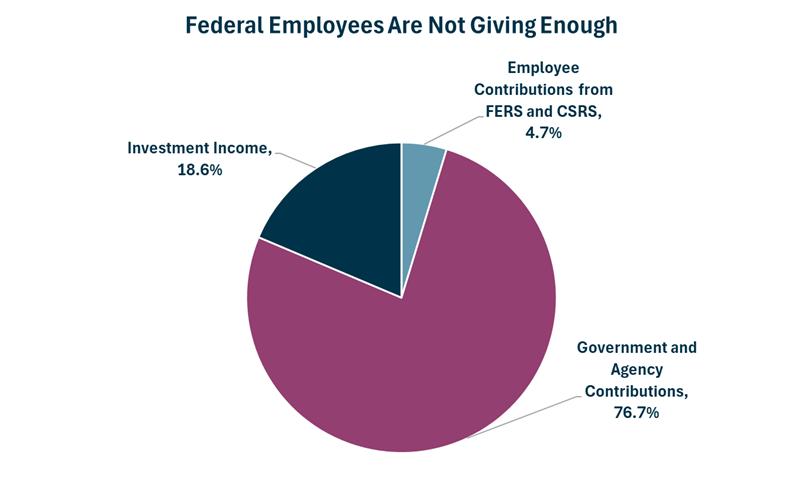
Federal employees enjoy significantly more contributions from the government than they give themselves. In FY 2022, federal employee contributions totaled a mere
4.7% of the CSRDF fund’s income for CSRS and FERS. The remaining 96.2% came from agency contributions, interest, and transfers from the U.S. Treasury. Almost all of these sources ultimately stem from taxpayer dollars.
The average years of service prior to retirement has decreased for federal employees from
40.6 years of service under CSRS to 24.3 years of service under FERS. Retirement after 25 years of work in the private sector is almost unheard of. Additionally, the average retirement age from federal service has also decreased from 65.9 to 63.3 years old. Comparatively, the average retirement age in the private sector has
increased.
As the workforce ages and more and more employees or dependents receive pension benefits, pension payouts will also increase, causing the deficit to rise. While there have been improvements in how much federal employees must contribute, these small changes have not been enough to create a sustainable federal pension system.