



The Subcommittee on Economic Growth, Energy Policy, and Regulatory Affairs Committee on Oversight and Accountability U.S. House of Representatives October 25, 2023
Testimony
Chairman Fallon, Ranking Member Bush, and Members of the Subcommittee, thank you for inviting me to testify today.
Apprenticeships have existed for hundreds of years. They have been associated with economic development by transferring basic skills necessary for technology diffusion and the spread of innovation.[1] However, the apprenticeship model has evolved dramatically alongside the labor market. Today, vocational training and apprenticeships can demonstrably improve labor market outcomes, increase income, and expand social mobility.[2] These outcomes make apprenticeships especially worthy of consideration by policymakers in any economic environment.
That being said, the apprenticeship model is even more relevant today as students continue to recover from the school closures that occurred during the COVID-19 pandemic. My research examining the effects of temporary school closures in U.S. history has found that school closures have a devastating impact on adulthood income by reducing the likelihood that students will be able to access higher-paid occupations.[3] Specifically, I find that missing a school year is equivalent to losing about $70,000 in lifetime income for a worker earning the median wage.
However, these effects are concentrated among disadvantaged students who grew up in lower- income households. Consequently, vocational training – when combined with apprenticeships – presents increased opportunities for the population of students most affected by temporary school closures.
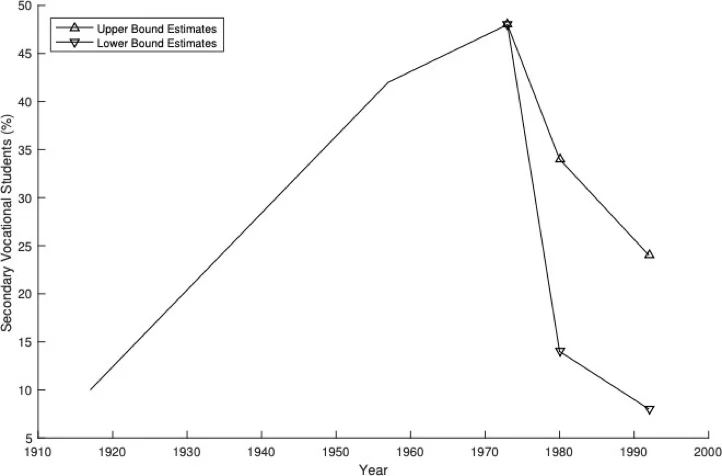
Relative to other countries, the U.S. has limited vocational education.[4] In fact, vocational education in the U.S. has declined since the 1970s (see Figure 1). Between the 1940s and the 1970s, the percentage of vocational students grew from 25 percent to nearly half of the student population. Since the early-1980s, it has declined to less than 20 percent.
Figure 1: Share of Vocational Secondary Students in the United States
Source: Alon (2018)[5]
Most European countries, however, have national policies to foster apprenticeships.[6] For example, Austria, Denmark, Germany, Norway, and Switzerland all have apprenticeship programs that are incorporated into general education. In these instances, students split their time between school and work. There is much we can learn from examining apprenticeship models that have been tried elsewhere.
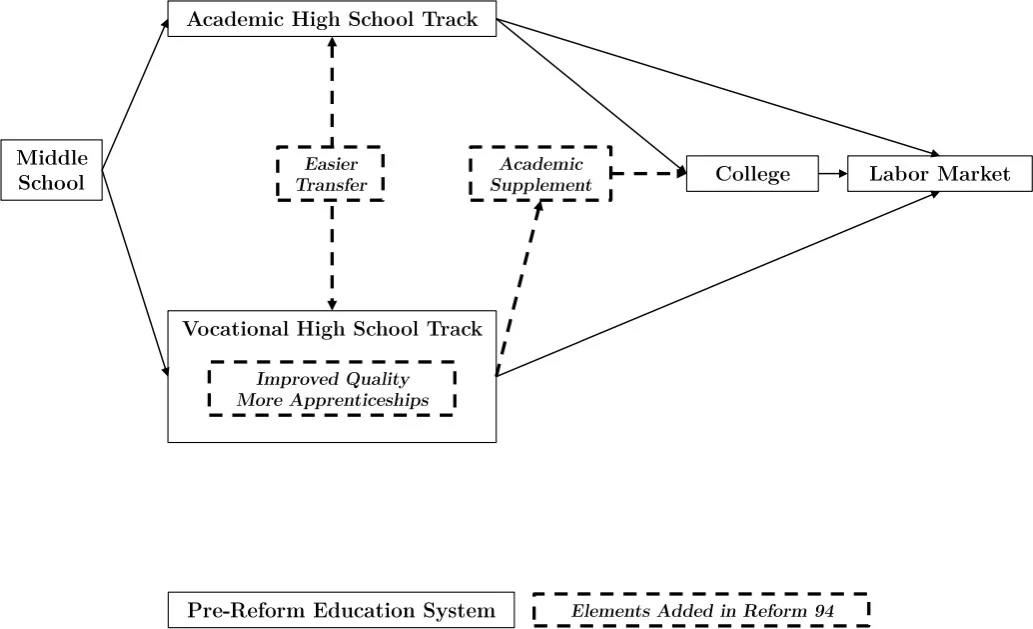
Let us examine one such successful model that has been adopted in Norway. In the 1990s, Norway integrated vocational and general education (this integration occurred roughly at the same time as students in the U.S. are in high school). Norway did this while also expanding access to apprenticeships and providing a path to traditional higher education for vocational students. Using a rigorous statistical analysis, a recent paper published in the Journal of Labor Economics found that these reforms significantly increased continued vocational training in skilled trades.[7] However, they did not have a meaningful effect on college completion, as more male students went into skilled trades (e.g., electrical and construction) while female students went to service-based fields (e.g., sales and communication). The Norwegian model did increase income in adulthood, as well as economic mobility, particularly for men who grew up in households where their parents had lower levels of education and income.
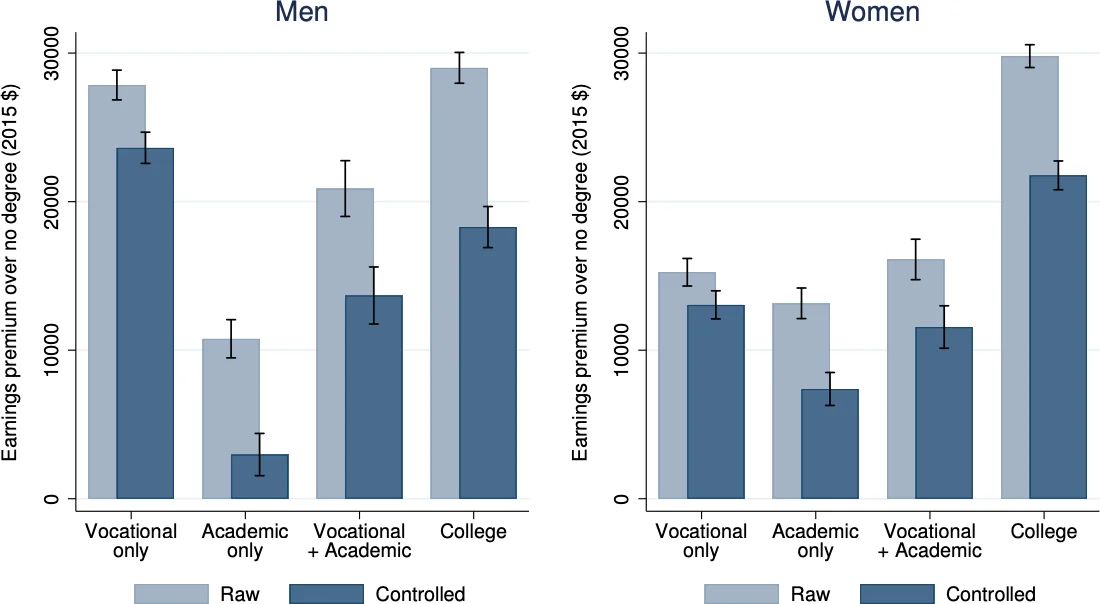
In fact, those with a vocational high school degree were significantly more likely to enter an apprenticeship after graduation following the 1994 reforms.[8] Further, their wage premium while in their 20s and 30s was almost as high as those who earned a college degree and much higher than those who earned only a normal academic high school degree. Put simply, earning a vocational degree and going into an apprenticeship after graduation amounted to almost $30,000 in additional earnings at age 30 compared to those without a high school degree (see Figure 2).
Figure 2: Earning Premia Relative to No High School Degree in Norway Post-1994 Reforms
Source: Bertrand, Mogstad, and Mountjoy (2021)
States with registered apprenticeship programs also provide policymakers with models from which to learn. According to data from the U.S. Department of Labor, there were 241,000 new apprenticeships added in 2021, while 96,000 students graduated from over 25,000 active registered apprenticeship programs.[9] Unfortunately, apprenticeships have been slow to expand into the fields of science, technology, engineering, and math (or STEM). For example, in Wisconsin’s Youth Apprenticeship Program for high school juniors and seniors, only 2 percent of all participating students were in STEM fields during the 2022-23 school year. The highest proportion of students in the Wisconsin program were in the areas of manufacturing (18 percent of students), health sciences (17 percent of students), and agriculture (12 percent of students).[10]
To expand apprenticeships in STEM, the United Kingdom is experimenting with degree apprenticeships that require more traditional academic instruction and are suited to areas such as aerospace engineering. Degree apprenticeships allow students to work within their industry of study while earning a bachelor’s or master's degree, they generally graduate without student debt, and median earnings are more than $40,000 a year while in the program.
Why might similar vocational education and apprenticeship models be successful in the United States? Last year, my colleague Rachel Greszler and I wrote in the Wall Street Journal that younger cohorts (ages 20 to 24) were slow to join the labor market after the U.S. economy began to recover from the initial pandemic-related closures. We also found that this cohort was not going to college at higher rates despite not working. This reflects a reversal of historical patterns because younger cohorts had been joining the labor market and going to school at increasingly higher rates since the recovery from the 2008-09 recession began.
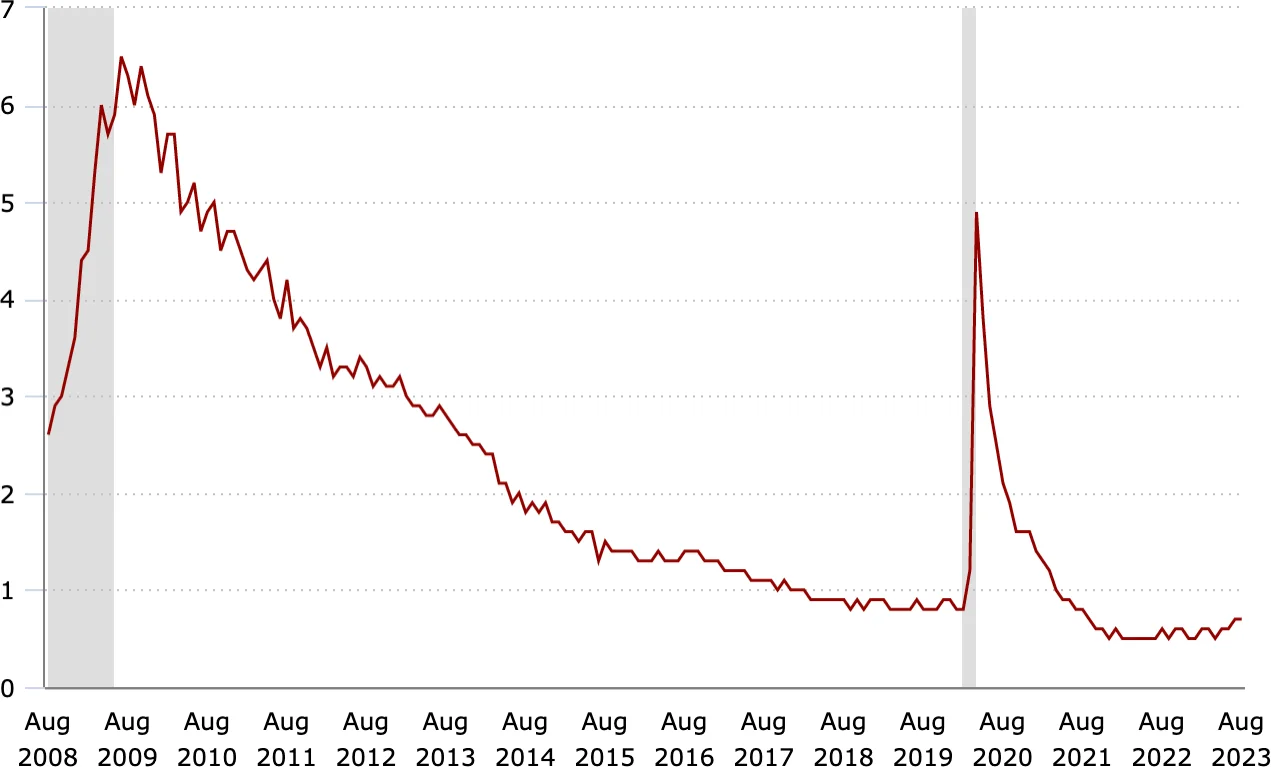
There are two things that make this finding even more profound. First, job openings exceed the number of unemployed people. According to data from the Bureau of Labor Statistics, there have been more job openings than there are unemployed people since May 2021 (see Figure 3). Second, we found that every other age cohort was more likely to participate in the labor market as of last summer compared to before the pandemic. This included teenagers and those over the age of 65.
Figure 3: Number of Unemployed Persons Per Job Opening
Source: U.S. Bureau of Labor Statistics
This is especially concerning given that a growing body of research has demonstrated that labor market disruptions that occur right when workers are typically entering the labor market can have persistently negative effects. The best way to improve one’s own economic condition is to become employed and stay employed. However, not entering the labor market can have effects on wages and job mobility that can take 10 to 15 years to overcome.[11] These persistent effects are also associated with delays in marriage and having children, as well as adverse behavioral conditions such as increased criminal activity, high levels of alcohol consumption, anti-social attitudes, and higher mortality in middle age.[12]
We propose that apprenticeships can help bring people into the labor market by providing a path from vocational education in high school to a job upon graduation. Furthermore, industry-led apprenticeships create an incentive for businesses to invest in skillsets for their workers that increase productivity for the firm, while simultaneously increasing the competitiveness of the worker, which translates into higher wages. In countries where robust apprenticeship programs exist, employment for men under the age of 35 is significantly higher for those who complete a vocational degree compared to a typical general education degree in high school.[13]
This recommendation has appeal across the ideological spectrum. In 2013, a Center for American Progress report noted that apprenticeships increase wages, provide a path to the middle class without a traditional college degree, and provide skills with little to no debt.[14]
In America, an incredible level of resources and attention flows towards higher education. And we do have something to show for it: the premier higher education system in the world. The premium for four-year college degrees has been increasing since the late-1970s.[15] I believe that this is, in part, responsible for the decline in vocational education in the U.S. We treat all students as if the goal is to get them into a four-year degree program regardless of whether earning that degree will pay off or whether their abilities, interests, and motivations would be better served by a vocational path that has only become less traditional over the last 40 years.
The U.S. education system requires more of a focus on vocational learning to be successful for its students. This will require reducing any perceived stigma from vocational education. Over the last 40 years, and since the four-year college wage premium has increased, many scholars have noted that vocational education in the U.S. has tended to segregate economically disadvantaged students from students who grow up in middle- or higher-income households.[16] Furthermore, vocational education has also been seen as an alternative track for underperforming students.[17] In contrast, the Norwegian model of improving the quality of vocational education, while better associating it with a paid apprenticeship on graduation, could help reduce stigma through better realized economic opportunities.
That said, reform must start at the local level, in our high schools and community colleges, and it should involve close partnerships with job creators. This way, America’s students will have access to cutting-edge technical skills and mentorship by leaders in their fields. Fostering such an educational environment has the potential to increase innovation, productivity, and wages for a group of students who are currently being left behind.
The federal government can encourage necessary innovation in the educational system by first doing no harm. During the Trump Administration, the U.S. Department of Labor initiated Industry-Recognized Apprenticeship Programs (IRAPs). The new IRAP model created a pathway for flexible, industry-driven apprenticeship alternatives to the traditional models that had been previously recognized by the federal government. This led to 130 new apprenticeship programs in high-demand fields, including nursing, during a time when our country needed them the most. However, last year, the Biden Administration canceled the initiative and reverted back to the pre-2017 policy that has failed to demonstrate success beyond male-dominated manual labor trades.
I would encourage Congress to revisit the IRAP model, and other successful models of vocational education and apprenticeships, not simply as an alternative to the educational system but as a core element to better prepare students for the evolving economy.
Appendix
Figure A1: Pathways to Labor Market in Norway Before / After 1994 Reforms
Source: Bertrand, Mogstad, and Mountjoy (2021)