On July 4
th, President Trump signed the
One Big Beautiful Bill into law, marking a historic step towards fiscal responsibility and promoting American opportunity. One significant provision of this
bill is the creation of Trump Accounts.
What Are Trump Accounts?
Trump Accounts are a new form of savings account available on behalf of children. Specifically, all U.S. children born between 2025-2028 and who have a Social Security number will qualify for a Trump Account that includes a one-time deposit of $1,000 from the federal government.
Parents, employers, and others can contribute up to a combined $5,000 per year until the child turns 18. Of that amount, employer contributions are capped at $2,500 per year per employee or the employee’s child. Starting in 2028, these $5,000 and $2,500 limits will be indexed for inflation. State and local governments and private charities can also contribute uniform amounts to particular groups of Accounts and their contributions do not count towards the $5,000 annual limit.
These Accounts will not be fully operational until July 2026 and contributions can begin at that time. The Treasury Department will oversee the program, while private banks will handle Account administration.
Investments must be made in mutual funds or exchange-traded funds with a ban on industry or sector-specific indexes. Funds must have
expense ratios of 0.1% or less, requiring indexing to funds similar to the S&P 500.
The Joint Committee on Taxation estimates that Trump Accounts will cost just over
$15 billion through 2034.
Extending the $1,000 federal contribution for children born in and after 2029 would cost another $19 billion through 2034. More than 95 percent of these costs come from the $1,000 federal government contribution and not from any tax advantage.
How are They Taxed?
Individual contributions to a Trump Account are made post-tax, meaning there is no tax advantage for parents to contribute. It is possible that there would be a tax disadvantage on the earnings of parents’ contributions as they will be taxed at ordinary income tax rates instead of at lower capital gains tax rates that would have applied if parents put the money in an ordinary investment account. If the child’s future income tax rate is higher than the parent’s capital gains tax rate at the time of withdrawal, there will be a tax disadvantage. And if the opposite is true and the child’s income tax rate is lower than the parent’s capital gains tax rate, there will be a tax advantage.
Employers may contribute up to $2,500 per year per child in tax-free contributions to the Trump Account of each employee’s child(ren) or to the Trump Account of a teenage employee (applicable to children born in 2025 and later who have Accounts and become working teens). Nonprofit 501(c)(3) organizations and state and local governments may also make tax-free contributions to Trump Accounts as long as those contributions are made on an equal basis to a general class of beneficiaries, such as all children living in a certain geographic area. While these contributions are tax free upon deposit, the initial contribution and all future earnings from them will be taxed at ordinary income tax rates upon withdrawal.
No withdrawals may be made before the year the beneficiary turns 18. On January 1
st of the year the beneficiary turns 18, they may begin withdrawing funds from the Account. Beginning at age 18, and individual’s Trump Account is treated like an IRA. The withdrawn funds are subject to income taxes and, if withdrawn before the age of 59 and a half for a non-qualified expense, an additional 10% penalty. Exemptions generally match the traditional IRA early withdrawal exemptions. Some examples of
qualifying exemptions include purchasing a first home, disaster recovery from a federally declared disaster, birth and adoption expenses, and college and other educational expenses.
If an individual waits until 59 and a half years old before withdrawing funds, then they can withdraw money for any reason without being subject to the 10% penalty.
Comparison to Other Savings Accounts
Trump Accounts are effectively a combination of a traditional IRA, a ROTH IRA, and an interest-bearing savings account.
Contributions made by employers, the original $1,000 contribution made by the federal government (taxpayers), and any potential contributions from state and local governments and charities are like a traditional IRA—the contributions are tax-free and the withdrawals of those contributions plus their earnings are taxed at ordinary income tax rates.
Contributions from individuals (such as a parent or family member) are like a Roth IRA in that the contributions are taxed before being deposited into Trump Accounts and the original contribution amount is not taxed upon withdrawal, so long as it is for a qualified expense. However, unlike a Roth IRA that allows the earnings of pre-taxed contributions to also go untaxed, the earnings that accumulate from an individual’s pre-taxed contributions are not only subject to taxes, but are—similar to interest income in a savings account—taxed at ordinary income tax rates instead of lower capital gains tax rates.
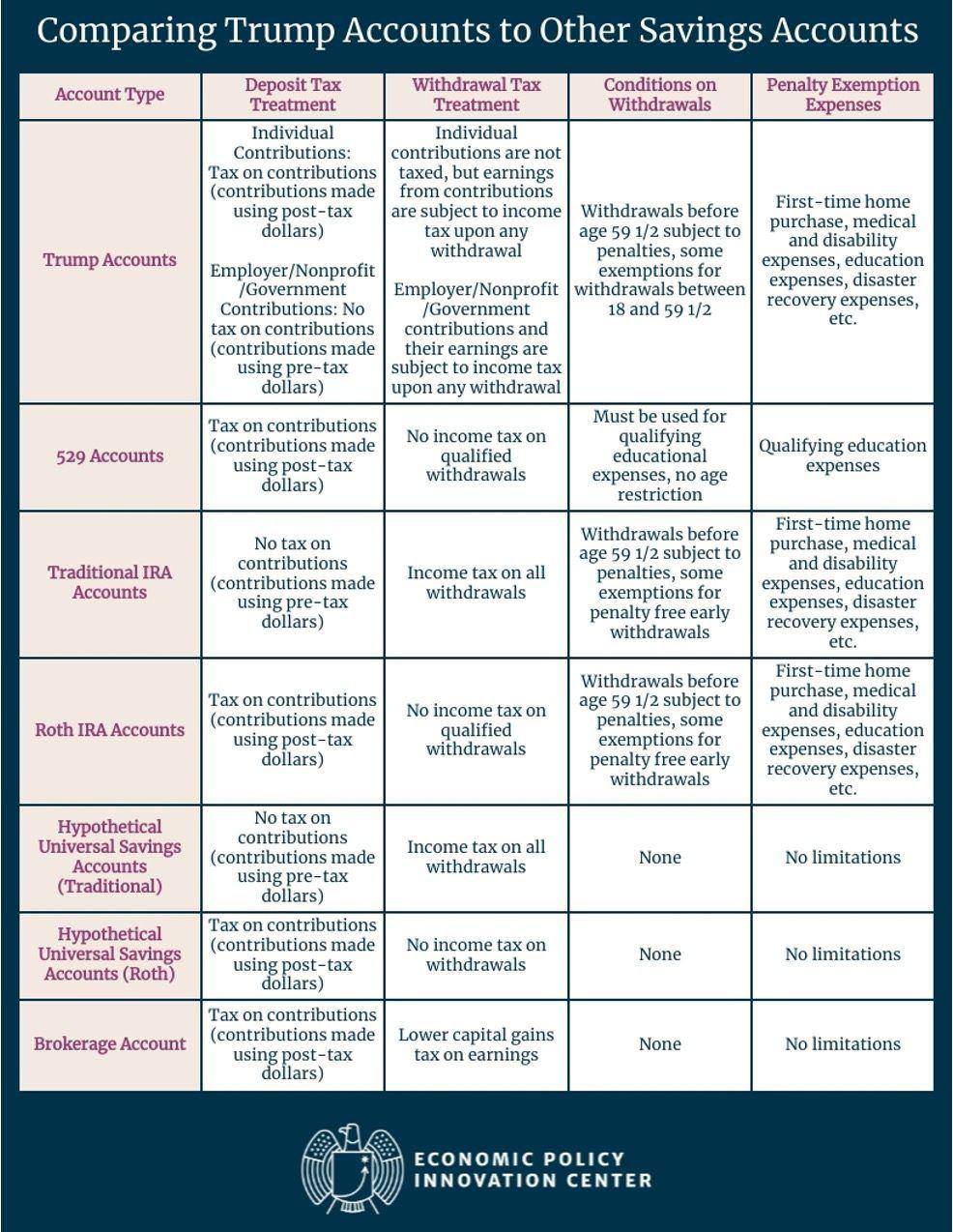
The main incentives to open a Trump Account are not the personal savings components, but the opportunity for contributions from other sources including: the $1,000 contribution from the federal government for children born between 2025 and 2028, potential employer contributions on behalf of the children of employees, and potential state and local government and charitable contributions. While that may seem attractive, other savings accounts provide a better investment vehicle for parents to maximize return on after-tax investments for their children.