Chairman Roy, Ranking Member Scanlon, and Members of the Subcommittee, thank you for inviting me to testify today.
It is a particular honor to join
this subcommittee given the critical moment in our nation’s conscience when we are called upon to address a growing fiscal crisis that threatens our constitutional prerogatives.
We are $38.4 trillion in debt.
[1]
To put this into context, our debt translates to approximately $288,000 per household across America. More than 60 percent of this total amount (in real, inflation-adjusted terms) occurred over the past 18 years, since the Obama Administration took office. We have added more debt during and since the Obama Administration than over the prior two and a half centuries, including the Revolutionary War, Civil War, and two World Wars.
This is wildly unsustainable, and it continues to grow at an alarming rate.
A Founding Question
Our Founding Fathers would be aghast – but I fear they may not even be surprised. In fact, they were exceedingly concerned about the detriment caused by high national debt. They just fought a war because the Kingdom of Great Britain didn’t know how to balance its books and Mad King George thought – wrongly, I might add – that the solution would be to raise revenues by raising taxes on the colonies.
I’ll spoil the story for you. It didn’t end well for the British. Or for tea drinkers.
What the Founding Fathers learned in a quite tangible way is that debt is dangerous.
[2] It is dangerous because it removes the ability of the government to adjust in times of need or respond to an existential threat. It is dangerous because it leads to squeezing the pocketbooks of the people beyond reason. It is dangerous because it is inflationary.
It is dangerous – perhaps most interestingly to this subcommittee – because it implies that government has gotten so large, so unwieldy, so involved in the people’s daily lives that the only way to sustain it is to deficit spend.
In other words, a failure to balance the budget is not just about what we see on CBO’s spreadsheets. It’s a signifier of the growing scope and scale of government interference.
You invited me here today to talk about a potential Balanced Budget Amendment to the Constitution. I recognize that the Constitutional jurisdiction of this Subcommittee is ostensibly the main topic of the day given that we are discussing an amendment, but I would like to encourage the Members at the dais to reframe your thinking. Because first, I would like to address the other part of this Subcommittee’s jurisdiction: the “Limited Government” piece.
What is the purpose of this debate? Is it to have balance on paper? We can achieve that with accounting and appropriations gimmicks.
Or is the purpose to stave off the debt spiral my colleague Dr. Paul Winfree warns us is coming? Because we can do that with simple cuts – they may not be politically popular, but the math would work. And Dr. Winfree is certainly right to warn us of the major negative implications of that coming fiscal crisis.
But I would like to start us not with the “what if” and “how” questions. Rather, I’d like us to first consider the “why” of this hearing.
I suggest to you that the purpose of “balancing the budget” is to make government spending match the peoples’ priorities. That activity is inherently American and inherently tied to the philosophy of limited government and individual liberty.
We all know the federal budget is bloated. It is rife with waste, fraud, and abuse. For example, GAO recently reported that the federal government has made nearly $3 trillion in improper payments since 2003.
[3] In fiscal year 2024, the biggest offenders, as has been the trend, were major autopilot spending programs, including Medicare and Medicaid. Together, those accounted for over half – 53 percent – of government-wide improper payments. Simply addressing this major problem would be a step in the right direction toward balance.
But there is an underlying, more nuanced problem we must tackle in any balanced budget debate. There is simply too much government. Not all of it is blatantly corrupt or wasteful or fraudulent. In fact, much of it is just not necessary for the government to do – which means it is not necessary for Congress to fund.
Is every outlay of Americans’ dollars a prudent way to act within the bounds of individual liberty and limited government? This is the foundational question to consider when budgeting.
In Federalist 41, Madison reminds us to be cognizant of the limitations built into the Constitution, writing:
“THE Constitution proposed by the convention may be considered under two general points of view. The FIRST relates to the sum or quantity of power which it vests in the government, including the restraints imposed on the States. The SECOND, to the particular structure of the government, and the distribution of this power among its several branches. Under the FIRST view of the subject, two important questions arise: 1.Whether any part of the powers transferred to the general government be unnecessary or improper? 2.Whether the entire mass of them be dangerous to the portion of jurisdiction left in the several States? Is the aggregate power of the general government greater than ought to have been vested in it?” [4]
According to the Federal Register, there are 444 federal agencies at present.
[5] Each and every one of these agencies and all of their activities and employees are funded by the taxpayer. Is it possible that all of that unrestrained power is necessary and proper for the federal government to exercise? I would readily argue the opposite.
Every dollar spent grows the government. And that grows incursions into the lives and freedoms of the American people. It is an overextension not only of our means – and we will get to that very important part of the discussion –, but also of what the government can and should do.
Ultimately, any debate on a balanced budget must be seen as a moral and philosophical fight against the tyranny from within. Freedom must prevail, and that begins with taxpayers not being manipulated into handing it over along with the contents of their wallets.
Balancing for the Sake of the People
Given the purpose of our mission, balance must be designed for the sake of the people, not simply as an accounting mechanism. That should guide
what is balanced programmatically, but the question of
how much is needed is relatively clear.
In fiscal year 2025, the Congressional Budget Office projects we will bring in $5.2 trillion in revenues, but outlay $7.0 trillion. That leaves us with a deficit of $1.9 trillion.
[6]
A major part of the problem is that mandatory (or, “autopilot”) spending has grown from 33 percent of outlays in fiscal year 1964 to 73 percent in fiscal year 2024. That means, including net interest payments, Congress does not actually review 73 percent of what it spends in taxpayer money each year.
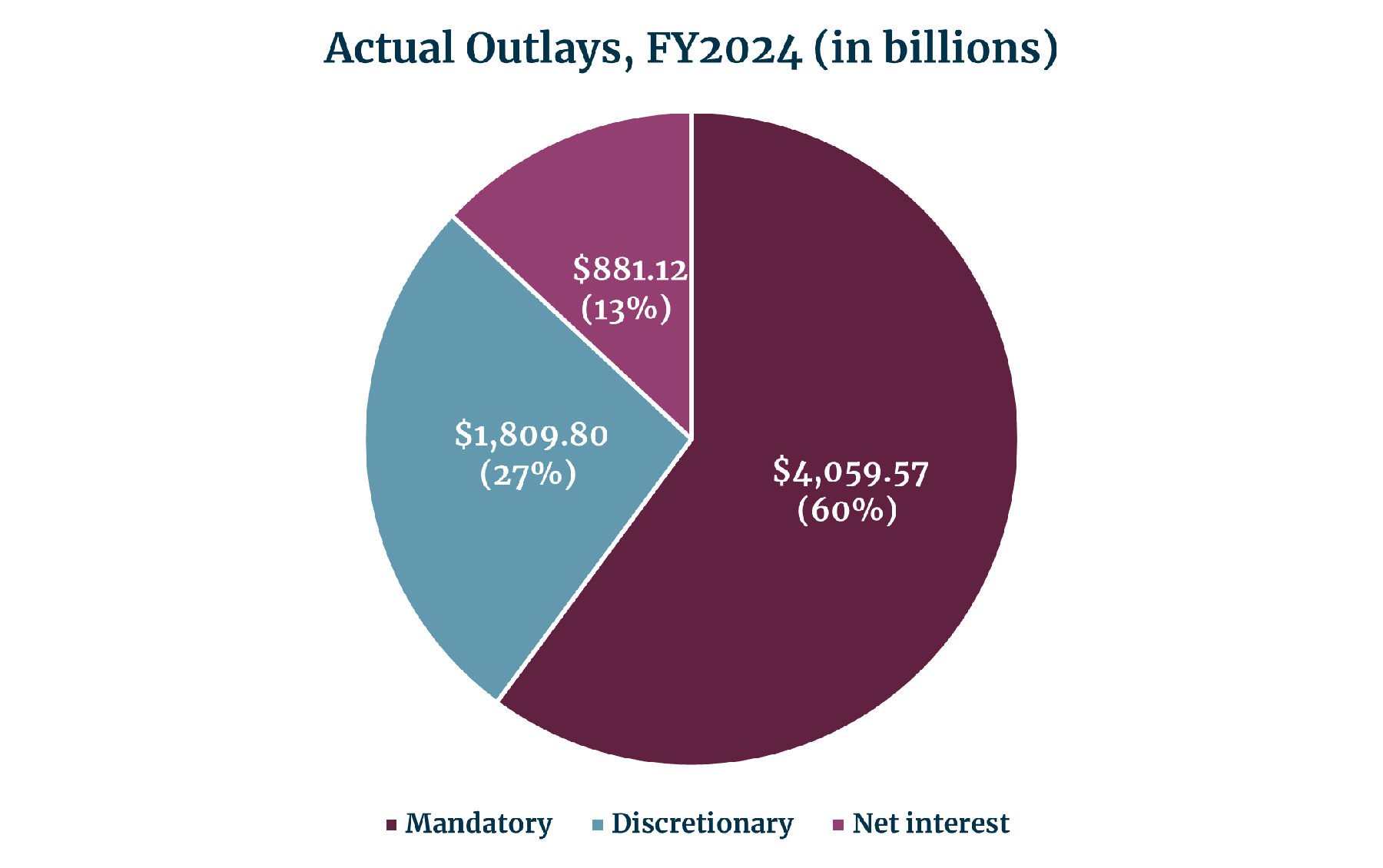
Source: Author’s chart using CBO baseline data.
[7]
This is certainly a worrying prospect if we are expecting the government to only exercise necessary and proper authorities. Quite the opposite – there seems to be little to no oversight of the scope and scale of government.
This alone – not to mention our $38 trillion debt picture – should precipitate Congressional action on a Balanced Budget Amendment.
Adding to this quandary is just how much taxpayers are being forced to spend to make interest payments on our national debt. The U.S. Department of the Treasury pegs fiscal year 2025 interest payments at $1.22 trillion.
[8] There are only 16 countries in the world – other than the United States itself – with GDPs greater than our interest payments.
[9]
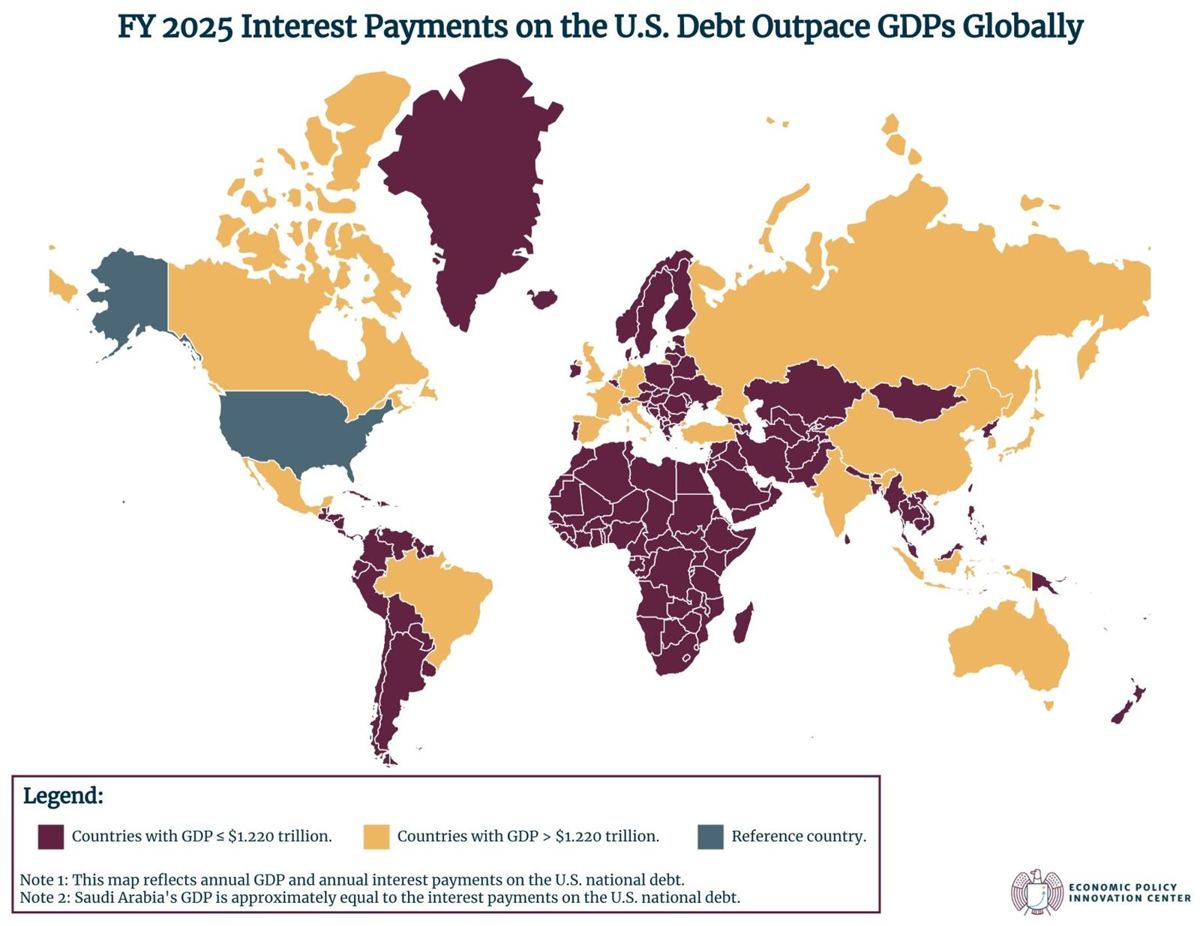
Our debt is out of control because our spending is beyond reason.
If nothing else, a Balanced Budget Amendment would push Representatives of our Republic to critically and thoughtfully reexamine, on a regular basis, whether our spending matches Americans’ priorities, is within taxpayers’ means, and is in line with the limited government promises of the Founders.
Why do I believe this somewhat severe way of handling imbalance is necessary? Because I was here as a staffer 10 years ago, bright-eyed and bushy-tailed, believing that the budget resolution alone could get us to balance.
I’m not too proud to admit that I was wrong.
In early 2016, I was working for a Member of this Subcommittee, Congressman McClintock. He charged me with working on a memo he later released to his colleagues on ways “to restore budget discipline” while we were considering the fiscal year 2017 budget resolution. I would like to read to you from that memo, which Mr. McClintock published on March 3, 2016.
[10] He wrote:
“The budget now before us spends $1.070 trillion and balances in 2026 – but ONLY if we summon the discipline to stick to the budget in future years that has eluded us again this year. Maintaining budget discipline becomes particularly crucial given the deteriorating economic picture.”
As everyone in this room knows, Congress did not, in fact, maintain the budget discipline necessary to balance by 2026. Here we sit today, a few months into fiscal year 2026, and our deficit is not $0. No, it is about $2 trillion.
I share this as a cautionary tale as a realist, but also as a willful optimist. Because there is a pathway out of this: a Balanced Budget Amendment that
requires fiscal discipline even when it is politically unsavory.
A Balanced Budget Amendment is an important tool for fiscal restraint. Unfortunately, we have come to a point where we cannot trust that Congress or a future president has the political fortitude to make difficult decisions and reduce spending.
It is time to consider ways to build that safeguard into the Constitution itself – or risk undermining the entire document.
Pitfalls to Avoid
Congress should consider three major pitfalls to avoid when drafting a Balanced Budget Amendment.
- Abdicating Article I powers.
- Failing to remember that we have a spending problem, not a revenues problem.
- Lacking any real enforcement mechanism.
Protecting Article I. There have been several iterations of Balanced Budget Amendments proposed in recent years. Some of those require a presidential signature on the annual Congressional budget, converting the budget resolution into a budget act. This would reduce the Congressional prerogative of the power of the purse significantly, abdicating spending and revenue authority to the Executive. The more this occurs, the less the people are in control through their elected Representatives.
A Spending Problem, Not a Revenues Problem. Some will argue that a Balanced Budget Amendment can be achieved not only by limiting spending, but by raising revenues. Let me be clear: we have a spending problem, not a revenues problem. The federal government is overextended and raising revenues ostensibly to “balance” is not balancing the budget with the intention of the people in mind whatsoever. It is, instead, an excuse to tax more and grow government more. Taxes for this purpose are theft with the intent of causing further harm by using those same dollars to infringe upon personal liberty, and should be admonished as such. Every dollar in deficit spending is a future tax.
Giving It Teeth. This is perhaps the greatest challenge in constructing a responsible Balanced Budget Amendment. Without an enforcement mechanism, what is to hold Congress to account? There must be an automatic response in place that limits – not just in theory, but in practice – spending.
These are the main three pitfalls to avoid. There are other considerations that must be settled, such as how quickly an amendment should take effect, whether balance should be annual (as I believe) or on another timeline, and whether we should consider the debt to GDP ratio rather than outlays to revenues. All of these are valid questions, but none matters if the first three concerns I have presented – and the ultimate “why” I discussed earlier – are not established as the foundation before the rest of the details are drafted.
Conclusion
As we approach America’s 250
th anniversary, I encourage you to have the heart of a scrappy startup once again. Let’s not be like the British following the French and Indian War, so desperate to get out from under their crushing debt they restricted freedom and raised the taxes that spurred a revolution in a failed attempt to hold onto monarchical power.
Big government through big spending was not the answer in 1776, and it is not the answer in 2026.
Let’s instead follow the advice of Thomas Jefferson, who wrote, “I would be willing to depend on that alone for the reduction of the administration of our government to the genuine principles of its Constitution.” He was speaking, of course, about a new article to be added to the Constitution – one that limited the federal government’s borrowing power, which he rightfully saw as a means to overspend and overexert the power of the government.
A government that spends too much insists upon itself. Instead, we should insist that government bend to the will of the people.
We have grave challenges in front of us. But we also have an opportunity. Now is the moment to advance a responsible Balanced Budget Amendment that emphasizes fiscal restraint, reasserts Article I, admonishes raising taxes as a cure-all, holds the government accountable, and potentially, saves the country.
Thank you, and I look forward to your questions.
[1] U.S. Department of the Treasury, FiscalData, “America’s Finance Guide: Debt,”
https://fiscaldata.treasury.gov/americas-finance-guide/national-debt/ (accessed December 2, 2025).
[2] Dr. Paul Winfree, Economic Policy Innovation Center “America’s Overwhelming Debt: Not the Founding Fathers’ Vision,” July 3, 2025,
../../federal-budget/americas-overwhelming-debt-not-the-founding-fathers-vision/ (accessed December 2, 2025).
[3] U.S. Government Accountability Office, “Improper Payments: Information on Agencies’ Fiscal Year 2024 Estimates,” March 11, 2025,
https://www.gao.gov/products/gao-25-107753 (accessed December 2, 2025).
[4] James Madison,
Federalist Papers, “Federalist No. 41,”
https://guides.loc.gov/federalist-papers/text-41-50#s-lg-box-wrapper-25493409.
[5] National Archives and Records Administration, Federal Register, “List of Agencies,”
https://www.federalregister.gov/agencies (accessed December 2, 2025).
[6] Congressional Budget Office, “Budget,”
https://www.cbo.gov/topics/budget (accessed December 2, 2025).
[7] Congressional Budget Office, 10-Year Budget Projections, January 2025,
https://www.cbo.gov/data/budget-economic-data#3 (accessed December 2, 2025).
[8] U.S. Department of the Treasury, FiscalData, “America’s Finance Guide: Debt,”
https://fiscaldata.treasury.gov/interest-expense-avg-interest-rates/ (accessed December 2, 2025).
[9] Brittany Madni, Economic Policy Innovation Center, “Interest Payments on the Debt Outpace Most Countries’ GDPs,” December 3, 2025, ../../federal-budget/interest-payment…t-countries-gdps/ (accessed December 3, 2025).
[10] U.S. Congressman Tom McClintock, U.S. House of Representatives, Memorandum to Interested Colleagues, “Rules changes to restore budget discipline,” March 3, 2016,
https://mcclintock.house.gov/newsroom/press-releases/rules-changes-to-restore-budget-discipline.