Coronavirus State and Local Fiscal Recovery Funds
As part of President Biden’s American Rescue Plan Act (ARPA), the Coronavirus State and Local Fiscal Recovery Funds (SLFRF) program is authorized to send $350 billion to state, local, territorial, and tribal governments.
[1]
These federal funds are intended “to support [the state and local] response to and recovery from the COVID-19 public health emergency,” according to the U.S. Department of the Treasury, which administers the program.
[2] Unfortunately, much of this funding has not been used for projects that are directly related to the COVID-19 pandemic even by the most generous definition of “response and recovery.”
SLFRF Adopted Budget and Obligations through June 2023
| Expenditure Category |
Adopted Budget |
Obligations |
| Revenue Replacement |
$100 billion |
$90 billion |
| Negative Economic Impacts |
$72 billion |
$60 billion |
| Infrastructure |
$30 billion |
$19 billion |
| Public Health |
$24 billion |
$18 billion |
| Public Sector |
$9 billion |
$7 billion |
| Premium Pay (Public Sector) |
$3 billion |
$3 billion |
| Administration |
$3 billion |
$2 billion |
| Total |
$241 billion |
$198 billion |
Note: Figures rounded to billions.
Source: Department of the Treasury.
$100 billion of the SLFRF has been approved for state and local revenue replacement even though these governments have considerable financial reserves.
[3] According to the Government Accountability Office (GAO), thirteen states have used more than half of the SLFRF funds to replace revenue while seven states haven’t used any funds to replace revenue.
[4]
Growth in State and Local Tax Revenues After Financial Crisis and the COVID-19 Pandemic
|
One Year Later |
Two Years Later |
| 2007-08 Financial Crisis |
-5.1% |
-2.2% |
| COVID-19 Pandemic |
13.2% |
24.0% |
Note: Relative to base year (2008 for financial crisis, 2019 for COVID-19 pandemic)
Source: Bureau of Economic Analysis
Between 2020 and 2022, the National Association of State Budget Offices (NASBO) estimated that state rainy day funds have doubled to $164 billion.
[5] State budgets increased more in 2022 in both nominal and real terms relative to any other year since 1979.
[6] Meanwhile, state and local revenues have increased by 24 percent since the pandemic began. The table above compares this increase to the 2.2 percent reduction in revenues that occurred over the same period after the 2007-08 financial crisis.
It has become clear over the last few years that far too much money has been directed to state and local governments to cover revenue shortfalls that never materialized in part due to shifting work from home during the pandemic and rising property values. These transfers reflect an overcorrection from the 2007-08 financial crisis that left state and local revenues depleted. The reality, however, is that state and local governments today are flush with cash – even without federal assistance.
Based on current estimates, there is still about $90 billion in SLFRF funding that has not been approved through an adopted budget. Furthermore, states and local governments have obligated only 56 percent of the total appropriation for the program.
Underlying Problems with the SLFRF
Available data on the SLFRF expenditures Treasury has approved suggest that there are several reasons for concern.
[7] For example, millions of dollars worth of projects fail to meet basic reporting requirements and, according to the data, these are serving zero households.
[8]
Beyond that, the SLFRF is funneling taxpayer money into projects that have limited connections (at best) to the COVID-19 pandemic. For example, more than $185 million has been approved for projects related to golf courses (such as updating irrigation systems or buying golf carts), more than $400 million has gone to improve swimming pools, almost $80 million has gone to sports stadiums, $34 million has gone to building tennis and pickleball courts, $10 million has gone to rodeos, and one town even got $15 million to install showers and a commercial kitchen at a site to host the circus and local flea market. $4 million even went to the Field of Dreams in Iowa where Major League Baseball hosts its annual late-summer game!
The SLFRF has also been used for politically controversial purposes. For example, the Treasury Department has approved $4.2 million to provide legal services for immigrants, refugees, and asylum seekers in Illinois. Another $12 million has been approved to provide housing for refugees and asylum seekers in Massachusetts and $2.2 million has been approved to provide a community space for asylum seekers crossing the Southern border into Arizona. The SLFRF is also being used to fund diversity, equity, and inclusion (DEI) coordinators in at least three states whose job is to apply for additional grants from the federal government.
Then there is just crazy spending. For example, $16 million went to New Mexico to run a lottery for people who received a COVID-19 vaccine. There is also much that we do not know simply because the reporting, including by Treasury, has been so poor.
How is this possible? The Treasury Department does not just enable it; the agency is actively encouraging this sort of taxpayer abuse. A key pathway to SLFRF funds is through an option called “revenue replacement.”
According to the Treasury’s 2022 final rule on the program, SLFRF dollars can be used by state and local governments to “[r]eplace lost public sector revenue, using this funding to provide government services up to the amount of revenue lost due to the pandemic.”
[9]
Taken altogether, Treasury’s management of SLFRF dollars verges on malfeasance at best.
Changing the Definition of an Obligation
In a time-honored Washington tradition of publishing rules immediately before major holidays to obscure transparency, the Department of Treasury issued an interim final rule (IFR) amending the definition of an obligation for the Coronavirus State and Local Fiscal Recovery Funds (SLFRF) on the weekend before Thanksgiving.
[10]
For the purposes of funding provided by the SLFRF, an obligation is “an order placed for property and services entering into contracts, subawards [subcontracts], and similar transactions that require payment.”
[11]
Treasury’s new IFR – or the “Hoarding Rule” because it allows states and local governments to hoard the remaining money – amends this definition to include any additional costs of “terms and conditions” that are associated with approved programs and activities. These can include several requirements with which state and local governments may have to comply to spend the money. Specifically, it covers:
- Reporting and compliance requirements
- Single audit costs
- Record retention and internal control requirements
- Property standards
- Environmental compliance requirements
- Civil rights and nondiscrimination requirements
In a slideshow presentation provided on the IFR, Treasury explains in Case Study #1 that personnel costs can be covered within the above buckets.
[12] Thus, the tens of thousands of dollars paid in local bureaucrats’ salaries to administer SLFRF funding would be eligible under the Hoarding Rule. The possibilities for how these dollars could be spent are vast; we are yet to see a limitation on how state and local governments are to interpret reasonable parameters for meeting these “terms and conditions” requirements.
In essence, Treasury is offering a slush fund pathway to state and local governments as a way to ensure at least the covered billions of SLFRF dollars are not left on the table when it could be spent on the salaries of local bureaucrats and other loosely administrative or compliance expenses. Thus, by April 30, 2023, Treasury would be able to claim these dollars have been “obligated” regardless of the legitimacy of that “obligation” thereby protecting funds from future recessions or repurposing by Congress.
According to Treasury, the Hoarding Rule “also clarifies that recipients may continue to charge their current negotiated indirect costs rate agreement established with their federal cognizant agency or the de minimis rate of 10 percent of modified total direct costs pursuant to 2 CFR 200.414(f), after December 31, 2024, through December 31, 2026.”
[13]
This is a departure from the 2022 SLFRF Final Rule, which requires: “Further, funds must be obligated by December 31, 2024, and expended by December 31, 2026. This time period, during which recipients can expend SLFRF funds, is the ‘period of performance.’”
[14] Under the Hoarding Rule, funding is now also considered “obligated” if it is in a covered administrative use outlined above and reported (not contracted) to Treasury by April 30, 2024, regardless of whether it would originally have missed the December 31, 2024, obligation deadline.
The High Cost of the Hoarding Rule
Unfortunately, the agency has failed to properly report, or enforce reporting requirements, on SLFRF dollars moving through the obligation process at each level. As such, it remains somewhat unclear precisely how much money is still available. However, we can draw some conclusions about which funding is likely affected.
Given that state and local governments have not obligated about 44 percent – or $152 billion – of SLFRF money on their level, we can presume that Treasury is carving out a safety net to ensure these dollars are considered out the door and unreachable (we will return to why this is important shortly). So just how much is walled off by the Hoarding Rule?
Based on the most recent data from Treasury, approximately $90 billion of the original $350 billion appropriation has not been approved through an adopted budget – this pot would likely be impacted by the Hoarding Rule.
[15] Even if only about 10 percent of the remaining funds are used for the narrowest version of “administrative” uses covered under the rule, that leaves at least $9 billion of affected funds.
Of the $240 billion Treasury has approved for SLFRF projects, only $198 billion has been obligated by the state and local governments. This leaves $42 billion unobligated by state and local governments. Even if we take only 10 percent of this $42 billion as “administrative” (again relying on the most conservative interpretation of the Hoarding Rule, which Treasury cannot be trusted to use), that leaves over $4 billion on the table.
Under the rule change, it would be reasonable to consider more than $13 billion as newly “obligated” to meet the “terms and conditions” of spending other SLFRF award dollars.
Taken together, at minimum, we must conclude that around $13 billion would be swept up in the “administrative” use obligation carve-out under the Hoarding Rule.
Treasury’s Tactics
At 8:45 am Friday, with no other announcement but a link at the bottom of an obscure page on the department’s website, Treasury released the unpublished rule.
[16] This is just the latest in a series of instances of the Biden Administration dropping major rule changes the Friday before a big holiday.
Normally, a rule would have at least a 30-day comment period before taking effect, with major rules requiring a 60-day comment period and advanced notice to Congress.
However, the Treasury quietly released the Hoarding Rule at 8:45 am Friday, November 17, 2023, and set its effective date for Monday, November 20, 2023.
[17]
This rule will have wide-reaching, significant economic impacts. We know this because the fiscal impacts alone must be multi-billions of dollars. But Treasury chose to ignore the procedures that would require the agency to slow down.
CRA Violation: Major Rule with Major Impact
Treasury claims in the IFR: “This rule is not a major rule for purposes of the Congressional Review Act (5 U.S.C. 801 et seq.).”
[18] That’s it, no further explanation was given or deemed necessary.
Major rules are economically significant and must provide time for Congressional review before finalization.
[19] The Congressional Review Act (CRA) also requires the involvement of the Government Accountability Office. Claiming the Hoarding Rule is not a major rule enables Treasury to sidestep several crucial steps in the rulemaking process.
The definition of a “major rule” under the CRA is one that has an annual economic effect of at least $100 million or meets other enumerated standards. Given that the Hoarding Rule is dealing in billions of dollars – at least covering about $13 billion – on the fiscal effects alone, there is no reasonable way to claim that there is not an economic impact of at least $100 million. According to the Congressional Research Services, “[r]ules can meet the economic threshold for classification as a major rule… for a variety of reasons, including because they involve compliance costs, result in transfers of funds, prompt consumer spending, establish user fees, or result in cost savings for consumers and taxpayers.”
[20] This is precisely what is happening under the Hoarding Rule.
By sidestepping the major rule classification, Treasury can skip Congressional reporting prior to publication and the Hoarding Rule can take effect without delay.
Congress should take note of the Department’s attempts to go around proper procedure and Legislative Branch involvement here and take action. Regardless of whether a rule is major or non-major, Congress has the right and ability under the CRA to overturn any final rule.
APA Violation: Failure to Meet Good Cause Standards
As Treasury’s justification for dropping the Hoarding Rule with barely any advance notice and no advanced public comment period, the Department claims the “good cause” exception to the ordinary requirements of the Administrative Procedure Act.
In contrast to Treasury’s usage in the Hoarding Rule, the “good cause” exception for skipping ordinary APA notice and comment period requirements is intended to be narrow.
[21] Previous examples of a “good cause” exemption include national security events, pandemics, and other unforeseeable emergencies and disasters that require immediate response.
The law is explicit in the narrow use of the exception, as found in 5 U.S.C. § 553(b)(3)(B); (d): “when the agency for good cause finds (and incorporates the finding and a brief statement of reasons therefor in the rules issued) that notice and public procedure thereon are impracticable, unnecessary, or contrary to the public interest.”
[22]
Claiming “good cause” is not acceptable simply because an agency failed to take timely action or believes a policy is important. And yet, that appears to be the case with the Hoarding Rule.
Treasury claims it has a right to the “good cause” exception because it failed to act quickly and thinks the policymaking is important: “Congress authorizes recipients to use SLFRF funds for costs incurred for eligible purposes by December 31, 2024. Given the rapidly approaching deadline, there is an urgent need for recipients to undertake the planning necessary for sound fiscal policymaking…”
[23]
With this move, Treasury is not only abusing taxpayers’ money and infringing on Congressional authority; it is also walking all over the APA.
With such a ramshackle approach to the process required under the APA, and a weak set of arguments to justify it, Treasury must have a reason for its actions. So why the rush? If there was no nefarious intent, the Biden Administration would have no need to behave the way it has.
Unpacking the Why: Legislative Implications of the Rule
There are several potential reasons why Treasury would push the Hoarding Rule out with little notice and in such an urgent way. We will explore three such options and the legislative implications of each.
I. Wall off funding from Congressional rescission.
Congress holds the power of the purse under Article I, Section 9, Clause 7 of the U.S. Constitution, which enables it to make appropriations.
[24] As part of this process, Congress provides budget authority in law. Congress can also take back those dollars through rescissions of unobligated balances, which cancels budget authority. These rescissions are scored by the Congressional Budget Office as savings in the federal budget.
[25] However, once fully obligated, Congress is no longer able to rescind the funds.
If we assume that just over $13 billion in funding would be considered newly “obligated” under the Hoarding Rule’s most conservative interpretation, that ostensibly blocks Congress from rescinding or repurposing the money. For context, the U.S. House of Representatives recently considered a funding package of similar size to provide aid for Israel. Speaker Mike Johnson insisted the package be offset; this means there is concern that Congress would be looking for unspent money to rake back in as a way to “pay for” foreign aid spending in a year-end package.
COVID-19 spending is unpopular with Republicans who hold the majority in the House and would likely be a viable offset option for major supplemental “emergency” spending at the end of the calendar year. It would also likely be a popular set of funds to review as Congress approaches the end of the current continuing resolution at the beginning of 2024.
[26]
The Administration could feel that SLFRF dollars are at high risk of repurposing. Any Congressional oversight of the mismanagement of the funds would likely only increase the chances of Congressional Republicans pushing for the spending to be restrained. Thus, it would be in Treasury’s interest to protect unspent ARPA dollars against a possible rescission.
II. Align with state legislative calendars.
Treasury notes in the IFR that it was partially motivated to issue the Hoarding Rule in response to commentary by state and local governments as they attempt to spend SLFRF dollars: “Recipients have identified for Treasury that they anticipate difficulty using SLFRF funds to satisfy administrative and other legal requirements applicable to the SLFRF program after the obligation deadline has passed.”
[27]
State legislature sessions typically begin at the start of the calendar year, often in January.
[28] It is likely that Treasury sees this as a soft deadline that the agency needed to beat to give state governments time to set up a plan for expenditure proposals. In particular, if state and local governments intend to use SLFRF money for revenue replacement projects, those would need to be “planned” before they can submit their requests and have Treasury approve the budgets.
The latest available guidance requires SLFRF recipients to report to Treasury by April 30, 2024, on anticipated expenditures under the Hoarding Rule.
[29] This deadline gives state and local governments approximately six months to come up with a way to spend currently unobligated funds. Conveniently, the funds do not actually have to be spent by the reporting deadline, merely reported as planned eligible spending.
III. Gain political wins prior to general election season.
As 2024 rapidly approaches, it is in the interest of the Biden-Harris Administration to inject as much federal money into the local ecosystem as possible, particularly if that money comes with a nice, big sign in the community that reads: “Project funded by American Rescue Plan Act (ARPA).”
[caption id="attachment_247738" align="aligncenter" width="586"]
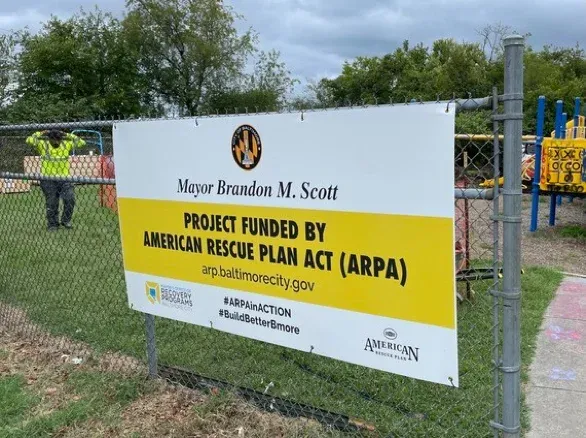
Source: City of Baltimore, Maryland.[/caption]
As the 2024 election season ramps up, the Administration has a vested interest in pushing dollars out the door as rapidly as possible to buy voters’ goodwill. This, of course, does not imply that the SLFRF spending is in the interest of the taxpayers – merely that the appearance of federal investment in local communities may be a political factor that drives turnout.
It is likely that all or some combination of these three reasons is behind Treasury’s rapid drop of the Hoarding Rule. Ultimately, the justification for the Department’s actions is weak at best and politically motivated malfeasance at worst.
Congressional Options for Action
The Hoarding Rule is an outright abuse of power by Treasury on multiple levels and should be immediately reversed. To encourage this, Congress should assert its intentions. Other stakeholders (including taxpayers) should engage in the notice and comment period, which is set to end on December 20, 2023, regardless of the rule already taking effect.
Should the agency fail to see the error in its ways, Congress should take action to disapprove the rule through the CRA immediately upon its finalization.
In the meantime, the wasteful spending of SLFRF dollars must be stopped. Congress could act now to provide additional oversight of the SLFRF and rescind all unobligated SLFRF funds to prevent further spending on projects that only serve to increase inflation while funding programs that are certainly not a priority for the American public.