
Background
The Fiscal Responsibility Act (FRA) of 2023 established caps on discretionary spending for fiscal years (FY) 2024 and 2025.
The caps place separate limits on both defense and non-defense discretionary budget authority. While the overall topline discretionary spending level is often discussed, the actual caps are only enforced separately on the defense and non-defense categories. Spending in one category cannot be decreased to offset higher spending in the other.
It is important to note that the caps enforce a ceiling – not a level or a floor – on discretionary spending within each category.
FRA Spending Caps
| Fiscal Responsibility Act Full-Year Caps Base Budget Authority (in billions of dollars) | |||
| Defense | Non-Defense | Total | |
| FRA 2024 Full Year |
886.349 | 703.651 | 1,590.000 |
| FRA 2025 Full Year |
895.212 | 710.688 | 1,605.900 |
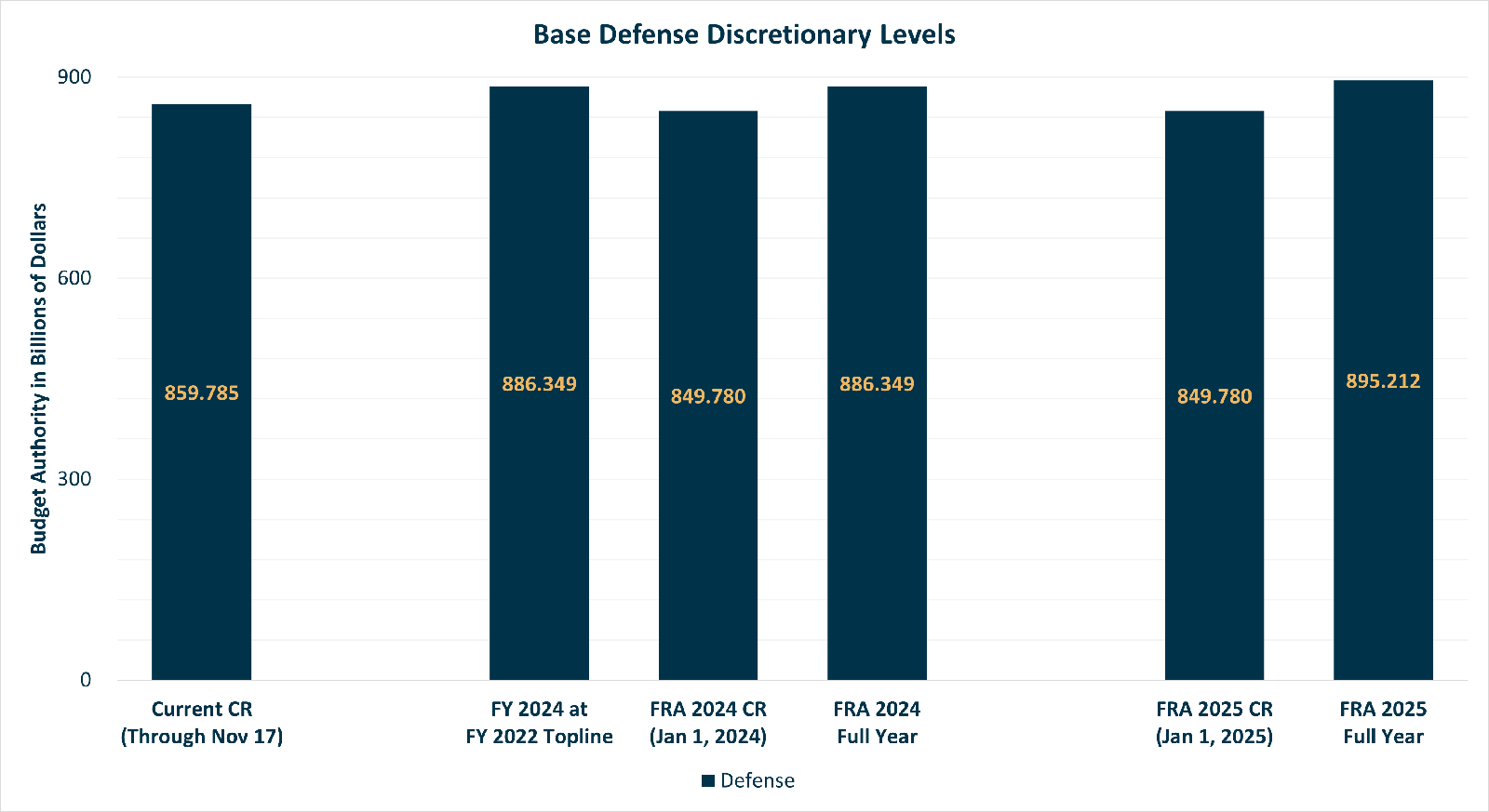
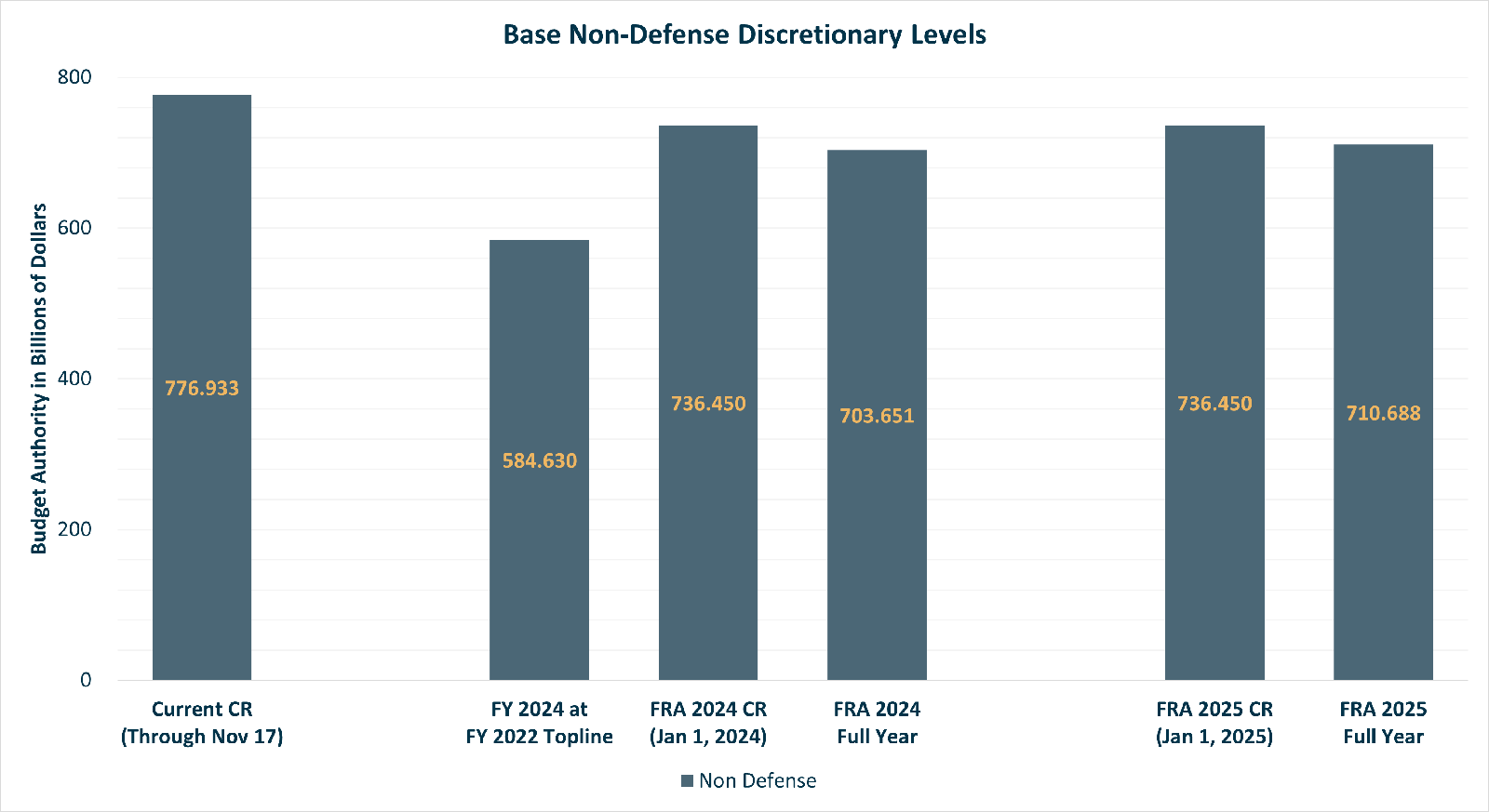
The FRA caps for full-year appropriations in FY 2024 would be $886.349 billion for defense and $703.651 billion for non-defense, adding to a $1.59 trillion topline base discretionary level.
For FY 2025, the caps would be $895.212 billion for defense and $710.688 billion for non-defense, adding to a $1.6059 trillion topline base discretionary level. Thus, the FRA allows up to a one percent increase in the caps from FY 2024 to FY 2025.
Alternative FRA Scenarios
The FRA caps are based on the Budget Control Act of 2011, which was in effect from FY 2012 to FY 2021.
However, the FRA includes a twist in an effort to push lawmakers into completing the full 12 bill regular appropriations process.
In the event a continuing resolution (CR) is in effect on January 1, modified caps would replace the full-year FRA caps.
Relative to the full-year FRA caps, the caps under a CR would reduce defense levels and increase the allowable non-defense levels. The overall topline would be slightly lower under the CR caps compared to the full-year FRA caps.
In other words, enacting all 12 appropriations bills separately by January 1enables Congress to fund the topline discretionary levels at a slightly higher amount than if they default to a CR scenario, but there is a shift in favor of non-defense spending under a CR.
For FY 2024, the CR cap for defense would be $36.569 billion below the full-year FRA cap, while the CR cap for non-defense would be $32.799 billion higher than the full-year FRA cap.
For FY 2025, the CR cap for defense would be $45.432 billion below the full-year FRA cap while the CR cap for non-defense would be $25.762 billion higher than the full-year FRA cap.
Sequestration enforcement of the CR caps would not occur until April 30 of the same year.
Comparing the Full-Year FRA Caps to Alternatives
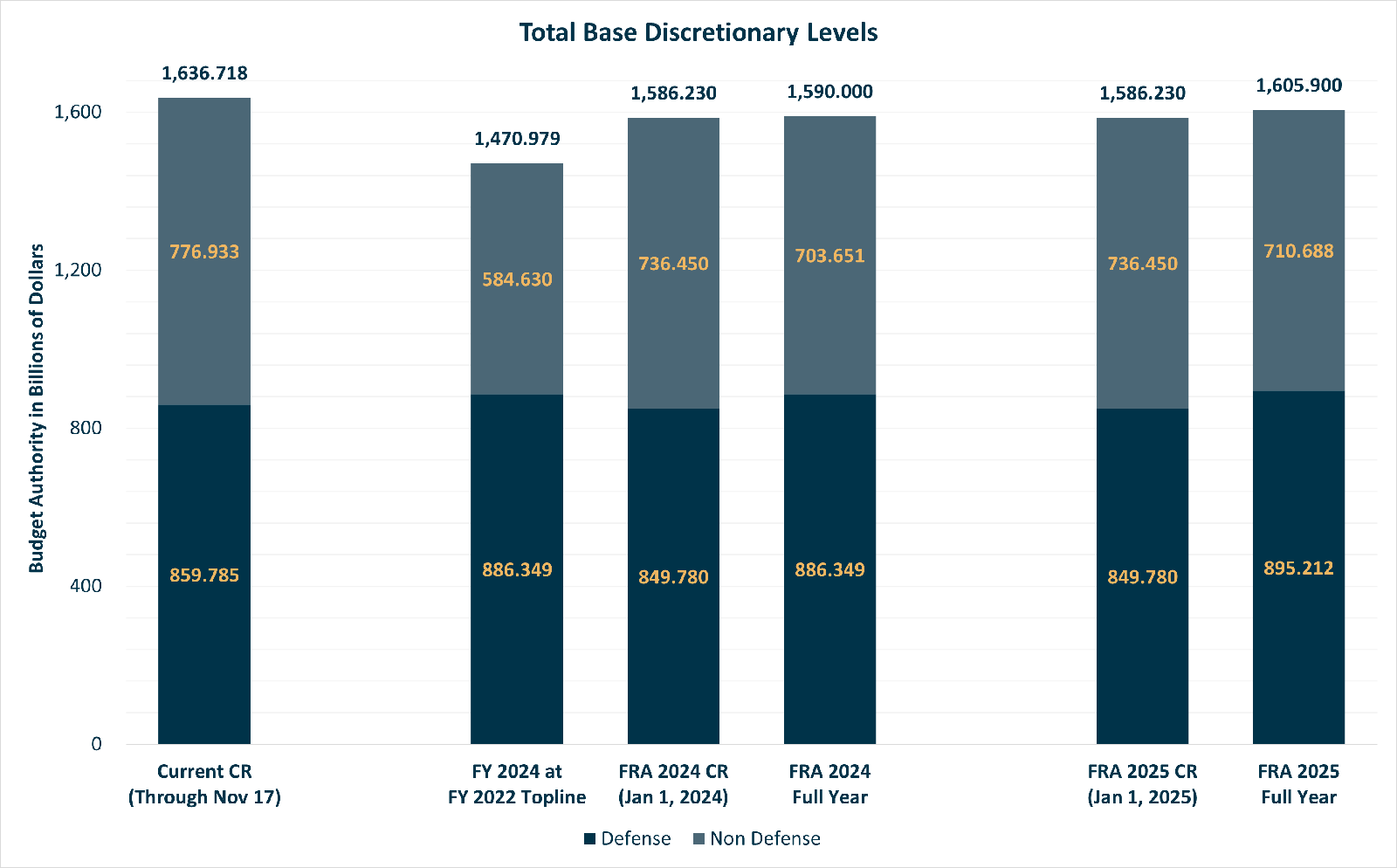
The table and charts below compare the FRA full-year caps to other proposed funding levels, including the current continuing resolution (CR), the alternative caps that come into force if a CR is extended past January 1, and the proposed $1.471 trillion spending level.
| Comparing FRA Caps Base Budget Authority (in billions of dollars) | |||
| Defense | Non-Defense | Total | |
| Current CR (Through Nov 17) |
859.785 | 776.933 | 1,636.718 |
| FRA 2024 CR (Jan 1, 2024) |
849.780 | 736.450 | 1,586.230 |
| FRA 2024 Full Year |
886.349 | 703.651 | 1,590.000 |
| FY 2024 at FY 2022 Topline |
886.349 | 584.630 | 1,470.979 |
| FRA 2025 CR (Jan 1, 2025) |
849.780 | 736.450 | 1,586.230 |
| FRA 2025 Full Year |
895.212 | 710.688 | 1,605.900 |
Sequestration Enforcement
The FRA caps are enforced by sequestration.
If appropriations for the defense or non-defense category exceed their cap on a certain date, then the President would be required to cut spending across-the-board within that category by a uniform percentage so that the resulting spending level meets the cap.
If full-year appropriations bills are in place that exceed either cap, the President is required to make a sequestration order within 15 days after the end of a session of Congress (by January 18 at the latest). As such, even if full-year appropriations bills are enacted, no enforcement is in place for up to 30 percent of the fiscal year.
If a CR is in effect that exceeds either cap, a sequestration order would be delayed until April 30. That means that if a CR is in place, there is effectively no enforcement of discretionary spending levels until the end of April – which means there is no enforcement for 63 percent of the fiscal year.
Another Path Forward
Resetting FY 2024 appropriations to FY 2022 levels would be a responsible first step to control runaway spending.
The FY 2024 House budget resolution and the House Appropriations Committee both call for the topline base discretionary appropriations for FY 2024 not to exceed the FY 2022 topline of $1.471 trillion. This spending level was originally included in the House-passed Limit, Save, Grow Act.
This proposal would comply with the FRA caps by appropriating at or below the defense and non-defense caps.
Appropriating to the $1.471 topline would represent a modest step in controlling the growth of spending, particularly compared to the trillions in higher spending approved by Congress and President Biden which has resulted in high inflation. Total FY 2023 spending was $966 billion above what CBO originally projected when Biden first came into office.
In addition to advancing prudent FY 2024 appropriations, lawmakers would be responsible to begin taking concrete steps to control the growth of the real drivers of the unsustainable budget: mandatory spending (including massive entitlement programs) and the interest payments financing them.