
The Congressional Budget Office (CBO) released its annual Budget and Economic Update on February 7, 2024. The Outlook – also known as the baseline – provides the updated budgetary and economic projections for the current fiscal year (FY 2024) and the upcoming ten-year budget window (FY 2025-2034).
| CBO Baseline | ||||||||||||
| 2024 | 2025 | 2026 | 2027 | 2028 | 2029 | 2030 | 2031 | 2032 | 3033 | 2034 | 2025 - 2034 | |
| Outlays | 6,442 | 6,768 | 7,042 | 7,323 | 7,715 | 7,870 | 8,331 | 8,710 | 9,128 | 9,724 | 10,054 | 82,665 |
| Revenues | 4,935 | 4,996 | 5,351 | 5,683 | 5,870 | 6,147 | 6,414 | 6,656 | 6,890 | 7,168 | 7,474 | 62,649 |
| Deficit | 1,507 | 1,772 | 1,691 | 1,640 | 1,845 | 1,723 | 1,917 | 2,054 | 2,238 | 2,556 | 2,580 | 20,016 |
| In billions of dollars. Source: Congressional Budget Office. | ||||||||||||
The budget baseline is often described as reflecting current law, but that is not really accurate. The CBO is required by law to include certain assumptions that deviate from the actual laws on the books, distorting the budget process towards higher spending and revenues.
It is not a projection of what fiscal outcomes will be, but rather what could happen if Congress:
- continues current appropriations with annual increases for inflation;
- extends expiring spending programs;
- continues permanently authorized autopilot spending programs unchanged;
- allows entitlement programs to make scheduled payments even after its trust fund is depleted; and
- makes no changes to the tax code except for extending highway and airport taxes.
The CBO baseline is important because it is used as the official benchmark against which legislative proposals are scored.
Rising Spending
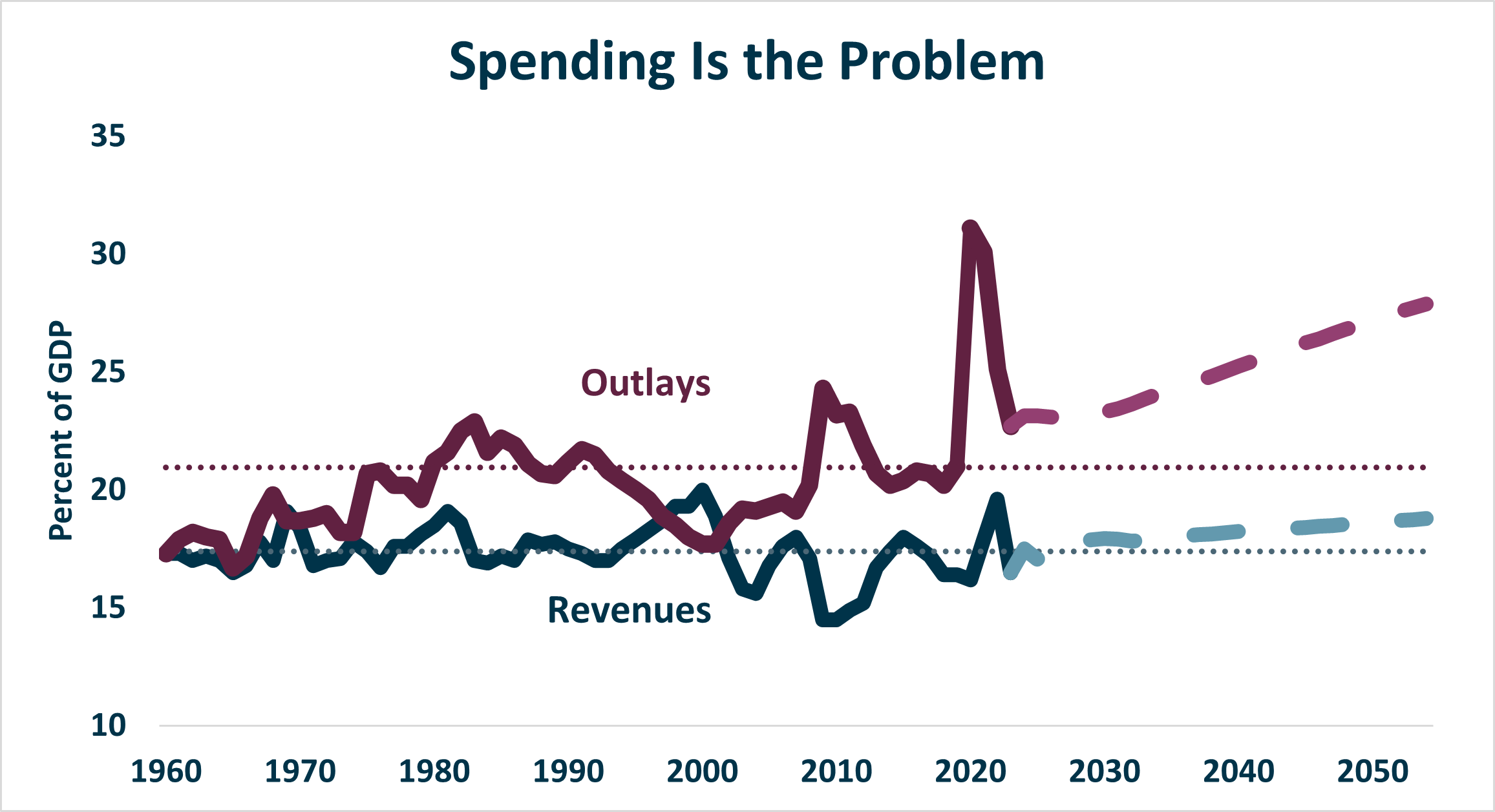
The CBO baseline projects outlays to total $6.4 trillion in FY 2024 (22.9 percent of GDP), rising to $10.1 trillion in FY 2034 (24.1 percent of GDP).
Over the FY 2025-2034 budget window, spending would total $82.7 trillion. That would be an average of 23.5 percent of GDP, significantly higher than the 50-year historical average of 21 percent. Over the long term, outlays are projected to grow to 27.9 percent of GDP by 2054.
Net interest spending is projected to grow significantly, from $659 billion (2.4 percent of GDP) in FY 2023 to $870 billion (3.1 percent of GDP) in FY 2024, to $1.6 trillion (3.9 percent of GDP) by FY 2034. Net interest outlays would be one of the largest categories of the federal budget, surpassing defense spending in 2024. Net interest outlays will trail only Social Security and Medicare outlays as the largest expenditures in the budget.
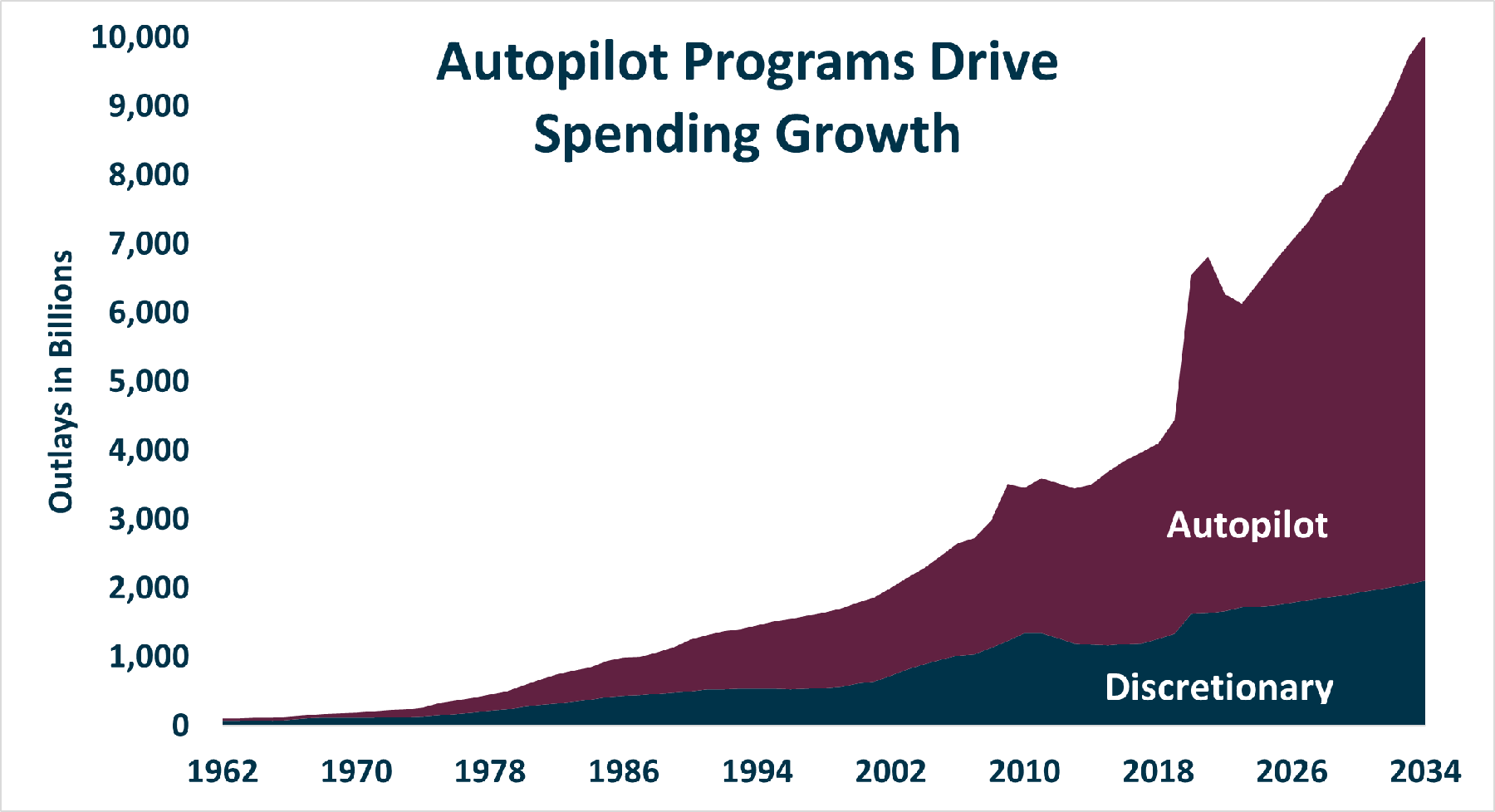
The growth in spending is driven by programs that are on “legislative autopilot.” In FY 2024, discretionary spending is projected to make up just 27 percent of the total budget, with the remaining 73 percent including direct spending and net interest costs (direct spending is sometimes misleadingly called “mandatory” spending, although there is nothing required about it – this is just a way to describe spending that Congress does not vote on in annual appropriations bills). Autopilot spending is projected to grow to 79 percent of the budget by FY 2034, with only 21 percent of spending a part of the annual discretionary appropriations process.
Steady Revenues Under Current Law
The CBO baseline projects revenues to total $4.9 trillion in FY 2024 (17.5 percent of GDP), rising to $7.5 trillion in FY 2034 (17.9 percent of GDP).
Over the FY 2025-2034 budget window, revenues would total $62.6 trillion. That would be an average of 17.8 percent of GDP, slightly higher than the 50-year historical average of 17.3 percent. Over the long term, revenues would grow to 18.8 percent of GDP by 2034.
It is important to note that these projections assume that the 2017 tax cuts for individuals expire as under current law at the end of 2025. Preventing large tax increases on families and workers could reduce revenues by about $4 trillion over the next decade.
Growing Debt
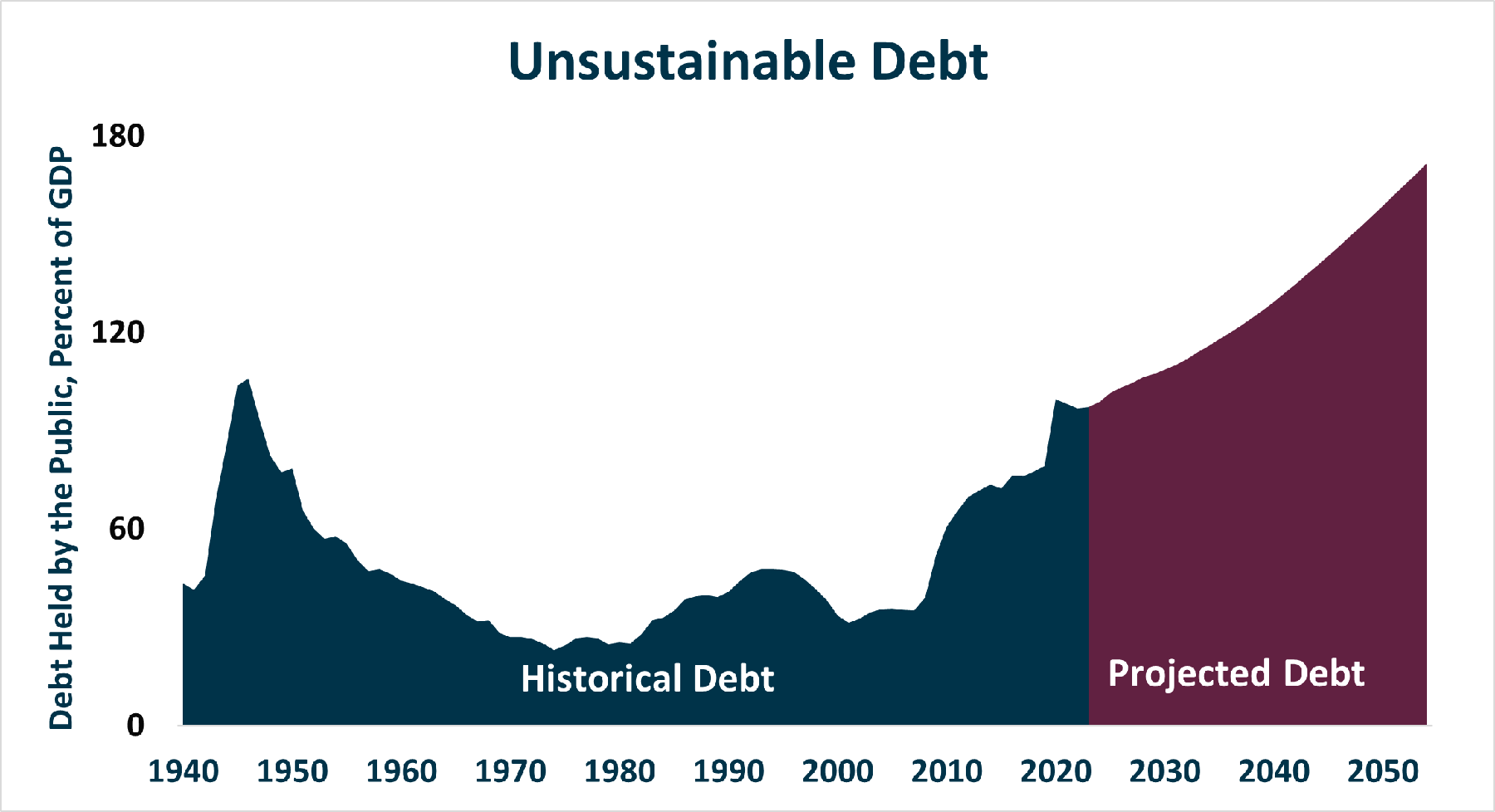
Debt held by the public is projected to rise from $26.2 trillion (97.3 percent of GDP) at the end of FY 2023 to $48.3 trillion (116 percent of GDP) at the end of FY 2034.
The government would surpass its record level of debt as a percentage of GDP (106.1 percent of GDP, set in the aftermath of World War II), by the end of FY 2028.
By 2054, debt held by the public would be projected to rise to 171.7 percent of GDP. Paul Winfree, the President and CEO of EPIC, has estimated that on this type of trajectory, the U.S. government could exhaust its available fiscal space within the next 25 to 50 years.
Depleted Social Security Trust Fund
The CBO expects the Social Security Trust Fund to be depleted within the next decade. The Social Security Old Age and Survivors Insurance (OASI) Trust Fund is projected to be depleted in FY 2033.
The Medicare Hospital Insurance (HI) Trust Fund is projected to only hold $88 billion at the end of FY 2034, putting it on a path towards insolvency shortly thereafter.
Actual Deficit Could Be Much Higher than CBO Baseline
The CBO says that the deficits projected over the FY 2024-2033 period are now about $1.4 trillion lower than its projections last May, primarily as the result of the Fiscal Responsibility Act’s discretionary spending caps.
However, the actual deficit this year could be much higher in FY 2024 than projected in this CBO baseline. Legislation currently under consideration would add billions to the deficit, including:
- The Johnson-Schumer side deal to increase discretionary spending above the levels specified in the Fiscal Responsibility Act would add about $40 billion in un-offset discretionary spending above the baseline.
- The Senate supplemental appropriations bill currently under consideration would add $118 billion in higher discretionary spending.
- The Smith-Wyden tax legislation that recently passed the House would increase FY 2024 spending by $3.6 billion and reduce revenues by $113.9 billion.
That is about $275 billion in potentially higher FY 2024 deficits above CBO’s baseline (assuming the additional discretionary appropriations are expended this year).
Because the budget baseline rules assume discretionary appropriations continue throughout the baseline – even one-time emergency appropriations – an updated baseline after enactment of the Johnson-Schumer side deal and Senate supplemental appropriations bill could result in more than $1.7 trillion in higher projected outlays over the next decade, canceling out the $1.5 trillion of projected deficit reduction from the Fiscal Responsibility Act. Within that total, about $1.3 trillion of the increase in the baseline would be attributable to the supplemental appropriations and about $400 billion would be attributable to the Johnson-Schumer side deal. The tax bill is largely offset over the ten-year budget window.
Big Challenges on the Horizon – Lawmakers Need to Plan
The CBO’s Budget and Economic Outlook should be a wake-up call.
Congress and the President will soon confront some of the most consequential budgetary decisions in American history.
In 2025, the debt limit will be reinstated, the 2017 tax cuts for families will expire, the Fiscal Responsibility Act discretionary spending limits will end, and Statutory PAYGO will be enforced.
As daunting as that may seem, even larger challenges are forthcoming: the depletion of the Medicare Hospital Insurance Trust Fund, the depletion of the Social Security Trust Fund, rising interest costs, and the potential erosion of fiscal space for financing unsustainable spending and deficits.
The time for lawmakers to start thinking big picture and long term about the nation’s fiscal challenges is now.