Budget authority and outlays are two closely tied but distinct budgetary terms.
Before the federal government can spend any money, Congress
must appropriate funds to spend, defining the amount, purpose, and time period of availability of spending authority. The appropriation grants the Executive Branch what is called
budget authority (BA). This can be thought of as the government’s “allowance.” BA is separate from a Congressional “authorization,” which is normally a prerequisite for an appropriation to be made.
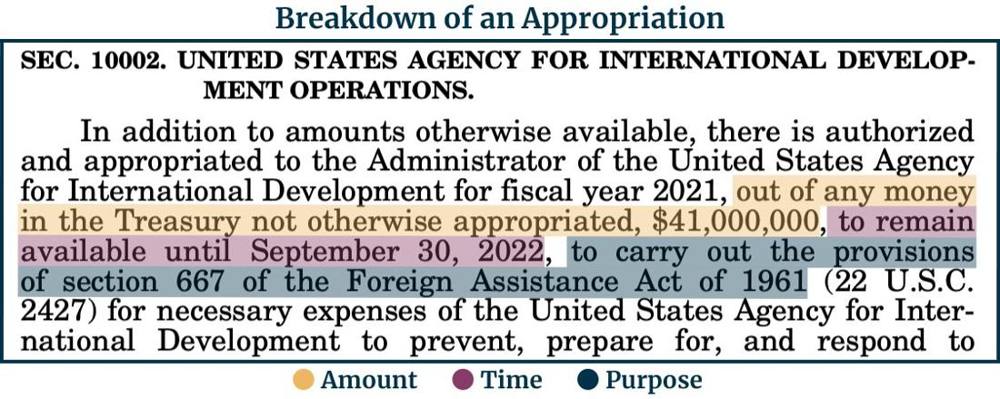
Once an appropriation is provided, the Executive Branch has the authority to incur an obligation
up to the amount of funds that were appropriated (via contracts, purchase orders, loan guarantees, etc.). An
obligation is a legal commitment for the government to make a payment.
An
outlay (OT), on the other hand, is the amount that an agency actually spends out to meet a specified federal obligation, or how much of the allowance the government uses. The
Anti-Deficiency Act prohibits any federal official from obligating funds in excess of amounts authorized by law, so total OT cannot be greater than the total BA.
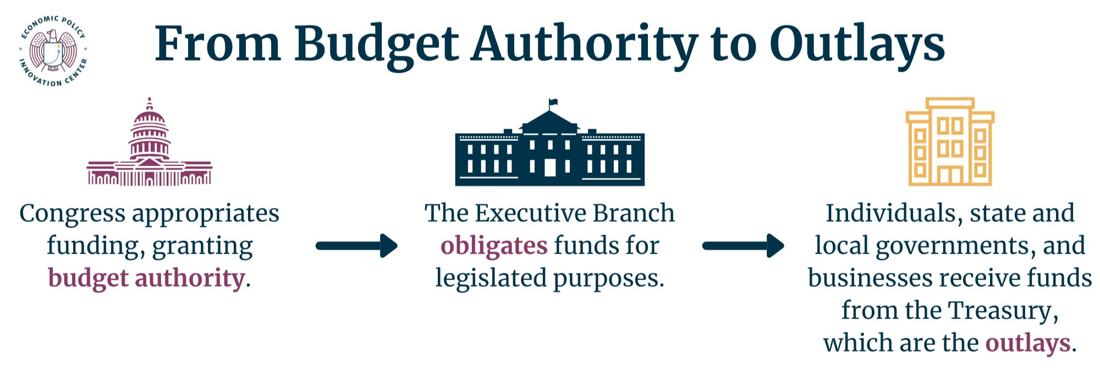
When the Congressional Budget Office (CBO) reports the projected spending of a bill, it typically estimates both the budget authority and the outlays of the proposal. Here is an example from the CBO:
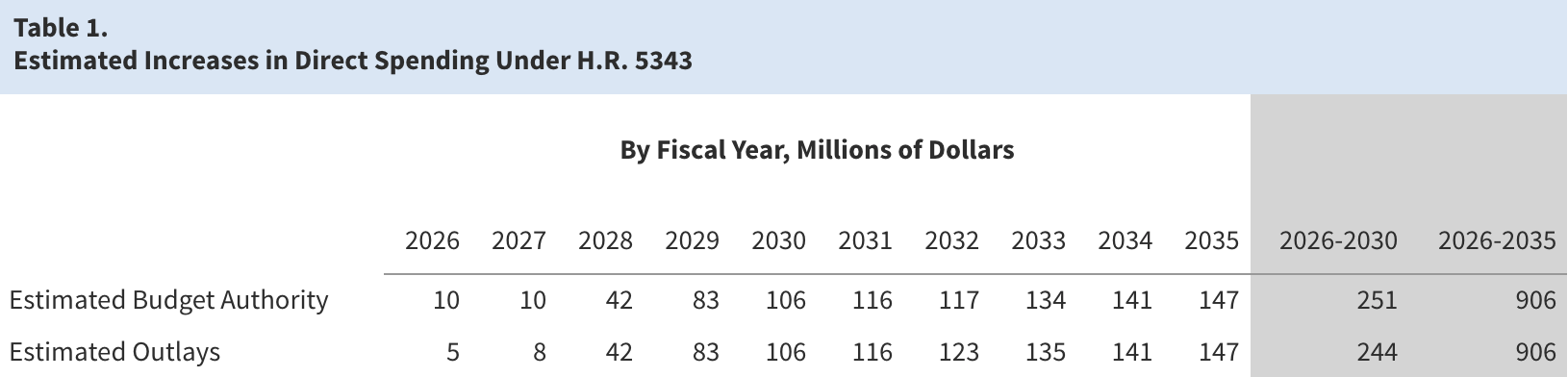
In the example above, the agency is estimated to be granted $906 million in BA from fiscal year (FY) 2026 to FY 2035. The agency is projected to actually spend $5 million (in OT) in FY 2026, and a total of $906 million over the 10-year budget window.
Answering the question “How much would this legislation cost?” depends on the type of legislation.
Autopilot (or "mandatory") spending programs should generally be measured by OT, given that they are formula-based spending streams with longer-term authorizations. Discretionary appropriations bills, however, should generally be discussed in terms of the BA provided because the spend-out rate can be less predictable and subject to changes in annual funding decisions.