American Employers Face a Higher Corporate Tax Rate than in Communist China
The corporate tax in the United States reduces the competitiveness of American businesses, directly harming American families.
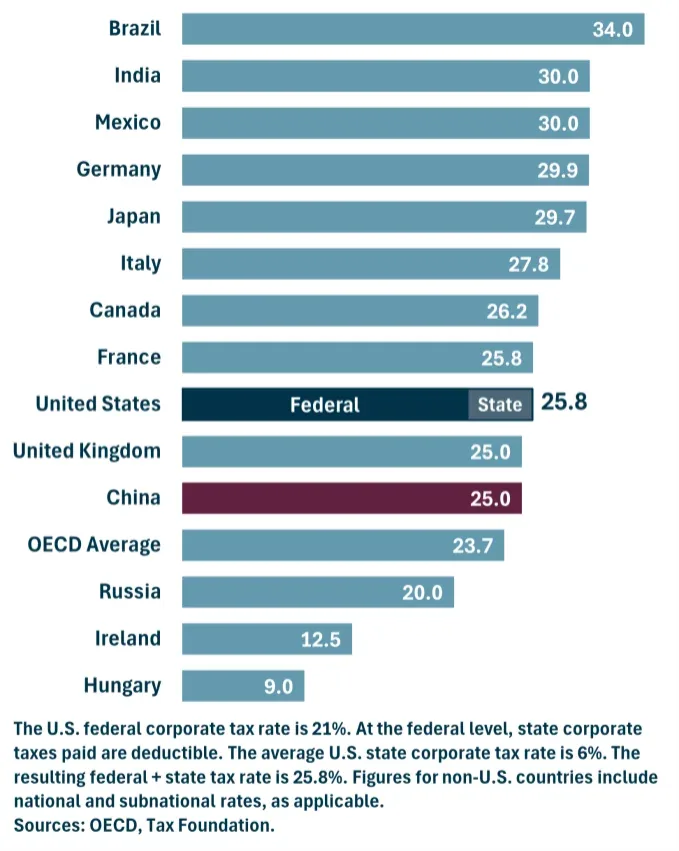
The U.S. federal corporate tax rate is 21%. Adding the average state tax rate brings the average total rate to 25.8%.
That means
employers in the United States face a higher corporate tax rate than the 25% rate imposed by the Chinese Communist Party.
The U.S. corporate rate is higher than the average of our major international competitors in the Organisation for Economic Cooperation and Development (OECD).
The Corporate Tax Is One of the Most Destructive Taxes
The
corporate income tax is one the most harmful and destructive taxes because it is a tax on the results of economically productive activity in the private sector. This tax hurts workers and consumers as well as shareholders.
Business taxes are, of course, paid by real people.
Workers bear 70% or more of the corporate tax burden in the form of lower wages, according to studies by the
Tax Foundation and the
Heritage Foundation.
Because of the Corporate Tax:
- Workers face Lower Wages
- Investors face Lower Returns
- Consumers face Higher Prices
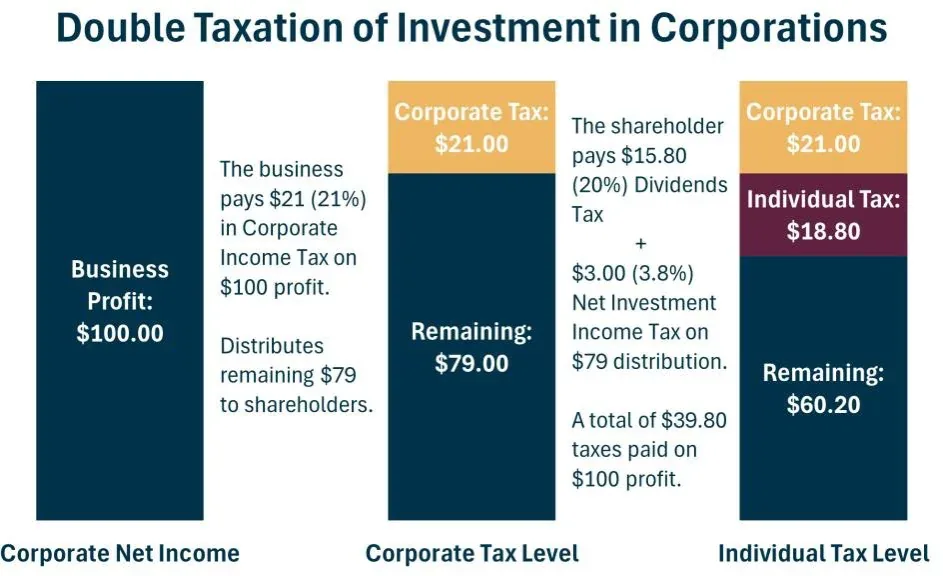
Corporate profits are subject to double taxation as a result of the corporate tax. After paying the corporate tax, the remaining profits are distributed to shareholders, who then pay taxes on those dividends or capital gains. This double layer of taxation on the same dollar of income is destructive and distortionary.
2017 Tax Cuts Made America More Competitive
The
Tax Cuts and Jobs Act (TCJA) of 2017 made key improvements to the corporate tax.
Most importantly, the
TCJA permanently reduced the corporate tax rate to 21%. This was by far the most pro-growth policy in the 2017 law. Before TCJA,
the U.S. corporate tax rate was 35%, the highest in the industrialized world.
To offset the cost of the tax cut and simplify the tax code, several corporate tax credits and deductions were repealed.
The TCJA
overhauled the international business tax system, ending the uncompetitive worldwide taxation of American-headquartered businesses and instituting a modified territorial tax system. The combination of the high tax rate and the worldwide system had led to American companies moving abroad through inversions.
By
providing full and immediate expensing, the TCJA allowed businesses to immediately deduct the full costs of capital investments, replacing longer depreciation schedules and removing a significant tax bias against investment. Expensing began phasing out in 2023 and is set to expire completely in 2027 if not renewed.
Corporate Tax Application
The federal corporate income tax applies to businesses incorporated as C Corporations. Other businesses, such as S Corporations, partnerships, and sole proprietorships, are considered pass through entities subject to the individual income tax.
The corporate income tax is levied on the firm’s profits. Profit equals the total revenue minus business costs. The tax liability can be reduced by various credits and deductions.
In FY 2023, federal corporate tax receipts were $420 billion. This was 10% of total revenues.