

PLEASE NOTE: This site is an archival resource, no longer updated as of June 1, 2026. Current questions: The Fiscal Lab.
The Federal Budget: Spending, Taxes, and Debt

Expedited Rescissions Allows Congress to Support DOGE’s Work to Eliminate Waste

Introduction

  • DOGE has identified billions in waste, fraud, and abuse of the taxpayers’ money.
  • The Impoundment Control Act expedited rescission process allows Congress to cut spending on a fast-track process that bypasses the Senate filibuster.
  • President Trump should identify and propose unneeded funds to be rescinded, and Congress should use this expedited process to pass rescissions bills to continue the DOGE momentum.

DOGE and the Rescission Opportunity

President Donald Trump’s new administration is off and running at breakneck speed. In particular, the Department of Government Efficiency (DOGE) has exposed astonishing amounts of government waste, fraud, and abuse. While it is still the early days of the new administration and results are still coming in, DOGE has been an asset to the American taxpayer. To ensure lasting change, Congress must partner with President Trump and DOGE to put the budget on a sustainable path. One important opportunity to reduce wasteful government spending is the power to rescind unneeded appropriations. Budget authority that has not yet been obligated by an agency can be canceled by new laws passed by Congress, preventing the funds from being obligated and spent. This cancelation of budget authority is called a rescission. President Trump has the authority to identify unspent funds, which Congress can then rescind in legislation passed through the Senate and House on a fast-track process that bypasses the Senate filibuster.[1]

The Expedited Rescission Process

The Impoundment Control Act (ICA) creates an expedited rescissions process.[2] The ICA rescission process allows certain spending cuts to bypass the Senate filibuster and be passed by a simple majority rather than the normal 60 vote threshold. The expedited process can only commence with Presidential action.[3] The ICA requires that: “Whenever the President determines that all or part of any budget authority will not be required to carry out the full objectives or scope of programs for which it is provided or that such budget authority should be rescinded for fiscal policy or other reasons (including the determination of authorized projects or activities for which budget authority has been provided), or whenever all or part of budget authority provided for only one fiscal year is to be reserved from obligation for such fiscal year,”[4] the President shall submit a rescission proposal to Congress. The rescission proposal is transmitted via a “special message” detailing the amount of budget authority and other information justifying the proposed rescission. The ICA expedited process is only available within 45 days of continuous Congressional session after Congress receives the special message.[5] Once the special message is received, any Member or Senator may introduce a rescission bill to implement the President’s requested spending cuts. Traditionally, the leader of the President’s party introduces legislation. To qualify for the expedited procedures, the rescission bill may not include anything outside the scope of the President’s special message. A rescission bill does not need to include all the proposed rescissions. Multiple rescission bills covering different parts of the President’s special message can be introduced. For example, if the President proposes 100 rescissions, Congress could consider them in one package that includes all the rescissions, 100 separate bills with the individual rescissions, or any combination of the proposed rescissions. This gives Congress flexibility in deciding how to consider all or parts of the President’s proposal. After one or more rescission bills are introduced, the ICA includes protections to prevent the legislation from being bogged down in committee. If a rescission bill has not been reported by a committee within 25 days of continuous session, any Member (or Senator) of the relevant chamber can make a motion to discharge the bill, allowing it to be brought to the floor. Once out of committee, a rescission bill is privileged. Most significantly in the Senate, debate on a rescission bill is limited to 10 hours. The motion to proceed to consideration of a rescission bill as well as passage are both a simple majority vote. Amendments may be considered, but those amendments must be germane. The ICA also provides a process for House consideration of rescission bills that limits debate to two hours, but they are usually considered under a rule like other legislation.

Billions of Unobligated Balances Available for Rescission

Appropriations acts provide budget authority, which grants federal agencies the authority to incur obligations. An obligation is a commitment to spend funds, creating a legal liability on behalf of the government to make the payment. When the payment is made, an outlay occurs and money is spent from the Treasury. Congress can rescind budget authority by passing a new law before the funds are obligated by an agency. At the end of February 2025, federal agencies had $860 billion unobligated balances of discretionary budget authority that could be rescinded.[6]

Table 1

Unobligated Appropriations

as of February 2025

No Year

Multi-Year Expiring

Total

$385 $283 $193

$860

In billions of dollars. Source: Office of Management and Budget.
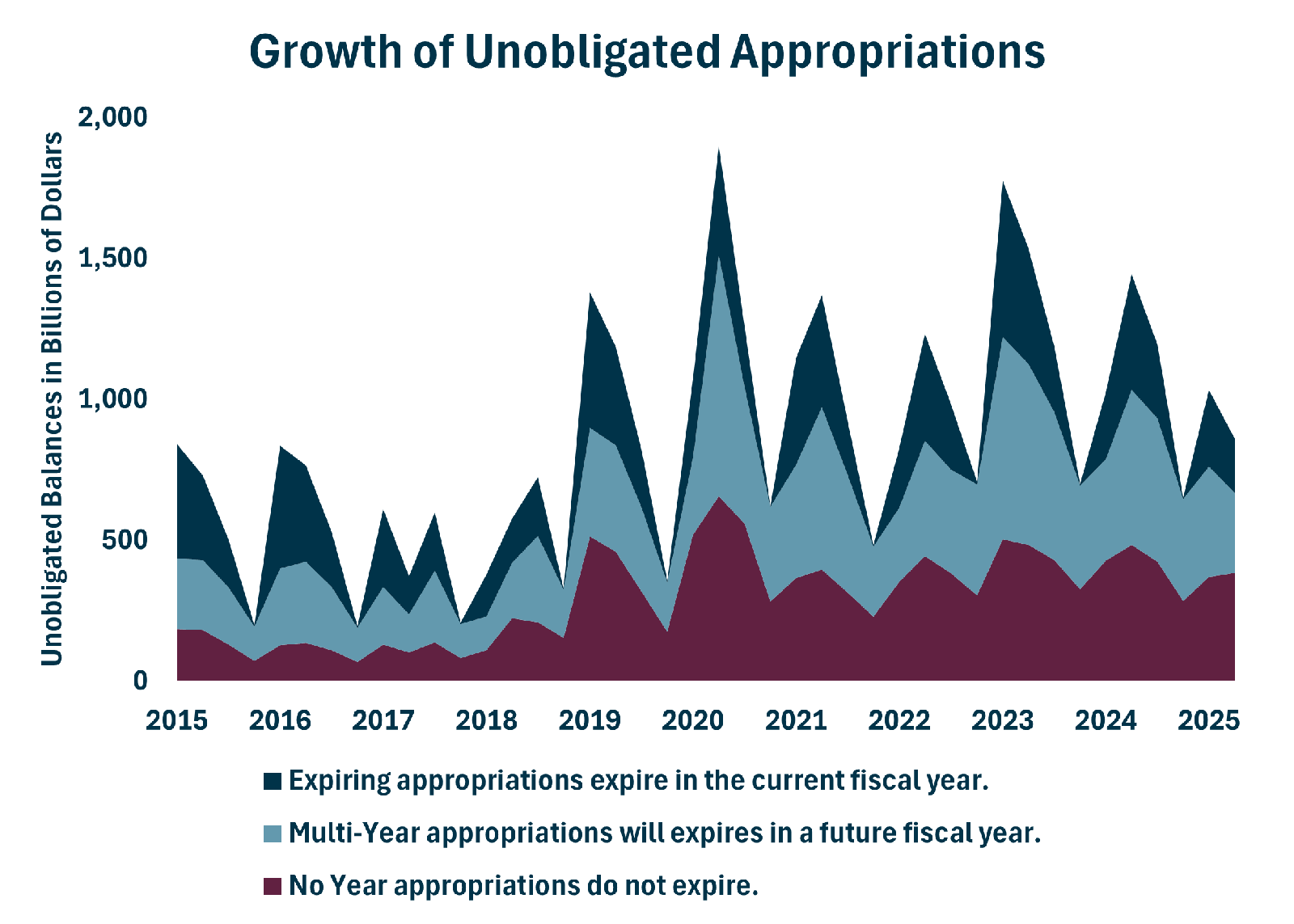
Balances of unobligated appropriations typically fluctuate throughout the fiscal year. At the beginning of the fiscal year, new budget authority becomes available, which is then spent over the course of the year. Over the last decade, balances of unobligated budget authority have grown significantly. At the end of FY 2017, $208 billion in unobligated balances remained. In contrast, $653 billion in unobligated budget authority was available at the end of FY 2024.

Chart 1

Unobligated Balances 2015 Feb 2025 3.25.2025

Source: Office of Management and Budget

An important element of any appropriation is the time period of availability for the budget authority, which represents how long the agency has to obligate the funds. The period of availability is classified in one of three categories:
  • Expiring appropriations, which expire at the end of the current fiscal year;
  • Multi-year appropriations, which expire in a future fiscal year; or
  • No year appropriations, which do not expire and remain available until spent.

A trend that has contributed to the growth of unobligated balances is the growth of no-year appropriations beginning in FY 2019. In the first quarter of FY 2018, $109 billion of no-year budget authority remained unobligated. By the first quarter of FY 2019, $514 billion of no-year budget authority was available. Some Members of Congress may be concerned that no-year appropriations weaken Article I oversight and control by allowing the Executive Branch discretion over when and how funds are spent. In some cases, appropriations that do not expire could be spent by a future administration on projects or activities that were never contemplated by the Congress that originally provided the funds.

Rescissions Are a Powerful Tool to Cut Waste

The rescission process of the Impoundment Control Act is a powerful way to eliminate waste, fraud, and abuse by reducing unneeded funds. Both the President and Congress must act to use this fast-track tool.

President Trump Should Propose Rescissions

The rescission process must begin with Presidential leadership. President Trump should direct the Office of Management and Budget (OMB), DOGE, and federal agencies to conduct a review of all unobligated budget authority. Any funds that are determined to be wasteful, harmful, or not needed should be officially proposed for rescission. When the President proposes rescissions in a special message to Congress, that sets off a chain of events allowing Congress to eliminate spending under an expedited process.

Congress Should Pass the Rescissions to Protect Taxpayers

Once Congress receives the special message proposing rescissions, the House and Senate should swiftly introduce and approve the rescission legislation. Because rescission bills considered under the ICA process cannot be filibustered and can be passed by a simple majority in the House and Senate, there should be no excuse for failure. DOGE has already identified billions in waste, fraud, and abuse of the taxpayers’ money. Rescinding unneeded and harmful appropriations is the natural next step to follow up on the important work that has been done.   [1] Matthew Dickerson, “Rescissions Proposal Would Help to Reduce Unnecessary Spending,” Heritage Foundation Issue Brief No. 6038, January 19, 2021, https://www.heritage.org/budget-and-spending/report/rescissions-proposal-would-help-reduce-unnecessary-spending (accessed March 28, 2025). [2] For a detailed summaries of the ICA process, see: Congressional Research Service, “The Impoundment Control Act of 1974: Background and Congressional Consideration of Rescissions,” February 25, 2025, https://www.congress.gov/crs-product/R48432 (accessed March 27, 2025); and Congressional Research Service, “Expedited Procedure for Considering Presidential Rescission Messages Under Section 1017 of the Impoundment Control Act of 1974,” Memorandum, July 6, 2017, https://gallery.mailchimp.com/d4254037a343b683d142111e0/files/a92c5795-7f8c-4ef7-953a-a626626794fa/CRS_Memo_Expedited_Rescission_Procedure_Final.pdf (accessed March 27, 2025). [3] Congress can initiate rescissions on its own, but rescissions not proposed by the President and considered under the ICA process do not qualify for the expedited process. [4] Sec. 1012(a) of Congressional Budget and Impoundment Control Act of 1974, Public Law 93-344. [2 U.S.C. 683]. [5] Sec. 1011(5) of the ICA provides that “continuity of a session of the Congress shall be considered as broken only by an adjournment of the Congress sine die, and the days on which either House is not in session because of an adjournment of more than 3 days to a day certain shall be excluded in the computation.” [6] The OMB periodically reports on the balances of unobligated budget authority in budget accounts in SF 133 Reports on Budget Execution and Budgetary Resources. Office of Management and Budget, “MAX Information and Reports (Executive, Legislative, and Judicial Users): FY 2025 - SF 133 Reports on Budget Execution and Budgetary Resources,” March 21, 2025, https://portal.max.gov/portal/document/SF133/Budget/FY%202025%20-%20SF%20133%20Reports%20on%20Budget%20Execution%20and%20Budgetary%20Resources.html (accessed March 25, 2025).

Author

Matthew D. Dickerson

Matthew D. Dickerson

Director of Budget Policy

Matthew D. Dickerson is Director of Budget Policy at the Economic Policy Innovation Center (EPIC). Dickerson is recognized as an expert on fiscal policy issues, including the budget, appropriations, and entitlement reform. His articles have been featured in the Wall Street Journal , the Miami Herald , National Review , the Sacramento Bee , the Washington Times , the Baltimore Sun , The Hill , the Washington Examiner , and other outlets. Prior to joining EPIC, Dickerson served as Senior Policy Advisor on the staff of the House Budget Committee, where he helped lead development of the fiscal year 2024 budget resolution. He has a dozen years of experience on Capitol Hill, including as a senior staffer with the Republican Study Committee (RSC), the caucus of conservatives in the House of Representatives. Under four different RSC chairmen, Dickerson held senior level roles including Policy Director and Senior Policy Staff. Additionally, he served as Legislative Director and other policy positions for the late Congressman C.W. Bill Young (R-FL), a former Chairman of the powerful House Appropriations Committee. During his tenure at The Heritage Foundation, Dickerson was Director of the Grover M. Hermann Center for the Federal Budget. In this capacity, he oversaw a team of budget analysts and economists researching diverse subjects including spending, entitlements, budget process, tax, labor, pensions, and infrastructure issues. He has also been a Policy Manager at Americans for Prosperity, where he supervised a team of fellows and analysts covering a variety of federal and state policy issues. Dickerson is a graduate of the College of William and Mary in Virginia and holds a Bachelor of Arts in Government and History.

More from Matthew D. Dickerson →

← All work