
- Investing in vital border security;
- Preventing the largest tax increase in American history by extending and expanding President Trump’s 2017 Tax Cuts and Jobs Act;
- Addressing waste, fraud, and abuse in Medicaid;
- Strengthening Food Stamp work requirements;
- Promoting American energy dominance; and
- Providing for national defense.
Fiscal Implications Depend on the Baseline
One challenge with this reconciliation process is that the House and Senate are using two different baselines. A budget baseline provides a benchmark against which to measure legislative proposals. The House budget resolution was prepared using the official baseline prepared by the Congressional Budget Office. The House budget also included assumptions about deficit reduction that would accrue due to future economic growth. Meanwhile, the Senate budget resolution used a “current policy” baseline. Senate Budget Committee Chaiman Lindsey Graham (R-SC) is expected to instruct the CBO and the Joint Committee on Taxation to assume that certain expiring provisions of the 2017 Tax Cuts and Jobs Act (TCJA) are extended in the baseline. The CBO recently released its cost estimate of the House-passed H.R. 1, the One Big Beautiful Bill Act. This report provides a crosswalk between the cost estimate using the official baseline conventional scoring, incorporating the House Budget Committee’s dynamic growth assumptions, and a current policy baseline.Official Baseline – Conventional Scoring
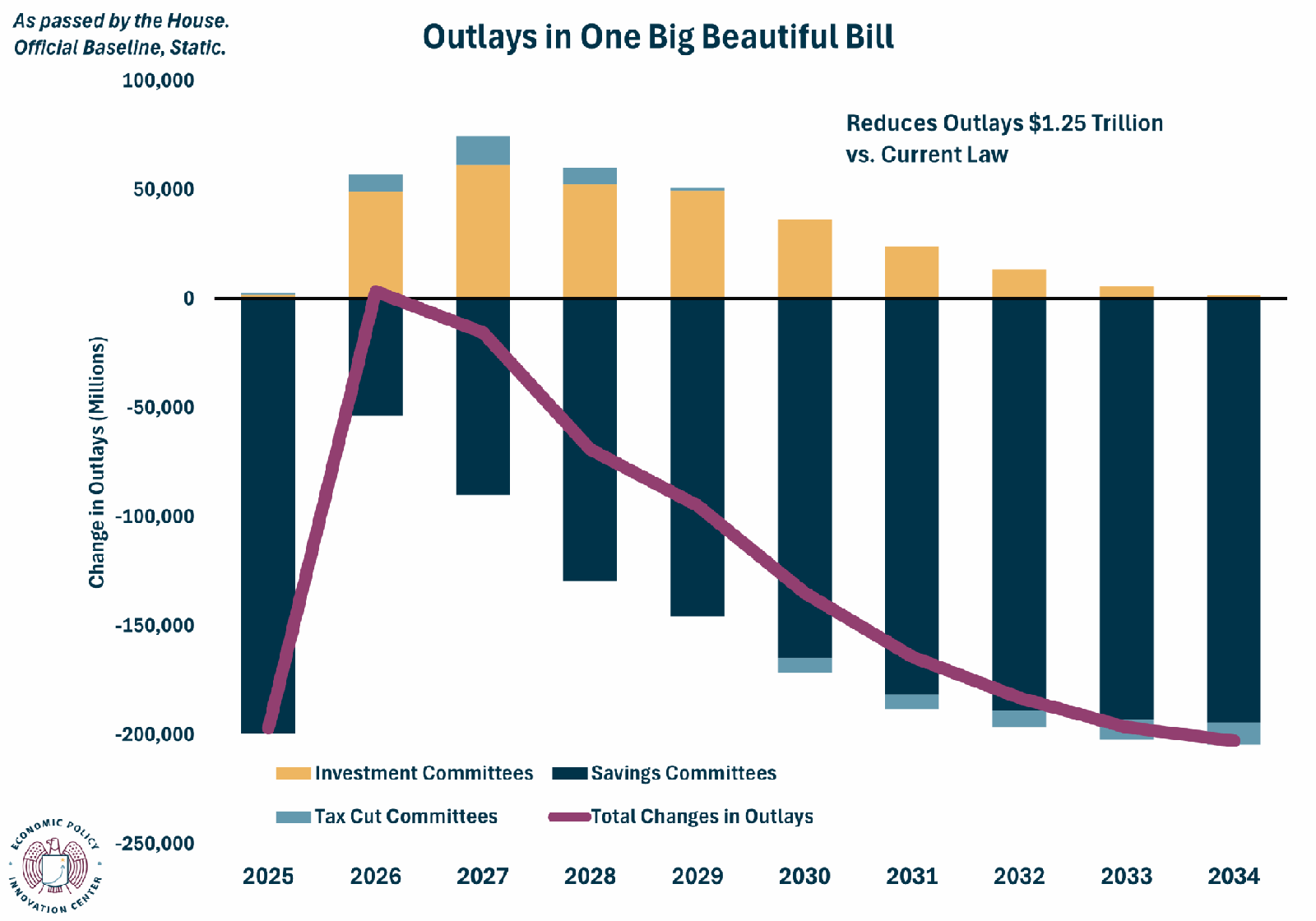
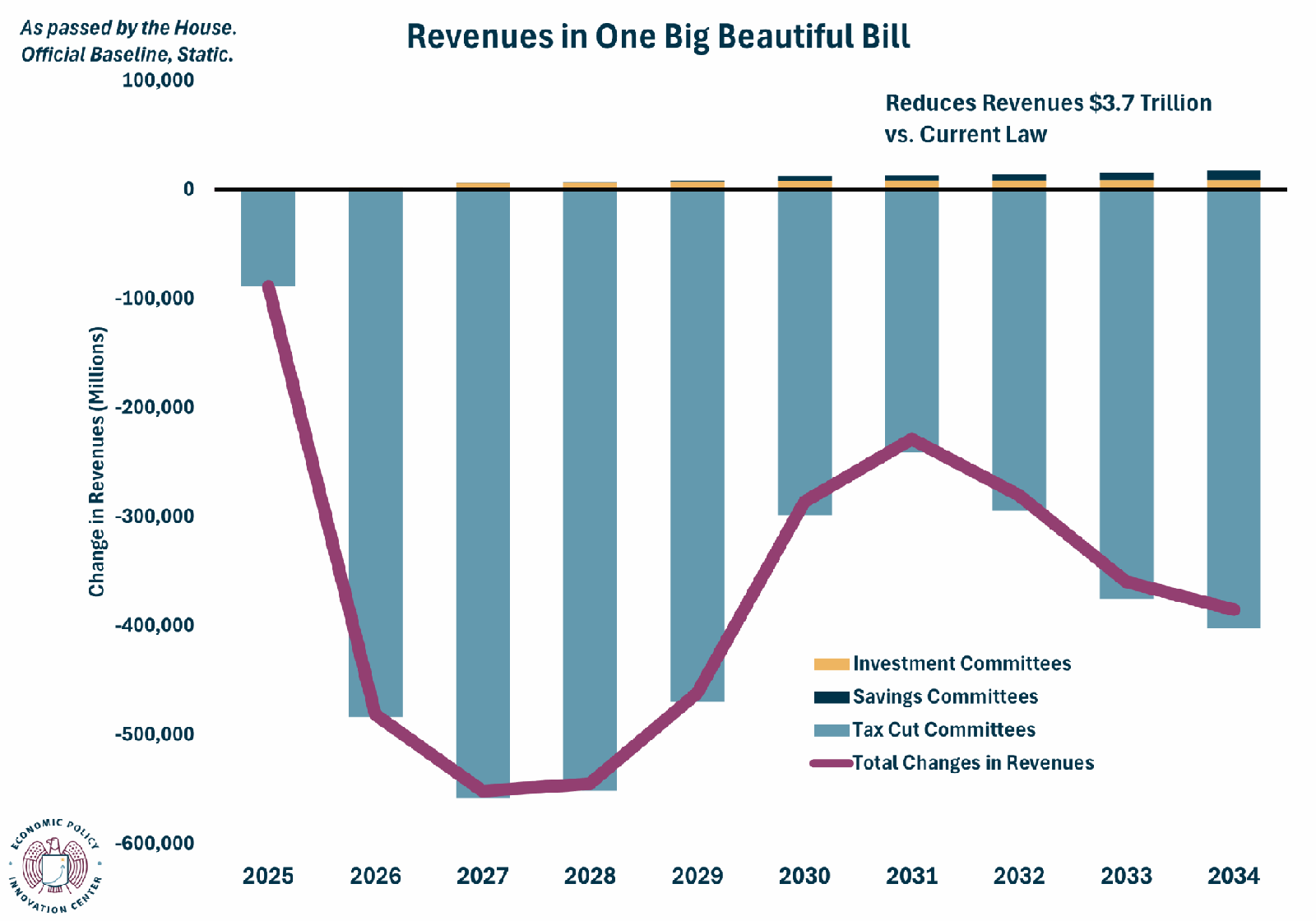
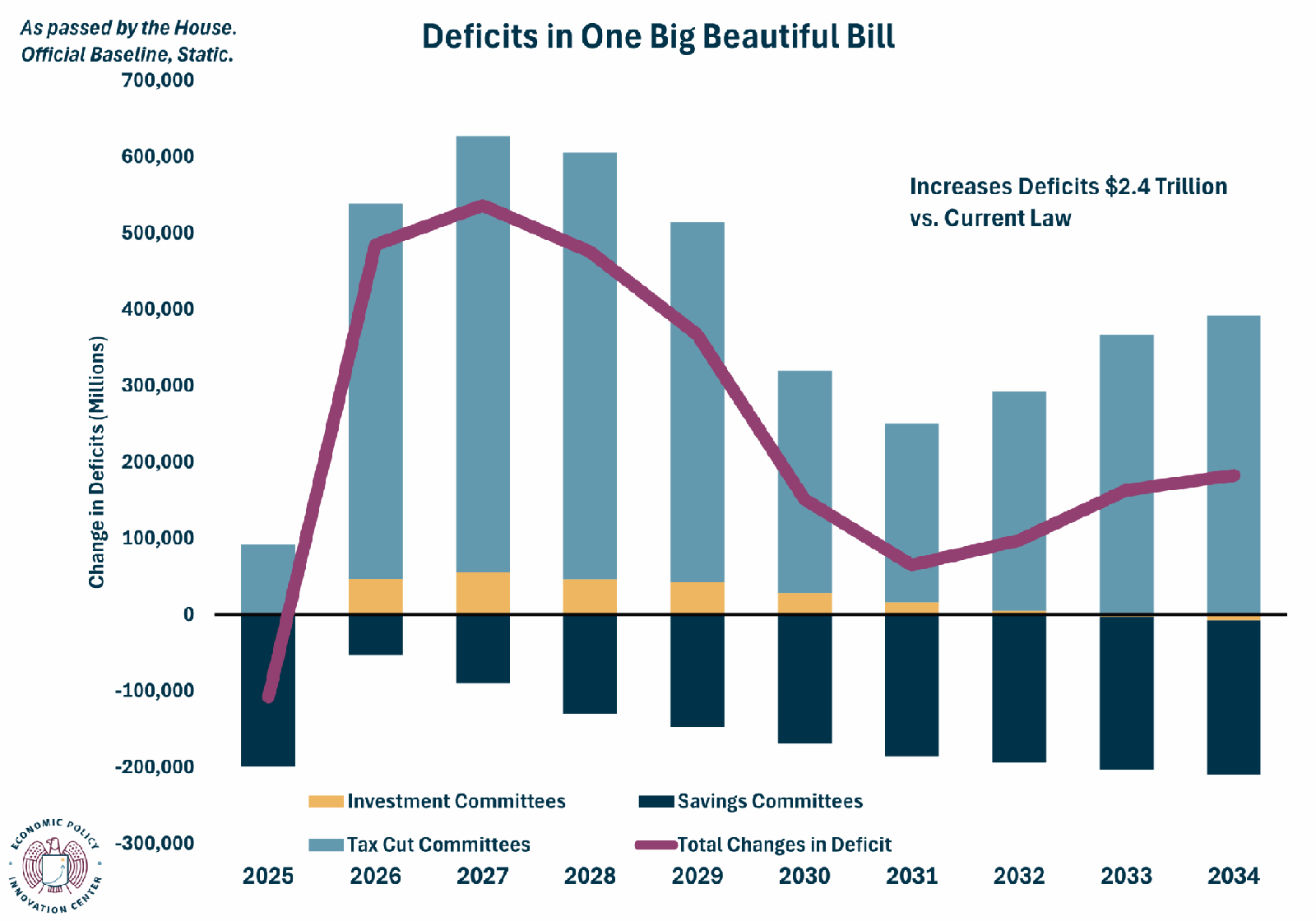
The CBO estimates that the One Big Beautiful Bill as passed by the House would reduce outlays by $1.25 trillion, reduce revenues by $3.7 trillion, and increase the deficit by $2.4 trillion over the FY 2025 – 2034 period.|
One Big Beautiful Bill As Passed by the House - Conventional Scoring |
|||||||||||
|
2025 |
2026 | 2027 | 2028 | 2029 | 2030 | 2031 | 2032 | 3033 | 3034 |
2025 - 2034 |
|
| Outlays |
-197 |
3 | -15 | -69 | -95 | -135 | -164 | -183 | -196 | -203 |
-1,254 |
| Revenues |
-89 |
-481 | -552 | -545 | -462 | -286 | -229 | -281 | -360 | -385 |
-3,670 |
| Deficit |
-108 |
485 | 536 | 476 | 367 | 151 | 65 | 98 | 163 | 183 |
2,416 |
| In billions of dollars. Source: Author Calculations based on Congressional Budget Office. | |||||||||||
- The savings committees reduce outlays by $1.5 trillion and increase revenues by $31 billion.[1]
- The investments committees increase outlays by $297 billion and increase revenues by $64 billion.
- The tax committee reduces outlays by $11 billion and reduces revenues by $3.8 billion.
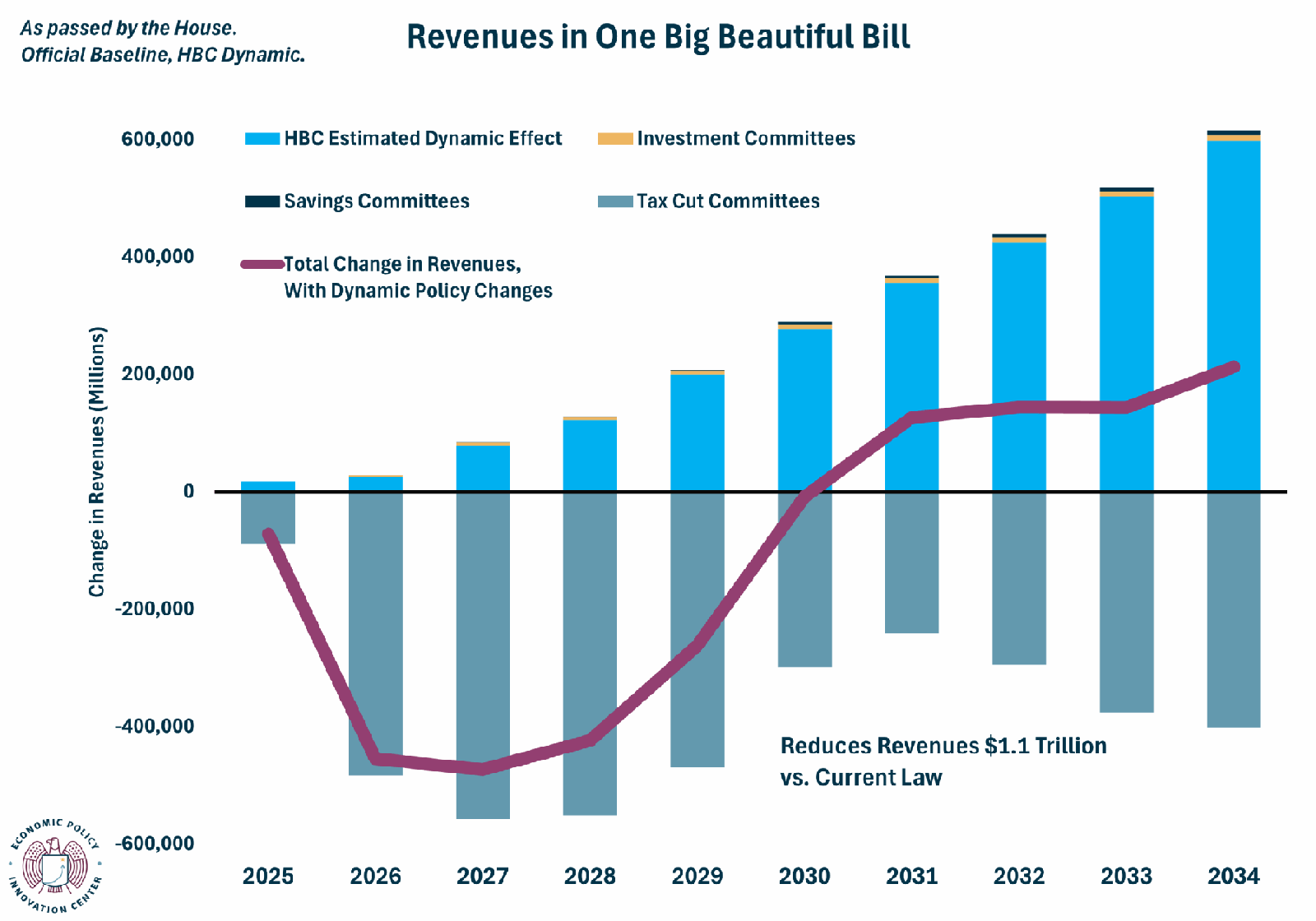
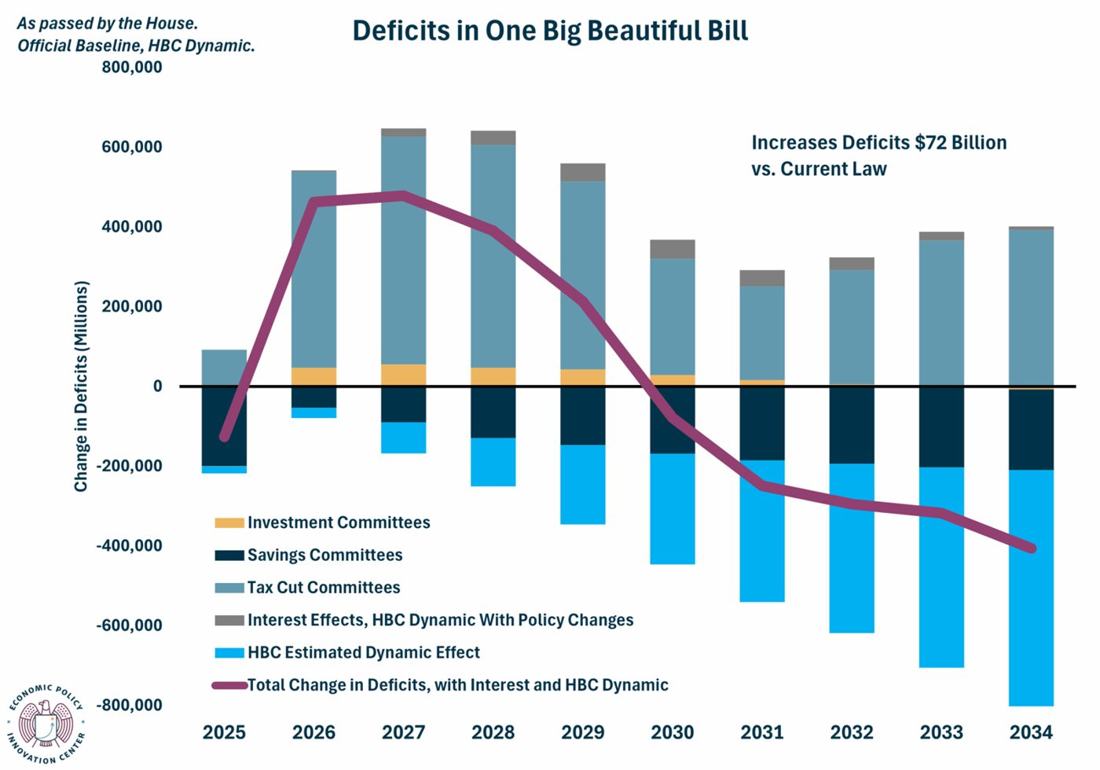
Official Baseline – With House Budget Committee’s Dynamic Growth Assumptions
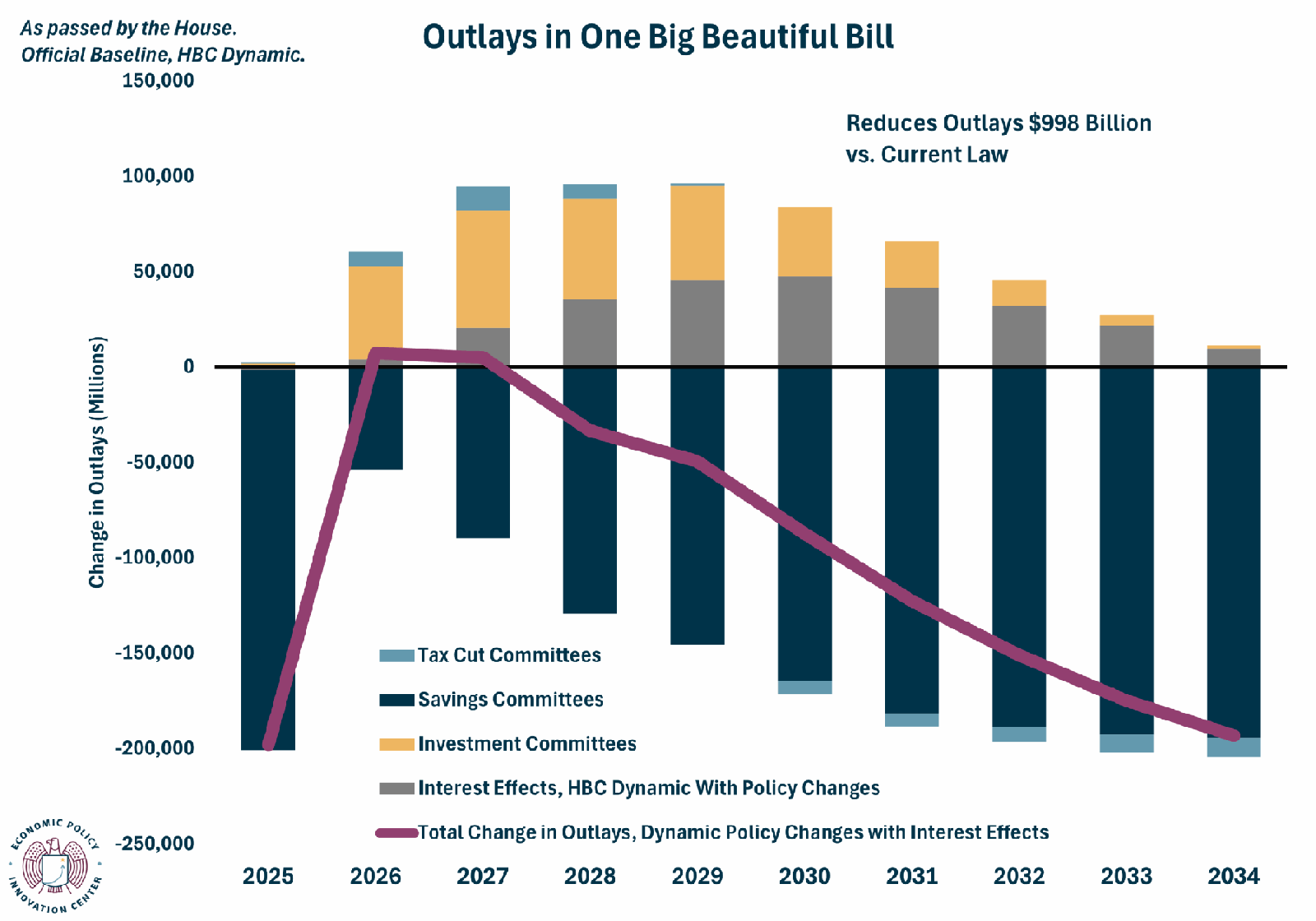
The House Budget Committee “estimates that economic growth will average 2.6 percent over ten years—generating a substantial $2.6 trillion in deficit reduction.”|
One Big Beautiful Bill As Passed by the House – HBC Dynamic Assumption |
|||||||||||
|
2025 |
2026 | 2027 | 2028 | 2029 | 2030 | 2031 | 2032 | 3033 | 3034 |
2025 - 2034 |
|
| Outlays |
-198 |
7 | 5 | -33 | -49 | -87 | -123 | -151 | -175 | -193 |
-998 |
| Revenues |
-72 |
-455 | -474 | -424 | -263 | -9 | 126 | 144 | 143 | 213 |
-1,070 |
| Deficit |
-126 |
463 | 479 | 390 | 213 | -79 | -249 | -295 | -318 | -406 |
72 |
| In billions of dollars. Source: Author Calculations based on Congressional Budget Office. | |||||||||||
Current Policy Baseline
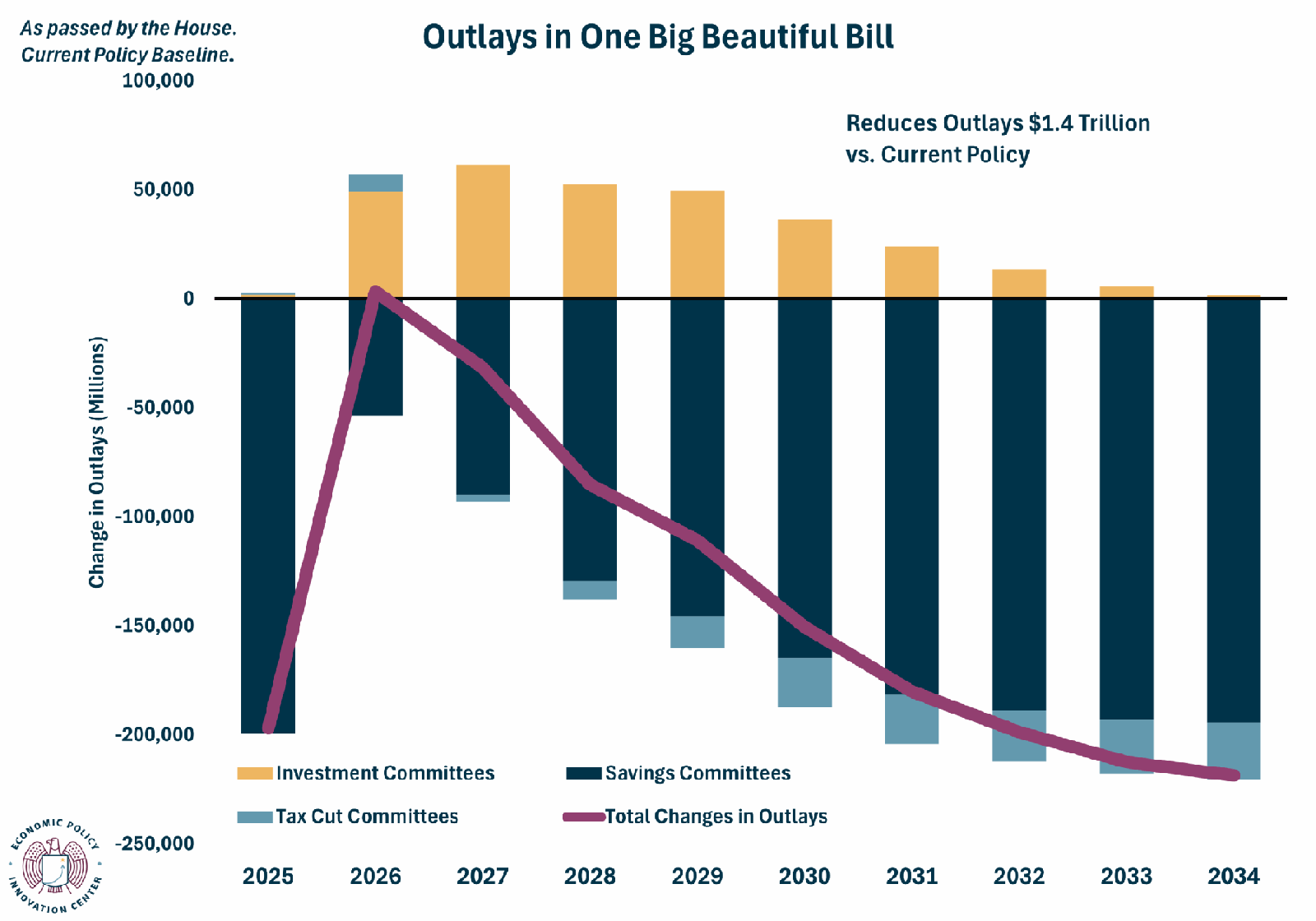
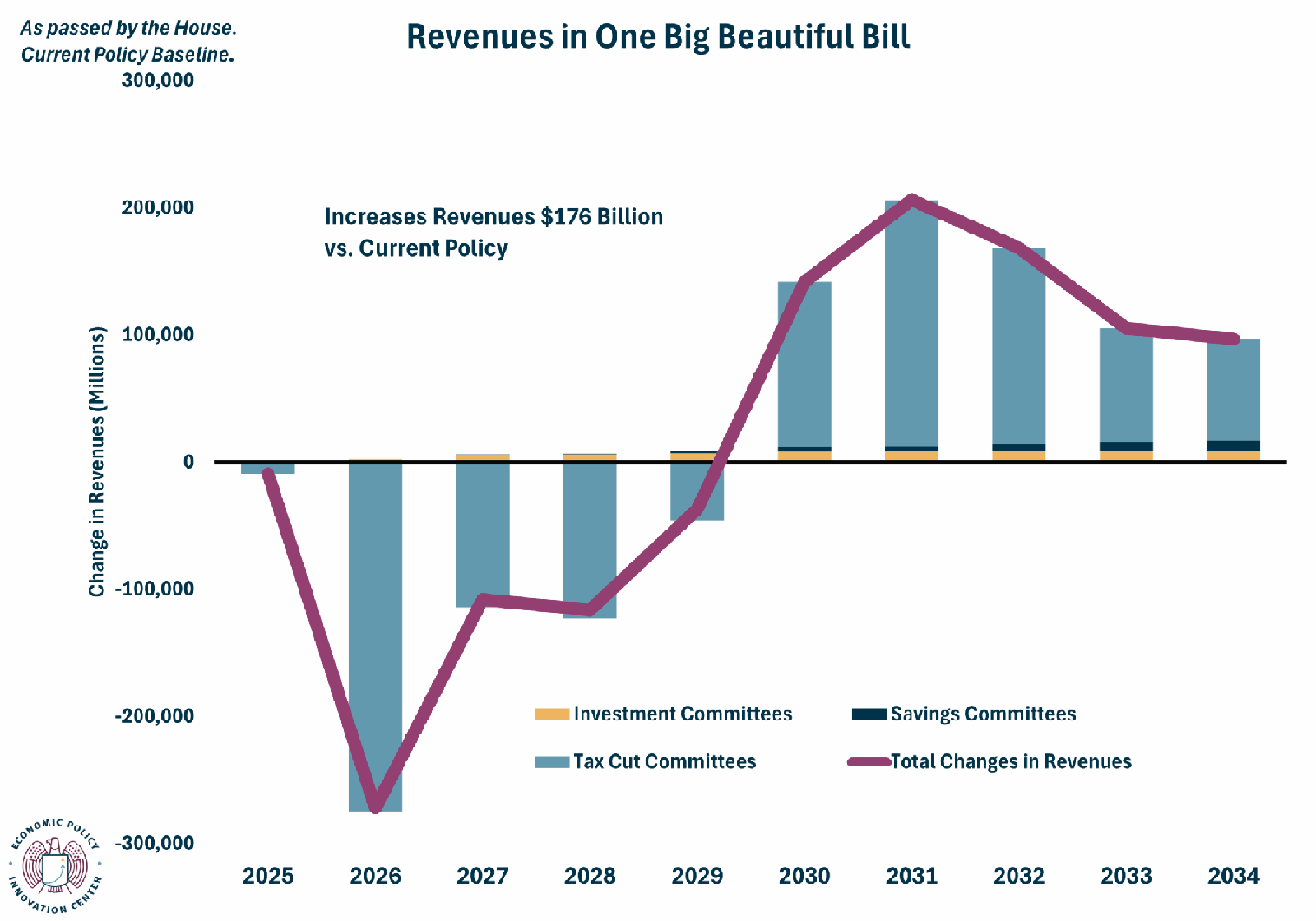
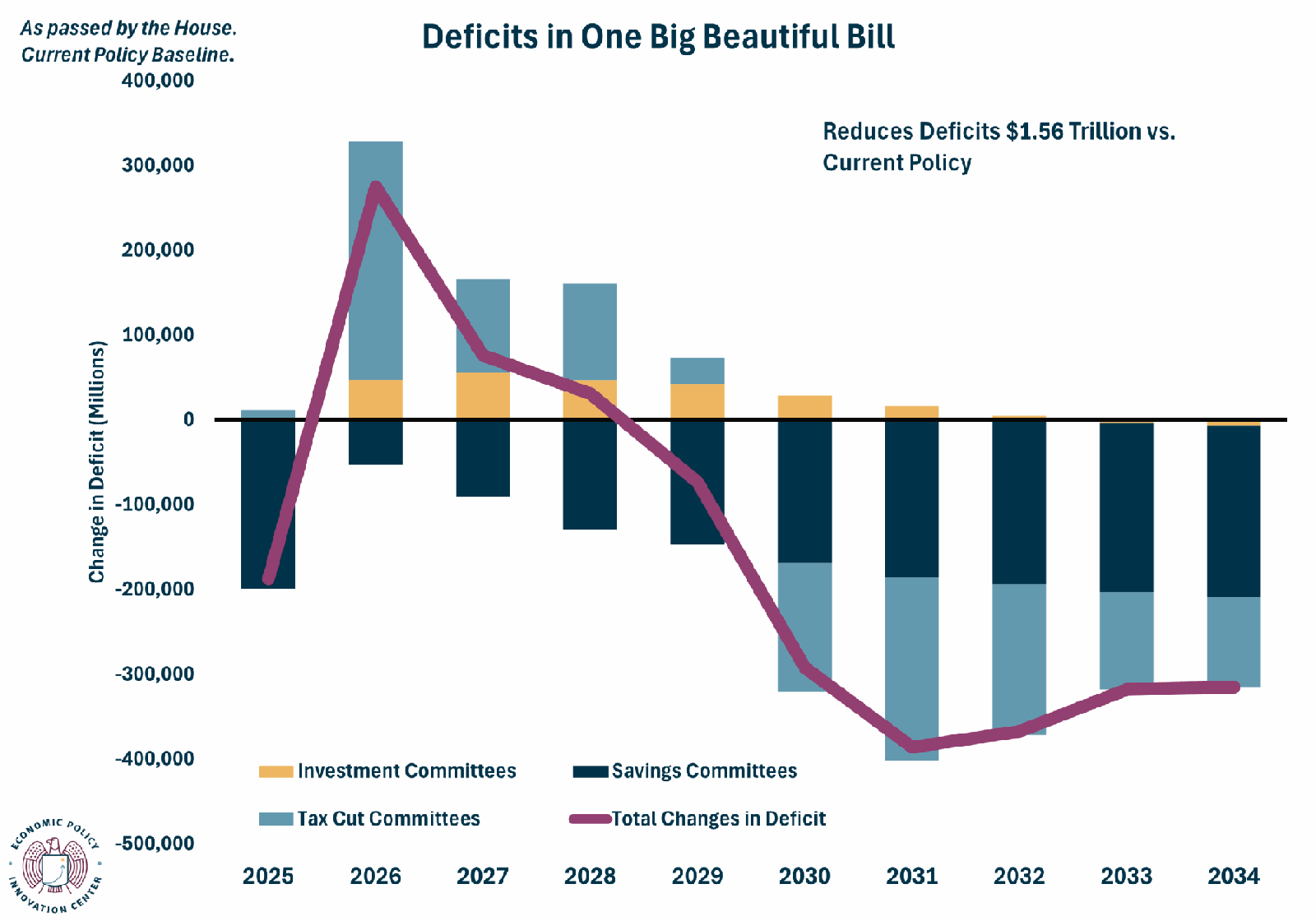
Compared to an estimated current policy baseline that assumes an extension of the expiring TCJA provisions, the One Big Beautiful Bill as passed by the House would reduce outlays by $1.4 trillion, increase revenues by $176 billion, and reduce the deficit by $1.6 trillion over the FY 2025 – 2034 period.|
One Big Beautiful Bill As Passed by the House – Current Policy Scoring |
|||||||||||
|
2025 |
2026 | 2027 | 2028 | 2029 | 2030 | 2031 | 2032 | 3033 | 3034 |
2025 - 2034 |
|
| Outlays |
-197 |
3 | -31 | -85 | -111 | -150 | -180 | -199 | -212 | -219 |
-1,381 |
| Revenues |
-9 |
-272 | -108 | -116 | -37 | 142 | 206 | 168 | 105 | 97 |
176 |
| Deficit |
-188 |
275 | 76 | 31 | -74 | -292 | -386 | -367 | -318 | -315 |
-1,557 |
| In billions of dollars. Source: Author Calculations based on Congressional Budget Office. | |||||||||||
- The savings committees reduce outlays by $1.5 trillion and increase revenues by $31 billion.
- The investments committees increase outlays by $297 billion and increase revenues by $64 billion.
- The tax committee reduces outlays by $138 billion and increases revenues by $81 billion.
 [1] The effects of interactions between committees are allocated to the Savings Committees.