PLEASE NOTE: This site is an archival resource, no longer updated as of June 1, 2026. Current questions: The Fiscal Lab.
The Federal Budget: Spending, Taxes, and Debt

Health Spending Surges Even With Medicaid Reform

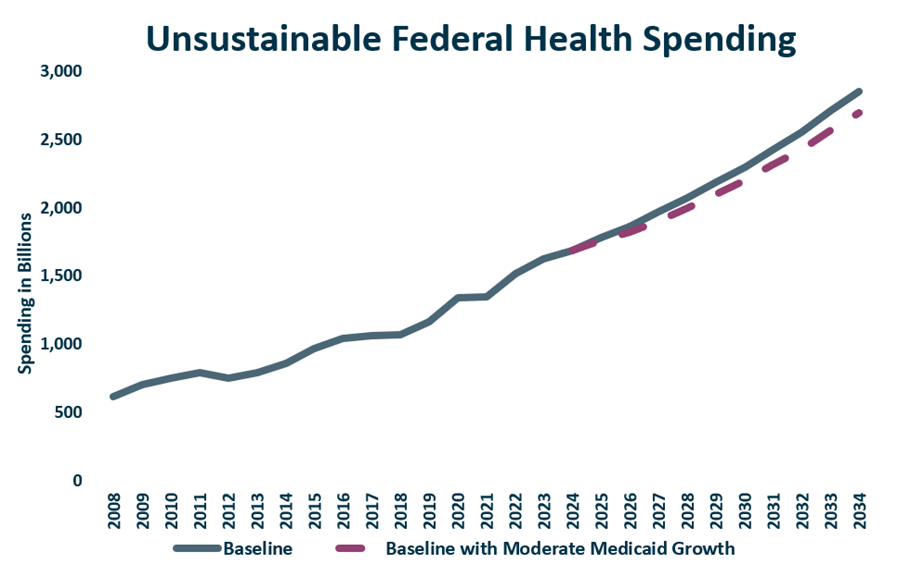
As Congress considers reforms to Medicaid through the reconciliation process, there has been a flurry of overheated rhetoric and lobbying in support of the broken status quo. The most common false claim is that Medicaid would face “deep cuts” if Congress enacts reforms proposed by the House Energy and Commerce Committee. A partial score of the measure estimates $625 billion in Medicaid savings. Even if the savings were increased to $900 billion, Medicaid spending would still grow by 3% per year. Another claim is that Medicaid reform would jeopardize medical providers. However, this ignores the fact that federal health spending will still surge 5% per year if Congress passes $625 billion in Medicaid savings, compared to 5.4% growth in the baseline. HealthSpend Legislators should recognize that a small reduction to the growth of federal health spending would not jeopardize any aspect of the medical system. The current growth of federal health spending is unsustainable, and those who benefit from the spending must not be allowed to drive the nation into bankruptcy.


Author

David A. Ditch

David A. Ditch

David A. Ditch is Senior Analyst in Fiscal Policy at the Economic Policy Innovation Center (EPIC). Ditch has over a decade of experience analyzing federal spending and fiscal policy, including appropriations, infrastructure, agriculture, and needed reforms for dozens of agencies and programs. He has appeared on radio stations across the country and has written for FoxNews.com , the Los Angeles Times , the Chicago Tribune , and many other publications. Prior to joining EPIC, Ditch was a Senior Policy Analyst at The Heritage Foundation, where he was a founding staffer for the Grover M. Hermann Center for the Federal Budget. He managed the Federal Budget in Pictures chart portfolio, was responsible for creating dozens of policy options for the Heritage Budget Blueprint, and produced several groundbreaking reports on federal spending and governance. Ditch was also previously an analyst for the Senate Budget Committee, where he oversaw budgetary enforcement for appropriations legislation. Ditch graduated from the University of Rochester with degrees in Economics and Political Science, and received a Master's in Political Management from George Washington University.

More from David A. Ditch →

← All work