


On Friday, the Internal Revenue Service (IRS) put out a press release touting how it is spending the $80 billion slush fund provided by President Joe Biden’s misnamed “Inflation Reduction Act” (IRA).
The IRA, enacted in August 2022, gave the IRS $80 billion on top of normal appropriations to increase enforcement operations, with just $3 billion set aside to expand taxpayer services. The Administration planned to use these funds to add an army of nearly 87,000 full time employees to the IRS workforce.
The IRS says that its new tax enforcement efforts so far “brings the total recovered from millionaires through these new initiatives to $520 million.” The Administration's press push garnered headlines such as "New results help prove that the Democrats’ IRS plan is working," from MSNBC.
$520 million in higher revenues over a year-and-a half may sound like a lot, but it falls well short of projected new revenues attributable to the enhancement of IRS resources.
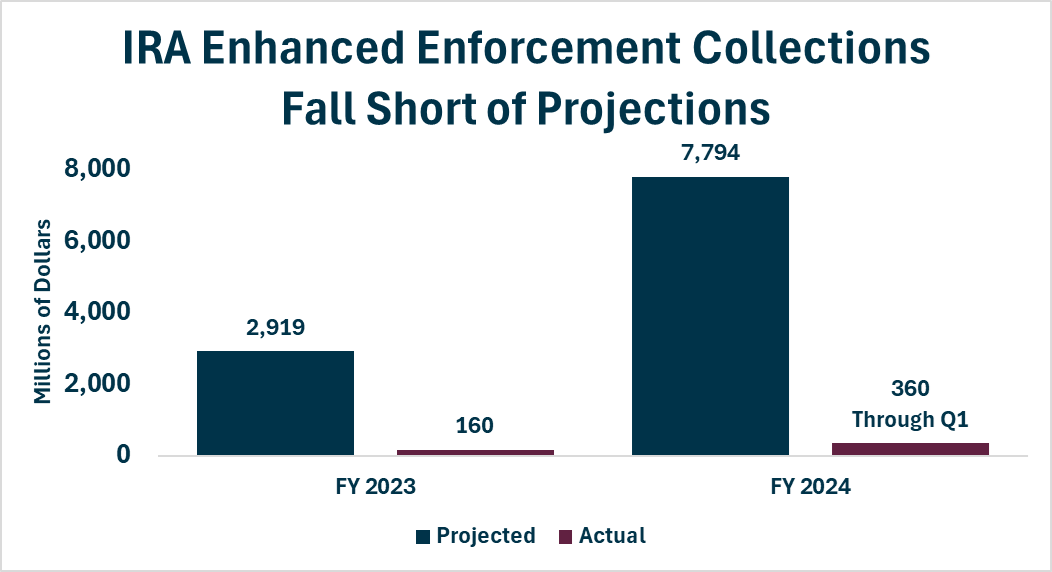
In fact, the $160 million collected in FY 2023 was just 5.5 percent of the $2.919 billion the Congressional Budget Office (CBO) projected would be collected through fiscal year 2023.
With just $360 million in revenues attributable to the IRA in the first quarter of FY 2024, the IRS has collected less than 5 percent of the $7.794 billion projected by CBO for the current fiscal year.
Even if the IRS doubles the current pace of its collections, the $80 billion IRS slush fund could end up adding to the federal deficit over the next decade rather than achieving the promised deficit reduction.
Congressional Oversight Needed
The IRS enforcement effort is one of the signature policies of the Biden Administration, and we can assume they will attempt to play up the numbers as much as possible.
Given the wide discrepancies between what CBO projected and the actual results claimed by the IRS, serious Congressional oversight is warranted.
- First, why has the IRS underperformed projections by so much? Is the IRS spending taxpayer funds appropriately? Should the slush fund be rescinded?
- Second, why were the CBO’s projections so flawed? Will the CBO be updating its modeling to reflect observed results and revising its scoring of the IRA so that lawmakers have accurate data?