


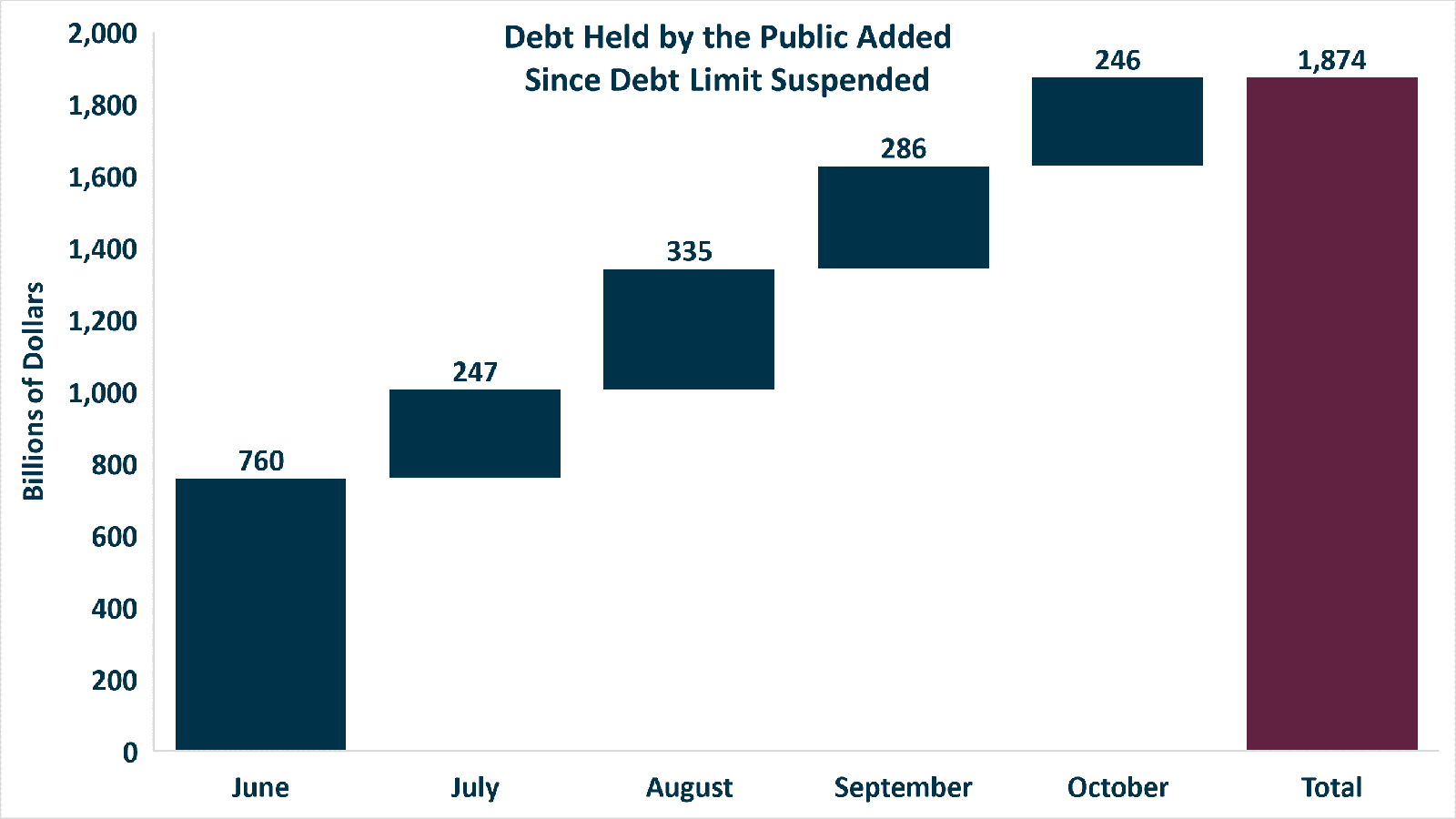
The Fiscal Responsibility Act suspended the debt limit until January 1, 2025. Since the Fiscal Responsibility Act was signed into law on June 2, 2023, the federal government has been able to issue new debt without any statutory limits.
In the first five months of the debt limit suspension, the debt held by the public has increased by nearly $1.9 trillion to a total of $26.6 trillion.
Even more debt is expected to be added in the near future.
On October 30, 2023, the Treasury announced its intent to “borrow $776 billion in privately-held net marketable debt” between October and December, and to increase borrowing to $816 billion in the January to March quarter. This would add another projected $1.592 trillion in new borrowing over the next six months.
The Limit, Save, Grow Act originally proposed by House Republicans would have increased the debt limit to the earlier of either March 31, 2024, or $1.5 trillion. Had the Limit, Save, Grow Act been enacted, the new debt limit would have been reached already by mid-September.
As it is, by the time the end of March 2024 date is reached, total new debt issued could be more than double the amount that would have been permitted under the Limit, Save, Grow Act.
The deluge of debt should be concerning, particularly given signals from the markets.
The most recent report from the Treasury Borrowing Advisory Committee (a group of finance practitioners established by law to advise the Secretary of the Treasury on debt management) released on November 1, 2023, stated:
“There is a view among market participants that the growing imbalance between supply of and demand for US Treasury debt may also have contributed to the sell-off. The $1.7 trillion fiscal year 2023 deficit was larger than originally forecast and both private sector and official projections expect a similarly large deficit next year. In addition, the Federal Reserve is allowing $60 billion in US Treasuries to run off its balance sheet each month, funding that will need to be replaced by issuance to the private market. On August 1st Fitch downgraded the US long-term rating from AAA to AA+, though the market reaction to the news was limited. Demand for US Treasuries may have softened among several traditional buyers.”
Interest rates on Treasury debt have increased significantly in recent months, with the market yield on 10-year securities nearing 5 percent, the highest rates since 2007. The 10-year interest rates are already higher than the 3.994 percent projected by the Congressional Budget Office for the fourth quarter of 2023 in their July 26, 2023, Update to the Economic Outlook.
CBO’s rule of thumb is that if interest rates are just 0.1 percentage points higher than projected each year, it would add $303 billion to the deficit over the next decade.
If interest rates stay 1.0 percentage point above the projection, that could increase deficits by more than $3 trillion over the next ten years.
All of this points towards the need for lawmakers to get serious about controlling government spending.