While the House was drafting the One Big Beautiful Bill (OBBB) reconciliation package, a group of members from high-tax states such as
New York demanded an enormous increase to the State and Local Tax (SALT) deduction. This
reduced the House bill’s pro-growth potential.
Fortunately, the
Senate Finance Committee seeks to rein in the SALT deduction. This gave the committee fiscal space to ensure that the tax code permanently encourages investment, giving the economy a shot in the arm. However, some House members are
threatening to sink the OBBB unless the SALT deduction increase returns.
California is one of the states most affected by changes to the SALT deduction. Both the House and Senate should know that increasing the deduction would encourage California’s flagrantly wasteful spending habits and spread the costs to more responsible states.
Californians Burned by Big Spending and Red Tape
It is no surprise that California, the nation’s most populous state, also has the largest state budget. However, the scale and growth of its spending is almost beyond belief.
California’s spending has increased
much faster than income in recent years, leading to repeated budget battles as taxes struggle to keep pace with outlays. This is made worse by the fact that its prior spending levels were already above average relative to the size of its economy.
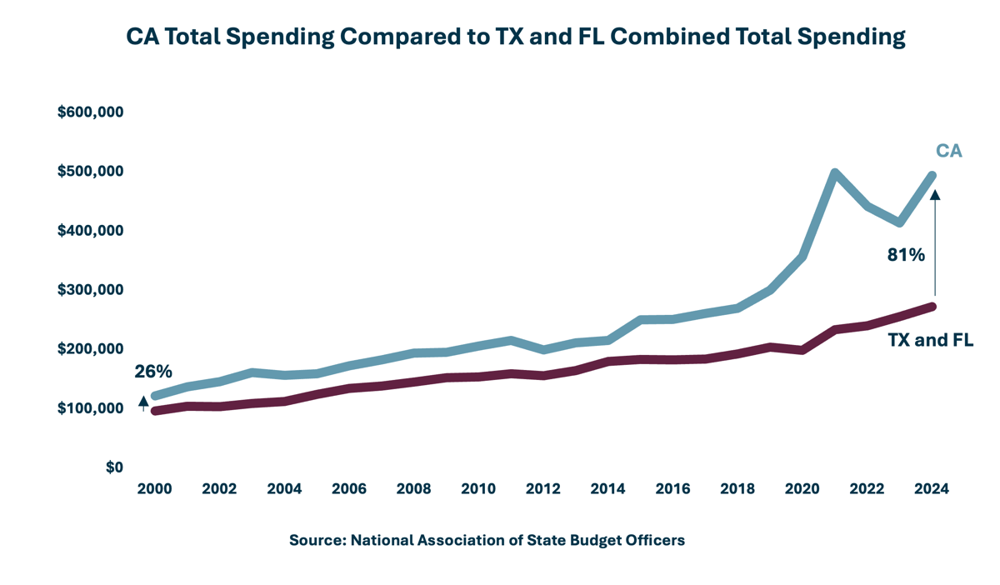
As of 2000, California’s budget was 26% larger than the combined budgets of Texas and Florida, even though California contained 3 million fewer people than these two states. Yet while population growth in Texas and Florida rapidly outpaced that of California – fueled in part by people
leaving California - the spending gap widened.
By 2024, California’s budget was 81% larger than that of Texas and Florida
combined, even though the latter states now have over
15 million more residents. California’s per capita spending is now 156% higher than Texas and 147% higher than Florida, without delivering markedly
more value to its taxpayers.
A common defense of higher spending in California is that the cost of living is higher, resulting in higher costs for government services. This argument misses the mark because the government of California is the
primary driver of higher costs. For example, layers of regulations make housing harder and
more expensive to build and
discourage private investment in the broader economy.
The governance culture is exemplified by Los Angeles blocking homeowners from rebuilding structures damaged or
destroyed by wildfires while essentially
condoning riots. California’s largest city wields the full force of law against people who want to put a roof over their heads while treating destructive radicals with kid gloves.
Increasing the SALT deduction would allow California to pass its self-inflicted cost inflation and dysfunction onto residents of other states.
Milking Medicaid to Benefit Illegal Immigrants
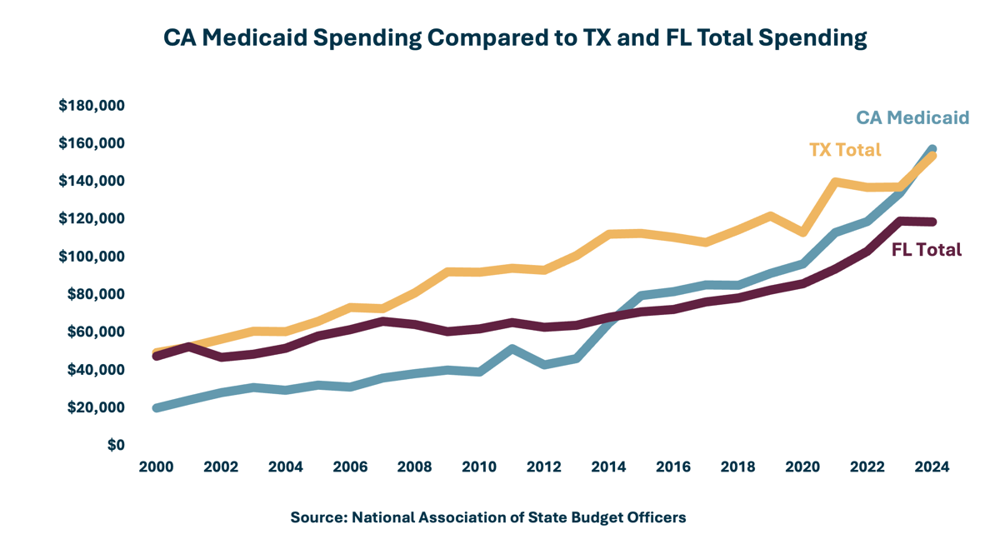
In 2000, California’s Medicaid budget was less than half as large as the total state budgets of Texas or Florida. Following the Obamacare expansion, California’s Medicaid spending surpassed Florida’s
total spending in 2015 and Texas’
total spending in 2024.
At $157.3 billion, California’s Medicaid budget is larger than the
GDP of 14 states (Alaska, Delaware, Hawaii, Idaho, Maine, Montana, New Hampshire, New Mexico, North Dakota, Rhode Island, South Dakota, Vermont, West Virginia, and Wyoming).
California has also extended Medicaid benefits to illegal immigrants. This is indirectly funded with federal tax dollars using a scheme referred to as “provider taxes.”
In this shell game, the state increases Medicaid payments to medical providers to incur large federal matching payments while also levying a fee on the same providers to offset the state’s share of the cost. Both the state government and medical providers reap a profit, while federal deficits ratchet ever higher.
While the Senate Finance Committee does
rein in the gimmick through its portion of the OBBB, this shows the dishonest way that Sacramento interacts with Washington.
The High-Speed Rail Hustle
In 2008, a California ballot initiative authorized $10 billion to construct a high-speed rail network from San Francisco to Los Angeles, with a goal of completing the project by 2020. The project is now estimated to cost well over $100 billion, the timetable for completion has slipped by
over a decade, and the project has become one of the largest white elephant boondoggles in human history due to a
variety of
blunders.
The Trump administration has
cut off federal support for the project, repeating its
2019 decision that further handouts to California would send good money after bad.
California’s leaders remain determined to waste hard-earned money on high-speed rail due to the interest groups that benefit from the spending. Increasing the federal SALT deduction would be a backdoor subsidy to this ongoing failure.
Dismal State of K-12 Education in California
Public schools in California exemplify problems seen in many states: despite
declining enrollment, spending and hiring continue to escalate. Since expenses such as fringe benefits are allowed to swell, school districts face
budget crunches. Rather than focusing resources on priorities, schools hire armies of non-instructional bureaucrats.
This takes place amidst a backdrop of miserable
learning outcomes. A majority of California public school students fail to read at grade level, including a supermajority of African American and Hispanic students.
Countless parents have fled California. Giving larger federal tax deductions to those who remain would do nothing to reform a broken educational system.
The Homeless & NGO Industrial Complex
California has had a homelessness problem for many years. This has intensified over the last decade, with roughly
187,000 people currently homeless in the state.
That figure is especially glaring because state and local governments in California spend billions of dollars per year, including
hundreds of thousands of dollars per unit of housing provided, attempting to address the problem.
One culprit is a
vast network of non-governmental organizations (NGOs) that receive grants predicated on addressing homelessness. These groups, often staffed by radical activists, lobby for
counterproductive mandates that exacerbate problems such as drug use among those receiving government assistance. Government-funded NGOs are not incentivized to solve the problem, but to perpetuate it.
There is no easy
solution to homelessness. However, what has become clear is that throwing endless tax dollars at “nonprofit” groups will not make a dent in the crisis.
Congress Should Stop Rewarding Wasteful Spending
The problems described in this piece are not unique to California. Other high-tax states are losing throngs of residents to low-tax, pro-business states year after year.
If the final version of the OBBB markedly increases the SALT deduction, it would mean transferring potentially hundreds of billions of dollars to jurisdictions that have proven themselves to be poor stewards of the public good.
Members whose goal is reducing the tax burden on their constituents should exchange problematic provisions such as the SALT deduction for lower tax rates. This would encourage work and investment across the country and make America more competitive in the global economy.