As Congress considers the
One Big Beautiful Bill (OBBB) reconciliation legislation, the
State and Local Tax (SALT) deduction has been a contentious issue. The House-passed OBBB increases the SALT deduction from $10,000 to $40,000 per taxpayer at a cost of $377 billion over 10 years, leaving
less room for pro-growth tax reforms.
Representatives from high-tax jurisdictions pushed for the dramatic SALT increase, claiming that their constituents need “relief” from exorbitant levies. (The related argument, that the larger deduction would especially benefit “middle class” households, is
even more dubious).
A review of the governance of New York State shows the punishingly high state and local taxes paid by Empire State residents benefit wasteful and corrupt bureaucracies. Increasing the SALT deduction would further subsidize New York’s dysfunction. Spreading the costs across the country would encourage more graft, ultimately leaving its residents no better off and with fewer alternatives to flee to.
Explosive Spending Growth
New York’s fiscal year 2026 budget proposal calls for a record
$254 billion in spending, an 8.3% increase from the 2024 level. This not only far exceeds inflation but also comes at a time when the state’s population is still below its peak in 2020, meaning the government is not having to provide services to a surging number of citizens.
In other words, business is booming for New York’s bureaucrats and state beneficiaries.
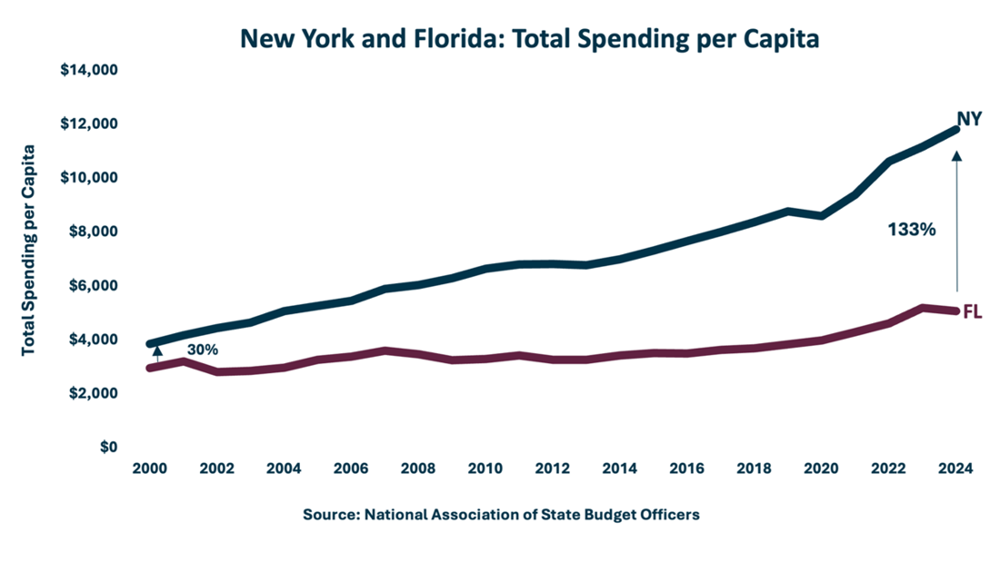
Contrasting New York’s budget with that of Florida is instructive. Both states have a mix of wealthy and blue-collar areas, both have big cities with significant demographic diversity, and they have the second and third largest state populations in the country.
In 2000, New York State spending per capita was already 30% higher than Florida. By 2024, New York spent 133% more per capita than Florida.
The results of these different budgetary approaches have been stark. From 2000 to 2024, New York’s population grew 4.5%, while Florida’s grew 45.6% - a tenfold difference.
 Tax-and-spend policies
 stifle private investment and jobs, encouraging residents to leave for better opportunities elsewhere. It is not a coincidence that New Yorkers are especially likely to
move to Florida.
New York’s attempt to use
corporate welfare to cover its high taxes has been a dismal failure. State and local subsidies now exceed $10 billion per year, much of which involves allowing selected businesses to dodge taxes while others pay the full price. In this way it mimics how the SALT deduction effects federal taxes: those who get to use the deduction defray their tax share onto others.
Such a dramatic difference in spending trends does not happen by chance, but rather because of specific choices by elected officials.
Medicaid Blowout
Following the passage of the Affordable Care Act (aka. Obamacare) and a
Supreme Court ruling, state governments have been able to choose whether to participate in a
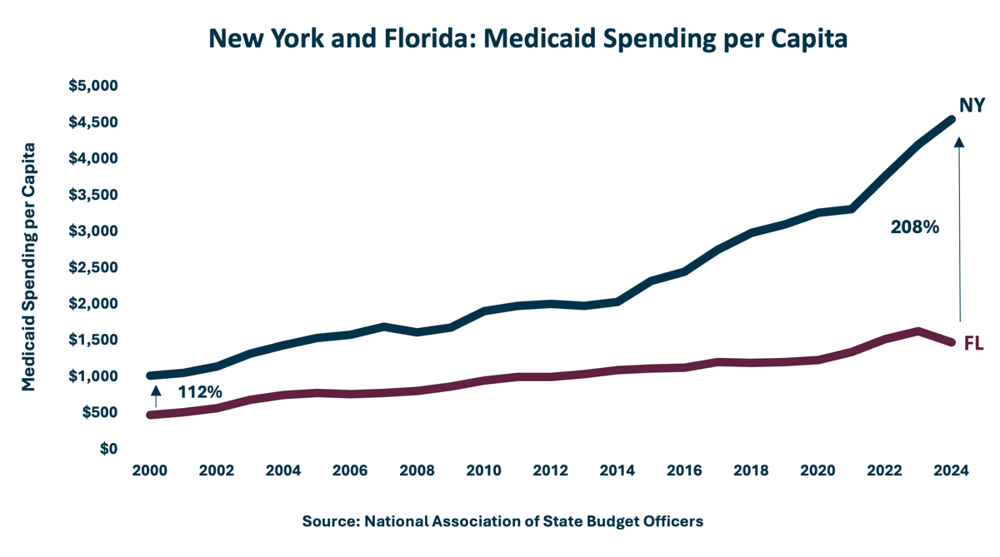
heavily subsidized expansion of Medicaid eligibility. While New York chose Medicaid expansion as quickly as it could, Florida continues to focus Medicaid on the traditional vulnerable populations rather than able-bodied adults.
This is the largest reason why New York’s Medicaid spending per capita has grown much more rapidly than Florida’s. For perspective, in 2024 New York spent nearly as much per capita on Medicaid ($4,551) as Florida did for its entire state budget ($5,076). New York’s Medicaid spending per capita is more than three times Florida’s.
While the choice to expand Medicaid eligibility was important, New York’s per capita Medicaid costs are the
highest in the country due to a multitude of questionable policies. These include:
- Offering “emergency” medical coverage for 480,000 illegal immigrants. (While this is not technically eligible for federal cost-sharing, the fungibility of money means that federal handouts to states enable these state-level decisions).
- Maximizing eligibility to the point where 44% of New Yorkers use Medicaid, the highest in the nation by seven points. Those earning up to two and a half times the poverty level are eligible for zero-premium coverage in New York.
- Aggressively funding at-home health work, which is now the largest occupation in the state and continuing to grow rapidly. An important factor is the unionization of such workers, meaning that the federal government is subsidizing a key political ally for Albany’s incumbents.
- Recklessly increasing both federal and state spending on Medicaid since the start of Gov. Kathy Hochul’s time in office.
There is no inherent reason why New York must spend exceptional amounts of tax dollars on Medicaid. Officials are consciously extending welfare benefits (of
questionable value) to as many people as possible. This does not justify increasing the federal write-off for SALT.
Education: Big Payouts for Unions, Poor Results for Students
Another major spending category is K-12 public schools, affecting taxes at state and local levels.
New York’s per-student spending is the highest in the nation, including an average of
$35,000 per student this year. A handful of school districts exceed $100,000 per student, and low-density Hamilton County will spend over $69,000 per student. (Notably, much lower-density counties in western states manage to avoid such sky-high costs).
Public school spending is driven by the demands of politically powerful teachers’ unions. Even though enrollment is
falling as part of the state’s demographic stagnation, New York’s unions demand:
Yet, higher education spending has produced worse outcomes. In 2022, New York’s 4
th graders ranked 36
th in the nation in reading and 46
th in the nation in math. Meanwhile, Florida spends about $13,000 per student and its 4
th graders rank 3
rd in the nation in reading and 4
th in the nation in math. While the state government’s share of K-12 spending is important, local voters also have a role in approving local school spending. New York taxpayers who believe the premium cost of public education in their area is justified are welcome to hold that opinion. However, they are not entitled to a larger SALT tax break at the expense of people living hundreds or thousands of miles away.
Don’t Force the American Taxpayers to Subsidize the Waste and Abuse
It is understandable that representatives of high-tax districts in New York want to assist their constituents. However, threatening to force massive tax hikes on all Americans for the sake of a bloated SALT deduction is the wrong solution. New York’s legislators and interest groups would use the increase as an excuse to ramp up spending even faster, leaving everyone worse off.