The
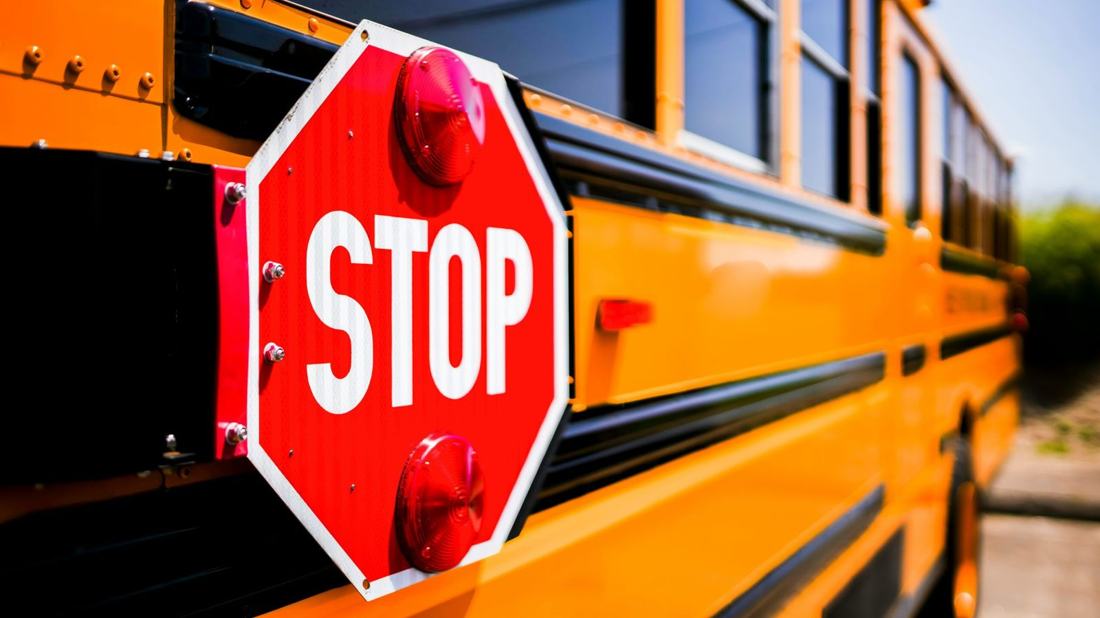
Infrastructure Investment and Jobs Act (IIJA) provided $5 billion to the Environmental Protection Agency (EPA) for the
Clean School Bus Program (CSB). This initiative funds the
replacement of diesel school buses with electric, propane, or hydrogen “zero-emission” alternatives. Thus far, $2.7 billion in funding has been issued and
90% of this funding went towards electric buses. Funding was distributed through grants and rebates and administered by the EPA prior to being
halted by the Trump Administration in February 2026 for programmatic review.
EPA Administrator Lee Zeldin
stated that, “the Clean School Bus program has been a disaster of poor management and wasteful spending of taxpayer dollars.” the
EPA Office of Inspector General (OIG) has identified substantial concerns with the CSB program, highlighting waste, fraud, and abuse.
Consequentely, the EPA has stopped new rounds of funding in an attempt to “reform the program to bring consumer choice back to schools and deliver results for American families, while still fulfilling congressional intent.” The EPA is seeking public input through a
Request for Information process on the “availability, cost, and performance” of school buses that meet the “zero-emission” statutory requirements and offer improve reliability compared to electric school buses.
These are prudential steps to take before distributing any of the remaining $2.3 billion in grant and rebate funding. The CSB program prioritized funding for school districts that met equity criteria, allowed waste, fraud, and abuse due to lax certification standards, and has not significantly increased the number of “clean” school buses on the road relative to the money spent on this initiative.
Most importantly, Congress and President Trump should rescind the remaining $2.3 billion CSB funding to protect taxpayers from additional waste, fraud, and abuse.
Funding Prioritized Race-Based Criteria Over Demonstrated Need
Federal infrastructure dollars traditionally support broad transportation initiatives. The CSB grants instead placed significant emphasis on
directing awards toward districts identified through President Biden’s
Justice40 equity framework.
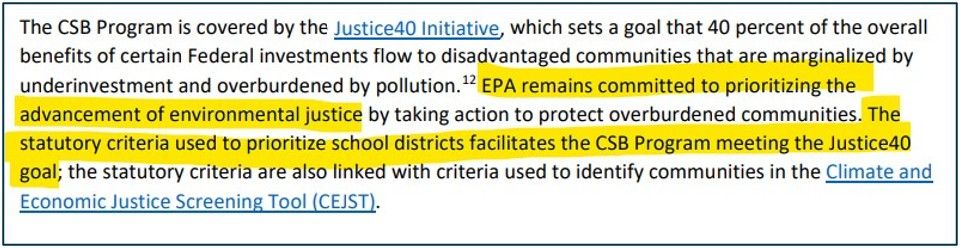
Under President Biden’s Justice40 Initiative, at least 40% of the funds for each project must go to “communities of color” to advance environmental and racial justice initiatives. In keeping with that requirement, the maximum rebate differs for a prioritized district vs a non-prioritized district. A prioritized district, as defined by meeting Justice40 criteria,
receives up to $20,000 per replacement bus compared to $13,000 for replacement busses in non-prioritized districts.
The
Electric School Bus Initiative hosts a
dashboard highlighting the CSB electric school bus deployment and has a page dedicated to how the program supported Justice40 and distributed buses based on race.
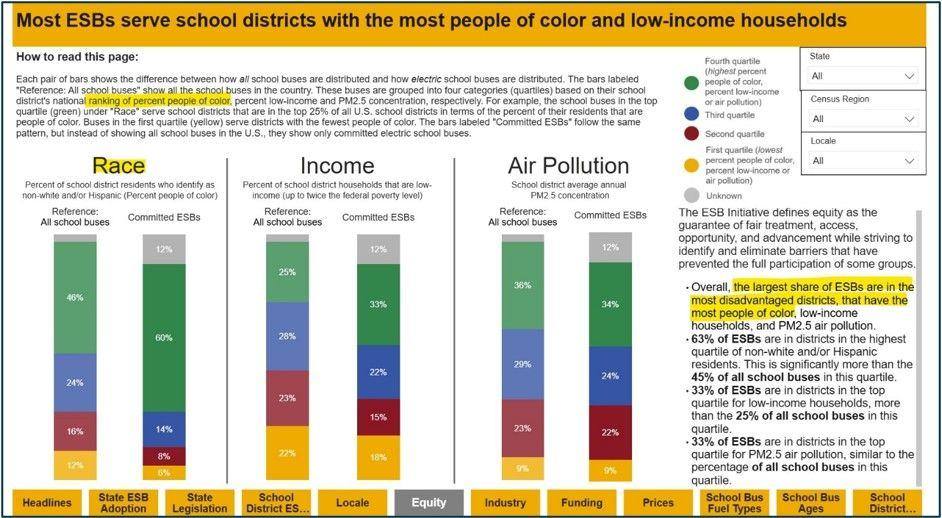
By distributing electric school buses based on racial justice indicatives, the CSB committed proportionally
fewer new electric school buses to areas with the highest air pollution. This means that the areas that arguably need “clean” school buses the most, received fewer of them because of the Justice40 bias towards prioritizing race and income over improving air quality.
Waste, Fraud, and Abuse in CSB Programs
The CSB Program operates through two primary mechanisms: competitive grants and rebates. The oversight structures contain significant weaknesses that create opportunities for waste, fraud, and abuse in both portions.
Under the grant program, school districts and third-party entities are eligible for funding that covers electric and broader “zero-emission” school buses such as propane as well as related infrastructure. However, the EPA OIG found that the EPA
relied on minimal verification mechanisms when reviewing applications. While the EPA confirmed basic eligibility, removed duplicate district applications, and verified that a school district existed, the agency did not independently validate fleet information, infrastructure plans, or operational claims made by applicants. Because applicants were permitted to “self-certify” eligibility simply by submitting an application, administrative entities with no enrolled students were able to apply for and receive funding.
The rebate program contains similar vulnerabilities. Initially limited to school districts, eligibility was later expanded to include third-party suppliers and utilities. Unlike most rebate programs, CSB rebates were
issued before purchases were made, rather than reimbursing documented expenditures. This structure increases the risk of improper payments.
Oversight failures were
documented by the EPA OIG. In one case, a rebate recipient received funds for buses that were ineligible under program guidance and intended for a school administrative entity with zero students. In another, a contractor received a rebate without the knowledge or support of the school district for which the buses were supposedly designated. In FY 2022 alone, more than
$38 million in rebates were issued to third-party contractors that applied without the consent or awareness of the affected school districts.
Identity verification controls were also insufficient. According to the OIG, confirming the identity of one grant recipient required six months of investigative work, including subpoenas and surveillance. A follow-up OIG report in
July 2024 found that these oversight deficiencies persisted. School districts did not need to provide copies of vehicle titles, registrations, or any supporting documentation that would indicate that the vehicle was operational or even belonged to the school district at all. Instead, the applicant providing any information on fuel type, model year, and gross vehicle weight was taken as sufficient proof that these buses existed and were eligible for programmatic grants to replace them.
High Costs with Limited Returns
Electric school buses are significantly more expensive than traditional diesel models. The purchase price is higher, and the transition requires additional investments in charging infrastructure, maintenance training, and route planning adjustments around the more limited range.
Electric buses also
weigh more than diesel options and are already sparking concerns about road damage. A heavier vehicle means more impact on road surfaces, increasing wear and leading to higher infrastructure bills.
Most conventional diesel school buses
cost between $105,000 and $150,000 and come with a range of up to
690 miles. Diesel fuel infrastructure is fairly common and does not require the same expense of implementing a new EV bus charging system, which can cost up to $140,000.
Electric school buses typically have a range of 100 to 150 miles and cost between
$300,000 and $400,000, two to four times more than their diesel counterparts.
Weather can significantly impact the
range of these vehicles and rural school districts or schools traveling to sporting events often exceed this range, making electric busing an unsuitable choice for them and forcing rerouting for rural areas.
Utility companies often were
not prepared to upgrade electrical infrastructure needed for charging the new bus fleets leading to delays in deployment and increases in the total project costs. Utility providers
estimate needing a year or more to construct chargers and infrastructure for a fleet of 25 electric school buses. These barriers increase total project costs and
slow deployment. They also reduce the likelihood that buses will operate consistently and cost effectively once delivered.
In February 2026, roughly
4,500 electric school buses are operating on the road despite issuing almost $3 billion in CSB awards or rebates,
90% of which went to electric school buses. That equates to more than $500,000 in CSB funding per deployed electric school bus. This gap between funding commitments and deployment highlights the program’s implementation challenges.
Rethinking the CSB
With only a fraction of funded buses fully operating despite billions in awards, the Clean School Bus program reflects poor fiscal stewardship rather than effective infrastructure investment. The Trump Administration is right to reevaluate the effectiveness of this program and investigate how the funding is distributed. Billions of dollars were committed under a structure that prioritized equity classifications over demonstrated transportation need, relied on self-certification and weak verification standards for awardees, and allowed waste, fraud, and abuse.
Going forward, the Trump Administration should use the responses to their request for information to find the most reliable and cost-effective bus system for schools based on the school districts’ needs and ability to support the specialized infrastructure for non-diesel school buses. Further, when issuing grants or rebates with the funds already provided, the EPA should strengthen oversight and ensure that data submitted by applicants is accurate to better steward taxpayer funds.
For its part, Congress should not reauthorize IIJA programs like the CSB that wasted taxpayer dollars and offered insufficient oversight. The CSB forces a transition to buses that many school districts and utility systems are not prepared to handle. Instead, funds in transportation legislation should flow to projects that have broad national use and not to “clean” school bus mandates.
With $2.3 billion in remaining funding, the CSB program should be a priority for rescission. The
Impoundment Control Act (ICA) allows the President to recommend unneeded funds for rescission, which can be passed by the Congress on an
expedited process that bypasses the Senate filibuster. Alternatively, Congress can initiate the rescission using the normal legislative process. Rescinding the remaining CSB funding, rather than spending it on other “clean energy” subsidies, would
reduce the deficit and protect taxpayers from additional waste, fraud, and abuse.