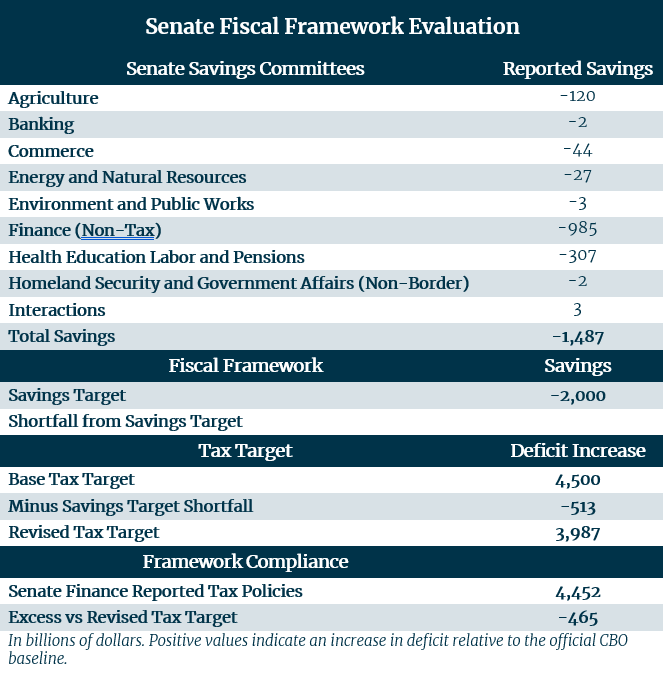
The Senate version of the One Big Beautiful Bill violates the Fiscal Framework agreed to in the budget resolution.
The Senate bill has a $465 billion shortfall in the necessary savings for purposes of the fiscal framework.
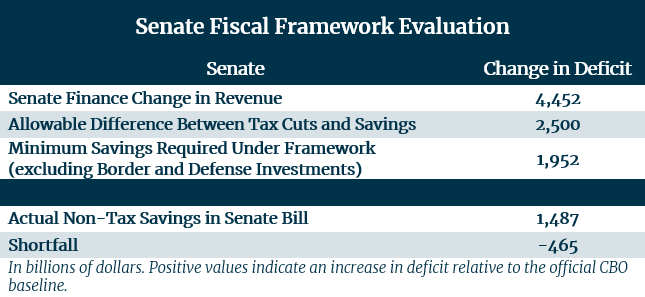 The Senate Finance Committee released a tax plan that increases the deficit by $4.452 trillion relative to the official CBO baseline.
This level of tax reduction would require $1.952 trillion of net deficit reduction to ensure compliance with the framework. This would be $382 billion in additional savings beyond the House-passed bill.
However, the Senate bill produces about $1.5 trillion of savings.
The Fiscal Framework
The budget resolution providing for the reconciliation process includes an
important fiscal framework to ensure the One Big Beautiful Bill is fiscally responsible and unlocks the full potential of tax reform.
The framework, codified in
Sec. 4001 of the budget resolution, essentially requires any tax reductions relative to the
official Congressional Budget Office (CBO) baseline in excess of $2.5 trillion be offset on a dollar-for-dollar basis by savings produced in other committees.
The House budget resolution
included an assumption that "economic growth will average 2.6 percent over ten years—generating a substantial $2.6 trillion in deficit reduction” due to pro-growth tax, regulatory, energy production, and other policies.
This framework also allows for investments in border security and national defense.
Compliance with the Framework is Necessary
Compliance with the fiscal framework by both the House and Senate version of the One Big Beautiful Bill is vital.
Thirty-eight Members of the House of Representatives recently
wrote to Senate Majority Leader John Thune (R-SD) that:
"This would not have been possible without the House framework that paired the tax cuts with meaningful reductions in spending to ensure that the bill will not add to the debt relative to current law. As the Senate considers changes, we remain unequivocal in our position that any additional tax cuts must be matched dollar- for-dollar by real, enforceable spending reductions. That union is the cornerstone of the House framework adopted in Section 4001 of H.Con.Res. 14 and it is the minimum standard for our support."
Many of these Members described the framework in an
earlier letter released in May:
"To fully extend and build upon the 2017 tax cuts, this means that the reconciliation bill must include at least $2 trillion in verifiable savings either through spending reductions or scaling back the size of the tax package. If savings fall short, the Ways and Means Committee’s instruction must be lowered dollar-for-dollar to keep the reconciliation bill within the agreed limits […] The House reconciliation instructions are binding. They set a floor for savings, not a ceiling."
This post was updated on the morning of June 29, 2025, to incorporate more detailed CBO cost estimates for the Senate Committee on Finance and Homeland Security and Government Affairs.
Appendix: Detailed Senate Fiscal Framework Evaluation