Infrastructure has been a focus of governments for thousands of years, and infrastructure is one of the few federal activities that still tends to receive broad bipartisan support both in Washington and among the public.
Unfortunately, politicians often take advantage of this sentiment and use “must-pass” legislation to fund dubious infrastructure programs that would struggle to find support on their own.
The 2021 Infrastructure Investment and Jobs Act (IIJA), a five-year $1.2 trillion package, was
loaded with questionable set-asides and mismanaged by the Biden administration under then-Transportation Secretary
Pete Buttigieg.
Taking place in the wake of the COVID-19 recession, the IIJA was sold as economic revitalization. This pattern previously occurred during the Great Recession, as several “
stimulus” packages including infrastructure were put forward based on
Keynesian economics. Both the Obama and Biden infrastructure initiatives failed to deliver on their promised growth effects, though they succeeded in growing the national debt.
To help identify where the Department of Transportation (DOT) went wrong in the IIJA era, Senator Joni Ernst (R-IA) requested data on major projects that are more than $1 billion over budget or five years behind schedule. The DOT’s information was used as the basis for
Off The Rails: The Billion Dollar Boondoggles Taking Taxpayers for a Ride, a
new report from Ernst on wasteful boondoggles.
With IIJA programs set to expire next year and still subject to appropriations guidance, Congress can take infrastructure policy down a better path.
The Slowest High-Speed Train
Of the projects in the Ernst report, California’s high-speed rail effort stands out as both exorbitantly expensive and grossly mismanaged. Initially passed by California voters in 2008 and receiving its first federal funding in 2009, the system was supposed to generate a high-speed rail line connecting San Francisco to Los Angeles by
2020.
Instead, the project’s cost has roughly quadrupled, and completion of the original route will likely not be finished for another decade (if ever). Operations between the less appealing destinations of Merced and Bakersfield could start sometime in the early 2030s, and construction beyond those points will be far more challenging.
President Trump has removed federal funding for the project twice: first in
2019, and again in
2025 due to the Biden administration restarting the funds in
2023. With California’s political leadership falling prey to the
sunk cost fallacy and allowing the project to lurch forward, there is still a risk that future administrations will again throw good money after bad.
Notwithstanding the
many ways California’s rail project became a debacle, federal support for would have been prevented if officials had considered whether the project had national ramifications. The answer in 2025 is the same as in 2008: it does not.
Even if the project was completed on time and on budget, its benefits would be concentrated in coastal California with only marginal effects on highways and air traffic in the region. This is not sufficient justification for federal dollars given the federal government’s unsustainable budgetary position.
State and local officials lobby Washington for
“free” money, and too many in the swamp feel the need to indulge them out of a mistaken belief that voters demand
pork-barrel spending. This political culture is responsible for significant federal bloat and exacerbates economically harmful deficits.
Senator Ernst’s report points to other costly projects that are flawed in similar ways.
The Honolulu Horror
The IIJA increased federal funding for projects to expand the capacity of local transit systems, even though transit already received
excessive subsidies before the bill’s passage. Outside of the New York City metropolitan area, transit accounts for less than 3% of personal transportation in the U.S. despite receiving a disproportionate share of government funding.
Transit ridership remains far below pre-pandemic levels, averaging around
80% of 2019 ridership nationally. Metro areas such as Atlanta, Phoenix and St. Louis remain below 60% of 2019 ridership. In this context, the value of expanding transit networks is questionable at best.
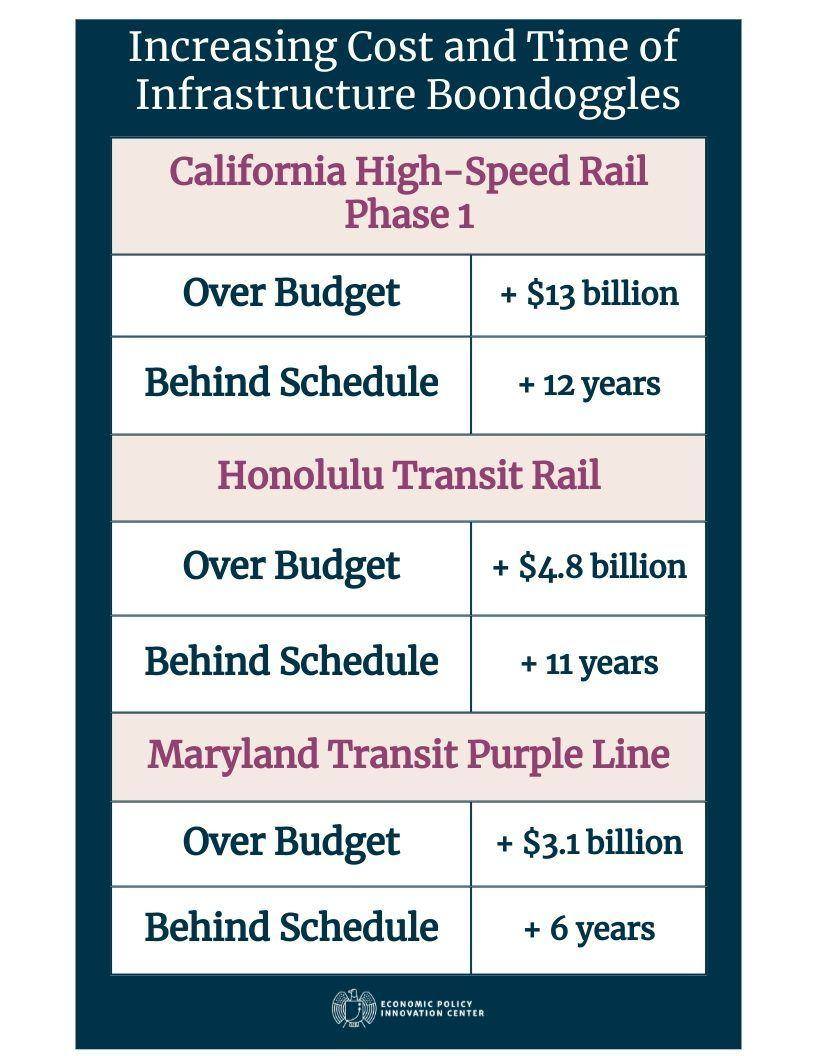
The Ernst report documents that federally supported transit projects in
California, Hawaii and
Maryland are each billions of dollars over budget. The worst of these is a rail project in Honolulu, which is 11 years behind schedule and approaching a $5 billion budget overrun.
The extent of the Honolulu project’s mismanagement was laid bare in a
2019 audit. Problems only compounded from there: a mismatch between track size and rail cars in
2021, opposite-direction tracks being too close together and risking derailment (
also 2021), and low ridership when the system finally opened in
2023.
The full cost of Honolulu’s rail system will likely exceed $10 billion despite the fact that existing transit use had been
stagnant for decades, signaling a lack of demand. Spending more than
half a billion dollars per mile for above-ground rail is incomprehensibly high, yet Uncle Sam was
still supporting the debacle under Secretary Buttigieg.
There is no good way to justify federal spending for a lightly used rail line on an island that the vast majority of Americans will never visit, let alone after years of substandard design and execution. The state and local governments that have overseen the project should bear the full cost.
Get Washington Out of the Boondoggle Business
It is past time for Washington to give state and local governments more control and responsibility for transportation infrastructure.
When the federal government gets involved with a project, local officials have incentives to overbuild and drive up costs, seeing an opportunity to extract cash from faraway taxpayers and dole out dollars to local contractors and unionized transit workers.
Federalism is not a guaranteed solution to boondoggles, but it can be a prophylactic measure by ensuring that those who dream up projects are responsible for managing the financial burden.
Congress should reform the
Highway Trust Fund, end appropriations for expanding rail and transit capacity, and avoid infrastructure “stimulus” in the wake of recessions. It is possible to attain meaningful budgetary savings by focusing federal infrastructure efforts on core national systems and cutting off boondoggles once and for all.