The reconciliation recommendations proposed by the House and the Senate Finance Committee both take crucial steps towards repealing the Inflation Reduction Act’s (IRA) expansion of energy tax credits. However, the
Senate proposal should more closely follow the blueprint laid out by the
House’s version of the One Big Beautiful Bill (OBBB) to lock in necessary savings and promote pro-growth policies.
A Tale of Two Bills
The House’s version of the OBBB includes reforms to the IRA’s
green energy tax credits that preserve roughly
60% of the savings generated by a full repeal. The Senate version reduces these savings by extending the phase out deadlines from where the House originally placed them. The IRA credits are projected to cost
between $936 billion and $1.97 trillion and subsidize unreliable energy sources at the expense of the American taxpayer and are a prime source of savings.
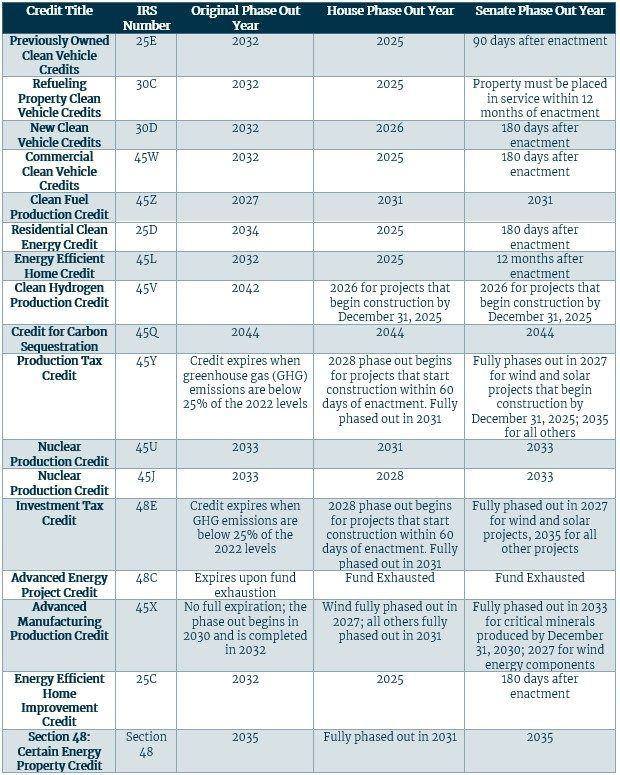
Under the IRA, most of the green energy tax credits were set to fully phase out between 2032 and the point at which greenhouse gases reached 25% below 2022 levels. In the bill that passed the House, conservatives secured earlier an earlier phase-out for most credits and a requirement that projects seeking to qualify for the Investment Tax Credit (ITC) and the Production Tax Credit (PTC) must begin construction within 60 days of the enactment as well as be placed in service before December 31, 2028.
However, the Senate proposal removes the placed-in-service requirement and substitutes a far weaker condition. It allows wind and solar projects to qualify for the credit simply by beginning construction by the end of 2025. Other sources, such as nuclear and geothermal, would need to begin construction before 2034 to remain eligible through 2035.
Construction Requirements Won’t Cut It
In this context,
beginning construction means either breaking ground on the site in question or incurring at least 5% of the total cost of the facility and receiving the components purchased. One or the other must occur before the end of the year in order to meet the placed-in-service requirement as set out by the Senate.
In contrast, a facility is considered to have been
placed-in-service once it is operable and capable of delivering energy to the grid. The House’s version required facilities to not only begin construction but also become operational before the end of 2028.
The House’s language meant that a facility must not only break ground but also must begin producing electricity before the end of 2028. The Senate’s version allows facilities to break ground by the end of 2025, but they can delay placing the facility into service until the end of 2029 due to “
safe harbor” provisions. These provisions allow developers to break ground, slow-walk production for up to four years, and still collect the tax credit.
Another problem with delayed phase outs is that as industries build themselves around subsidies, they have a strong incentive to lobby for subsidy extensions. Subsidies that phase out five or more years in the future have a strong chance of remaining in place.
The Senate Makes Gains but There’s Still Room to Grow
While the Senate may have weakened the House’s placed in service requirements, they did accelerate phase outs for most of the clean vehicle and residential tax credits as well as including faster phase out times for non-dispatchable energy sources than for dispatchable. Solar and wind are non-dispatchable energy sources, which means that they can provide too much or too little energy depending on external conditions. Non-dispatchable energy sources are intermittent and not predictable enough to build a stable energy grid off of, requiring complementary dispatchable base power loads such as nuclear or natural gas which are stable energy sources.
With that in mind, retaining the construction requirements and implementing faster phase out times for wind and solar than for base power loads in the ITC and PTC can be counted as a strategic win.
While the Senate preserved some of the House’s reforms, the current draft of the text does not go far enough at making the meaningful reforms needed. With the IRA’s potential price tag nearing $2 trillion, the Senate should align their bill more closely with the House’s version of the OBBB.
Congress should not let this opportunity pass them by and should instead push for key energy reforms that promote energy reliability and affordability for future generations.