PLEASE NOTE: This site is an archival resource, no longer updated as of June 1, 2026. Current questions: The Fiscal Lab.
The Federal Budget: Spending, Taxes, and Debt

Washington Math on Medicaid

The Federal Budget: Spending, Taxes, and Debt Infographics, Tables, & Charts BlogMay 20, 2025 By Paul Winfree, Ph.D.

Introduction

Updated May 20, 2025
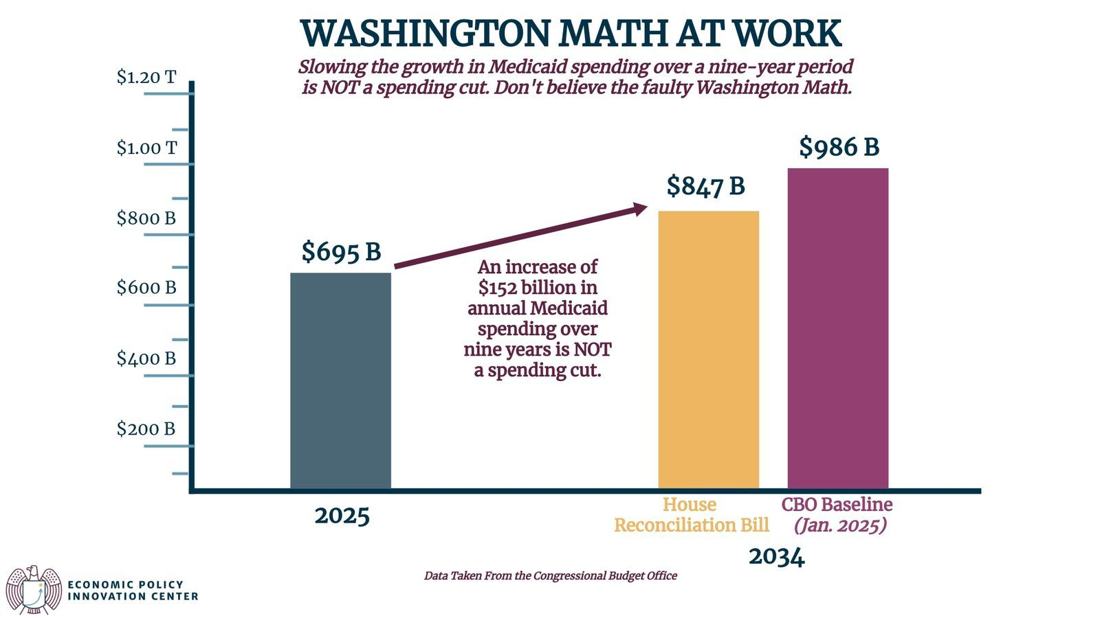
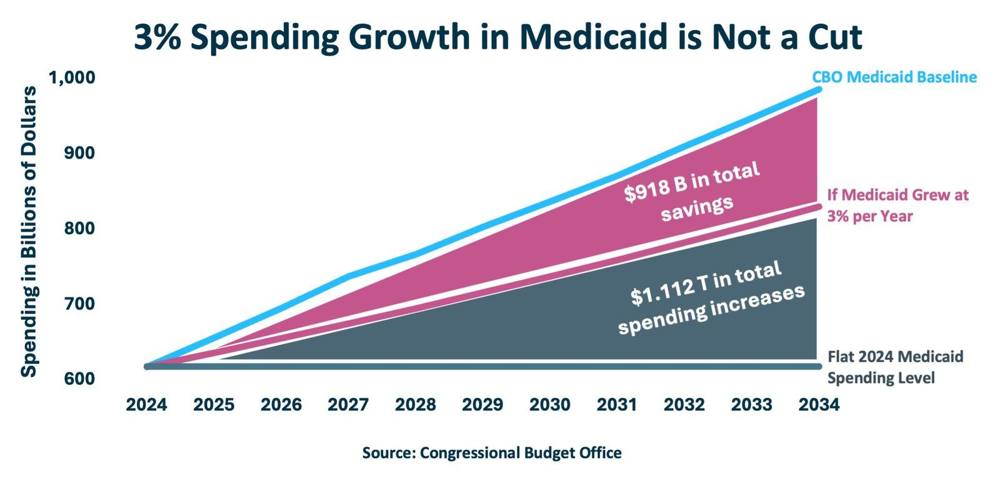
Congress is weighing reforms to Medicaid with a goal of saving up to $880 billion as part of the budget reconciliation process.  Under these reforms, annual Medicaid spending would grow from $695 billion in FY 2025 to about $847 billion by FY 2034. Only in Washington can a $152  billion increase in annual Medicaid spending be spun as a “cut.” Washington Math Medicaid Spending (1) If Congress implements reforms to lower Medicaid’s spending growth rate to 3% per year, spending will increase to $830 billion by FY 2034. This would generate $918 billion in total savings compared to the CBO baseline. Under this scenario, there would still be a cumulative 10-year spending increase of $1.112 trillion. Graph 3% Medicaid Spending Growth Is Not A Cut
Author

Paul Winfree, Ph.D.

Paul Winfree, Ph.D.

President & CEO

Paul Winfree, Ph.D., is the President and CEO of the Economic Policy Innovation Center (EPIC). He has served in top management and policy roles in the White House, the U.S. Senate, and think tanks. Prior to founding EPIC, Winfree served in multiple positions during three different tours at The Heritage Foundation. These included Distinguished Fellow in Economic Policy and Public Leadership, Director of Economic Policy Studies the Richard F. Aster Fellow, and acting Director of the Center for Data Analysis. Before rejoining Heritage in 2018, Winfree was Deputy Assistant to the President for Domestic Policy, the Deputy Director of the Domestic Policy Council, and the Director of Budget Policy, all at the White House. Winfree was also Chair of the Deputies Committee that oversaw the execution of all domestic policy at the Deputy Secretary level throughout the administration as well as the interagency policy coordination process. During the 2016 Presidential Transition, Winfree led the team responsible for the Office of Management and Budget. Winfree served three terms as Chair of the Fulbright Foreign Scholarship Board , a 12-member board selected by the President of the United States. In 2022, he received a distinguished service award from the U.S. State Department’s Bureau of Education and Culture Affairs for his “stewardship during the COVID-19 pandemic, and for meaningful contributions to advance mutual understanding through the Fulbright Program.” Winfree’s research focuses on U.S. economic history, public finance, political economy, the economics of media, and the economics of education. He is author of a book on the evolution of economic and fiscal policy from colonial America until the present called The History (and Future) of the Budget Process in the United States: Budget by Fire (Palgrave Macmillan, 2019). His research has been featured in The Wall Street Journal , The New York Times , The Washington Post , Investor’s Business Daily , USA Today , and Congressional Quarterly , among other publications. Winfree holds a Ph.D. in economics from Queen’s University Belfast, an M.Sc. in economics and economic history from the London School of Economics and Political Science, and a B.S. in economics from George Mason University. He lives in Virginia with his wife and three children.

More from Paul Winfree, Ph.D. →

← All work