

Saving 2.3% for Taxpayers
The House budget resolution provides instructions to seven House committees to reduce the deficit. The House budget also includes a deficit reduction failsafe requiring $2 trillion of deficit reduction over the FY 2025 - 2034 period. The Senate budget resolution provides instructions to four Senate committees to reduce the deficit by at least $1 billion each over the next decade, for a minimum total of $4 billion in savings. These savings would represent a better direction for the budget. However, honest commentators must acknowledge that those figures pale in comparison to the government's spending plans over the next decade. The Congressional Budget Office's (CBO) projected baseline includes $85.8 trillion of spending over the FY 2025 - 2034 period. Over that time, spending is projected to grow at an average annual rate of 4.3%, about twice the rate of projected inflation.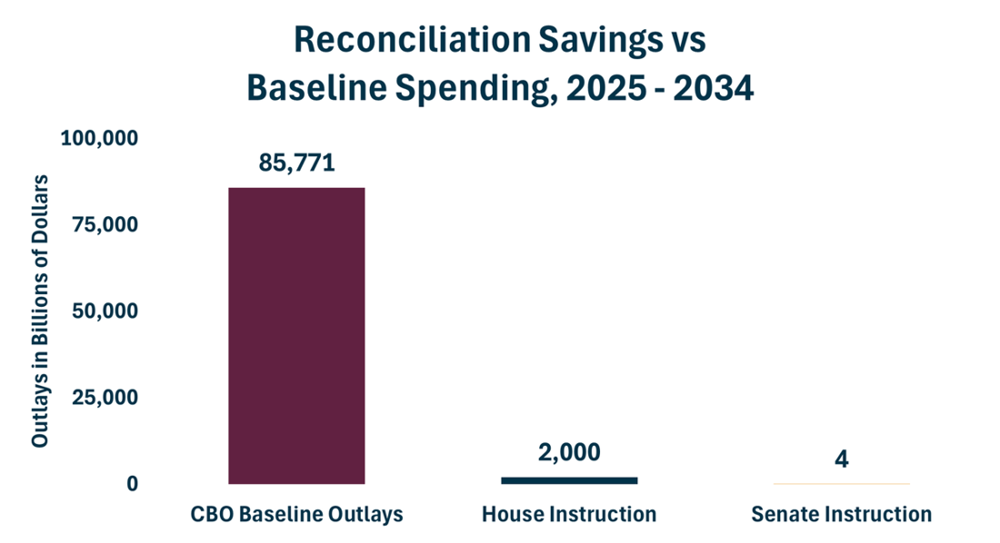 If the House's proposed $2 trillion of savings is achieved, that would amount to a modest 2.3% of the government's planned spending over the next decade.
The Senate's $4 billion in savings represents just 0.01% of the $85.8 trillion in planned spending.
For perspective, if Congress simply held the growth of spending to the very reasonable rate of population increases plus inflation, that would achieve nearly $6 trillion in savings, about 7% of the planned spending.
While the swamp wails over moderately slowing the growth of Washington D.C. agency budgets, they seem to forget what the American people just went through. As a result of the excessive government spending that sparked the highest rates of inflation in four decades, the average American worker has seen their real take home pay fall by 3.9% in just four years.
If the House's proposed $2 trillion of savings is achieved, that would amount to a modest 2.3% of the government's planned spending over the next decade.
The Senate's $4 billion in savings represents just 0.01% of the $85.8 trillion in planned spending.
For perspective, if Congress simply held the growth of spending to the very reasonable rate of population increases plus inflation, that would achieve nearly $6 trillion in savings, about 7% of the planned spending.
While the swamp wails over moderately slowing the growth of Washington D.C. agency budgets, they seem to forget what the American people just went through. As a result of the excessive government spending that sparked the highest rates of inflation in four decades, the average American worker has seen their real take home pay fall by 3.9% in just four years.
Spending Would Still Be Very High After Reconciliation
Assuming the House reconciliation instructions are followed, total federal spending would fall to "just" $84.1 trillion over the next decade. If only the minimum $4 billion of savings required by the Senate budget resolution is achieved, then federal spending would actually increase, after investments in border security and national defense are made.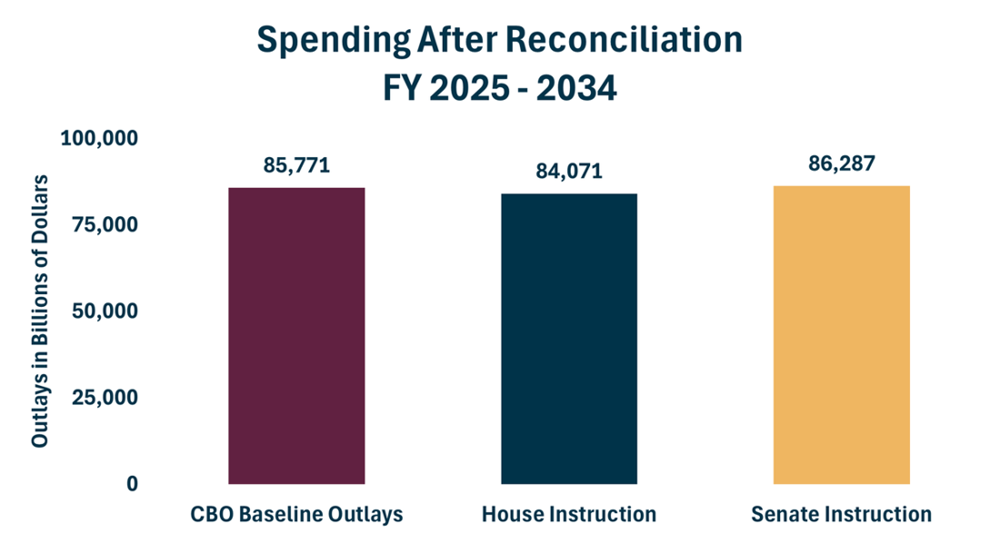
The Government Will Still Collect a Lot of Taxes After Reconciliation
Assuming key provisions of the Tax Cuts and Jobs Act expire, the CBO projects baseline revenues to be $64.7 trillion over the FY 2025 - 2034 period. Of course, no one thinks that Congress or President Trump will allow the largest tax increase in American history to happen at the end of this year. The House budget resolution provides a reconciliation instruction to the House Ways and Means Committee to increase the deficit by not more than $4.5 trillion relative to the CBO baseline. (If the deficit reduction failsafe is triggered, that $4.5 trillion instruction could be decreased or increased). If the full $4.5 trillion in tax cuts are implemented, then revenues would total "only" $60.2 trillion over the FY 2025 - 2034 period.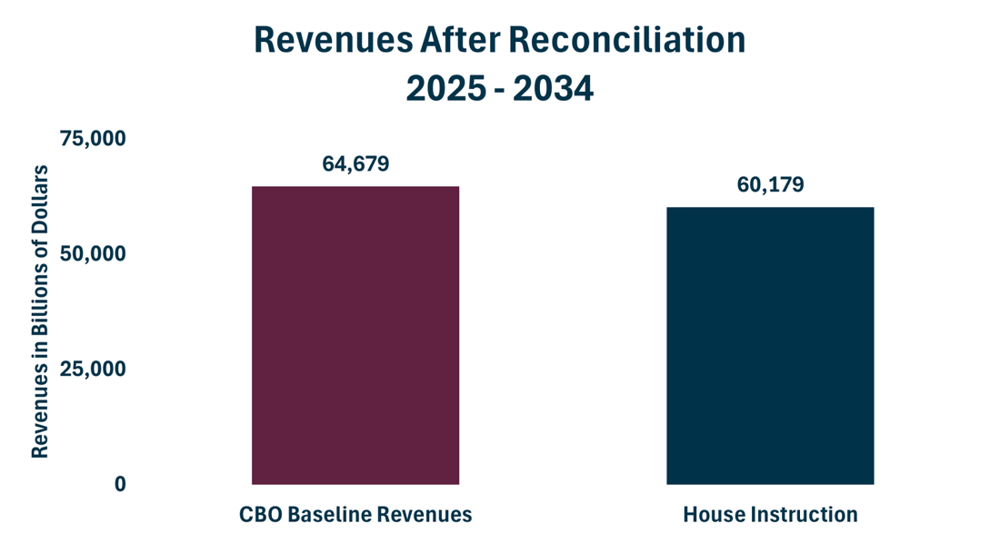 The proposed $4.5 trillion reduction in government revenues is less than 7% of the taxes in the CBO's baseline over the next decade. Of course, any reduction in the government's revenue is money kept in the pockets of Americans to invest in a better future for their families.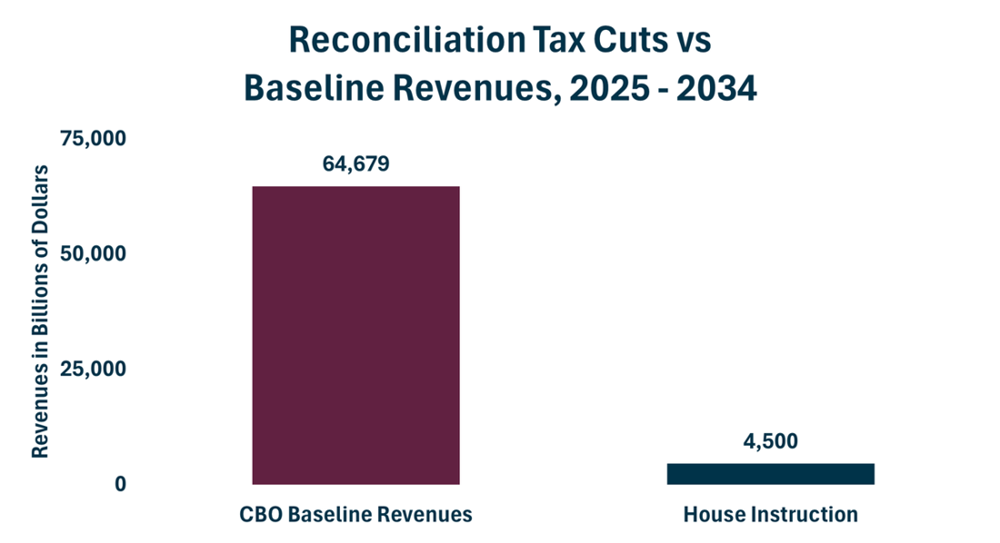
Spending is The Problem
Most Americans recognize that the issue isn't the government taking more of their hard-earned money. The real problem is the federal government's excessive spending.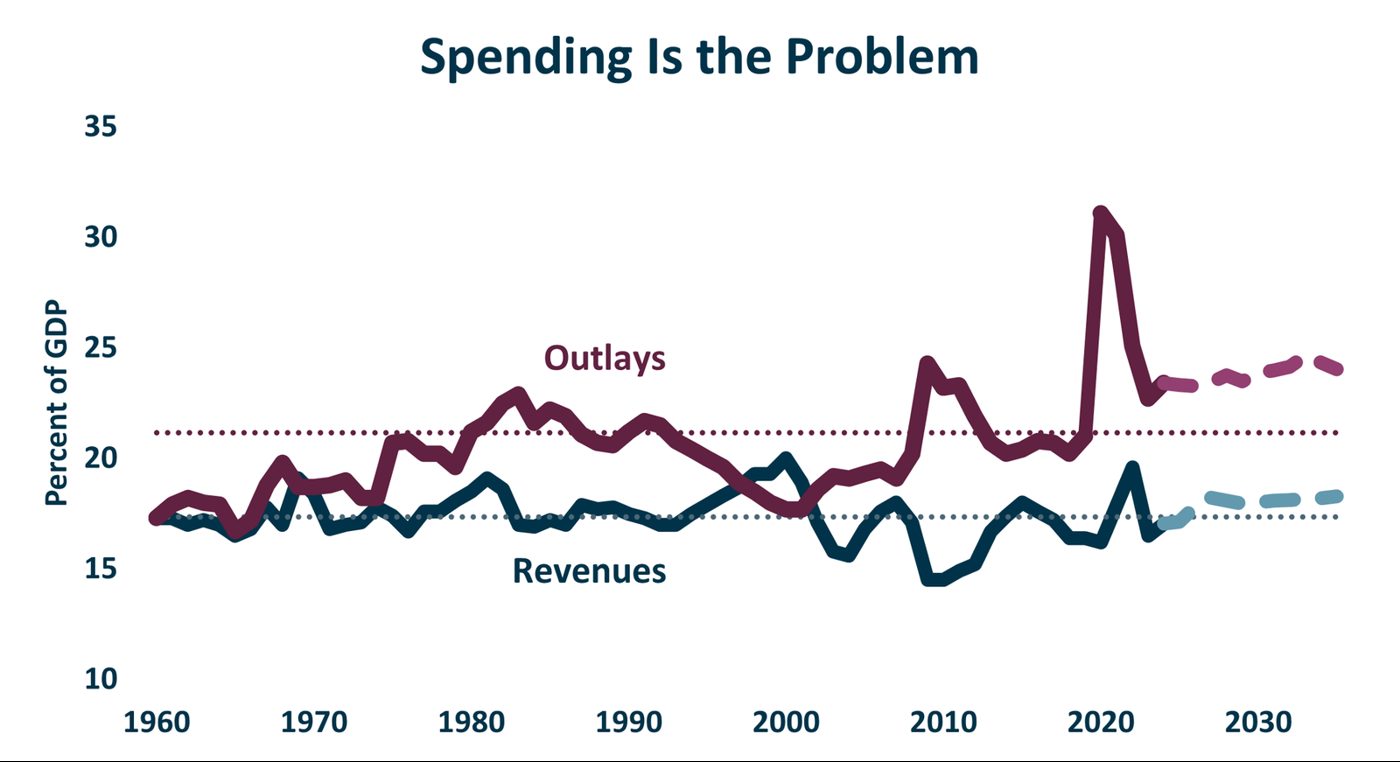 Annual spending is 52% higher than prior to the COVID-19 pandemic. Out of control spending has driven the national debt higher than any other time in history aside from the immediate aftermath of World War II.
This growing spending is driven by autopilot spending programs. Thankfully, the budget reconciliation process will allow Congress to begin to right the ship and get our fiscal house in order.
Annual spending is 52% higher than prior to the COVID-19 pandemic. Out of control spending has driven the national debt higher than any other time in history aside from the immediate aftermath of World War II.
This growing spending is driven by autopilot spending programs. Thankfully, the budget reconciliation process will allow Congress to begin to right the ship and get our fiscal house in order.
How the Swamp Can Cope
Any member of the D.C. swamp who thinks that taxes are too low and that the government needs more money can mail a check or money order to:Gifts to the United States
U.S. Department of the Treasury
Reporting and Analysis Branch 2
P.O. Box 1328
Parkersburg, WV 26106-1328
Of course, hardly anyone in the swamp voluntarily sends their own money to the government.