The 2025 Fiscal Cliff is Here
2025 brings the most consequential fiscal policy decisions yet in modern American history.
This year alone, Congress and President Donald Trump must
prevent the largest tax increase in American history, deal with the
debt limit, complete the
fiscal year 2025 appropriations bills, extend
discretionary spending caps for FY 2026 and beyond, address the Farm Bill, and ensure that expanded Obamacare subsidies expire as scheduled.
At the same time, Congress and the President will also be focused on using the budget reconciliation process.
As the recent
The Budget and Economic Outlook: 2025 to 2035 report from the Congressional Budget Office (CBO) shows, Congress will be reckoning with these major challenges as the fiscal state of the nation continues to deteriorate.
The CBO Provides the New Budget Baseline
The CBO's
Outlook includes the new budget baseline covering FY 2025 through 2035.
This baseline is important because it is used as the official benchmark against which legislative proposals are scored. The official baseline is often described as reflecting current law, but this is a myth – the CBO is required by law to bias the baseline in favor of higher spending and taxes, making it easier for lawmakers to expand the size of government.
Reflecting the
rules imposed by law, the official CBO baseline reflects current law for most tax policies, but follows a mix of current policy and current law for spending programs.
This means that the CBO is required to assume that major provisions of the 2017 Tax Cuts and Jobs Act (TCJA) expire at the end of the year and that several expiring spending programs are reauthorized and funded in perpetuity.
Extending the TCJA would reduce revenues by about $4.5 trillion on a static basis over the next decade compared to the official baseline. Allowing the expiring direct and discretionary spending programs to follow current law would reduce outlays by about $25 trillion compared to the official CBO baseline.
The baseline is sometimes misunderstood as being a forecast of what budgetary outcomes
will be in the future. But we know that laws, policies, and economic conditions will ultimately be different than the assumptions that the baseline is built upon — in fact most politicians run for office because they
want different outcomes than the status quo. Rather, the baseline shows what outcome
could be unless the fiscal and economic trajectory is changed.
Spending is the Problem
The CBO's baseline shows that unsustainable spending is the underlying problem of the budget.
Government spending in FY 2024 was $2.3 trillion higher than FY 2019. This means annual spending is already about 52% higher than prior to the COVID-19 pandemic.
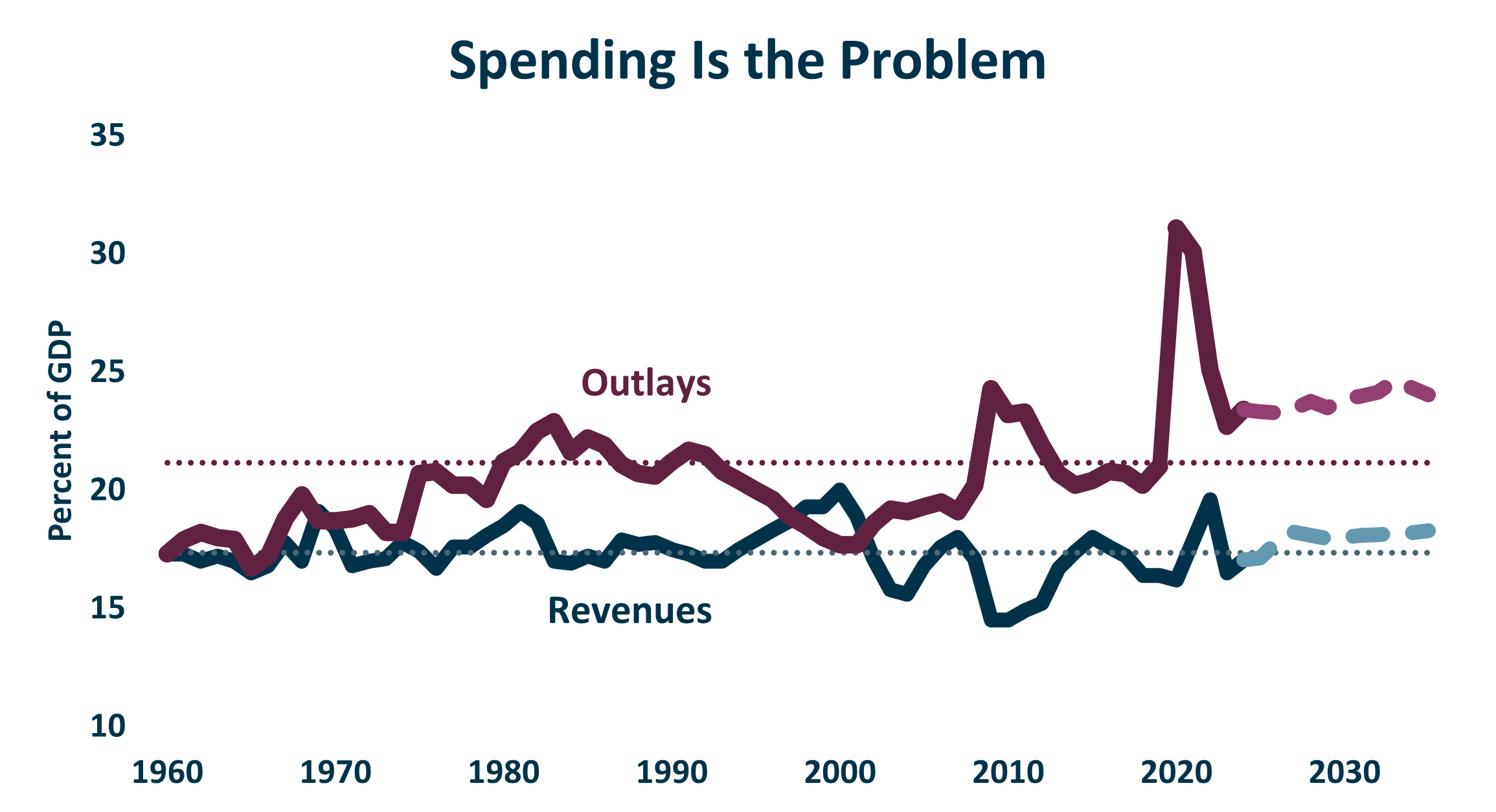
Spending in FY 2025 is projected to total more than $7 trillion, equivalent to 23.3% of GDP. This is about $640 billion higher than the if outlays were just at the 50-year historical average of 21.2% of GDP (spending in FY 2019 was 21% of GDP).
By FY 2033, spending would exceed $10 trillion, more than 24% of GDP.
| CBO’s January 2025 Baseline |
|
2025 |
2026 |
2027 |
2028 |
2029 |
2030 |
2031 |
2032 |
3033 |
2034 |
2035 |
2026 - 2035 |
| Outlays |
7,028 |
7,294 |
7,622 |
8,019 |
8,228 |
8,689 |
9,067 |
9,477 |
10,042 |
10,306 |
10,563 |
89,306 |
| Revenues |
5,163 |
5,580 |
5,935 |
6,108 |
6,290 |
6,549 |
6,834 |
7,106 |
7,405 |
7,708 |
8,031 |
67,548 |
| Deficit |
1,865 |
1,713 |
1,687 |
1,911 |
1,938 |
2,140 |
2,233 |
2,371 |
2,637 |
2,597 |
2,531 |
21,758 |
| In billions of dollars.
Source: CBO January 2025 baseline. |
CBO assumes that the primary deficit (the deficit excluding net interest payments) will never fall below $612 billion and will average $803 billion over the next 10 years. This is unprecedented, particularly given the assumptions of relative peace and no recessions.
Growing Debt
The national debt held by the public is projected to reach 99.9% of GDP this year.
In 1944 — the
year of D-Day & the Battle of the Bulge — U.S. debt held by the public was 86.4% of GDP. Federal debt held by the public hit its record high in 1946, in the immediate aftermath of World War II at 106% of GDP.
The CBO projects that record will be broken by 2029, with debt levels continuing to grow thereafter.
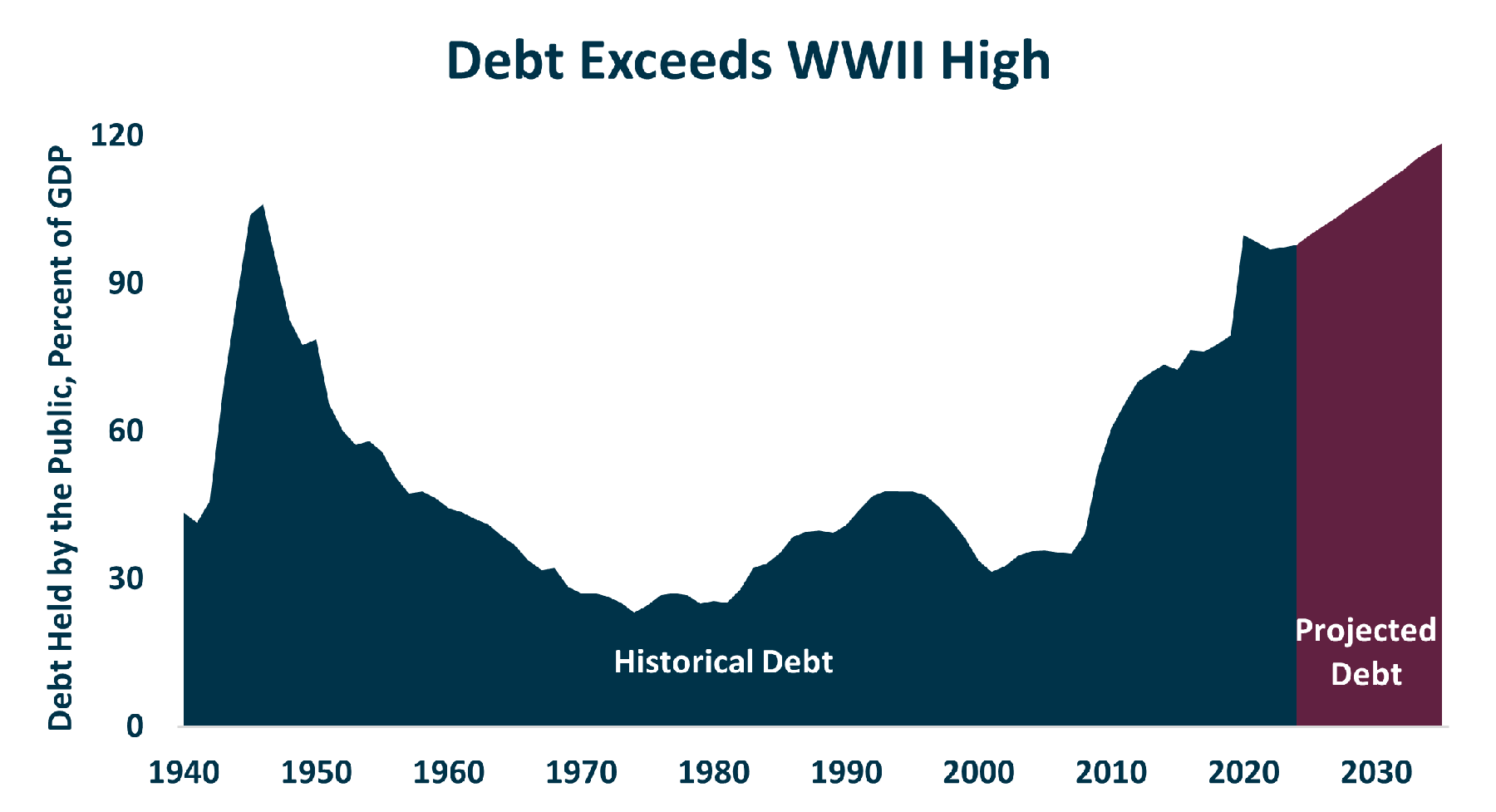
As the government’s debt piles up, it can be more difficult and costly for the Treasury to borrow for actual emergencies. As described by EPIC’s President and CEO Paul Winfree, this fiscal space is “crucial for the government’s ability to respond to crises such as war, pandemics, and recessions. However, persistent structural deficits, rising interest costs, and slower economic growth erode fiscal capacity and threaten the nation’s ability to manage future challenges without causing additional harm.”
The $36 trillion
debt limit will need to be increased by as early as June this year.
Rising Interest Costs
Rising interest costs will be a significant challenge over the next decade.
In FY 2025, net interest payments will amount to 18.4% of total revenues — the highest level in modern history. Within a few years, one out of every five tax dollars will be allocated towards servicing the national debt.
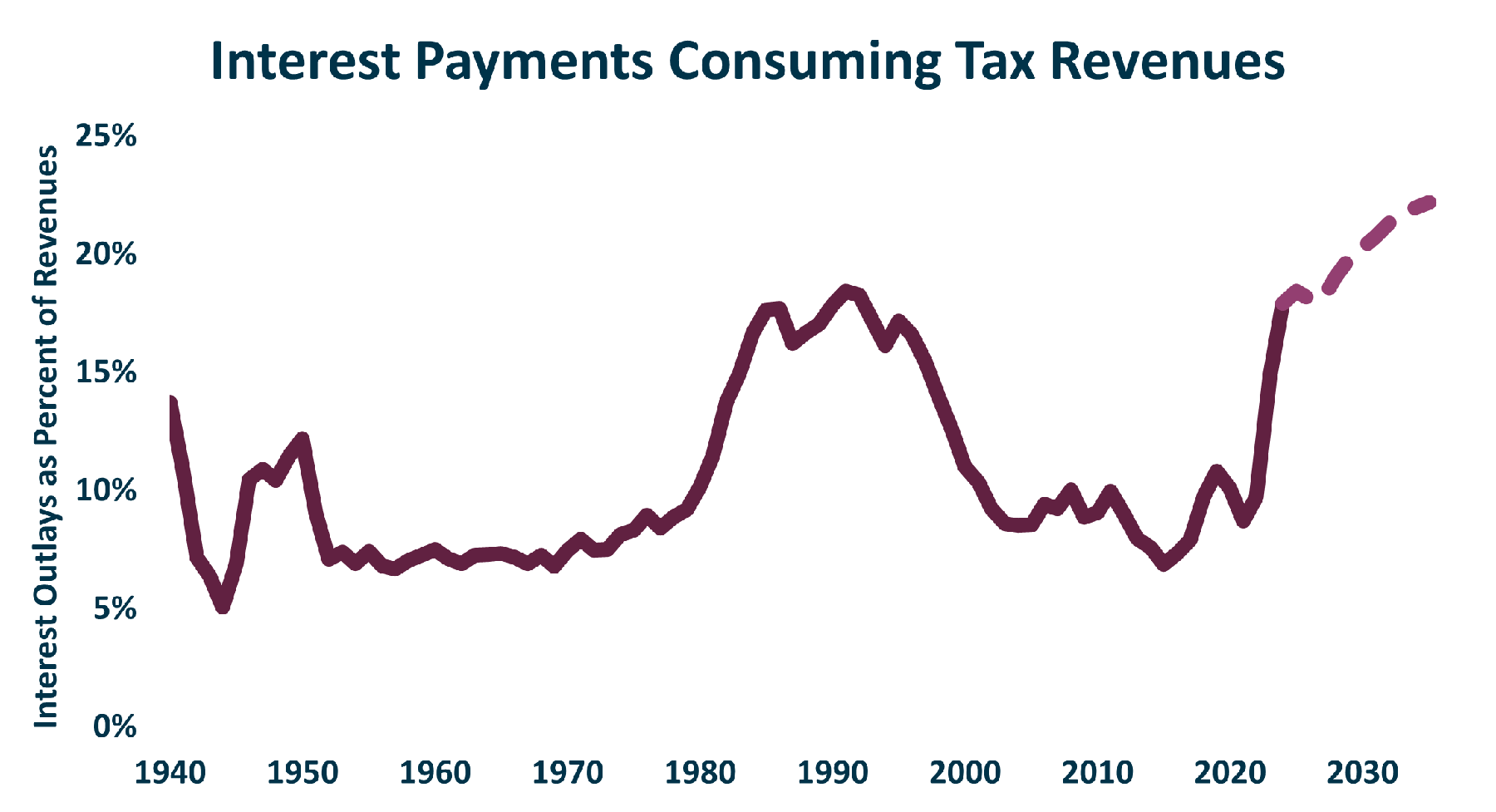
Interest on the national debt eclipses funding for national defense and border security combined.
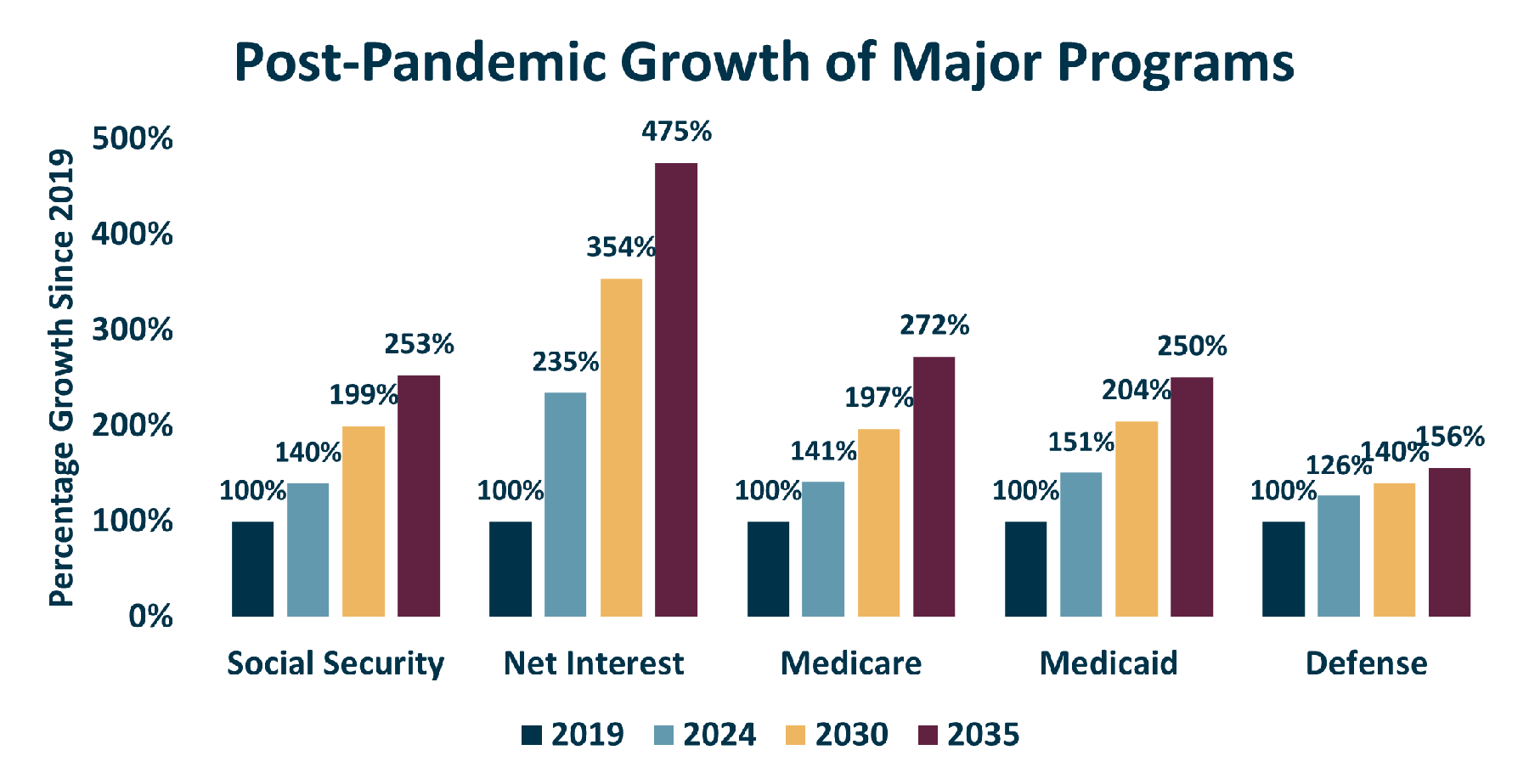
By FY 2035, interest outlays would be 375% higher than they were in FY 2019.
CBO's projections are based on an average interest rate of 3.9% on 10-year Treasury Notes. Today, the yield on a 10-year Treasury Note is 4.6%. If interest rates average half a percentage point higher than projected, that would increase deficits by more than $1.6 trillion over the next decade.
Autopilot Spending
Many programs are on legislative autopilot (sometimes
misleadingly called “mandatory” spending, although there is nothing required about it) and are not reviewed on a regular basis by Congress.
Since the modern budget process was
created in 1974, autopilot spending has exploded and is projected to continue growing under current law.
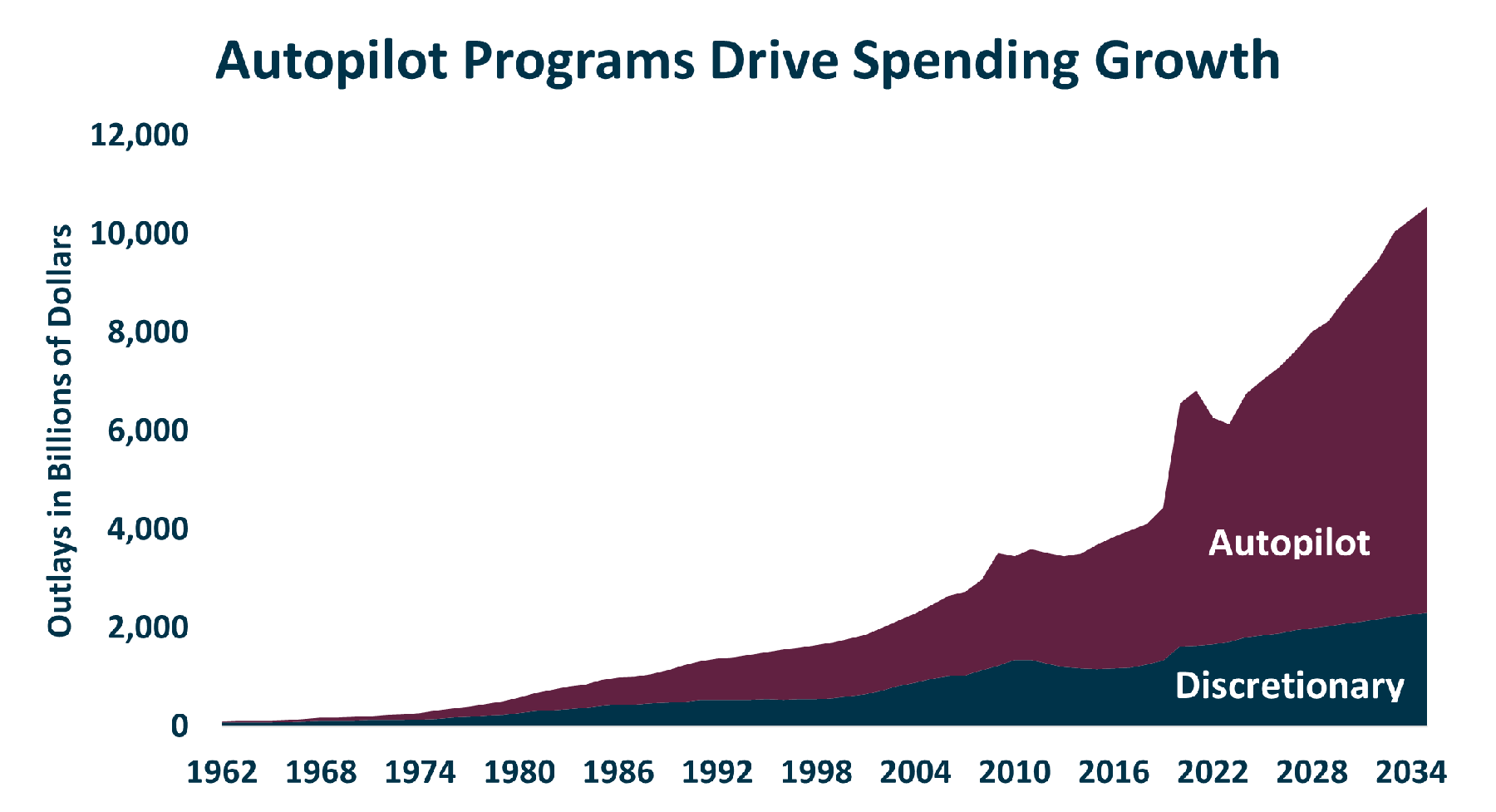
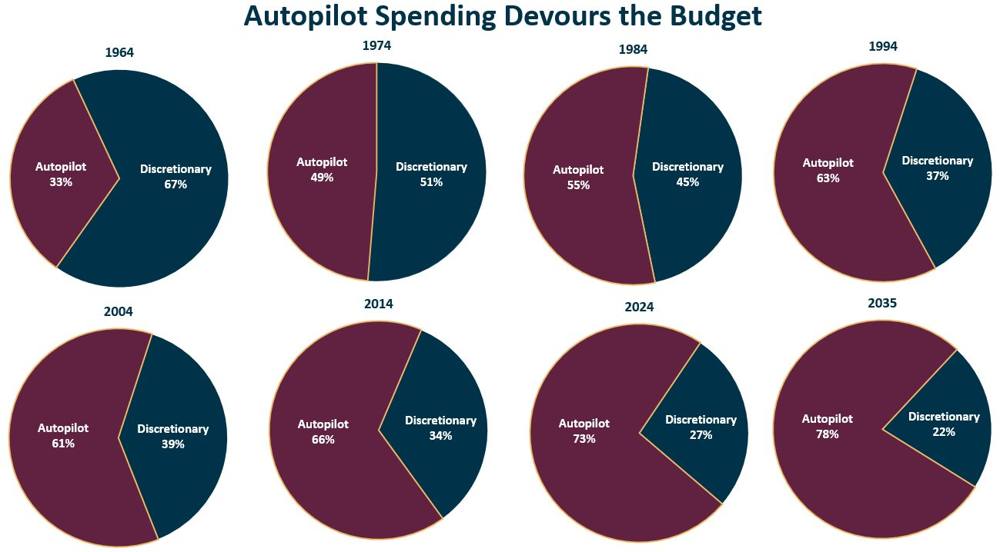
In FY 2024, autopilot spending was 73% of total spending, while 27% was provided in appropriations bills.
Autopilot spending is projected to grow to 78% of the budget by FY 2035, with only 22% of spending as a part of the annual discretionary appropriations process.
Many of these large autopilot programs have already grown significantly since the COVID-19 pandemic. Social Security spending was already 40% higher in FY 2024 than in FY 2019; Medicare was 41% higher, and Medicaid spending was 51% higher.
By 2035, spending on these programs will have exploded even further: Social Security outlays are projected to be 153% higher than in FY 2019, Medicare 172% higher, and Medicaid 150% higher.
Even Bigger Fiscal Cliffs Ahead as Entitlements Go Broke
As big of a challenge that the 2025 Fiscal Cliff represents to lawmakers, it pales in comparison to what is coming in just a few years.
The CBO projects that the trust fund for the largest program in the federal budget will be completely depleted within a decade.
| Trust Funds Depleted Within Decade |
| Social Security |
2033 |
| Medicare Hospital Insurance |
2036 |
| Source: CBO January 2025 Baseline Projections and Social Security and Medicare Trustees |
In 2033, the Social Security Trust Fund will be exhausted. The so-called
Social Security Fairness Act, recently signed into law by President Biden, increased benefit payments by $200 billion for certain government employees and reduced the solvency of the program.
The Medicare Hospital Insurance Trust Fund could be exhausted by 2036, according to the
Medicare Trustees.
When the trust funds are depleted, the programs are required to spend only incoming payroll tax revenues, which will be insufficient to meet promised benefits. This is due to the outdated design of the programs, which have been operating the same ways for decades and fail to meet the needs of modern workers and retirees.
The exhaustion of the trust funds means that Congress will be forced to vote one way or another on entitlement reform in just a few years. Lawmakers should be prepared for this and focus on making Medicare and Social Security a better deal for both beneficiaries and taxpayers.
Conclusion
The 2025 Fiscal Cliff presents a massive challenge. The budget inherited by President Trump and the 119th Congress was on an unsustainable trajectory.
President
Biden's excessive and irresponsible government spending caused inflation to spike to rates not seen in decades. Since January 2021, inflation has grown by 21 percent. As the price of gas, groceries, and other things grew faster than incomes, the dwindling purchasing power has been a painful squeeze on family budgets.
However, these challenges provide an important opportunity to right the ship and put the federal budget back on a better path that will lead to higher incomes and a higher quality life for Americans throughout the country.