Committee on Commerce, Science, and Transportation Subcommittee on Communications, Media, and Broadband United States Senate, May 2, 2024
Chairman Luján, Ranking Member Thune, and Members of the Committee, thank you for inviting me to testify today.
The issue of broadband affordability is critical to the success of the American economy. Like the development of canals and railroads in the 19th century or highways in the 20th century, access to affordable high-speed internet will determine regional development as well as America’s ability to continue to grow by leading the world in innovation.
Fortunately, policymakers have paid an incredible amount of attention to the issue of broadband affordability over the past decade. This has led to many new policies that we can use as guidance on how to increase broadband affordability. These policies include deregulation, new regulations, as well as subsidizing demand for high-speed internet and the supply of internet service providers (ISPs).
What we have learned from those different policies is that deregulation and competition have reduced prices. We have also learned that policies that subsidize demand, such as the Affordable Connectivity Program, tend to increase prices. This is especially true if they do not fundamentally change the demand for high-speed internet or the supply of ISPs.
Deregulation Reduces Prices of High-Speed Internet
Experience has demonstrated that deregulation can produce significant gains for consumers, especially when it enhances transparency, by increasing the scale on which providers can compete on the price and quality of services. One recent case of how deregulation reduced prices was in 2017 when Congress nullified a rule enacted by the Federal Communication Commission (FCC) regarding consumer data sharing.
Before the enactment of the FCC’s 2016 rule, ISPs could share consumer data with companies unless the consumer “opted out” of the data-sharing arrangement. Companies designed plans that allowed consumers to opt in or out of data sharing at different subscription rates. In essence, those who chose to opt-in paid lower rates than those who decided to opt out of data sharing. This is because companies would sell that consumer data and use it to reduce the price of internet service.
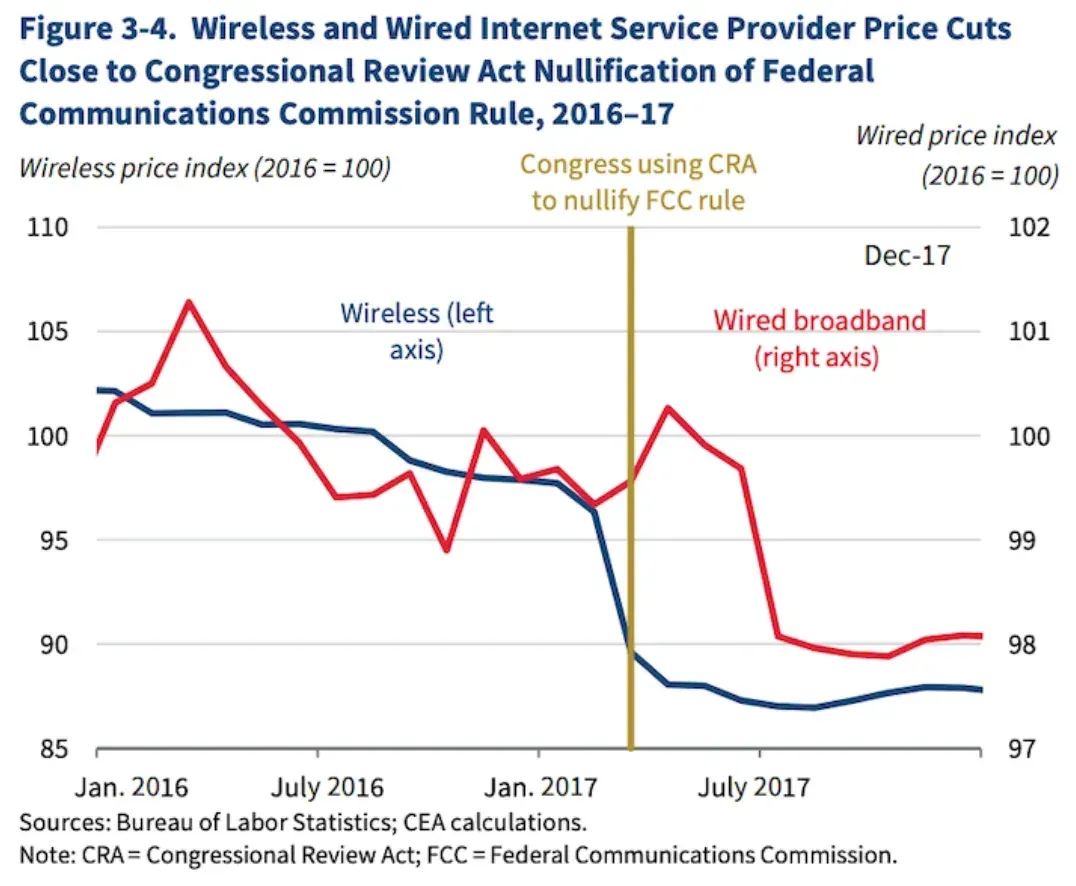
The FCC enacted a rule in 2016 that required “opt-in” to a data-sharing model. However, Congress used the Congressional Review Act (CRA) process to cancel this rule in 2017. The 2020 Economic Report of the President, written by the White House’s Council of Economic Advisers, found that the CRA overturning the FCC’s rule requiring consumers to “opt-in” to data sharing reduced wireless prices by more than 10 percent and wired prices by as much as 2 percent (see Figure 3-4 above from the 2020 ERP).
Subsidizing Demand Can Increase Prices for High-Speed Internet
In December 2020, Congress passed the Consolidated Appropriations Act of 2021 (P.L. 116-260) that established the Emergency Broadband Benefit Program (EBB). EBB was a temporary subsidy of up to $50 per month. EBB was intended to help low-income households afford broadband internet services amid the COVID-19 pandemic when most students were still engaged in remote learning. The initial appropriation for the program was $3.2 billion.
In November 2021, the Infrastructure Investment and Jobs Act (IIJA or P.L. 117- 58) made three significant changes to EBB. First, it eliminated the sunset of the program, which was set to coincide with the expiration of the COVID-19
pandemic. Second, it provided another $14.2 billion for the program. Third, it renamed EBB as the Affordable Connectivity Program (ACP).
Like its predecessor, ACP provides a monthly subsidy of $30 per month to low- income households that purchase services from participating ISPs. ACP also provides a $100 one-time subsidy to buy a tablet, laptop, or desktop computer. There are currently 23.3 million households enrolled in ACP (based on data from February 2024).
[1] In other words, about 15 percent of all households in the U.S. receive a subsidy.
Why Might Have ACP Increased Prices?
Economic theory would predict that a demand subsidy can act as a price floor, especially in a market where the demand and supply of a product remain relatively fixed. In this environment, the producer (in this case, ISPs) will capture a portion (or even all) of the subsidy.
The FCC has said that a goal of ACP is to close the digital divide for low-income consumers. However, most ACP subsidies are going to households who already have broadband. FCC surveys have found that around 80% of ACP recipients already had broadband before the subsidy.
[2]
The FCC has also tried to study the effect of losing ACP on internet service. In a survey conducted earlier this year, the FCC reports that “more than three- quarters (77%) of survey respondents say losing their ACP benefit would disrupt their service by making them change their plans or drop internet service entirely.” However, this is an inaccurate reading of the survey.
[3]
The 77 percent referenced by FCC is derived by adding two responses together including the 29.3 percent of respondents who said that they would choose a different service and the 47.6 percent who said that they would choose a lower cost service. Only 15.7 percent said that they would drop their service with no alternative. This 15.7 percent that would lose coverage in the absence of ACP is
very similar to the rate of new take-up in internet service after the adoption of ACP based on other FCC data.
One reason why it may not have increased demand is that the program is duplicative of other programs. For example, the FCC’s Universal Service Fund Lifeline Program already provided a subsidy to low-income consumers for broadband services (i.e., the Lifeline subsidy is $9.25 per month).
There has also not been a significant increase in the number of ISPs that are associated with the ACP subsidy.
[4] This is not surprising given that ACP is a relatively small program, and providing internet service requires significant fixed investments in capital and labor.
The Potential Effect of ACP on Prices
In a recent paper, I estimate the relationship between ACP enrollment in regional prices for high-speed internet.
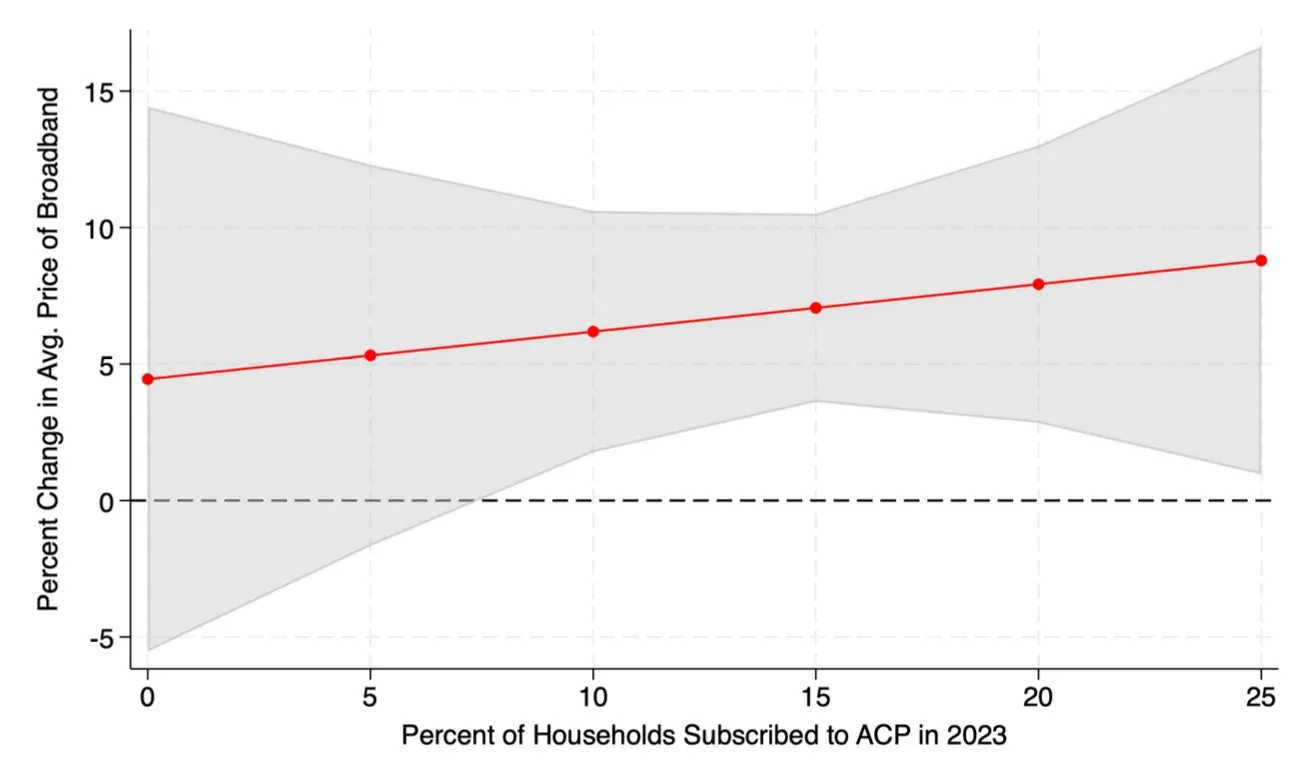
[5] I find that there is a positive relationship between the percentage of households receiving ACP subsidies and the increase in the average total monthly price for broadband since 2022.
[6]
However, there is no statistically meaningful association between ACP subsidies and prices when the level of households receiving the subsidies is under 7 percent (see Figure 1). Today, about 15 percent of households across the country receive an ACP subsidy. That corresponds with an average increase of about 7 percent in the total cost of a monthly broadband subscription. These estimates do not change even when factoring in the market concentration of ISPs.
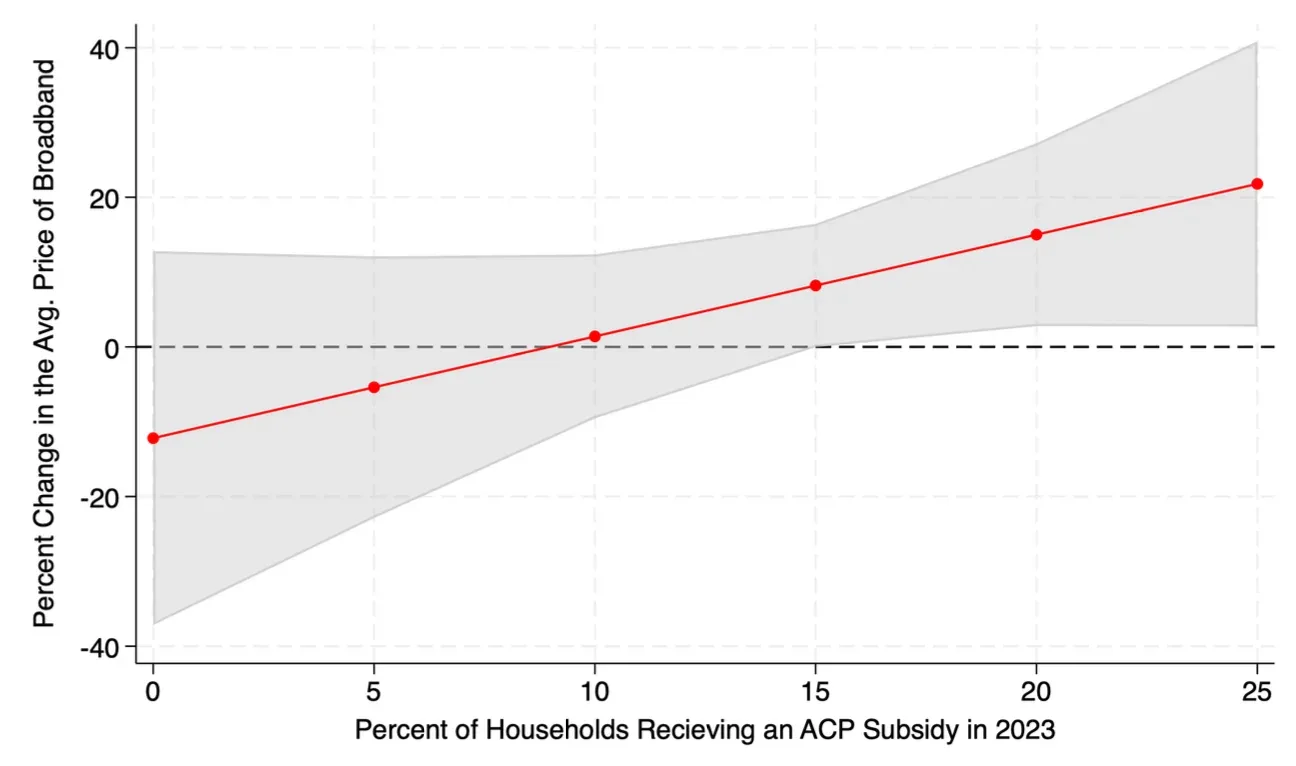
The FCC finds that there is a nonlinear relationship between broadband speed and the price paid for different speeds. Figure 2 shows the relationship between ACP subsidies and prices for lower broadband speeds (measured as less than 20 Mbps in download speed). Here you can see that the proportion of households receiving an ACP subsidy is positively associated with prices for lower-speed plans. The change in prices is higher in states with a greater percentage of households receiving ACP subsidies relative to the price change for all plans. One possible explanation is that broadband service providers are marketing their lower-speed plans to those eligible to receive the ACP subsidy while raising the cost of these basic plans to capture larger proportions of the subsidy.
Figure 1. Households Receiving ACP Subsidies and Broadband Costs, All Broadband Plans
Source: Author’s calculation using data described in Winfree (2024).
Figure 2. Households Receiving ACP Subsidies and Broadband Costs, Lower Speed Broadband Plans
Source: Author’s calculation using data described in Winfree (2024).
Table 1 shows the average change in price for broadband plans that is associated with a percent of households receiving an ACP subsidy. Based on estimates in Winfree (2024), the average cost of broadband is about $5.48 higher because of ACP while broadband service providers are capturing about 18 percent of the total subsidy. If 40 percent of households were enrolled in ACP, as would be the case under the Biden Administration’s enrollment proposal, the average change in prices for plans would increase by about $9.39 and 31 percent of the subsidy would be pocketed by broadband service providers.
Table 1. Average Change in the Price of Broadband Associated with the ACP Subsidy at Different Levels of Household Saturation, All Plans
|
15% of Households |
30% of Households |
40% of Households |
| Price Change ($) |
$5.48 |
$7.56 |
$9.39 |
| % of ACP Subsidy |
18% |
25% |
31% |
Source: Author’s calculation using data described in Winfree (2024).
Table 2 shows the same estimates for lower-speed plans. Under higher levels of ACP enrollment, lower-speed plans will become more expensive with the broadband service providers able to capture larger portions of the total subsidy. This makes sense given that the ACP subsidy essentially operates as a floor for the prices of broadband.
Table 2. Average Change in the Price of Broadband Associated with the ACP Subsidy at Different Levels of Household Saturation Lower-Speed Plans (Under 20 Mbps)
|
15% of Households |
30% of Households |
40% of Households |
| Price Change ($) |
$4.24 |
$15.38 |
$22.27 |
| % of ACP Subsidy |
14% |
51% |
75% |
Source: Author’s calculation using data described in Winfree (2024).
The Biden Administration has posited that ACP helps households save about $500 million per month on internet bills. However, that calculation does not include the effects of ACP on prices for broadband services. Based on the estimates provided in this report, ACP likely reduces the monthly net cost of broadband by about $380 million for households who qualify for the subsidies after adjusting for the increase in prices. Once we factor in the price increase for all households (including ACP beneficiaries), ACP likely increases the net out-
of-pocket cost of broadband that households pay by about $185 million per month or $2.2 billion per year.[7]
Competition Will Make Broadband More Affordable
In the case study on deregulation referenced above, we saw that when providers can compete on prices and services, they offer choices to consumers and pass along savings through lower prices in a competitive market. The same could be true under a more competitive market post-ACP.
Today, a large portion of the ACP subsidies go to a fraction of the ISPs and are slightly more likely to serve urban areas. According to the FCC, for every rural household that receives an ACP subsidy, six urban households receive a subsidy.
[8] In other words, urban consumers were disproportionately served by ACP given 16 percent of the subsidies are going to rural households who make up nearly 20 percent of the population.
Subsidizing demand through ACP also makes consumers less sensitive to prices and quality. This advantages large existing ISPs who are more likely to have had market share when EBB and ACP were created. If ACP funding were to become exhausted, many companies would be encouraged to compete for consumers who would be shopping for better plans (as the FCC survey data referenced above shows). Most ISPs have told their investors that when ACP ends, they don’t plan to lose any money.
[9] Other ISPs have reported to Communications Daily that they explicitly plan to compete on price and quality to attract consumers who are coming off subsidized coverage.
[10]
There are also much better ways to subsidize demand than to provide payments through ACP which go directly to ISPs. For example, subsidies could be provided directly to households to be used on internet service or other household items. Also, policymakers could look to the tax code. Some provisions are scheduled to expire at the end of 2025. These expiring provisions reduce the cost of capital (and increase domestic investment) and allowing the expirations to take effect would raise the tax liability for the average household qualifying for ACP by more than three times the amount of the ACP subsidy.
[11]
The results in this testimony, along with data on how ACP is failing to close the digital divide, suggest that governments at all levels should focus on increasing the supply of internet services to provide consumers with more access to lower cost services. Focusing on deregulation and competition avoids the costs associated with ACP which can raise prices for all consumers without meaningfully closing the digital divide. Deregulation and competition can also avoid the hidden costs of subsidizing demand with additional inflation fueled by deficit spending.