
Op-Ed
CBO: One Big Beautiful Bill Grows the Economy, Cuts Taxes & Slows Welfare Spending
February 12, 2026 · David Ditch

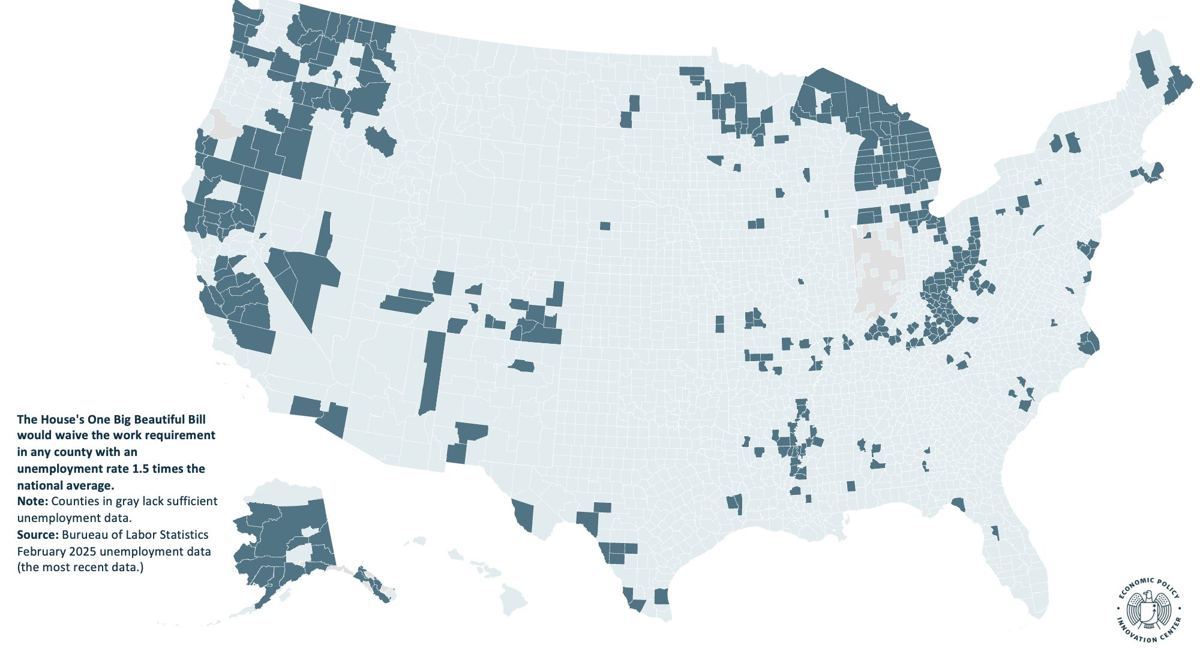
 States with the large percentages of waived counties are Michigan, California, Alaska, Oregon, Washington, Idaho, Maine, Nevada, Ohio, Kentucky, and Colorado.
The actual counties eligible for a waiver will be dependent on the rules for calculating the 1.5 times the national average unemployment rate threshold. For decades, the U.S. Department of Agriculture has allowed states to manipulate data to make Food Stamp work requirement waivers as broad as possible.
Some of the largest urban counties in blue states have unemployment rates close to the 6.15 percent threshold. For example, Los Angeles County had an unemployment rate of 5.9 percent in February 2025. Bronx County, New York, had a 5.8 percent rate. Cook County, Illinois had a 5.5 percent rate. If the calculations for the waivers are allowed to be manipulated, a significant number of able-bodied Medicaid recipients could be exempt from work requirements.
To prevent this fraud, the Senate should establish clear guardrails around unemployment rate calculations. One approach to prevent the use of outdated figures could be requiring states to use data in fixed three-month blocks – meaning only the most recent three months of unemployment data could be used to assess waiver eligibility for the following three-month period.
The Senate should also address the misalignment between calculations of county and national unemployment rates. BLS relies extensively on mathematical estimates for county unemployment, while the national rate is based on survey data. The Senate should require that BLS produce unemployment estimates for every U.S. county using its current local area methodology, where possible, to create rates that can be properly compared to the national rate. In order to carry this out, though, it is necessary that Congress annually appropriates funding for the Local Area Employment Estimates program.
If the 1.5 times the national average unemployment rate criteria were stricken from the bill and the waiver threshold was left at a flat 8 percent unemployment rate, 116 counties (4 percent of counties) would be eligible for a waiver.
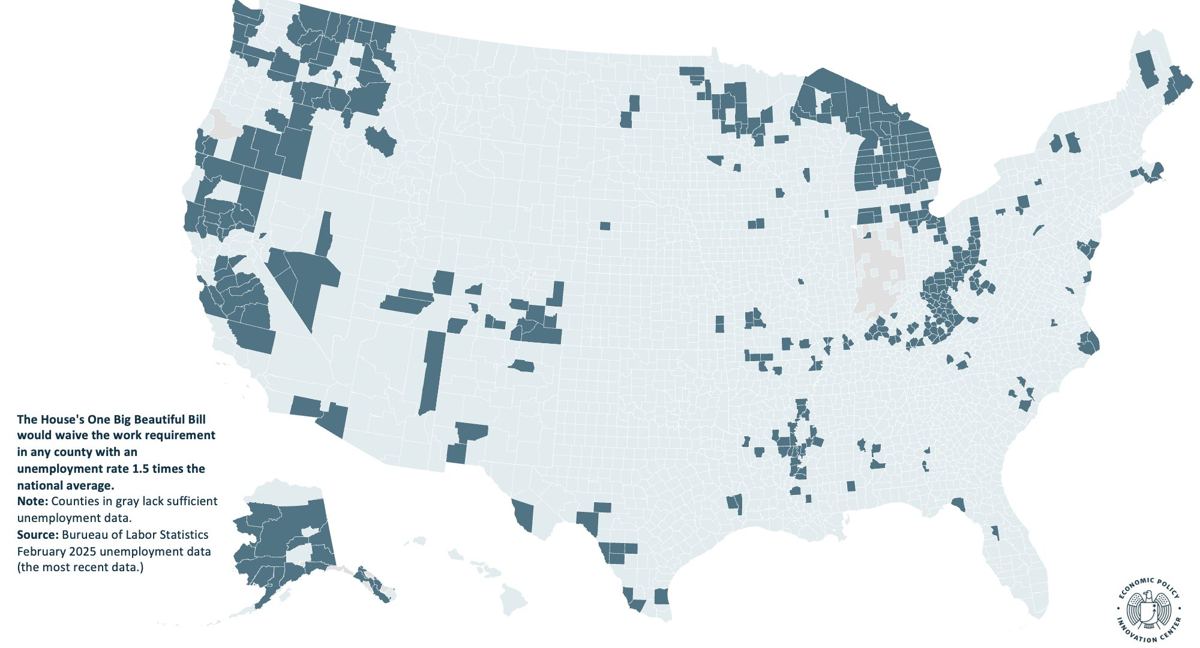
States with the large percentages of waived counties are Michigan, California, Alaska, Oregon, Washington, Idaho, Maine, Nevada, Ohio, Kentucky, and Colorado.
The actual counties eligible for a waiver will be dependent on the rules for calculating the 1.5 times the national average unemployment rate threshold. For decades, the U.S. Department of Agriculture has allowed states to manipulate data to make Food Stamp work requirement waivers as broad as possible.
Some of the largest urban counties in blue states have unemployment rates close to the 6.15 percent threshold. For example, Los Angeles County had an unemployment rate of 5.9 percent in February 2025. Bronx County, New York, had a 5.8 percent rate. Cook County, Illinois had a 5.5 percent rate. If the calculations for the waivers are allowed to be manipulated, a significant number of able-bodied Medicaid recipients could be exempt from work requirements.
To prevent this fraud, the Senate should establish clear guardrails around unemployment rate calculations. One approach to prevent the use of outdated figures could be requiring states to use data in fixed three-month blocks – meaning only the most recent three months of unemployment data could be used to assess waiver eligibility for the following three-month period.
The Senate should also address the misalignment between calculations of county and national unemployment rates. BLS relies extensively on mathematical estimates for county unemployment, while the national rate is based on survey data. The Senate should require that BLS produce unemployment estimates for every U.S. county using its current local area methodology, where possible, to create rates that can be properly compared to the national rate. In order to carry this out, though, it is necessary that Congress annually appropriates funding for the Local Area Employment Estimates program.
If the 1.5 times the national average unemployment rate criteria were stricken from the bill and the waiver threshold was left at a flat 8 percent unemployment rate, 116 counties (4 percent of counties) would be eligible for a waiver.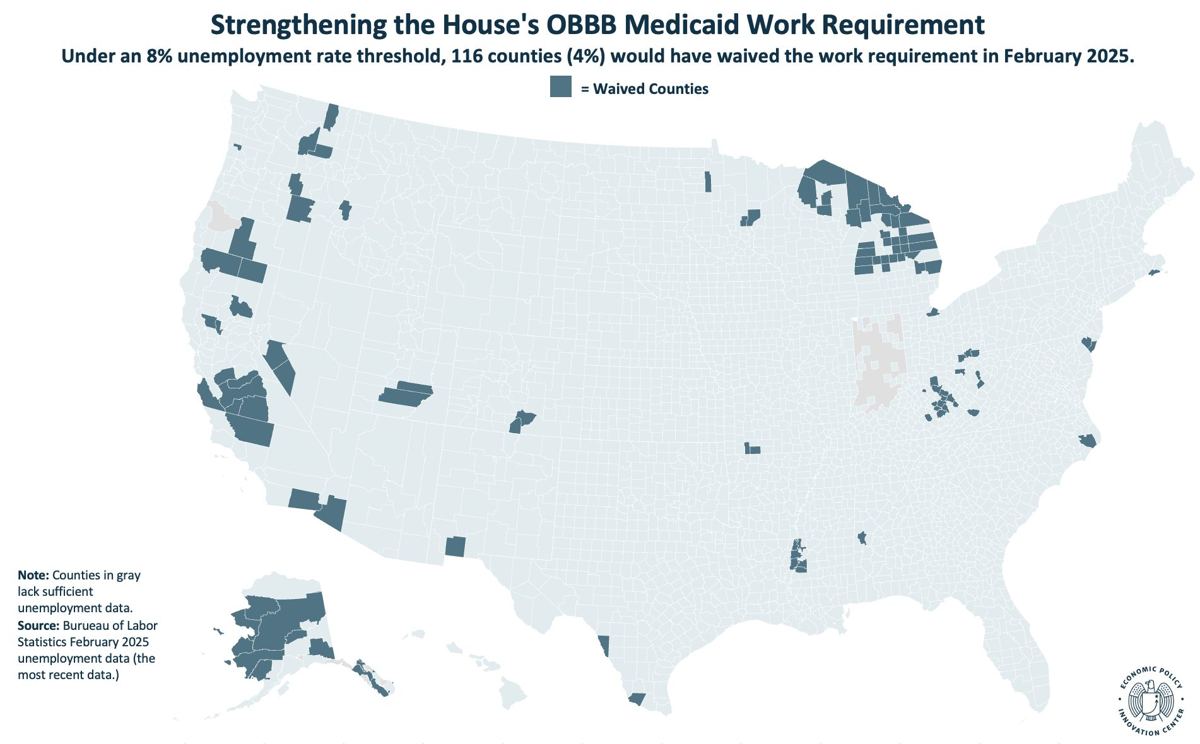 In contrast, the bill lays out a stronger and more effective work requirement for the Food Stamp program. It limits waivers to counties with unemployment rates exceeding 10 percent.
If the Senate were to adopt the 10 percent standard for Medicaid as well, only 52 counties (2 percent of counties), would have been waived using the same February 2025 data.
In contrast, the bill lays out a stronger and more effective work requirement for the Food Stamp program. It limits waivers to counties with unemployment rates exceeding 10 percent.
If the Senate were to adopt the 10 percent standard for Medicaid as well, only 52 counties (2 percent of counties), would have been waived using the same February 2025 data.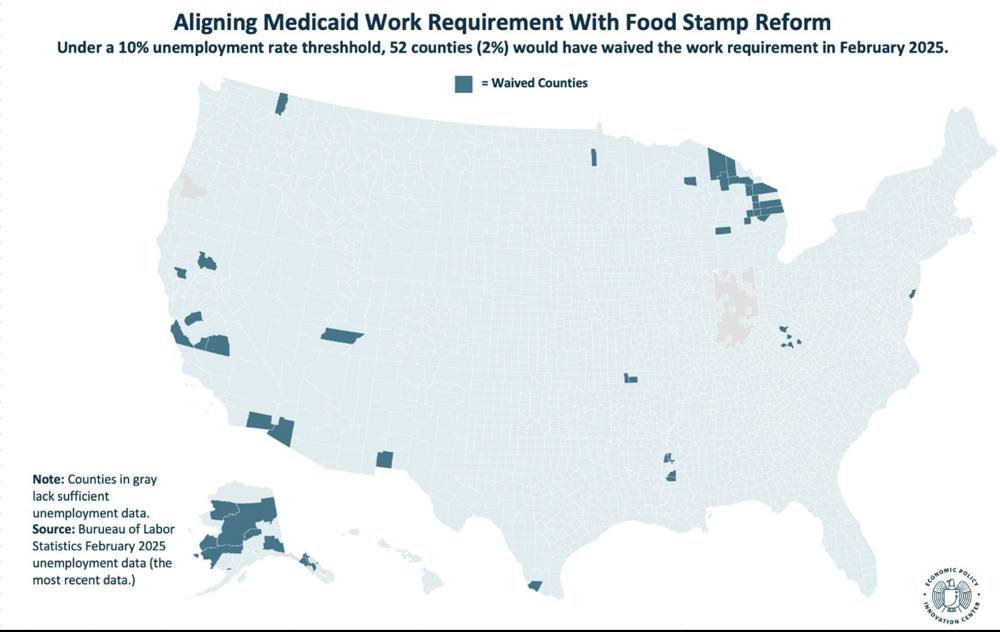 The Senate should align the Medicaid work requirements with those of the Food Stamp program and encourage work requirements for able-bodied adults.
Work requirements are a proven pathway to upward mobility and allow individuals to move off welfare towards long-term independence. This should be the shared goal of all our nation’s safety net programs.
The Senate should align the Medicaid work requirements with those of the Food Stamp program and encourage work requirements for able-bodied adults.
Work requirements are a proven pathway to upward mobility and allow individuals to move off welfare towards long-term independence. This should be the shared goal of all our nation’s safety net programs.