Despite a robust labor market boasting millions of open jobs, states continue to exploit the U.S. Department of Agriculture’s (USDA) geographic‑waiver rules to suspend the Food Stamp work requirement for able‑bodied adults without dependents (ABAWDs). This loophole now shields millions of work-capable welfare recipients from work requirements Congress enacted to promote employment and self‑sufficiency, inflating program costs and weakening the incentive to work. Eliminating the geographic waiver loophole would restore Food Stamp program integrity while safeguarding assistance for the truly needy.
Background About the Work Requirement and Waivers
The work requirement for able-bodied adults without dependents (ABAWDs) in food stamps was added by the 1996 welfare reform law.
[1] ABAWDs can meet the work requirement by working, training, or volunteering 20 hours per week.
The work requirement is enforced by limiting benefits to no more than three months out of a 36-month period for individuals who are subject to, but fail to satisfy, the requirement. Because of this enforcement mechanism, the ABAWD work requirement is sometimes called a “time limit.”
Geographic Waivers of the Work Requirement
States may request waivers of the ABAWD work requirement for food stamp recipients in any geographic area that has an unemployment rate above 10 percent or is deemed to “not have a sufficient number of jobs.”
Waivers can cover all or parts of the state. The law does not specify how long a waiver should last, but the U.S. Department of Agriculture (USDA) typically approves waivers lasting 12 months and sometimes 24 months.
[2]
The current policy governing the geographic waivers acts as a massive loophole in the ABAWD work requirement.
Regulatory Loopholes
The USDA’s regulations that attempt to expand waivers as broadly as possible also set the stage for abuse.
[3]
The terms “area” and “sufficient number of jobs” with respect to the geographic work requirement waiver are not defined in statute. Rather, USDA defines them by regulations put in place by the Clinton Administration. The regulations describe how an area can be deemed to “not have a sufficient number of jobs”:
“To support a claim of lack of sufficient jobs, a state may submit evidence that an area:
-
Is designated as a Labor Surplus Area (LSA) by the Department of Labor's Employment and Training Administration (ETA);[4]
-
is determined by the Department of Labor's Unemployment Insurance Service as qualifying for extended unemployment benefits;
-
has a low and declining employment-to-population ratio;
-
has a lack of jobs in declining occupations or industries;
-
is described in an academic study or other publications as an area where there are lack of jobs;
-
has a 24-month average unemployment rate 20 percent above the national average for the same 24-month period. This 24-month period may not be any earlier than the same 24-month period the ETA uses to designate LSAs for the current fiscal year.”[5]
These criteria are not included in the underlying law and were created administratively by the USDA. The USDA permits states to rely on outdated, cherry-picked data to justify waivers, ensuring exemptions cover as many areas and recipients as possible. States are allowed to submit proposals based on economic data that may not reflect present conditions, despite the plain language of the underlying law that waivers should be based on the actual circumstances experienced by affected individuals.
The regulations allow states to gerrymander waivers to include areas with very low unemployment, effectively gutting work requirements in many states. States can manipulate jurisdictions by grouping them together to meet waiver criteria and further expand exemptions. Left-wing advocacy groups even provide mapping and consulting services for states to maximize waivers.
[6]
Work Requirements Waived for Millions
The loopholes have gutted the work requirement, allowing millions of work-capable adults to receive Food Stamps without working.
Chart 1
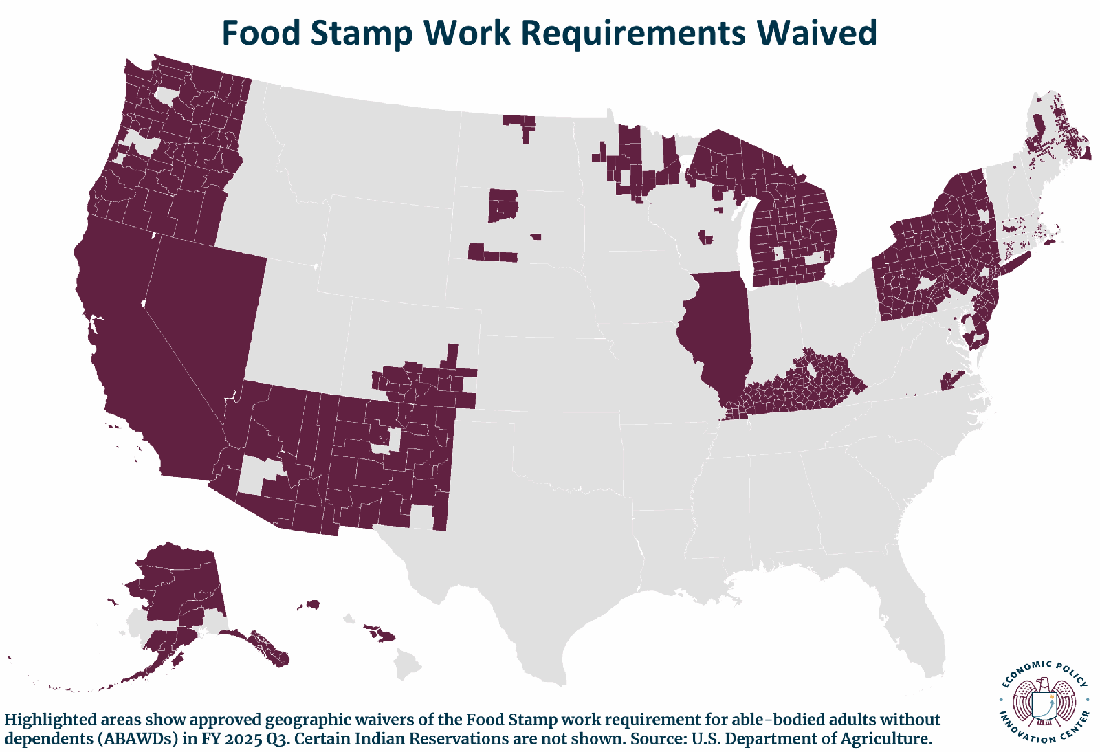
In total, about 128 million Americans live in the jurisdictions covered by work requirement waivers. California, Illinois, Nevada, and Washington, D.C. have completely waived the work requirement statewide. Another 25 states have waived the work requirements in parts of their states. In many of the states with partial waivers, the work requirement is waived in most of the state, including Alaska, Arizona, Kentucky, Michigan, New Jersey, New Mexico, New York, Oregon, Pennsylvania, and Washington.
States that have completely or partially waived work requirements have disproportionately more Food Stamp recipients than their share of the overall population. The waiver states also have a disproportionately large share of ABAWD households.
Table 1
|
Summary Profiles of States by Food Stamp Work Requirement Waivers
|
|
Waiver Types
|
Number of States |
Percent of Total Population |
Percent of Food Stamp Recipients |
Percent of ABAWD Households
|
| Statewide Waiver |
4
|
16.5% |
19.0% |
23.9%
|
| Partial Waiver |
25
|
39.0% |
39.2% |
42.2%
|
| No Waivers |
22
|
44.5% |
41.8% |
33.8%
|
| Each category uses the latest data available as of April 2025. Waiver status represents Q3 of FY 2025. Total population in 2024 estimate. Food Stamp recipient distribution is January 2025. ABAWD household distribution is FY 2022.
Sources: USDA and Census Bureau. |
The four states with statewide waivers have more than 8 million Food Stamp recipients, 19 percent of total Food Stamp enrollment.
[7] The statewide waiver states also had 785,000 ABAWD households, about 24 percent of all ABAWD households.
[8] The 25 states with partial statewide waivers have 16.6 million Food Stamp recipients and 1.4 million ABAWD households. In contrast, the 22 states without work requirement waivers have 17.7 million recipients and 1.1 million ABAWD households.
These waivers exempting millions of ABAWDs from work requirements come despite job opportunities across the country. Dr. Bill Beach, EPIC Senior Fellow in Economics and former Commissioner of the Bureau of Labor Statistics (BLS), characterized the most recent employment data as a “ray of sunshine,” as job growth was brighter than expected.
[9] The BLS estimates that there are 7.6 million job openings across the country.
[10] The current national unemployment rate is a low 4.2 percent in March 2025.
[11]
In the states with a statewide or partial waiver, the weighted average unemployment rate was 4.4 percent in February 2025.
[12] This is just about the same as the CBO’s estimated Noncyclical Rate of Unemployment of 4.3 percent, considered the “natural unemployment” or “full employment” rate.
[13]
Case Studies of Waiver Gimmicks
Many of the geographic waivers of the Food Stamp work requirements for able-bodied adults are the result of gimmicks that violate the spirit, if not the text, of the law. These waivers often rely on gerrymandered maps, selectively cherry-picking data, and using old data to keep as many people on welfare as possible without requiring any work.
California
California has 5.5 million Food Stamp recipients. At the very end of the Biden Administration, California was granted a two-year statewide waiver of work requirements, lasting through January 2027. The California waiver and the process are the epitome of the gimmicks embedded in the geographic waiver process.
On January 13, 2025, California submitted a request to USDA to waive the Food Stamp work requirements statewide. Two days later, on January 15, the lame-duck USDA approved the request, just five days before President Trump was sworn into office.
[14]
When California submitted the January request, the state already had a one-year statewide waiver approved through October 31, 2025. This previous waiver had been approved in August 2024, after a month-long review by the USDA.
[15] It appears the January waiver request could have been expedited by the Biden Administration to help their political allies.
Even more egregious is the waiver and the justifications used to support its approval.
California supported its request by arguing that the unemployment rate in California between December 2021 and November 2024 was 20 percent higher than the nationwide 4.5 percent unemployment rate over that 36-month period. This means that the work requirements for the entire state of California will be waived in January 2027 based on data from December 2021, more than five years earlier.
California is the only approved two-year statewide waiver. Both Illinois
[16] and Nevada
[17] recently requested two-year waivers, but were denied by the Trump administration, which instead allowed one-year waivers. The only other approved two-year waiver currently in effect only covers the cities of Lancaster and Lebanon in Pennsylvania through August 2026.
[18]
New York
New York is another example of an egregious work requirement waiver gimmick.
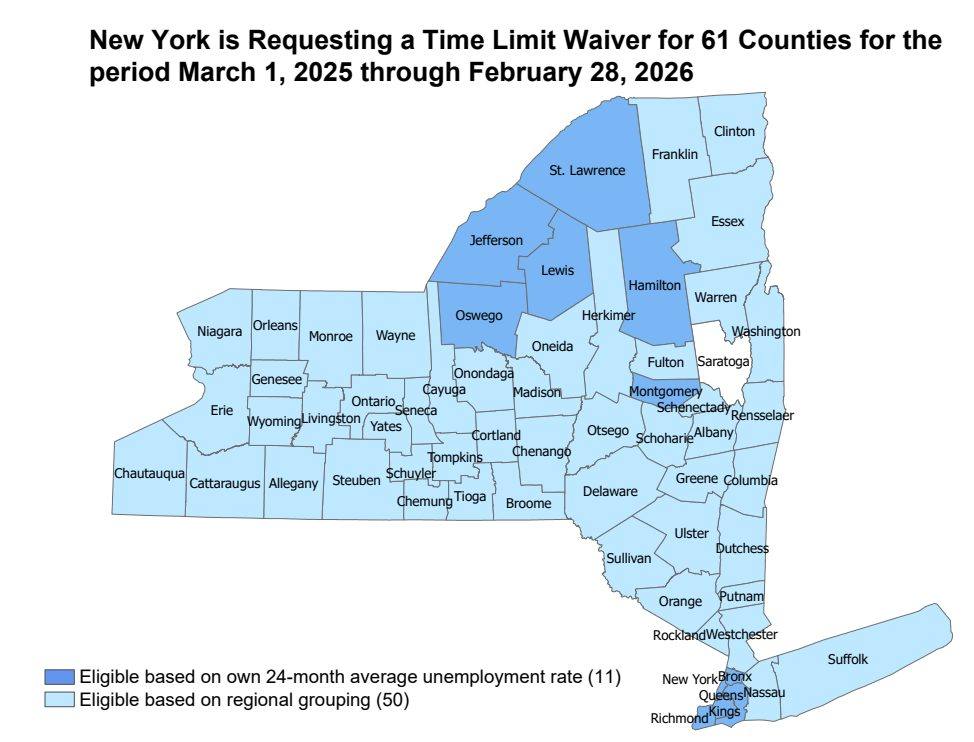
New York grouped 61 of its 62 counties into one massive “area” to gerrymander the data and exclude as many people as possible from the work requirement.
[19] The only county excluded from the waiver was Saratoga County, with its low unemployment rate of just 2.5 percent at the time New York applied for the waiver.
[20]
Even in its submission to the USDA, New York admitted that only 11 counties would have qualified on their own. (
See the nearby Chart 2)
New York also relied on old data to justify the waiver. For the waiver that extends through February 2026, the state used unemployment data from February 2022 through January 2024. That means four-year-old data will be used to keep work requirements turned off for about 3 million New York Food Stamp recipients. The state made no attempt to use the most recent data available to reflect the current economic conditions, as required by the law.
Chart 2
Source: New York State Office of Temporary and Disability Assistance
Work is Important and Work Requirements are Successful
Work is an essential American value. It is a positive good for individuals, families, communities, and our nation.
Participating in the workforce promotes upward mobility and economic opportunity, allowing people to achieve the American dream. Those who work full time are virtually guaranteed not to be in poverty.
[21]
Work requirements as a condition of welfare benefits for able-bodied adults have shown to help move people off welfare and into the workforce.
[22] It is only right that government policy helps people escape from poverty and reach their full potential. Offering a hand up and not just a handout ensures better results for everyone: recipients who are put on a path towards self-sufficiency, the truly needy for whom a safety net is safeguarded, and the taxpayers whose funds are used more efficiently and effectively. The best welfare benefit is one that gets a person off of welfare and into a job. In the Fiscal Responsibility Act of 2023, Congress declared that a purpose of Food Stamps was “to assist low-income adults in obtaining employment and increasing their earnings.”
[23]
Unfortunately, the work requirement waivers have undermined the program. Few adult food stamp recipients work, even those who should be subject to work requirements.
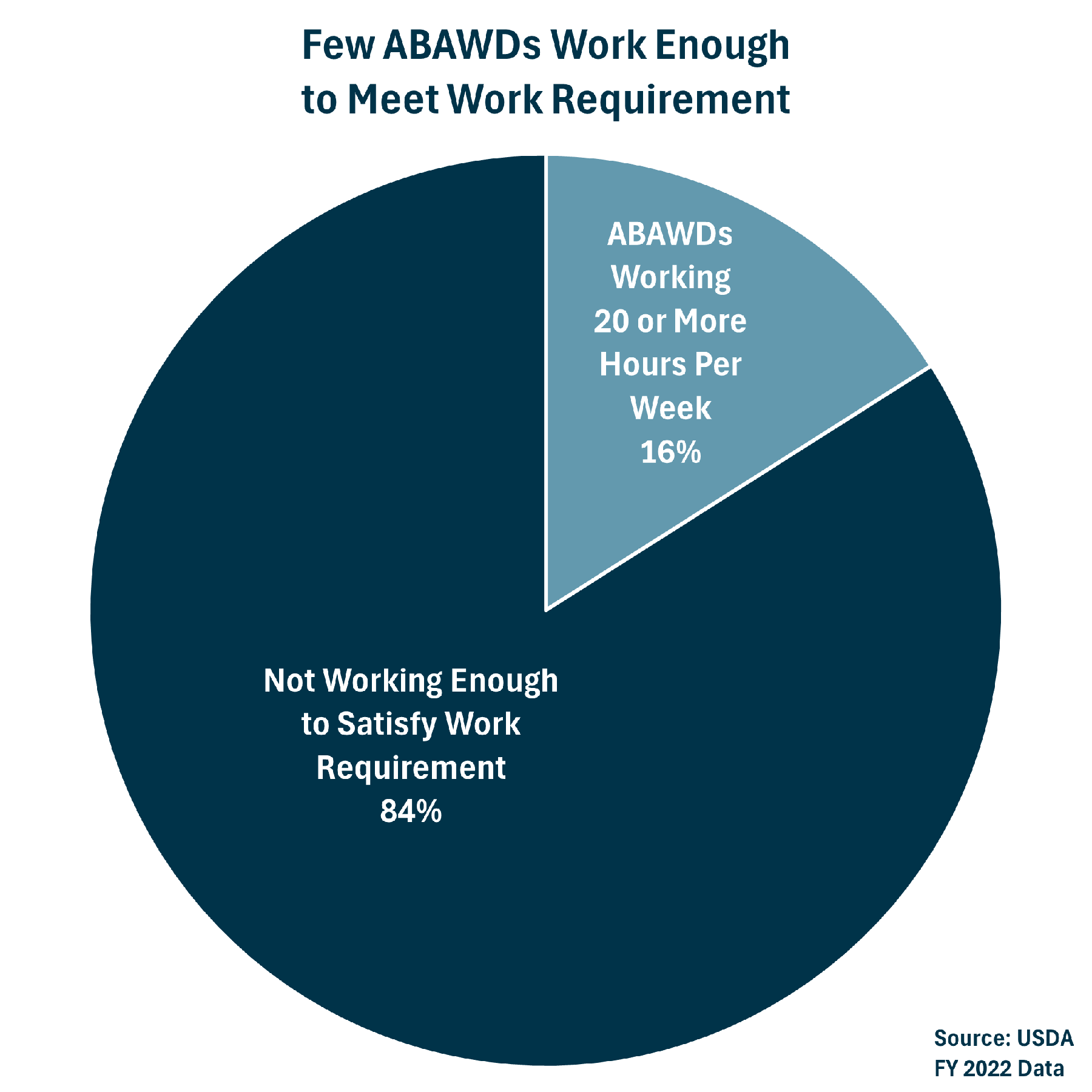
Those who do work do not work very much. In fact, only 16 percent of the 3.6 million ABAWDs worked the 20 or more hours per week needed to satisfy the work requirement through employment in FY 2022 (the most recent data available).
[24] This means that 84 percent of those who are supposed to be subject to the work requirement did not work enough hours.
Chart 3
Legislative Proposals to Eliminate or Reform Geographic Waivers
Lawmakers should eliminate geographic work requirement waivers for able-bodied Food Stamp recipients.
There are several legislative proposals in the 119
th Congress to eliminate or reform the waivers. The Ending the Cycle of Dependency Act of 2025 would end geographic waivers. Both the SNAP Reform and Upward Mobility Act of 2025 and the America Works Act of 2025 would eliminate the arbitrary lack of “sufficient number of jobs” justification for waivers and instead require waivers to be for counties (or equivalent) with an unemployment rate over 10 percent.
Table 2
|
Proposals to Eliminate or Reform Food Stamp Work Requirement Waivers
|
| Bill # |
Bill Name |
Sponsor(s) |
Reforms to Geographic Waivers |
| H.R. 1452 |
Ending the Cycle of Dependency Act of 2025 |
Rep. Eric Burlison (R-MO) |
Eliminated. |
| H.R. 2407 S. 1197 |
SNAP Reform and Upward Mobility Act of 2025 |
Rep. Josh Brecheen (R-OK)
Sen. Mike Lee (R-UT) |
Requires waivers to be for counties (or equivalent) with an unemployment rate over 10%. |
| H.R. 1528 |
America Works Act of 2025 |
Rep. Dusty Johnson (R-SD) |
Requires waivers to be for counties (or equivalent) with an unemployment rate over 10%. |
| Legislation proposed in the 119th Congress.
Source: Congress.gov |
In December 2019, the Trump Administration promulgated a final rule modifying some of the Clinton-era regulations governing geographic waivers.
[25] The rule would have tightened the definition of “area” and established an unemployment rate floor of 6 percent to qualify for a geographic waiver. However, the rule was quickly blocked by the courts.
Restoring Food Stamp Work Requirements
Because the USDA regulations let states gerrymander “areas,” rely on outdated or cherry‑picked employment data, and ignore current labor market conditions, four states have statewide waivers while twenty‑five more have partial ones—despite 7.6 million open jobs nationwide. Evidence shows that work requirements move recipients toward self‑sufficiency, yet only 16 percent of ABAWDs now meet the 20‑hour threshold.
To realign SNAP with its statutory aim of encouraging work and upward mobility, Congress should end the geographic work requirement waiver loophole. Eliminating these waiver gimmicks would protect taxpayers, preserve limited resources for the truly needy, and, most importantly, help millions of work‑capable adults reconnect with the labor force.
[1] Personal Responsibility and Work Opportunity Reconciliation Act of 1996, Public Law 104-193.
[2] U.S. Department of Agriculture, “Guide to Supporting Requests to Waive the Time Limit for Able-Bodied Adults without Dependents (ABAWD),” September 30, 2021,
https://www.fns.usda.gov/snap/guide-supporting-requests-waive-time-limit-abawd (accessed April 21, 2025).
[3] For additional background, see Matthew Dickerson, “Strengthen Food Stamp Work Requirements to Promote Opportunity,” Economic Policy Innovation Center,” May 1, 2024,
../../social-programs/strengthen-food-stamp-work-requirements-to-promote-opportunity/.
[4] The list of Labor Surplus Area designations may be found at: U.S. Department of Labor, “Labor Surplus Area,”
https://www.dol.gov/agencies/eta/lsa (accessed April 21, 2025).
[5] 7 CFR 273.24(f),
https://www.ecfr.gov/current/title-7/subtitle-B/chapter-II/subchapter-C/part-273/subpart-G/section-273.24#p-273.24(f) (accessed April 21, 2025).
[6] See for example, Tennessee Department of Labor & Workforce Development, “SNAP Employment and Training State Plan,” Appendix C, Federal Fiscal Year 2016,
https://web.archive.org/web/20170222160158/https://www.tn.gov/assets/entities/labor/attachments/TN_SNAP_ET_State_Plan_FFY_2016.pdf (accessed April 21, 2025).
[7] https://www.fns.usda.gov/pd/supplemental-nutrition-assistance-program-snap
[8] ABAWD household data is from FY 2022, the latest data available.
https://fns-prod.azureedge.us/sites/default/files/resource-files/ops-snap-fy22-characteristics.pdf
[9] William W. Beach, D. Phil., Amelia Kuntzman and Sarah Wagoner, “Brighter Than Expected Job Growth: The EPIC First Friday Report,” Economic Policy Innovation Center,
../../the-economy/brighter-than-expected-job-growth-the-epic-first-friday-report/.
[10] Bureau of Labor Statistics, “Job Openings and Labor Turnover Summary,” April 1, 2025,
https://www.bls.gov/news.release/jolts.nr0.htm (accessed April 21, 2025).
[11] Bureau of Labor Statistics, “Employment Situation Summary,” April 4, 2025,
https://www.bls.gov/news.release/empsit.nr0.htm (accessed April 21, 2025).
[12] Author calculation based on Bureau of Labor Statistics, “Civilian labor force and unemployment by state, seasonally adjusted,” April 18, 2025,
https://www.bls.gov/news.release/laus.t01.htm (accessed April 21, 2025).
[13] U.S. Congressional Budget Office, Noncyclical Rate of Unemployment [NROU], retrieved from FRED, Federal Reserve Bank of St. Louis;
https://fred.stlouisfed.org/series/NROU, (accessed April 21, 2025).
[14] Catrina L. Kamau to Alexis Fernández Garcia, “RE: Supplemental Nutrition Assistance Program (SNAP) – California Request to Waive Able-bodied Adults Without Dependents Time Limit – Initial – Approval,” U.S. Department of Agriculture, January 15, 2025,
https://fns-prod.azureedge.us/sites/default/files/resource-files/ca-abawd-response-fy2025-b.pdf (accessed April 21, 2025).
[15] Catrina L. Kamau to Andrea D. Brayboy, “RE: Supplemental Nutrition Assistance Program (SNAP) – California Request to Waive Able-bodied Adults Without Dependents Time Limit – Initial – Approval,” U.S. Department of Agriculture, August 12, 2024,
https://fns-prod.azureedge.us/sites/default/files/resource-files/ca-abawd-response-fy2025.pdf (accessed April 21, 2025).
[16] Sasha Gersten-Paal to Leslie K. Cully, “RE: Supplemental Nutrition Assistance Program (SNAP) – Illinois Request to Waive Able-bodied Adults Without Dependents Time Limit – Initial – Partial Approval,” U.S. Department of Agriculture, March 14, 2025,
https://fns-prod.azureedge.us/sites/default/files/resource-files/il-abawd-response-fy2025-b.pdf (accessed April 21, 2025).
[17] Sasha Gersten-Paal to Robert Thompson, “RE: Supplemental Nutrition Assistance Program (SNAP) – Nevada Request to Waive Able-Bodied Adults Without Dependents Time Limit – Initial – Partial Approval,” U.S. Department of Agriculture, March 14, 2025,
https://fns-prod.azureedge.us/sites/default/files/resource-files/nv-abawd-response-fy2025.pdf (accessed April 21, 2025).
[18] Catrina L. Kamau to Hoa Pham, “RE: Supplemental Nutrition Assistance Program (SNAP) – Pennsylvania Request to Waive Able-Bodied Adults Without Dependents Time Limit – Initial – Approval,” U.S. Department of Agriculture, August 20, 2025,
https://fns-prod.azureedge.us/sites/default/files/resource-files/pa-abawd-response-fy2024.pdf (accessed April 21, 2025).
[19] Catrina L. Kamau to Valerie T. Figueroa, “RE: Supplemental Nutrition Assistance Program (SNAP) – New York Request to Waive Able-Bodied Adults Without Dependents Time Limit – Initial – Approval,” U.S. Department of Agriculture, October 2, 2024,
https://fns-prod.azureedge.us/sites/default/files/resource-files/ny-abawd-response-fy2025.pdf (accessed April 21, 2025).
[20] Bureau of Labor Statistics, “Unemployment Rate: Saratoga County, NY,” LAUCN360910000000003,
https://data.bls.gov/dataViewer/view/timeseries/LAUCN360910000000003 (accessed April 21, 2025).
[21] According to the Bureau of Labor Statistics, “Full-time workers remained much less likely to be among the working poor than part-time workers. Among people in the labor force for 27 weeks or more, 2.6 percent of those usually employed full time were classified as working poor, compared with 10.2 percent of part-time workers.” Bureau of Labor Statistics, “A profile of the working poor, 2020,” September 2022,
https://www.bls.gov/opub/reports/working-poor/2020/home.htm (accessed April 21, 2025).
[22] For additional background, see Matthew Dickerson, “Strengthen Food Stamp Work Requirements to Promote Opportunity,” Economic Policy Innovation Center,” May 1, 2024,
../../social-programs/strengthen-food-stamp-work-requirements-to-promote-opportunity/.
[23] 7 U.S. Code 2011.
[24] United States Department of Agriculture, “Characteristics of Supplemental Nutrition Assistance Program
Households: Fiscal Year 2022,” Table A.26. Work status of participants by age and household composition, June 2024,
https://www.fns.usda.gov/research/snap/characteristics-fy22 (accessed April 21, 2025).
[25] U.S. Department of Agriculture Food and Nutrition Service, “Supplemental Nutrition Assistance Program Requirements for Able-Bodied Adults Without Dependents,”
Federal Register, 84 FR 66782, 66782-66812, December 5, 2019,
https://www.federalregister.gov/documents/2019/12/05/2019-26044/supplemental-nutrition-assistance-program-requirements-for-able-bodied-adults-without-dependents (accessed April 21, 2025).