
Op-Ed
CBO: One Big Beautiful Bill Grows the Economy, Cuts Taxes & Slows Welfare Spending
February 12, 2026 · David Ditch

Millions of food stamp recipients do not meet the program's own statutory income and asset limit rules.
Millions of food stamp recipients do not meet the program's own statutory income and asset limit rules.
That is because states may provide food stamps to households that receive benefits through TANF, SSI, and state-funded general assistance programs, even if the household does not meet the food stamp income or asset requirements. Through broad-based categorical eligibility (BBCE), the “benefits” provided by TANF that confer food stamp eligibility can be as limited as being provided a brochure or a pamphlet.
Through the BBCE loophole, states can use federal money intended to help low-income families instead provide a token “benefit,” which unlocks additional federally-financed welfare payments to a person who would not otherwise be eligible under the law.
BBCE allows millionaires and thousands of lottery winners to receive food stamp benefits.
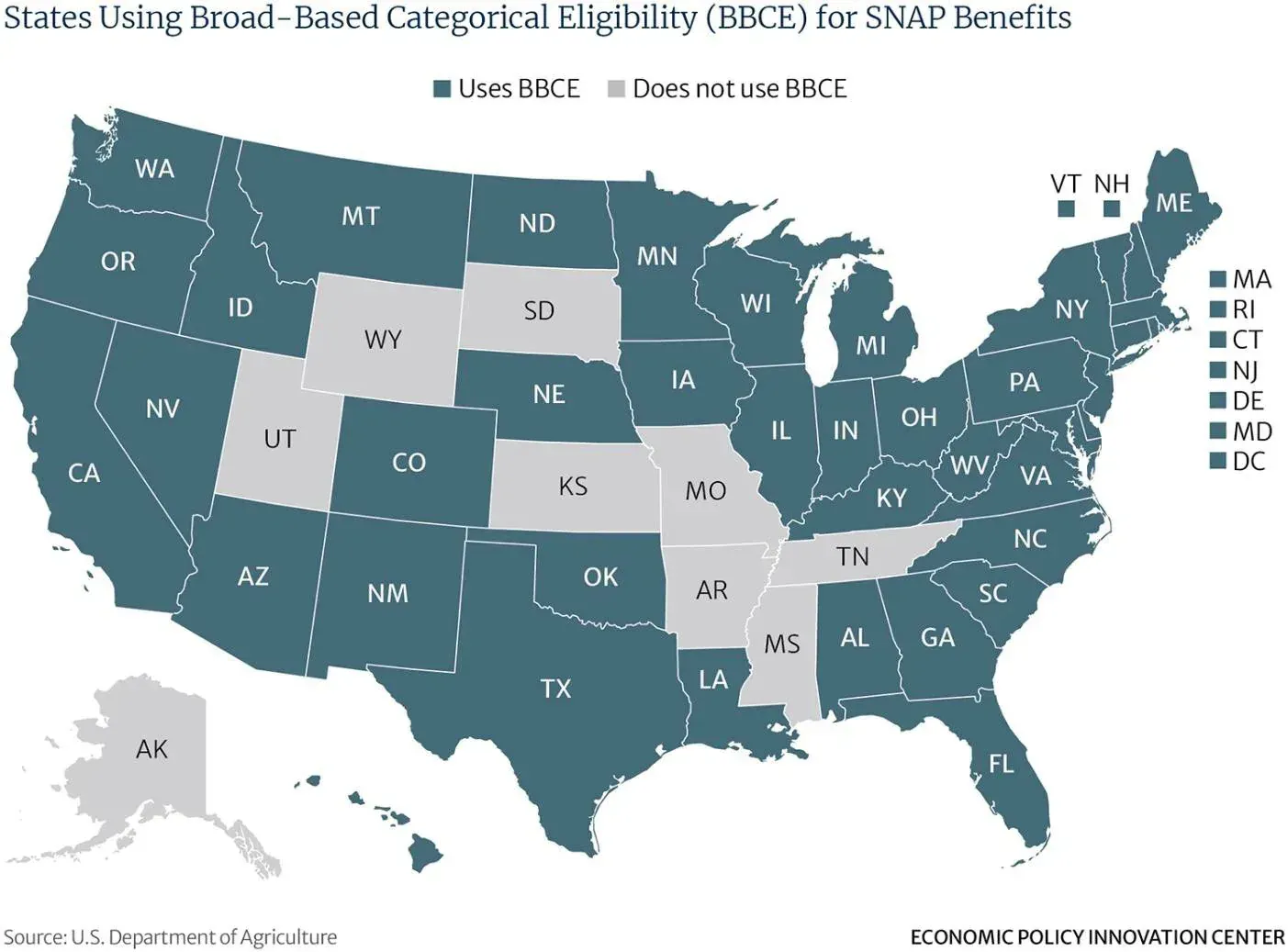
In FY 2024, 44 states and territories provide BBCE for food stamp eligibility. Many of these states allow participation for households with gross income of 200 percent of the federal poverty line (versus the 130 percent limit in the underlying law) and completely waive the asset limits.
Categorical eligibility has expanded over time, both in terms of the programs that can qualify for food stamp categorical eligibility and the use of categorical eligibility by states. In 2007, 29 states used BBCE. The number grew to 36 in 2010.
The Food Security Act of 1985 provided categorical eligibility for food stamps for households receiving cash welfare benefits. The eligibility rules, including the asset test, for the Aid to Families with Dependent Children (AFDC) program were more restrictive than for food stamps.
TANF, which replaced AFDC in the 1996 welfare reform law, proved states with broad flexibility for eligibility criteria as well as the types of benefits that could be provided beyond cash welfare. Most TANF spending is now for non-cash benefits.
The Clinton Administration issued regulations allowing states to make a household eligible for the food stamp program if it receives or is authorized to receive non-cash TANF benefits. Guidance from the Obama Administration further encouraged states to utilize BBCE.