
Introduction
My name is Rachel Greszler, and I am a Visiting Fellow in Workforce at the Economic Policy Innovation Center (EPIC). The ideas I express in this testimony are my own and do not necessarily represent an official position of EPIC. In my testimony today, I will: (1) review the recent state of telework among federal employees, (2) discuss current telework law and administrative policy, (3) consider how civil service protections and practices can prevent accountability and effective telework, and (4) suggest policies to improve the effectiveness of federal telework.Telework Among Federal Employees
The Office of Personnel Management’s (OPM’s) December 2024 “Status of Telework in the Federal Government Report to Congress” recounts an increase in the percentage of federal employees eligible for telework, from 52 percent in fiscal year (FY) 2022 to 57 percent in FY 2023.[1] This compares to 40 percent of federal employees who were eligible for telework in December 2019.[2] Factoring in the percentage of telework-eligible employees who are teleworking (75 percent in 2023), the OPM reports that 43 percent of federal employees participated in telework in 2023. While this is a decline from the high of 47 percent reached in 2022, it is still roughly double the 22 percent of federal employees who teleworked in 2019.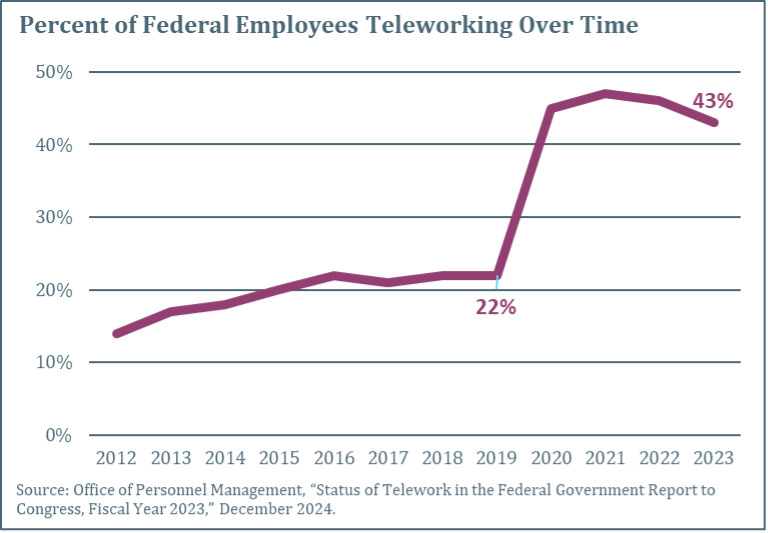 It should be noted that while the general trends in reported telework are reliable, the precise amount of telework is unknown, as the OPM collects data in broad categories, such as three+ days per two-week pay period, and agencies use different systems and metrics to track telework, with a small portion relying only on employee surveys.
An April 2024 report from the Congressional Budget Office (CBO) estimated that federal employees were slightly less likely than private sector employees to “usually work from home” (22 percent of federal employees versus 25 percent of their private-sector counterparts), in part because of their need to access sensitive data.[3] The big movement back to in-person work began in 2023, and private surveys and analysis suggest that the federal government’s return to offices lags that of the private sector. For example, a study by Owl Labs showed a dramatic drop in hybrid and remote work from 59 percent in 2022 to 33 percent in 2023.[4]
Telework can have both benefits and drawbacks. Potential benefits include saved time and money on foregone commutes, improved time-management, savings on rents if office space is reduced, and increased productivity for hybrid work (but not fully remote work). Drawbacks can include challenges in oversight, reduced collaboration, limited mentorship and career advancement, cybersecurity risks, and reduced quality of products and services.
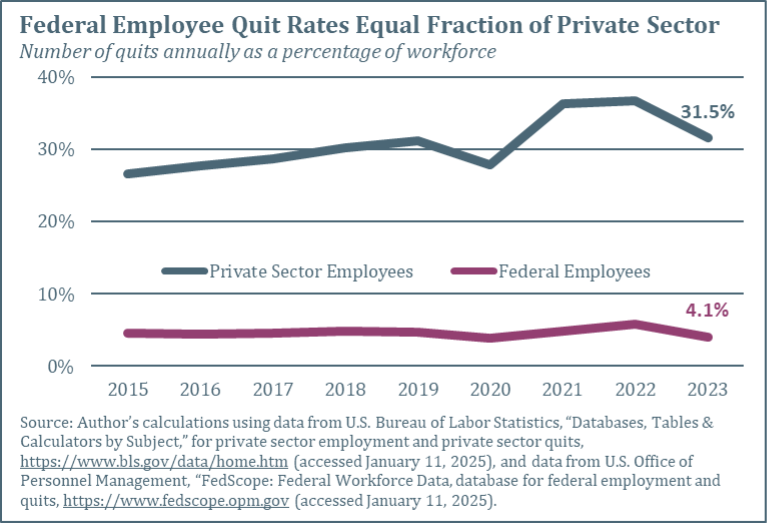
Federal agencies cite telework as a recruitment and retention tool, but the federal government generally outperforms the private sector in attracting applicants and retaining workers. Media reports cite extremely high numbers of job applicants per federal job,[5] and between 2015 and 2023, the federal employee quit rate averaged 4.6 percent per year, compared to 30.8 percent per year for private sector employees. [6]
It should be noted that while the general trends in reported telework are reliable, the precise amount of telework is unknown, as the OPM collects data in broad categories, such as three+ days per two-week pay period, and agencies use different systems and metrics to track telework, with a small portion relying only on employee surveys.
An April 2024 report from the Congressional Budget Office (CBO) estimated that federal employees were slightly less likely than private sector employees to “usually work from home” (22 percent of federal employees versus 25 percent of their private-sector counterparts), in part because of their need to access sensitive data.[3] The big movement back to in-person work began in 2023, and private surveys and analysis suggest that the federal government’s return to offices lags that of the private sector. For example, a study by Owl Labs showed a dramatic drop in hybrid and remote work from 59 percent in 2022 to 33 percent in 2023.[4]
Telework can have both benefits and drawbacks. Potential benefits include saved time and money on foregone commutes, improved time-management, savings on rents if office space is reduced, and increased productivity for hybrid work (but not fully remote work). Drawbacks can include challenges in oversight, reduced collaboration, limited mentorship and career advancement, cybersecurity risks, and reduced quality of products and services.
Federal agencies cite telework as a recruitment and retention tool, but the federal government generally outperforms the private sector in attracting applicants and retaining workers. Media reports cite extremely high numbers of job applicants per federal job,[5] and between 2015 and 2023, the federal employee quit rate averaged 4.6 percent per year, compared to 30.8 percent per year for private sector employees. [6]
Federal Telework Policy
Congress established a telework policy requirement for executive agencies in its passage of the Telework Enhancement Act of 2010.[7] That law required the heads of executive agencies to establish a telework policy under which eligible employees may be authorized to work, and to determine employees’ eligibility for telework. Congress also required that agencies’ telework policies must “ensure that telework does not diminish employee performance or agency operations.” While Congress requires the existence of telework policies and imposes certain requirements and limitations within them, the President’s duties under Article II of the U.S. Constitution require him to supervise executive agencies and faithfully execute the laws. Consequently, the President and his appointed agency heads have significant authority over telework policies. Moreover, the Telework Enhancement Act requires that agencies consult with and follow guidance issued by the OPM when establishing and carrying out telework policies. The Biden Administration’s 2021 memo on telework noted that, although the Act requires federal agencies to establish telework policies and determine which positions are appropriate for telework, “it does not mandate telework or confer a legal right or entitlement on an individual employee to participate in an agency telework program.”[8] It was initially the policy of the Biden Administration to encourage widespread use of telework across federal agencies, particularly in light of the COVID-19 pandemic. But the surge in telework—from 22 percent of federal employees in 2019 to 47 percent in 2021—created problems for some agencies, with rising complaints about telework compromising the federal government’s ability to provide reliable taxpayer services.[9] On April 13, 2023, the Biden Administration issued a memorandum calling on heads of agencies to improve their organizational health and performance, including a directive to “substantially increase meaningful in-person work in Federal offices.”[10] An August 2023 email obtained by Axios from President’s Biden’s White House Chief of Staff Jeff Zients told agency heads that it was a priority of the President to increase in-person work, instructing agency heads to “aggressively implement this shift in September and October.”[11] Zients’ email explained, “We are returning to in-person work because it is critical for the well-being of our teams and will enable us to deliver better results for the American people.” Just as the Biden Administration recognized the importance of in-person work and oversaw a significant shift in telework policies over its tenure, the incoming Trump Administration has the right and duty to direct its own telework policies. Specifically, this includes issuing executive orders and using the OPM to issue telework guidance and to consult with agencies over their telework policies, to maximize the efficiency and efficacy of the federal government.How Civil Service Protections and Practices Can Prevent Accountability and Effective Telework
The Pendleton Civil Service Reform Act of 1883 intended to create a merit system that prohibits patronage while also rejecting poor performers. Yet, the current application of civil service protections and practices make it incredibly difficult, costly, and time consuming to effectively discipline or dismiss federal employees. The overwhelming majority of federal employees perform their jobs diligently and successfully. Not surprisingly, federal employees themselves are dissatisfied with a general acceptance of poor performers. Even when few in number, poor performers hurt workplace morale and burden other employees who are left to pick up their slack. As indicated in the OPM’s annual Federal Employee Viewpoint Survey, federal employees consistently provide the lowest positive response rates to the question: “In my work unit, steps are taken to deal with a poor performer who cannot or will not improve.”[12] Between 2012 and 2021, an average of just 32 percent of federal employees agreed with that statement.[13] In 2022, the Biden Administration removed this lowest-satisfaction-level question from the survey. While adequate data do not exist to compare the federal government’s performance-improvement efforts to those of private employers, data on rates of dismissals and layoffs provide a comparison of the final straw in performance management. Over the past four years (2020 to 2023) private sector employees were 33 times more likely to be laid off or dismissed than federal employees.[14]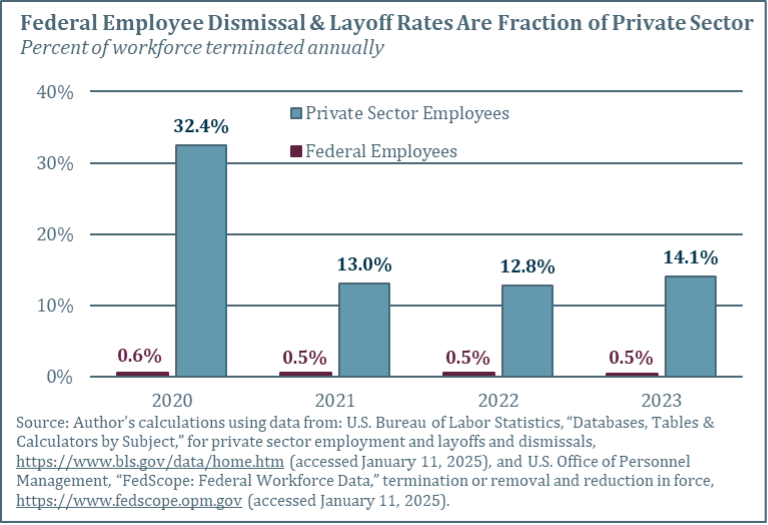 In large part, this is because the process to dismiss a federal employee is extremely burdensome and takes a year and a half, on average to complete. The extremely low risk of being fired—even for just cause—fosters poor performance. Although firing federal employees requires a significantly higher bar than restricting telework eligibility, the exceptionally low rate of dismissals among federal employees signals a lack of accountability.[15]
Telework is a privilege, not a right. Oversight and accountability are fundamental to effective telework policies, and agencies have a legal obligations to “ensure that telework does not diminish employee performance or agency operations.”[16] Yet, civil service practices that protect poor performers, as well as collective bargaining agreements, can stand in the way of agencies’ ability to fulfill this requirement.[17]
For example, a clear indicator that a federal employee’s performance has diminished is if he or she is put on a performance improvement plan (PIP). Developing a PIP is an extensive and time-consuming process for federal managers, and not something taken lightly. Some agencies rightly recognize that a PIP indicates diminished employee performance and warrants removal of telework eligibility. For example, the U.S. Coast Guard’s remote work program states that, “Examples of a decline in performance include placement on a performance improvement plan…”[18] and the program explicitly prohibits telework eligibility for employees who are on PIPs.[19] Many other agencies include similar prohibitions of telework for employees on PIPs.
Other agencies, however, do the opposite and maintain the rights of individuals placed on PIPs to telework eligibility. Among the telework plans and collective bargaining agreements included in the Office of Management and Budget’s “Report to Congress on Telework and Real Property Utilization” in August 2024, at least five agencies included protections similar or identical to that in the United States Patent and Trademarks Office: “Participants who are on a Performance Improvement Plan (PIP) will not be required to change their telework arrangement due to the PIP.”[20]
Moreover, some agencies have enacted last-minute changes to their collective bargaining agreements to thwart the income Trump Administration’s plans to alter current telework policies. In November 2024, the Social Security Administration (SSA) made changes to its 2019 collective bargaining agreement with the American Federation of Government Employees (AFGE) to make it harder for the incoming Administration to change telework policies. Such revisions included: 1) striking out the ability of each Deputy Commissioner to determine telework days, eligible positions, and certain telework policies and adding text requiring each Deputy Commissioner to “adhere to the current number of telework days, eligible positions, and percentage of employees permitted to telework as of the date of this agreement until October 25, 2029. Additionally, as of the date of this agreement until October 25, 2029, each Deputy Commissioner will adhere to current component policies on:,” and 2) removing the ability of management to eliminate approved telework days for any employee due to the employee’s performance or due to operational needs.[21] These provisions apply to roughly 42,000 unionized employees at the SSA, of whom roughly 98.5 percent are eligible for telework.[22] These collectively bargained provisions arguably conflict with the law’s requirements and should not be allowed.
Even when collective bargaining agreements and telework policies prevent individuals on PIPs from being eligible for telework, employees might still challenge a decision to remove their telework eligibility if that decision constitutes a disciplinary action.[23] For example, if an employee’s telework eligibility were removed due to inappropriate use of work time or of telework equipment, the employee could work with his union to file a grievance arguing that the action was arbitrary, retaliatory, or lacked due process. In addition, and depending on the employee’s allegations, he may also be able to file appeals through the Merit Systems Protection Board, the Equal Employment Opportunity Commission, or the Office of Special Counsel. Agency heads and managers who want to avoid costly and time-consuming litigation over decisions to remove telework eligibility are less likely to remove or modify telework arrangements, even if they believe they are diminishing employee performance or agency operations.
Senate Joni Ernst’s December 2024 “Out of Office” report exposed some particularly egregious examples of federal employees’ telework abuse and taxpayer resources wasted by having to defend agencies’ attempts to discipline or dismiss employees for such abuse. For example, the report finds:
“It took years to fire a senior IRS employee who routinely abused his remote work arrangement by playing golf during the workday for nearly a decade. Legal appeals by the “golf ball bureaucrat” dragged on for many years before the court finally ruled firing someone for taking tee time on the taxpayers’ dime is par for the course.”[24]
“a Department of Veterans Affairs (VA) manager posted a picture of himself “working” from a bubble bath on social media,” with the caption “my office for the next hr.”[25]
“For more than three years, a Social Security Administration (SSA) employee claimed to be teleworking while running his own personal business. He ‘routinely performed home inspections for his personal business during the workweek while purporting to ‘telework’ on official SSA time. He concealed the fact that he was not performing SSA work during official work hours by having his wife and his mother access the SSA computer system and send emails to supervisors to make it appear as though he was online and working.’”[26]
A general lack of accountability across the federal workforce hurts employee morale, wastes taxpayer dollars, and makes it difficult or impossible to maintain effective telework policies. Moreover, federal collective bargaining agreements can create universal rights to benefits that the private sector treats as earned privileges
In large part, this is because the process to dismiss a federal employee is extremely burdensome and takes a year and a half, on average to complete. The extremely low risk of being fired—even for just cause—fosters poor performance. Although firing federal employees requires a significantly higher bar than restricting telework eligibility, the exceptionally low rate of dismissals among federal employees signals a lack of accountability.[15]
Telework is a privilege, not a right. Oversight and accountability are fundamental to effective telework policies, and agencies have a legal obligations to “ensure that telework does not diminish employee performance or agency operations.”[16] Yet, civil service practices that protect poor performers, as well as collective bargaining agreements, can stand in the way of agencies’ ability to fulfill this requirement.[17]
For example, a clear indicator that a federal employee’s performance has diminished is if he or she is put on a performance improvement plan (PIP). Developing a PIP is an extensive and time-consuming process for federal managers, and not something taken lightly. Some agencies rightly recognize that a PIP indicates diminished employee performance and warrants removal of telework eligibility. For example, the U.S. Coast Guard’s remote work program states that, “Examples of a decline in performance include placement on a performance improvement plan…”[18] and the program explicitly prohibits telework eligibility for employees who are on PIPs.[19] Many other agencies include similar prohibitions of telework for employees on PIPs.
Other agencies, however, do the opposite and maintain the rights of individuals placed on PIPs to telework eligibility. Among the telework plans and collective bargaining agreements included in the Office of Management and Budget’s “Report to Congress on Telework and Real Property Utilization” in August 2024, at least five agencies included protections similar or identical to that in the United States Patent and Trademarks Office: “Participants who are on a Performance Improvement Plan (PIP) will not be required to change their telework arrangement due to the PIP.”[20]
Moreover, some agencies have enacted last-minute changes to their collective bargaining agreements to thwart the income Trump Administration’s plans to alter current telework policies. In November 2024, the Social Security Administration (SSA) made changes to its 2019 collective bargaining agreement with the American Federation of Government Employees (AFGE) to make it harder for the incoming Administration to change telework policies. Such revisions included: 1) striking out the ability of each Deputy Commissioner to determine telework days, eligible positions, and certain telework policies and adding text requiring each Deputy Commissioner to “adhere to the current number of telework days, eligible positions, and percentage of employees permitted to telework as of the date of this agreement until October 25, 2029. Additionally, as of the date of this agreement until October 25, 2029, each Deputy Commissioner will adhere to current component policies on:,” and 2) removing the ability of management to eliminate approved telework days for any employee due to the employee’s performance or due to operational needs.[21] These provisions apply to roughly 42,000 unionized employees at the SSA, of whom roughly 98.5 percent are eligible for telework.[22] These collectively bargained provisions arguably conflict with the law’s requirements and should not be allowed.
Even when collective bargaining agreements and telework policies prevent individuals on PIPs from being eligible for telework, employees might still challenge a decision to remove their telework eligibility if that decision constitutes a disciplinary action.[23] For example, if an employee’s telework eligibility were removed due to inappropriate use of work time or of telework equipment, the employee could work with his union to file a grievance arguing that the action was arbitrary, retaliatory, or lacked due process. In addition, and depending on the employee’s allegations, he may also be able to file appeals through the Merit Systems Protection Board, the Equal Employment Opportunity Commission, or the Office of Special Counsel. Agency heads and managers who want to avoid costly and time-consuming litigation over decisions to remove telework eligibility are less likely to remove or modify telework arrangements, even if they believe they are diminishing employee performance or agency operations.
Senate Joni Ernst’s December 2024 “Out of Office” report exposed some particularly egregious examples of federal employees’ telework abuse and taxpayer resources wasted by having to defend agencies’ attempts to discipline or dismiss employees for such abuse. For example, the report finds:
“It took years to fire a senior IRS employee who routinely abused his remote work arrangement by playing golf during the workday for nearly a decade. Legal appeals by the “golf ball bureaucrat” dragged on for many years before the court finally ruled firing someone for taking tee time on the taxpayers’ dime is par for the course.”[24]
“a Department of Veterans Affairs (VA) manager posted a picture of himself “working” from a bubble bath on social media,” with the caption “my office for the next hr.”[25]
“For more than three years, a Social Security Administration (SSA) employee claimed to be teleworking while running his own personal business. He ‘routinely performed home inspections for his personal business during the workweek while purporting to ‘telework’ on official SSA time. He concealed the fact that he was not performing SSA work during official work hours by having his wife and his mother access the SSA computer system and send emails to supervisors to make it appear as though he was online and working.’”[26]
A general lack of accountability across the federal workforce hurts employee morale, wastes taxpayer dollars, and makes it difficult or impossible to maintain effective telework policies. Moreover, federal collective bargaining agreements can create universal rights to benefits that the private sector treats as earned privileges