What are Port Workers’ Current Compensation?
According to the
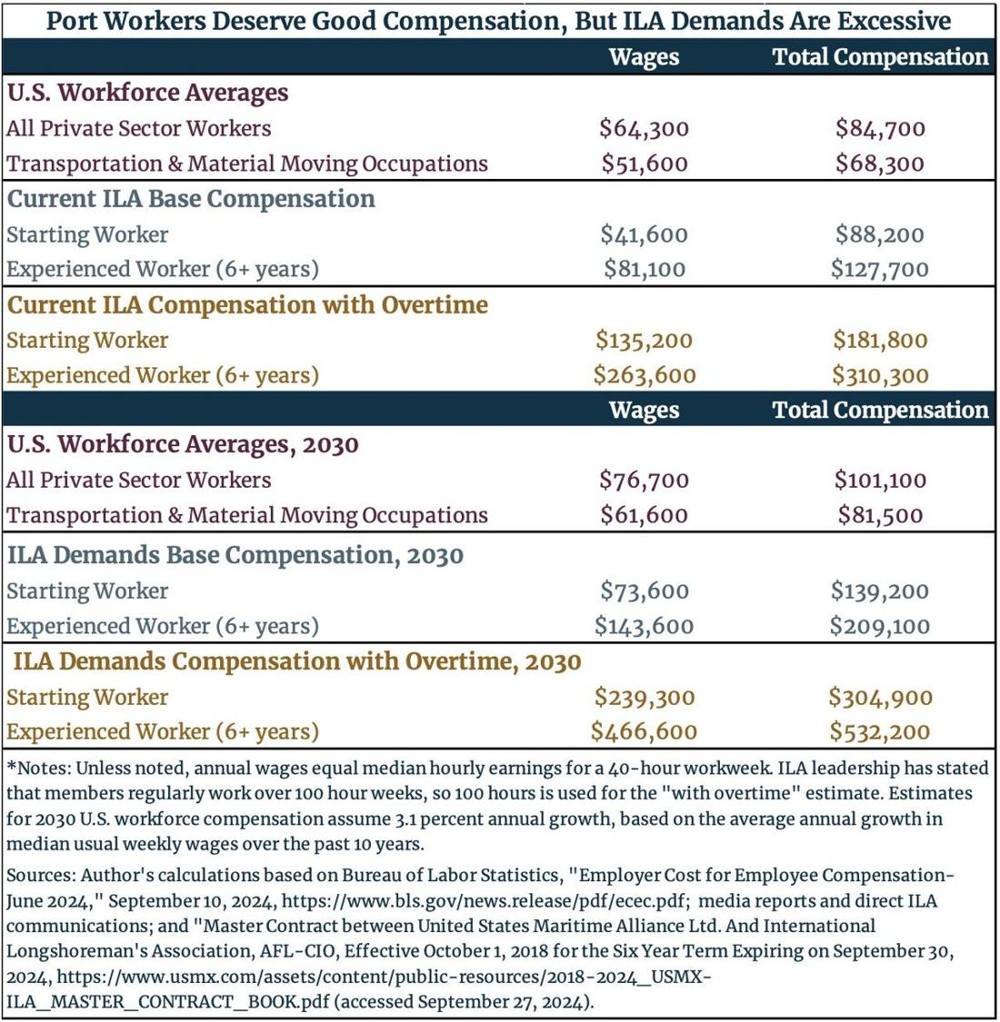
master contract between the ILA and the United States Maritime Alliance (USMX) that expired on September 30, 2024, port workers’ pay in 2024 starts out at $20 per hour and rises to $39 for workers with six or more years of experience, which comes out to between $41,600 and $81,100 in base wages annually.
Employers also pay $14 per hour, or $29,100 per year, in health, welfare, and pension contributions for each worker, and workers also receive container royalty payments averaging between
$15,000 and $20,000 per year. Container royalties are payments based on the tonnage (or volume) that ports process and under the just-expired contract, the ILA received the first $19 million in royalties plus 50% of the excess above that. In total, port workers’ compensation starts at $88,200 and rises to $127,700 for workers with six or more years of experience.
This compensation calculation assumes a typical 40-hour work week, but according to
ILA leadership, many port workers regularly work 100 hours or more per weeks. (Setting aside compensation for a moment, such long hours can’t be good for workers’ wellbeing and could almost certainly be alleviated if the ILA eased its restrictions on technology and its control over the supply of workers.) All hours over 40 in a week receive a 50% overtime premium, and in addition to overtime, any of the first 40 hours worked outside of the 8am to 5pm window receive a 25% premium. With 100 hour-weeks, ILA members could—under the contract that just expired—earn $263,600 in wages and $310,300 in total compensation per year. Various reports confirm high levels of overtime, including one-third of longshoremen based in New York Harbor
making over $200,000 per year, not including container royalties.
ILA President Harold Daggett
reportedly made $901,000 last year, including $728,000 as ILA President and another $173,000 as president emeritus of a local union branch.
What is the ILA Demanding?
ILA President
Harold Daggett said, “Mark my words, we will shut them down October 1st if we don’t get the kind of wages we deserve, container royalty, top-notch healthcare and no automation terminals or semi-automated terminals.” It is understandable that the ILA is pushing for more than the roughly 2.5% annual pay raises included in the contract that just expired because excessive inflation has eaten away over $31,000 in value from a full-time port-worker’s paycheck since January 2021.
This time around, the ILA is reportedly demanding a 77% pay increase over six years and turned down an offer for a 50% increase. That would bring normal full-time wages to between $73,600 and $143,600 in 2030 (with a top hourly rate of $69).
The ILA’s demands for top-notch healthcare are not specified, but supposing the ILA seeks a 50% increase, employers’ annual contributions to the health and welfare fund would rise from $29,100 to about $44,000 per worker. And supposing a 25% increase in container royalties would boost annual royalty bonuses from an estimated $17,500 to about $22,000 per worker.
In total, the ILA’s demands could bring total compensation to $139,200 for starting workers and $209,100 for experienced workers in 2030. With overtime, total compensation for ILA members working 100-hour weeks could exceed $530,000.
How Does Port-Worker Pay Compare to the Average American Worker?
Across the U.S., the
median private sector worker earns $64,300 in wages and $84,700 in total compensation (assuming typical 40-hour work weeks). Within “transportation and material moving occupations”—which includes port workers—the median worker earns $51,600 in wages and
$68,300 in total compensation. This compares to ILA workers’ current range of $88,200 to $127,700 in total compensation.
Looking ahead six years to compare ordinary workers’ pay with the ILA’s six-year contract demands, and assuming 3.1% annual compensation growth (matching median earnings growth over the past 10 years), compensation across all private sector workers would equal $101,100 in 2030, and $81,500 for transportation and material moving occupations. This compares to the ILA’s demands for an estimated $139,200 for starting workers’ compensation and $209,100 for experienced workers’ compensation in 2030.
What is a Better Pathway to Sustained Wage Gains?
While port workers would benefit in the short run from the ILA’s extraordinary compensation demands, those higher labor costs would be passed on to consumers through higher prices on goods transported through East Coast ports. Since compensation cannot rise more than workers’ productivity in the long-run—or else employers would go out of business—a better way to increase port workers’ compensation and wellbeing would be for the ILA to
allow smart automation that could make their jobs easier, safer, and more productive. Yet, ILA leadership refers to automation as “cancer” and bolstering restrictions on automation remain a sticking point in contract negotiations. But fighting innovation will hurt American producers and consumers, as well as American port workers because as the ILA acknowledged in its
2013 contract, new methods, new devices, and additional automation “make the ILA more competitive and their employers more able to provide continued employment.”