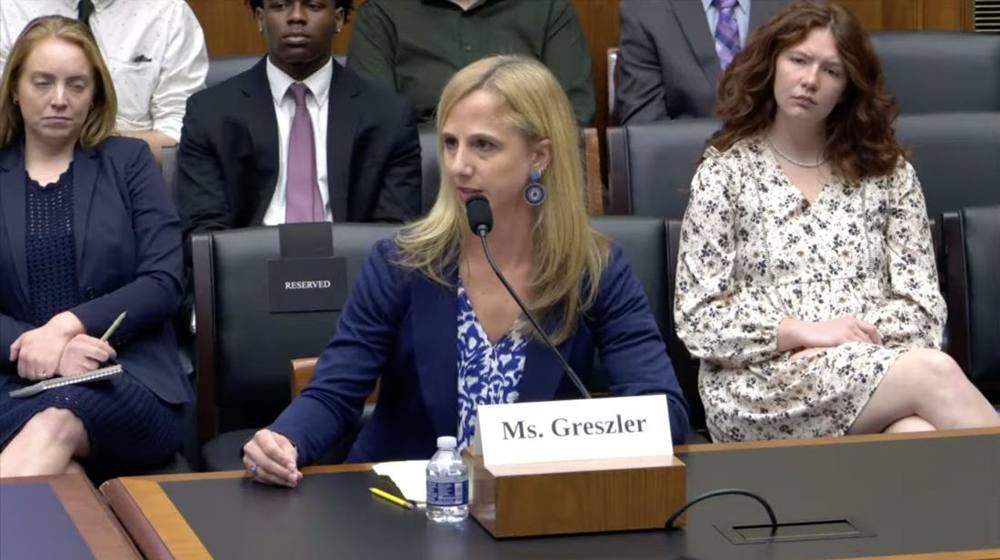
My name is Rachel Greszler. I am a senior research fellow in workforce and economics at Advancing American Freedom and a visiting fellow in workforce at the Economic Policy Innovation Center. The views I express in this testimony are my own and should not be construed as representing any official position of Advancing American Freedom or the Economic Policy Innovation Center.
In my testimony today, I will focus on a central challenge before policymakers: how to measure AI’s impact on workers and employers so that policymakers can make informed decisions that support innovation and expand opportunity.
Historical Context of Artificial Intelligence
The future of work is not a unique concept for today’s generations. Throughout history, transformative technologies have changed the way that people work and live. Artificial intelligence (AI) is, on the one hand, simply another iteration of technological innovation. On the other hand, it is distinct from past innovations in the speed at which it is advancing and the level at which it operates.
Rapid Speed of Adoption. The widespread adoption and productivity gains that accompanied most technological innovations to date have taken years or even decades to achieve. The first general purpose computer, for example, was unveiled in 1946. Two decades later, in the 1960s, only about 5 percent to 10 percent of large businesses used computers and virtually no small businesses or households had them. It was not until the 1980s—four decades later—that a majority of businesses used computers, and it took until the turn of the 21
st century in 2000 before a majority of U.S. households owned a computer. Today, I think it is safe to say that every American’s life has been improved as a result of computers.
In contrast, AI—while still evolving—has been adopted at an unprecedented pace. According to an April 2026 report from the Federal Reserve, about 18 percent of U.S. firms had adopted AI as of the end of 2025, 78 percent of the labor force worked at firms that had adopted AI, and 54 percent worked at firms that used large language models (LLMs), which are a specific subset of Generative AI.
[1] At the individual level, AI has also exploded. ChatGPT, for example, was first released to the public in November 2022 and within two months, it had 100 million users.
Role of AI: Adaptive Capital. As with most technological innovation, AI includes both substitution and complementary components—replacing some tasks or even entire jobs, while also improving the productivity of other jobs and creating entire new jobs. In many ways, AI is similar to robots. For example, a robot can paint various components of a car, but it cannot build the entire car. Similarly, AI can summarize patient records for doctors and nurses, but it cannot treat patients.
Yet, unlike past innovations, AI has a greater capacity to learn and develop. Whereas robots are dependent on software updates to adapt and improve over time, AI can adapt and refine itself through ongoing learning, enabling iterative self-improvements that differ from traditional software. In this way, AI does not fit purely into our traditional definition of a capital input. Nor is it a pure labor input as AI has extreme physical limitations and cannot “think” beyond the data to which it has access. Another way to think of AI is as a new form of adaptive capital (or, to use an economic term, endogenous capital)—an input that can perform certain tasks, can learn and improve, and which can replace some human labor, but which more often complements and improves the productivity of human labor.
While AI can learn, what it can create is fundamentally constrained. Unlike the human mind that can perceive and leap into areas in which data does not exist, everything that AI creates is limited to the data it has been given. While AI can absolutely gather data and provide answers at an astonishing speed compared to humans, AI lacks human perception (the combined mind, body, and physical experience) that is necessary to leap beyond the bounds of the data world in which it lives. This is why AI hallucinates when it does not know an answer. When humanity does not know an answer—such as how to cure cancer—it seeks out experiments in the real world to solve the problem. While AI can help in the quest for a cure for cancer, it can only provide ideas and recommendations—based on already known data—that ultimately must be tested in the real world by humans.
Modernizing Federal Data to Better Understand and Respond to AI
AI’s rapid adoption and unique role in production have both benefits and risks, including faster productivity gains and accompanying wage and job growth, and potentially sharper disruptions. A better understanding of how AI is used in the workplace can help policymakers make informed decisions that soften AI’s disruptions without obstructing its gains. While we currently have some survey information about the number of companies and workers that are using AI in the workplace, we lack data on the specific ways it is being used. Information about what tasks AI is replacing, how it is affecting productivity, and which jobs it is transforming or newly creating is necessary to understand how AI is impacting workers and employers.
The Census Bureau’s Business Trends and Outlook Survey (BTOS) recently began surveying firms about their current and future uses of AI, including broad questions about: the types of AI used; whether AI replaced a small, moderate, or large number of worker tasks; and if the use of AI increased, decreased or did not affect the business’s total employment. Meanwhile, the Bureau of Labor Statistics does a good job measuring employment, wages, and industry trends, but its core frameworks are built around jobs and occupations—not tasks. Because AI more often replaces tasks within jobs rather than eliminating entire occupations outright, we do not have sufficient data to understand how AI is affecting workers and employers.
That leaves policymakers reliant on anecdotes, speculation, or incomplete evidence. Effective AI policy design requires sufficient measurement and understanding of how it is impacting the labor force. To that end, policymakers should:
Direct Census Bureau to Augment AI Data Collection. Congress should direct the U.S. Census Bureau to build on the Business Trends and Outlook Survey (BTOS) by expanding and refining its AI-related questions in a way that provides greater specificity regarding the impact of AI on workers’ tasks, productivity, and employment. To minimize burdens on employers, this AI survey should focus on a limited set of high-value indicators, such as: the primary business functions in which AI is used (e.g., customer service, accounting, logistics, compliance); whether AI is primarily augmenting workers or replacing discrete tasks; the share of workflows or processes in which AI is incorporated; and whether AI adoption is associated with changes in hiring, hours, or skill requirements. The Trump Administration’s AI Action Plan included a similar recommendation to expand AI data collection utilizing existing surveys such as the BTOS.
[2]
Direct the Bureau of Labor Statistics to Establish a Task-Based Classification System. We do not currently know how much AI is complementing human labor (and creating a demand for new types of human labor) and how much AI is substituting human labor because we only measure jobs and occupations and not the specific tasks within them. The Bureau of Labor Statistics already has a framework for establishing a task-based classification system within the Occupational Requirements Survey (ORS) that BLS developed in partnership with the Social Security Administration to help improve evaluation of disability insurance claims. The ORS already has millions of classified job tasks. Policymakers should direct the BLS to build upon the existing work of the ORS to create a comprehensive task classification system capable of tracking how AI is transforming tasks, productivity, and workforce demand.
This could be one of the first components in the “AI Workforce Research Hub” that the Trump Administration calls for in its AI Action Plan.
[3] Specifically, that plan call for the establishment of “the AI Workforce Research Hub under DOL to lead a sustained Federal effort to evaluate the impact of AI on the labor market and the experience of the American worker, in collaboration with BLS and DOC through the Census Bureau and BEA. The Hub would produce recurring analyses, conduct scenario planning for a range of potential AI impact levels, and generate actionable insights to inform workforce and education policy.”
[4]
Coordinate Data Collection for Widespread Application. In developing these new and expanded measurements, the BLS, Department of Commerce, and Census Bureau should coordinate with one another (and with other relevant statistical agencies) to align definitions and enable linkage between firm-level data and labor market outcomes. Specifically, the task-classification system should follow a similar code structure as the North American Industry Classification System (NAICS) and Standard Occupational Classification (SOC), allowing the data to cross-walk between surveys. This would help determine how AI usage within specific industries, occupations, and tasks translates into changes in wages, employment, and job structure.
We Need Not Fear AI, But We Should Fear AI Dominance
Ultimately, good policy depends not only on access to better data, but also on avoiding premature constraints. AI holds enormous promise for improving productivity, expanding opportunity, and enhancing the quality of work. Like past technological innovations—from the Industrial Revolution to the rise of computing—AI has the potential to complement human labor, reduce burdensome tasks, and create new forms of economic activity. History shows that these innovations always lead to higher incomes, new jobs, and improved living standards over the long run. While AI’s onset is swifter than past innovations and it brings unique self-learning capabilities, there is no reason to believe it will defy past innovations and make people worse off.
AI cannot escape basic economics, which offers extreme optimism. The definition of economics is the study of how people (individuals, businesses, governments) make choices regarding the allocation of scarce resources across unlimited wants and needs. We should not fear AI replacing tasks or entire jobs and leaving people with nothing to do because as AI frees up time and resources (including human labor), it will spur the creation of new types of products and services to meet more of humans’ limitless wants and needs. Moreover, while it may seem like AI will sweep across the entire economy, affecting most jobs, AI will only be employed where its benefits exceed its costs. In some areas, AI will not be cost-effective. OpenAI’s recent decision to pull the plug on its video generation platform Sora just months after it launched boiled down to economics—Sora consumed too many resources and produced too little revenue.
[5] AI is not without costs, and those costs will naturally limit how AI is employed across the economy.
We do, however, need to fear AI dominance. By dominance, I do not mean AI replacing or overtaking human beings, but a world in which government policies limiting access and opportunities to the benefits of AI, and in which overregulation threatens America’s economic power and national security by allowing countries like China—which are investing heavily in AI and will likely take an aggressive approach to deployment—to dominate AI.
Proposals such as the Artificial Intelligence Data Center Moratorium Act would quite literally make it impossible to carry out the focus of this hearing: Building An AI-Ready America. By placing a sweeping moratorium on new or expanded data centers “until legislation is enacted that safeguards the public from the dangers of artificial intelligence,” this legislation risks halting development indefinitely because terms like “safeguards” and “dangers” are inherently subjective and difficult to operationalize.
[6]
Imagine if the very first Congresses had—instead of facilitating the economic conditions that allowed steam engine technology to expand (patents, roads, canals)—placed a moratorium on further steam engine usage until they could be fueled not by coal or wood, but by sustainable, clean energy sources. The United States would have delayed or even forfeited the transformative gains of the Industrial Revolution.
AI policies should not be driven by fear, but by a desire to expand opportunities and standards of living. That means encouraging innovation, promoting competition, expanding access, and equipping workers to adapt and thrive in the ever-changing future of work. Humans naturally fear the unknown, and much about AI is unknown. By expanding federal data collection on AI, we can increase knowledge and understanding of how AI is being used in the workplace. This will help alleviate uncertainty surrounding AI and equip policymakers to balance its risks with its enormous potential. With better data, policymakers can move beyond speculation and toward evidence-based decisions that foster innovation and expand opportunities across the American workforce.
[1] Jeffrey S. Allen, “Monitoring AI Adoption in the US Economy,” Board of Governors of the Federal Reserve, April 3, 2026,
https://www.federalreserve.gov/econres/notes/feds-notes/monitoring-ai-adoption-in-the-u-s-economy-20260403.html (accessed April 8, 2026).
[2] The White House, “Winning the Race: America’s AI Action Plan,” July 2025,
https://www.whitehouse.gov/wp-content/uploads/2025/07/Americas-AI-Action-Plan.pdf (accessed April 9, 2026).
[3] Ibid.
[4] Ibid.
[5] Berber Jin and Jessica Toonkel, “The Sudden Fall of OpenAI’s Most Hyped Product Since ChatGPT,”
The Wall Street Journal, March 29, 2026,
https://www.wsj.com/tech/ai/the-sudden-fall-of-openais-most-hyped-product-since-chatgpt-64c730c9 (accessed April 7, 2026).
[6] S. 4214, “A bill to impose a moratorium on the construction of new data centers until legislation is enacted that safeguards the public from the dangers of artificial intelligence,” 119th Congress, Introduced March 25, 2026.